Brass, and the Four Things You Hang From It
Two chandeliers can look identical in a photograph and behave completely differently five years into a room. Most of that difference comes down to two choices nobody talks about: what the frame is made of, and what the shade is made of.

- Three things brass does that painted steel doesn't
- Four shade materials, and what each one does to light
- Why a damaged shade should never mean a new fixture
- Five brass chandeliers, and what each one is for
- How to choose in ninety seconds — and the questions people ask

Three things brass does that painted steel doesn't
Walk through any lighting showroom and most of what you see is painted steel. It is cheap, it is strong, and on day one it is indistinguishable from anything else in the room. The differences show up later, and they come down to three properties of the metal itself.
1. There is no iron in it, so it cannot rust
This is the whole argument in one sentence. Steel rusts because it is mostly iron: put a scratch in a painted steel arm and moisture reaches the iron underneath, an orange bloom starts at the scratch, and it spreads outward from there. Brass is copper and zinc. Scratch brass and you have a scratch — you see metal, and it stays metal.
Nobody thinks about this when they buy a light. It is the only thing they think about when they replace one. In a kitchen or a bathroom, where the air carries moisture every day of the year, it is the difference between a fixture that ages and one that fails.
2. It takes a plated finish evenly
Black, gold and nickel are not paint. They are plated onto the metal and then polished — a chemical bond rather than a coat sitting on top. That is why a plated finish holds a crisp edge at a joint where paint would build up and blur it, and why it does not chip away in flakes at the corners.
It also explains something customers notice without being able to name: plated finishes have depth. Paint gives you one flat colour under every light. Plating lets the metal underneath show through slightly, which is why the same black reads differently on a curve than on a flat face.
3. It has weight, and weight is what holds a joint
A brass arm has real mass, and mass is what stops a fixture from feeling hollow when you tighten a fitting or lift a shade off its ring. It is also why we ask customers to check the ceiling box before ordering: a proper metal chandelier weighs more than most people expect, and a standard junction box carries less than most people assume.
Photographs flatten everything to colour and shape. Material is the part you only find out about later — which is exactly why it is worth deciding first.
Four shade materials, and what each does to light
The frame decides how long a fixture lasts. The shade decides what the room feels like. We build the same brass frames with four different materials hanging from them, and they are not four price points for one effect — each does something the others cannot.
Crystal
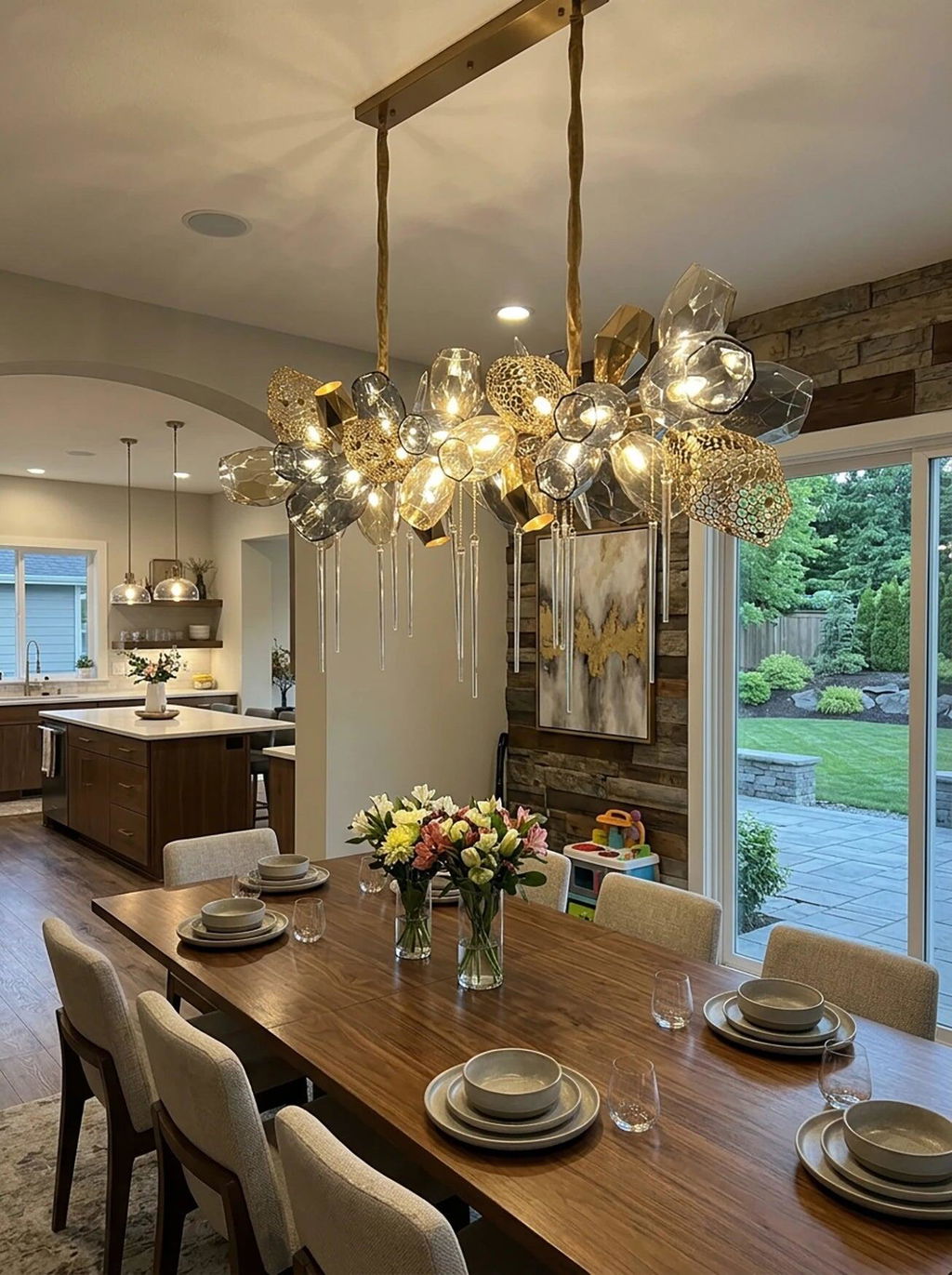
Sparkle · formal · reflectiveCut faces return light as points rather than a wash. A single lamp behind a hundred cut surfaces becomes a hundred small reflections, each at its own angle, which is why a crystal fixture changes as you walk past it and a smooth one does not.
It is the most decorative of the four and the most formal. Best where you want the fixture itself to be an event — an entry, a stairwell, a dining room used for occasions.
The trade-off: cut faces catch dust in the grooves, and clear glass hides nothing. Plan on a dry brush twice a year.

Glass
Colour · depth · the widest rangeGlass is the most versatile because it can be almost anything: clear and sparkling, smoked and warm, frosted and soft, or tinted right through the body of the material. Tinted glass is coloured while molten, not sprayed afterwards — so chip an edge and the break is the same colour all the way through. It cannot scratch back to clear or pale out beside a hot lamp.
Frosted glass gives an even glow with no visible filament. Clear glass gives sparkle and lets you see through the fixture, which matters in an open-plan room where a solid shade would close a sightline.
The trade-off: glass has weight, and weight means checking your ceiling box. It also chips — which is why every glass piece on our fixtures is fixed individually.

Fabric
Comfort · no glare · for rooms you sit inFabric is the only one of the four that hides the bulb completely. A cylinder open at the top and the bottom sends light up to wash the ceiling and down onto the table, and nothing sideways — so across a dinner table you see calm glowing shapes rather than filaments at eye level.
That makes it the right answer for a room people sit in for hours. Dining rooms, kitchens, bedrooms. A bare-bulb fixture photographs beautifully and is tiring to sit under for three hours; fabric is the opposite of that trade.
The trade-off: fabric marks permanently if it gets wet, so it is a dry brush only — never a damp cloth. And it ages with heat, which is a good reason to use LED rather than incandescent.

Acrylic
Light · safe · for ceilings that can't take muchWe will be straightforward about this one: acrylic is not glass and does not pretend to be. What it is good at is weight. An acrylic fixture can be a fraction of the weight of the same shape in glass, which matters more often than people expect — a rental where you cannot brace the ceiling, an older house with a fragile junction box, a room above a nursery.
It is also the safe answer where something might get knocked: a child's room, a low ceiling in a hallway, a holiday let. Acrylic does not shatter.
The trade-off: acrylic ages differently from glass and can amber over years of heat. Use LED, which runs far cooler, and it holds up well.

| Material | What it gives you | Best in |
|---|---|---|
| Crystal | Sparkle, reflection, formality | Entry, stairwell, occasion dining |
| Glass | Colour, depth, see-through | Anywhere — the widest range |
| Fabric | No glare, comfort over hours | Dining, kitchen, bedroom |
| Acrylic | Low weight, no shattering | Rentals, kids' rooms, weak ceilings |
Why a damaged shade should never mean a new fixture
Here is the thing almost nobody asks before they buy, and everybody asks afterwards: what happens when one piece breaks?
It is not a remote possibility. Glass chips during a move. A fabric shade discolours after years next to a warm bulb. Someone catches a rod with a broom handle while cleaning. Over the fifteen or twenty years a good chandelier stays on a ceiling, one piece going wrong is close to certain. What varies is what that costs you.
The way most fixtures are built
On a lot of chandeliers the shades are part of a moulded assembly — bonded, glued or captured in a housing that was never designed to come apart. When one piece is damaged there is no way to reach it on its own, so the answer is to take the whole fixture down and send it back.
That means freight in both directions on something heavy and fragile, weeks of waiting, an electrician twice, and a bare ceiling in the meantime. On plenty of fixtures the cost of doing all that comes close enough to the price of a new one that people simply replace it. A five-dollar piece of glass ends a fixture that had fifteen good years left in it.
The way ours are built
Every shade, rod and globe on our fixtures is fixed on its own point — its own hook, its own cord, its own socket ring. Nothing is bonded into an assembly. That decision costs a little more to manufacture and it is invisible in a photograph, which is why most brands skip it.
Loosen one fixing or lift one shade off its ring. The rest of the fixture stays exactly where it is.
The new piece goes on the same point. No rewiring, no tools on most fixtures, and no electrician.
Minutes rather than weeks, and the chandelier never leaves the ceiling.
It also changes what happens on delivery day. If something arrives damaged, send us photographs within 24 hours and we ship the affected pieces — you are never asked to crate up and return a whole chandelier because one globe travelled badly.
Beyond that, we hold spare shades for the life of the collection, in all four materials. Tell us the fixture and the finish you own and we will send what you need.
The most sustainable fixture is not the one made from recycled anything. It is the one you never have to replace because of a single broken piece.
Five brass chandeliers, and what each one is for
Same metal, five completely different jobs. The useful question is not which is best — it is which shape suits the room you are lighting.
Honoria Tiered Glass Fringe Chandelier
Glass rods · tiered
Hundreds of narrow glass rods hung in close rows from a brass frame, in two tiers. Each rod is a small lens, so one row of lamps comes back as a dense band of vertical glitter — solid enough to read as a single shape, open enough to see the room straight through it. For a rectangular dining table or a kitchen island, where a round fixture would light the middle and leave the ends dark.
See Honoria →Garrick Hammered Chandelier
Fabric shades · hammered surface · five sizes, round and linear
The quiet one. Fabric cylinders open at the top and the bottom, so light washes the ceiling and lands on the table and nothing fires sideways into anyone's eyes. The arms are dimpled and faceted rather than smooth, which keeps a plain six-arm frame from reading as plain. For a room you sit in for hours rather than one you pass through.
See Garrick →Halden Smoked Glass Cluster Chandelier
Smoked glass globes · staggered cords · four sizes
Most multi-light chandeliers hang their shades level. This one drops each globe on its own cord, cut to its own length at installation, so the group occupies three dimensions instead of one — and looks different from every chair at the table. The tinted glass takes the hard edge off each filament. For a round table, an entry with height, or a stairwell seen from two floors.
See Halden →Corin Curved Arm Candle Chandelier
Candle form · curved arms
The traditional silhouette, drawn with the ornament taken out. Curved arms carry upright candle lamps, and because there is no shade in the way, the light goes up to the ceiling and outward across the room rather than down onto a single surface. For a room that needs a centre more than it needs task light — an entry, a landing, a formal dining room.
See Corin →Alden Candle Ring Chandelier
Candle form · open ring · 4 to 16 lights, round or linear
Candles standing upright on an open ring, with nothing beneath them — so light goes up and the ceiling hands it back as a soft wash instead of firing down into your eyes. Bulbs are included, which on a sixteen-light fixture is not a small detail. For anyone who wants the candle look without the glare that usually comes with it.
See Alden →How to choose between them in ninety seconds
Start with the shape of what is underneath. A round table wants a round fixture; a long table or an island wants a linear one. A round chandelier over a long table pools light in the middle and leaves both ends dark, which is where half your guests are sitting. Honoria is linear. Halden and Corin are round. Garrick and Alden come both ways.
Then decide whether you want to see the bulbs. Shaded fixtures — Garrick, Halden — hide the lamp and stay comfortable for hours. Open ones — Honoria, Corin, Alden — show the light source and are more decorative, which suits a room you move through more than one you settle into.
Then the arithmetic. A round fixture should be about half to two thirds the width of a round table. A linear one should run about two thirds the length of the table or island beneath it. Hang the lowest point 30–36″ above the tabletop, and keep 7 ft of clearance anywhere people walk.
Finally, the finish. All five come in the same family of finishes, which is deliberate: it means a chandelier and a pair of sconces from different collections will still agree with each other. Gold warms a room and suits wood and stone. Black holds as a defined shape against a pale ceiling. Nickel stays cool and quiet beside white and marble.
Questions people ask before they order
Does brass rust?
No. Rust is iron oxidising, and there is no iron in brass — it is copper and zinc. That is the practical reason to choose it over painted steel, which starts an orange bloom at the first scratch that reaches the metal.
Brass can develop a patina over many years if it is left bare, which some people want and some don't. A plated and polished finish, which is what ours carry, keeps the colour stable.
Which shade material should I choose?
Start with how long people sit under it. Fabric for a room you spend hours in — it hides the bulb completely. Crystal where you want the fixture to be the event, like an entry or a stairwell. Glass when you want colour or want to see through the fixture. Acrylic when weight is the constraint.
Can I buy a replacement shade on its own?
Yes. Every shade, rod and globe is fixed on its own point, so a single piece is replaced without the fixture leaving the ceiling. We hold spares for the life of the collection in all four materials — tell us the fixture and finish you own.
How big should a chandelier be for my table?
A round fixture should be roughly half to two thirds the width of a round table: a 60″ table suits about 36″, a 72″ table about 48″.
A linear fixture should run about two thirds the length of the table or island, leaving at least 6″ of clear surface beyond each end. And a rule that works for a whole room: add the room's length and width in feet, and read that number as inches — a 14 × 16 ft room suits roughly a 30″ fixture.
How high above the table should it hang?
30–36″ from the tabletop to the lowest point of the fixture. Nobody walks under a table, so you can go lower here than anywhere else in the house. Anywhere people do walk beneath a fixture, keep 7 ft of clearance from the floor.
Do I need to worry about the ceiling?
Yes, and it is a five-minute check before ordering rather than an expensive one afterwards. A metal chandelier with glass or crystal on it weighs more than most people expect, and a standard junction box carries far less than most people assume — a brace may need fitting first.
Ask us for the exact weight of the size you are considering and give it to your electrician before you order.
Can these be dimmed?
On fixtures that take replaceable bulbs, dimming depends on the bulbs, not the fixture. Fit dimmable bulbs on a compatible dimmer and it dims; fit standard bulbs and it will not, whatever switch is on the wall. Use dimmable bulbs in every socket rather than a mix.
One thing to tell your electrician: multiply one bulb's wattage by the number of sockets and check the total against the dimmer's rating. On a ten- or sixteen-light fixture that number is bigger than people expect.
What bulbs do you recommend?
LED, 2700K warm white, the same bulb in every socket. LED runs far cooler than incandescent at the same brightness, which matters for fabric shades in particular — heat is what ages them.
On clear glass and crystal, use clear filament bulbs: the filament is meant to show through, and a frosted bulb behind tinted glass goes flat and muddy. One odd colour temperature among ten shades shows immediately, so buy them all at once.
Still deciding? Send us your table dimensions and ceiling height and we will tell you which of the five actually suits the room — including when the smaller or cheaper one is the right answer. support@vidirlighting.com