The Alden Candle Ring Chandelier sets a row of upright tapers directly onto an open metal ring and puts nothing above them at all — no shade, no canopy of glass, no arms reaching over the top. The ring is the only structure, and the light rises off it into open air. Look up from underneath and you see the ceiling straight through the middle.
That emptiness is the point, and it comes from how candlelight actually behaved. A real flame throws its light upward and outward, never downward — which is why historic chandeliers put candles on a rim and left the centre open. Modern fixtures inverted the logic: bulbs point down, shades hang below, and the ceiling above goes dark. Alden keeps the original arrangement. The tapers wash the ceiling and the upper walls, the room fills with reflected rather than direct light, and there is nothing at eye level to look into across a dinner table.
Specifications
The Details
MaterialBrass Ring, Stem & Canopy · GlassMetal electroplated and polished; glass cut and finished.
FinishGold · Black · Nickel
Light sourceE12 or E14 candle bulbs — included E12 in North America, E14 in Europe and most of Asia.
PowerMax 40W per socket
VoltageAC 110–240V
ControlWall switch — dimmable only with dimmable bulbs, see note below
SuspensionRigid stem — 39.4″ / 100 cm Fixed at manufacture, not adjustable on site.
MountingCeiling — hardwired
EnvironmentIndoor only · IP20
Preparation time5–10 days Made and inspected at our own workshop before dispatch.
Good to Know
About dimming — read this before you wire it
Dimming depends entirely on the bulbs, and the bulbs supplied as standard are not dimmable. If you want to dim it — and over a dining table most people eventually do — fit dimmable E12 or E14 bulbs in every socket and pair them with a compatible dimmer.
Size Guide
Round or Linear, Four to Sixteen
A ring for a round table, a bar for a long one. Choose the width from what sits beneath it — then read the note about the drop, because it decides everything else.
Before anything else — the dropTotal height as supplied: 72.8″185 cm, including a rigid 39.4″ / 100 cm stem
Round — a ringCircular tables, entries, bedrooms
4 Lights
∅ 12.6″∅ 32 cm · height [__]
Best forSmall entry · powder room · beside a stair · a bedroom where the big ones would dominate
Ceiling8 ft +
A third the width of the next size — a different class of fixture entirely.
8 Lights · 35.8″Popular
∅ 35.8″ × H 72.8″∅ 91 × H 185 cm
Best forRound table 54–66″ · standard entry hall · square dining room
Ceiling9 ft + (shorter stem)
The size most dining rooms actually want.
8 Lights · 48″
∅ 48″ × H 72.8″∅ 122 × H 185 cm
Best forRound table 66–78″ · large entry · open-plan room needing a wide, sparse ring
Ceiling10 ft + (shorter stem)
Same eight lights, spread a foot wider — a lighter, airier look.
12 Lights · Round
∅ 59.8″ × H 72.8″∅ 152 × H 185 cm
Best forRound table 78–90″ · double-height entry · restaurant or private dining room
Ceiling10–12 ft
Five feet across — measure the room, not just the table.
16 Lights · Round
∅ 72″ × H 72.8″∅ 183 × H 185 cm
Best forHotel lobby · event space · grand entry · banquet round of 90″ or more
Ceiling12 ft +
Six feet wide. Plan a lift for installation and for changing bulbs.
Linear — a barRectangular tables, kitchen islands
12 Lights · 53.9″
L 53.9″ × H 72.8″L 137 × H 185 cm
Best forStandard kitchen island · rectangular table seating six · long console
Ceiling9 ft + (shorter stem)
Suits a table or island of 72–84″.
12 Lights · 66.9″
L 66.9″ × H 72.8″L 170 × H 185 cm
Best forLong dining table seating eight to ten · large island · restaurant communal table
Ceiling9 ft + (shorter stem)
Same twelve lights, spaced further apart — suits a table of 90–108″.
The design
A Flame Was Never Pointing Down
Put the light back on top of the ring and everything else follows.
For four centuries a chandelier was a rim with candles standing on it — nothing above them, nothing hanging below, and the centre left empty because there was nothing to put there. That was not a stylistic choice. A flame throws its light upward and outward and almost none of it downward, so the only sensible place for it was on top of the rim, pointing at the ceiling.
Then bulbs arrived and the logic inverted. A bulb can point in any direction, so designers turned it downward and hung a shade underneath to stop the glare. It worked, but something was lost with it: the ceiling went dark, and the brightest object in the room ended up at eye level across the table.
simply puts it back. The tapers stand upright on an open ring with no shade, no diffuser and nothing crossing over the top, so the light rises, meets the ceiling, and comes back down having been softened by the room itself rather than by a piece of glass. Look up from underneath and you see your own ceiling through the middle — which is why a fixture six feet across still reads as an outline rather than a mass. In brass it looks like it has always been there; in black it becomes a drawing; in nickel, an instrument.
— The oldest arrangement, and still the most comfortable —
Materials
Why Brass
There are no shades on this fixture, so the metal is what you're actually looking at. Here's what brass does that painted steel doesn't.
BrassPainted steel
If it gets chippedA scratch stays a scratch — there's no iron in brass to rustOne chip and rust starts spreading under the paint
The colourIn the metal itself, not a coat of paint over the top of itSprayed on — and it can wear through at the edges
Holding its shapeStiff enough to keep a six-foot ring perfectly roundThin steel flexes, and a large ring can sit slightly out of true
In your handDense and solid — you can feel it when you unbox itLight and hollow, and it sounds like it too
After ten yearsStill the same metal it was, just a little more settledWhatever the paint has done by then is what you're left with
Fingerpr intsShows them on a polished finish — worth knowing before you chooseA matte painted finish hides them better
Questions, Answered
Common Questions
How low will it hang — and can I change that?
Read this before ordering. As supplied it is 72.8″ from the ceiling to the bottom of the fixture — six feet — because the stem alone is 39.4″.
The stem is rigid, not a chain, so it cannot be shortened on installation day. What you get in return is a fixture that hangs perfectly level and never swings or slowly turns. But the height is decided when it's made.
So measure first: from your ceiling down to where you want the bottom of the fixture. Over a dining table that's 30–36″ above the tabletop. Send us that number with your order and we'll confirm the stem length before anything is built. [__ STEM — confirm options]
Will the bulbs shine in my eyes?
Not if it's hung at the right height — and that's the thing to get right on this fixture.
The tapers point upward, so the light goes to the ceiling and comes back down softened rather than shining at you. But there are no shades, so if it hangs too low you will be looking straight at the bulbs across the table. Keep the tapers above the eyeline of someone seated and it's comfortable all evening.
Do I get the bulbs with it?
Yes — bulbs are included. On a fixture with no shades the bulbs are the part you actually see, so they come fitted and every one matches from day one. On a 16-light ring that's sixteen bulbs you don't have to go and buy.
If you replace one later, use the same type throughout. Mixing brands on a bare-taper fixture shows immediately — one slightly whiter bulb in a ring of sixteen is obvious.
Can I dim it?
Yes, but the bulbs supplied as standard are not dimmable, so you'd need to swap them. Fit dimmable E12 or E14 bulbs in every socket — not just some — and pair them with a dimmer switch.
One thing to mention to your electrician: add up the wattage of all the bulbs together and check the dimmer is rated for that total. On a 16-light fixture it's a bigger number than most people expect.
Which bulbs does it take?
Small candle bulbs — E12 in the US and Canada, E14 in Europe and most of Asia, up to 40W each. If you're buying replacements, choose warm white around 2700K; cool white light on a brass fixture turns the metal grey and loses the whole point of it.
Is a ring or a bar right for my room?
Match the shape to what sits underneath. A ring goes over a round table or in the middle of an entry. A bar runs along a rectangular table or a kitchen island.
Worth double-checking, because three different fixtures are labelled "12 Lights" — one round at 59.8″ and two linear at 53.9″ and 66.9″. Check the shape before the count.
Will my ceiling hold it?
Check before ordering, especially on the larger rings — a six-foot brass ring is genuinely heavy and all of it hangs from one point. Your electrician needs to confirm the ceiling box is rated for the weight and fixed into the structure above, not just plasterboard. A fixture this size often needs a brace fitted first. Ask us for the exact weight and pass it on.
How do I clean it?
Switch off, let the bulbs cool, then wipe the ring with a soft dry cloth — barely damp for fingerprints, then dry it off. The glass tapers take the same treatment.
No metal polish and nothing abrasive. The finish is applied to the brass, and polish designed for bare metal will cut straight through it. Twice a year is plenty.
Can I put it in a bathroom?
No. It's rated IP20 — indoor dry rooms only, with no protection against water or steam. Dining rooms, kitchens, entries, living rooms and bedrooms are all fine.
Installation
The Complete Installation Guide
Not sure how to wire it, how high to hang it, or whether you need an electrician? Our full guide walks through every step for US homes.
01
Power Off First
Switch off at the breaker and confirm before you touch any wiring.
02
Check the Box
Make sure your junction box is standard, secure, and rated for the weight.
03
Match the Wires
Black to black, white to white, ground to ground — the US standard explained.
04
Set the Height
Mounting heights and clearances for sconces, pendants, and chandeliers.
Natural stone · ∅ 4.7″ × H 17.8″ · Brass, Nickel, Black
A single drop of natural alabaster on a slim arm. Only 4.7″ wide, so it fits the narrow walls a chandelier can't reach — and there's a better price on a pair.
Brass & clear glass · W 17.7″ × H 15″ · Gold, Black, Nickel
Clear glass held in a metal cage — the graphic, hard-edged answer where Elowen is the soft one. For a hallway, a porch-style entry, or either side of a doorway.
Dimpled, hand-worked arms that scatter light where a smooth surface just reflects it. Seven sizes, round or linear — the textured alternative to a plain metal frame.
The other candle-style shape. Arms sweep out and turn back up rather than standing on a ring — wider, softer, and with the tapers shaded rather than bare.
The Alden Candle Ring Chandelier sets a row of upright tapers directly onto an open metal ring and puts nothing above them at all — no shade, no canopy of glass, no arms reaching over the top. The ring is the only structure, and the light rises off it into open air. Look up from underneath and you see the ceiling straight through the middle.
That emptiness is the point, and it comes from how candlelight actually behaved. A real flame throws its light upward and outward, never downward — which is why historic chandeliers put candles on a rim and left the centre open. Modern fixtures inverted the logic: bulbs point down, shades hang below, and the ceiling above goes dark. Alden keeps the original arrangement. The tapers wash the ceiling and the upper walls, the room fills with reflected rather than direct light, and there is nothing at eye level to look into across a dinner table.
Specifications
The Details
MaterialBrass Ring, Stem & Canopy · GlassMetal electroplated and polished; glass cut and finished.
FinishGold · Black · Nickel
Light sourceE12 or E14 candle bulbs — included E12 in North America, E14 in Europe and most of Asia.
PowerMax 40W per socket
VoltageAC 110–240V
ControlWall switch — dimmable only with dimmable bulbs, see note below
SuspensionRigid stem — 39.4″ / 100 cm Fixed at manufacture, not adjustable on site.
MountingCeiling — hardwired
EnvironmentIndoor only · IP20
Preparation time5–10 days Made and inspected at our own workshop before dispatch.
Good to Know
About dimming — read this before you wire it
Dimming depends entirely on the bulbs, and the bulbs supplied as standard are not dimmable. If you want to dim it — and over a dining table most people eventually do — fit dimmable E12 or E14 bulbs in every socket and pair them with a compatible dimmer.
Size Guide
Round or Linear, Four to Sixteen
A ring for a round table, a bar for a long one. Choose the width from what sits beneath it — then read the note about the drop, because it decides everything else.
Before anything else — the dropTotal height as supplied: 72.8″185 cm, including a rigid 39.4″ / 100 cm stem
Round — a ringCircular tables, entries, bedrooms
4 Lights
∅ 12.6″∅ 32 cm · height [__]
Best forSmall entry · powder room · beside a stair · a bedroom where the big ones would dominate
Ceiling8 ft +
A third the width of the next size — a different class of fixture entirely.
8 Lights · 35.8″Popular
∅ 35.8″ × H 72.8″∅ 91 × H 185 cm
Best forRound table 54–66″ · standard entry hall · square dining room
Ceiling9 ft + (shorter stem)
The size most dining rooms actually want.
8 Lights · 48″
∅ 48″ × H 72.8″∅ 122 × H 185 cm
Best forRound table 66–78″ · large entry · open-plan room needing a wide, sparse ring
Ceiling10 ft + (shorter stem)
Same eight lights, spread a foot wider — a lighter, airier look.
12 Lights · Round
∅ 59.8″ × H 72.8″∅ 152 × H 185 cm
Best forRound table 78–90″ · double-height entry · restaurant or private dining room
Ceiling10–12 ft
Five feet across — measure the room, not just the table.
16 Lights · Round
∅ 72″ × H 72.8″∅ 183 × H 185 cm
Best forHotel lobby · event space · grand entry · banquet round of 90″ or more
Ceiling12 ft +
Six feet wide. Plan a lift for installation and for changing bulbs.
Linear — a barRectangular tables, kitchen islands
12 Lights · 53.9″
L 53.9″ × H 72.8″L 137 × H 185 cm
Best forStandard kitchen island · rectangular table seating six · long console
Ceiling9 ft + (shorter stem)
Suits a table or island of 72–84″.
12 Lights · 66.9″
L 66.9″ × H 72.8″L 170 × H 185 cm
Best forLong dining table seating eight to ten · large island · restaurant communal table
Ceiling9 ft + (shorter stem)
Same twelve lights, spaced further apart — suits a table of 90–108″.
The design
A Flame Was Never Pointing Down
Put the light back on top of the ring and everything else follows.
For four centuries a chandelier was a rim with candles standing on it — nothing above them, nothing hanging below, and the centre left empty because there was nothing to put there. That was not a stylistic choice. A flame throws its light upward and outward and almost none of it downward, so the only sensible place for it was on top of the rim, pointing at the ceiling.
Then bulbs arrived and the logic inverted. A bulb can point in any direction, so designers turned it downward and hung a shade underneath to stop the glare. It worked, but something was lost with it: the ceiling went dark, and the brightest object in the room ended up at eye level across the table.
simply puts it back. The tapers stand upright on an open ring with no shade, no diffuser and nothing crossing over the top, so the light rises, meets the ceiling, and comes back down having been softened by the room itself rather than by a piece of glass. Look up from underneath and you see your own ceiling through the middle — which is why a fixture six feet across still reads as an outline rather than a mass. In brass it looks like it has always been there; in black it becomes a drawing; in nickel, an instrument.
— The oldest arrangement, and still the most comfortable —
Materials
Why Brass
There are no shades on this fixture, so the metal is what you're actually looking at. Here's what brass does that painted steel doesn't.
BrassPainted steel
If it gets chippedA scratch stays a scratch — there's no iron in brass to rustOne chip and rust starts spreading under the paint
The colourIn the metal itself, not a coat of paint over the top of itSprayed on — and it can wear through at the edges
Holding its shapeStiff enough to keep a six-foot ring perfectly roundThin steel flexes, and a large ring can sit slightly out of true
In your handDense and solid — you can feel it when you unbox itLight and hollow, and it sounds like it too
After ten yearsStill the same metal it was, just a little more settledWhatever the paint has done by then is what you're left with
Fingerpr intsShows them on a polished finish — worth knowing before you chooseA matte painted finish hides them better
Questions, Answered
Common Questions
How low will it hang — and can I change that?
Read this before ordering. As supplied it is 72.8″ from the ceiling to the bottom of the fixture — six feet — because the stem alone is 39.4″.
The stem is rigid, not a chain, so it cannot be shortened on installation day. What you get in return is a fixture that hangs perfectly level and never swings or slowly turns. But the height is decided when it's made.
So measure first: from your ceiling down to where you want the bottom of the fixture. Over a dining table that's 30–36″ above the tabletop. Send us that number with your order and we'll confirm the stem length before anything is built. [__ STEM — confirm options]
Will the bulbs shine in my eyes?
Not if it's hung at the right height — and that's the thing to get right on this fixture.
The tapers point upward, so the light goes to the ceiling and comes back down softened rather than shining at you. But there are no shades, so if it hangs too low you will be looking straight at the bulbs across the table. Keep the tapers above the eyeline of someone seated and it's comfortable all evening.
Do I get the bulbs with it?
Yes — bulbs are included. On a fixture with no shades the bulbs are the part you actually see, so they come fitted and every one matches from day one. On a 16-light ring that's sixteen bulbs you don't have to go and buy.
If you replace one later, use the same type throughout. Mixing brands on a bare-taper fixture shows immediately — one slightly whiter bulb in a ring of sixteen is obvious.
Can I dim it?
Yes, but the bulbs supplied as standard are not dimmable, so you'd need to swap them. Fit dimmable E12 or E14 bulbs in every socket — not just some — and pair them with a dimmer switch.
One thing to mention to your electrician: add up the wattage of all the bulbs together and check the dimmer is rated for that total. On a 16-light fixture it's a bigger number than most people expect.
Which bulbs does it take?
Small candle bulbs — E12 in the US and Canada, E14 in Europe and most of Asia, up to 40W each. If you're buying replacements, choose warm white around 2700K; cool white light on a brass fixture turns the metal grey and loses the whole point of it.
Is a ring or a bar right for my room?
Match the shape to what sits underneath. A ring goes over a round table or in the middle of an entry. A bar runs along a rectangular table or a kitchen island.
Worth double-checking, because three different fixtures are labelled "12 Lights" — one round at 59.8″ and two linear at 53.9″ and 66.9″. Check the shape before the count.
Will my ceiling hold it?
Check before ordering, especially on the larger rings — a six-foot brass ring is genuinely heavy and all of it hangs from one point. Your electrician needs to confirm the ceiling box is rated for the weight and fixed into the structure above, not just plasterboard. A fixture this size often needs a brace fitted first. Ask us for the exact weight and pass it on.
How do I clean it?
Switch off, let the bulbs cool, then wipe the ring with a soft dry cloth — barely damp for fingerprints, then dry it off. The glass tapers take the same treatment.
No metal polish and nothing abrasive. The finish is applied to the brass, and polish designed for bare metal will cut straight through it. Twice a year is plenty.
Can I put it in a bathroom?
No. It's rated IP20 — indoor dry rooms only, with no protection against water or steam. Dining rooms, kitchens, entries, living rooms and bedrooms are all fine.
Installation
The Complete Installation Guide
Not sure how to wire it, how high to hang it, or whether you need an electrician? Our full guide walks through every step for US homes.
01
Power Off First
Switch off at the breaker and confirm before you touch any wiring.
02
Check the Box
Make sure your junction box is standard, secure, and rated for the weight.
03
Match the Wires
Black to black, white to white, ground to ground — the US standard explained.
04
Set the Height
Mounting heights and clearances for sconces, pendants, and chandeliers.
Natural stone · ∅ 4.7″ × H 17.8″ · Brass, Nickel, Black
A single drop of natural alabaster on a slim arm. Only 4.7″ wide, so it fits the narrow walls a chandelier can't reach — and there's a better price on a pair.
Brass & clear glass · W 17.7″ × H 15″ · Gold, Black, Nickel
Clear glass held in a metal cage — the graphic, hard-edged answer where Elowen is the soft one. For a hallway, a porch-style entry, or either side of a doorway.
Dimpled, hand-worked arms that scatter light where a smooth surface just reflects it. Seven sizes, round or linear — the textured alternative to a plain metal frame.
The other candle-style shape. Arms sweep out and turn back up rather than standing on a ring — wider, softer, and with the tapers shaded rather than bare.
Every order over $100 is 10% off, applied automatically at checkout. Leave your email to see new alabaster, travertine and glass pieces from our workshop first.
No code to enter
First to hear about sales
Early look at new arrivals
We never share your email. Unsubscribe any time.
You're subscribed
Thank you for joining
We'll send new arrivals and sale news your way. Your 10% off is applied automatically at checkout on orders over $100.
The stone pattern is unique, made from genuine materials.
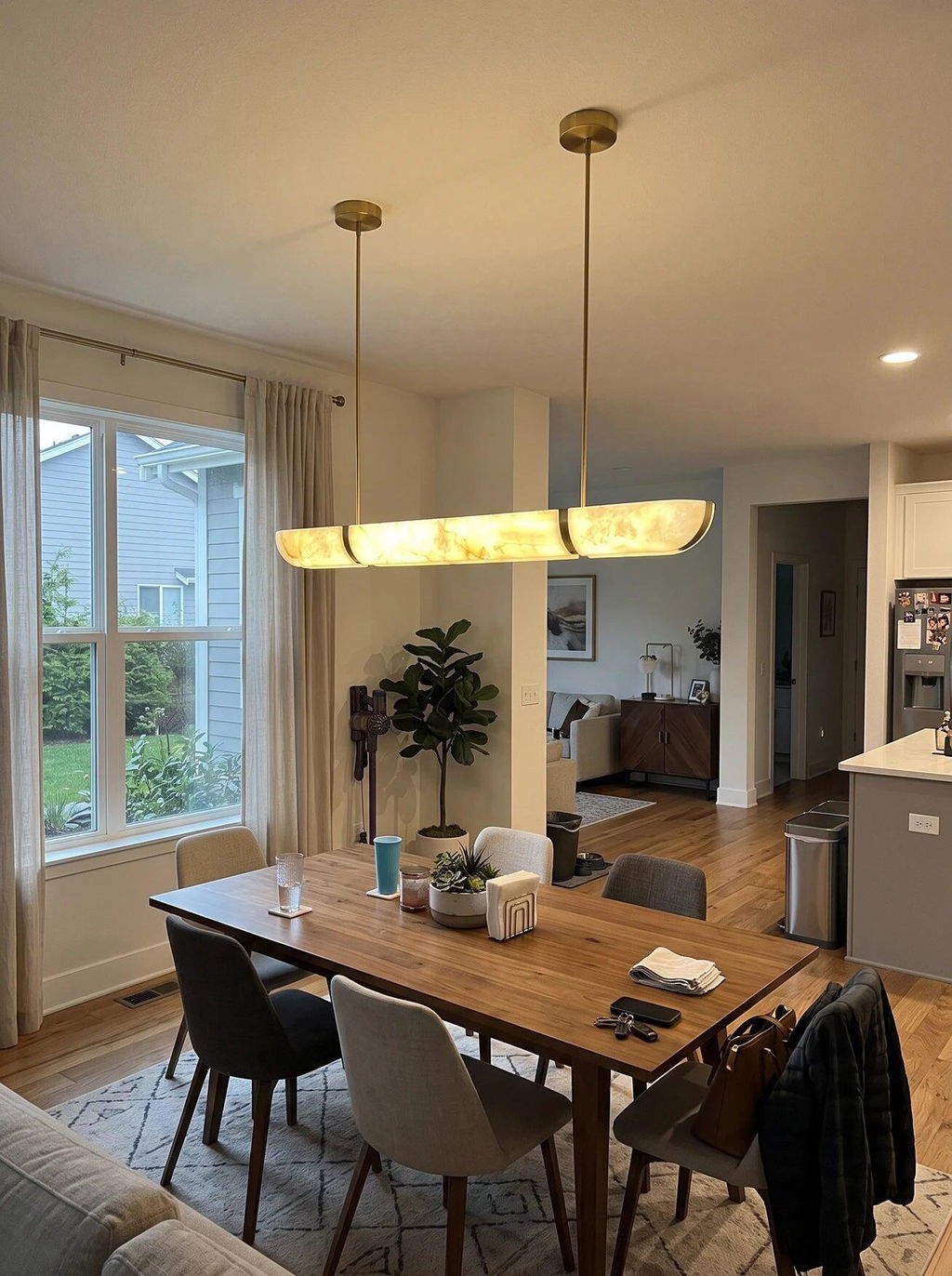
I bought a pair to hang above the kitchen island. When I received them, I noticed that the patterns on the two lamps were not quite the same. One lamp had a more misty feel, while the other had a few light brown mineral lines.
Both the base and the body are made of solid stone, giving it a satisfying weight. It feels incredibly stable, so I don't have to worry about it being easily knocked over by kids or dogs running around.
Satisfied with the entire process, from ordering to installation.
The experience was fantastic. Shipping was fast, the packaging was meticulous, and the product itself is flawless. The natural veining of the alabaster is even more exquisite than I expected.
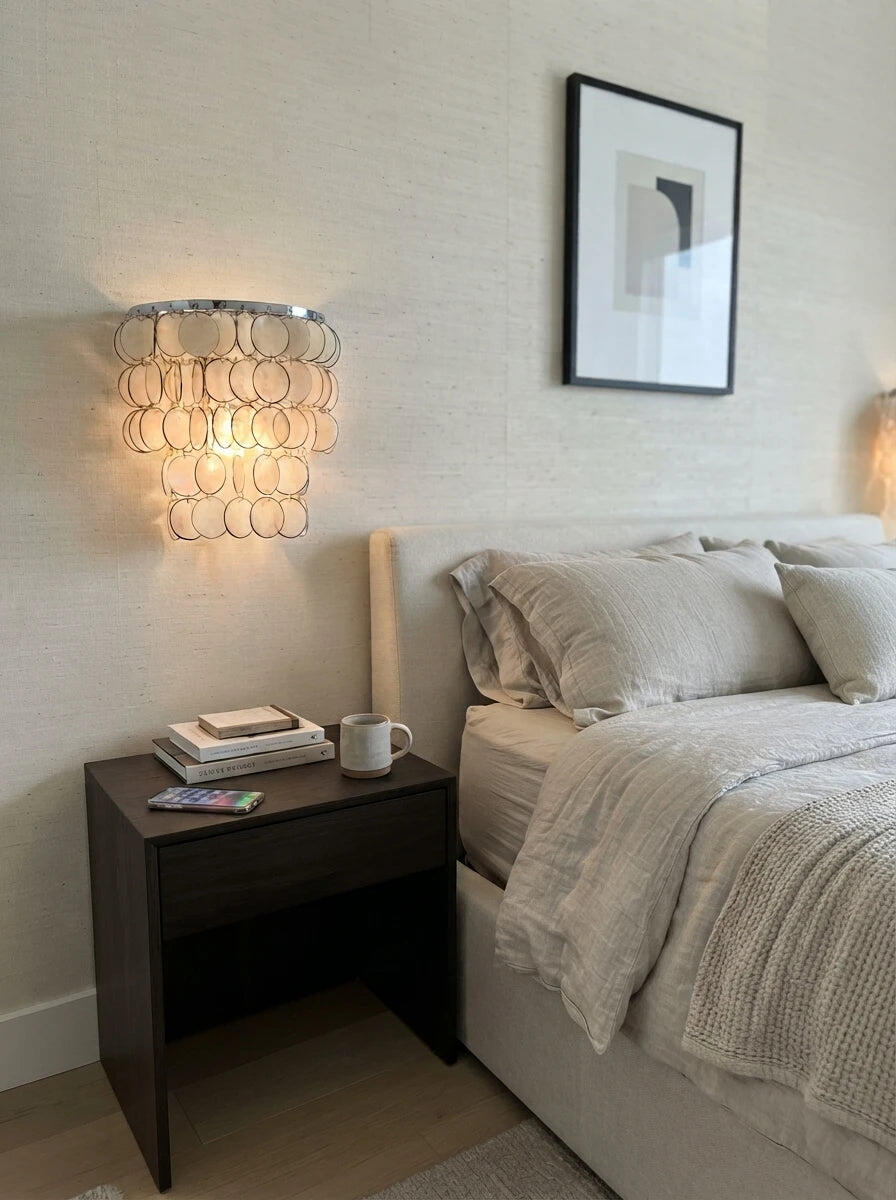
I bought this to serve as a background light for bedside reading. At night, the soft, warm glow filtering through the shells is very soothing and helps with sleep. The chrome metal ring adds a touch of sophistication—I absolutely love it.
The built-in light source has a very pleasant color temperature—a cozy warm white. When paired with the alabaster, it creates an effect reminiscent of light glowing from within a cloud, filling the room with a sense of happiness and comfort.