See It In Motion
Watch the Light Come to Life
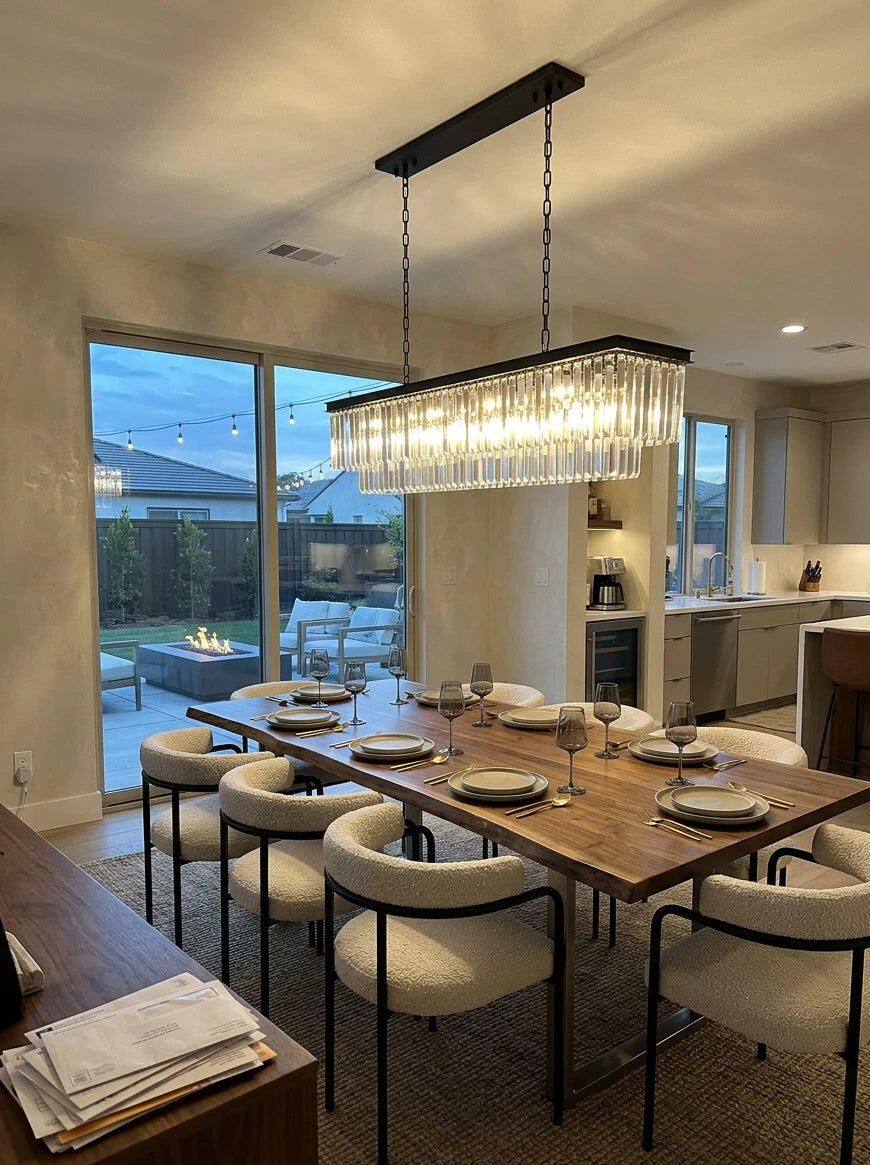
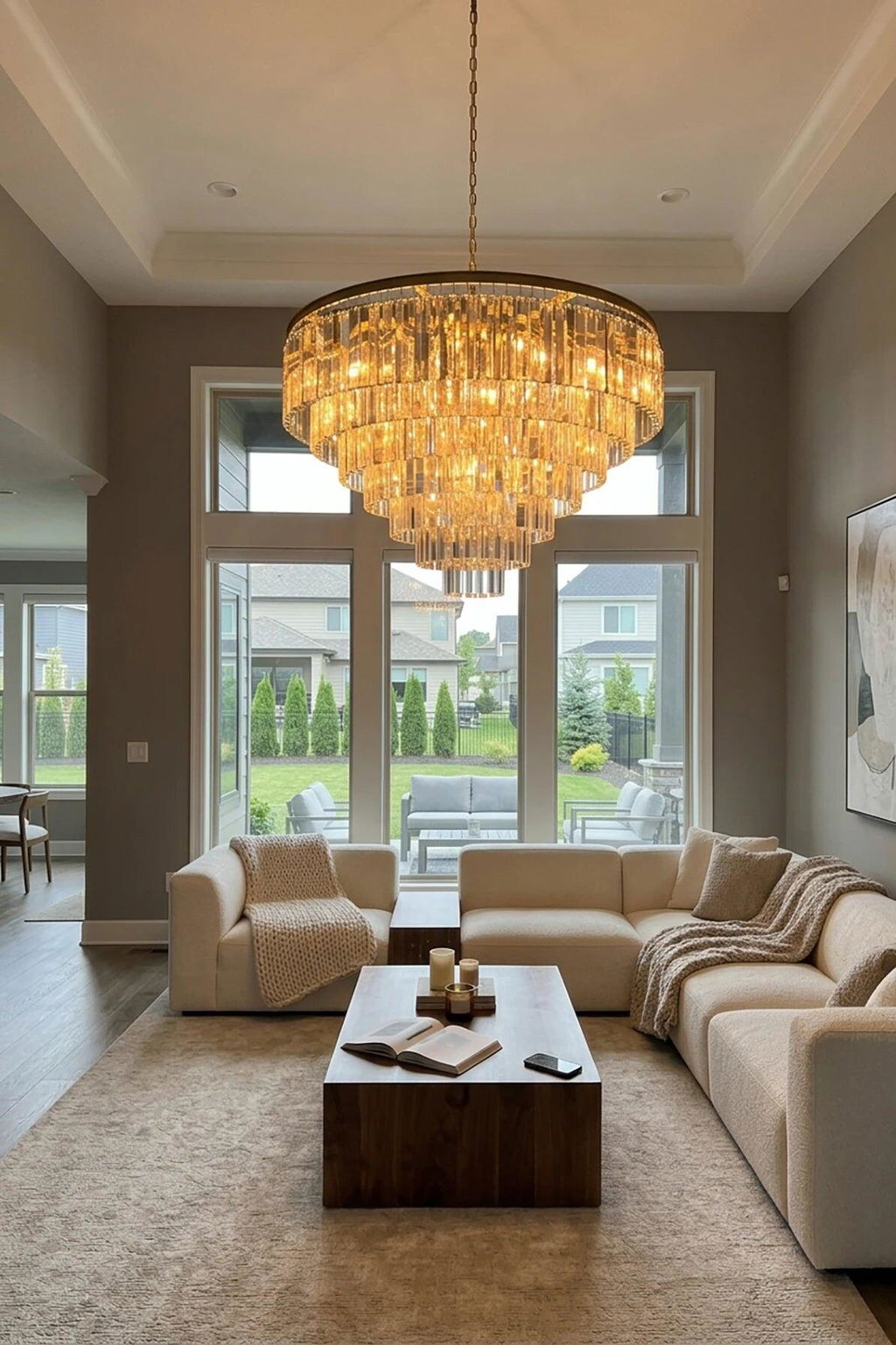
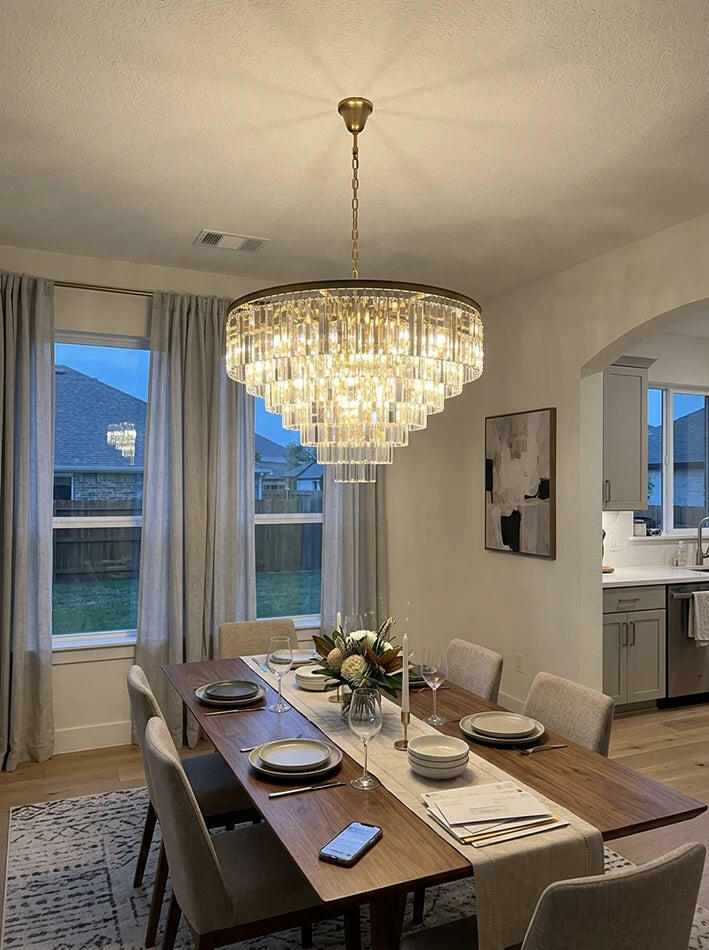
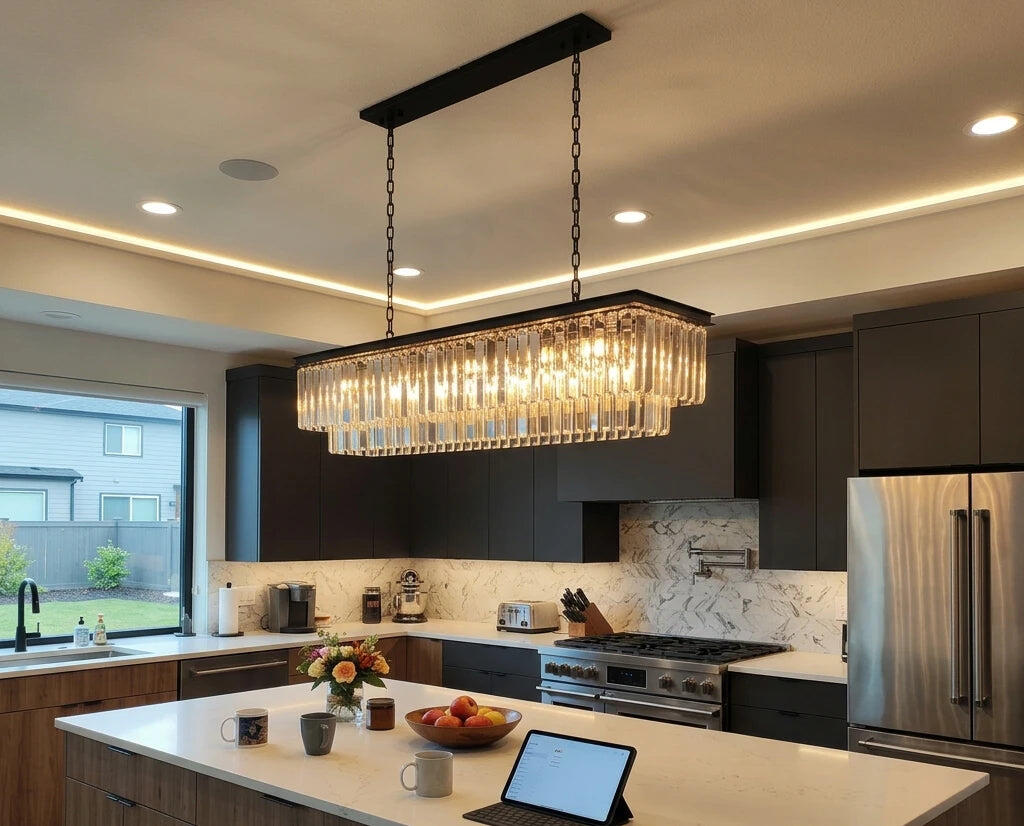
The Honoria Tiered Glass Fringe Chandelier hangs row upon row of faceted glass prisms from a stepped metal frame, each tier drawing in tighter than the one above it so the whole fixture tapers as it falls. The prisms are cut on every face and hung close together — dense enough that you never see the bulbs, only what the glass does with them.
Honoria keeps that density and lets the frame do the modern work — a clean band of metal at the top, no scrollwork, no fuss. Lit, the prisms scatter warm light in every direction and throw small flecks of colour across the ceiling and walls. It comes as a round chandelier or a linear chandelier for long tables, in gold, matte black, or brushed nickel, all for hardwired installation on an adjustable chain.
What You See Is What You Get
 The brass frame, before a single prism goes on
 One prism — cut on every face, checked by hand
Described Honestly
Materials, diameters and finishes are listed exactly as they are — including that the frame arrives assembled and the prisms are hung on during installation.
Genuine Materials
Real glass cut on every face, on a brass frame — never acrylic, never painted steel. Photographed as it leaves our workshop, not rendered.
Safely Packed
Every prism is inspected and packed in cushioned trays, boxed apart from the metalwork — the only way this much glass arrives without a single chipped edge.
The Details
Good to Know
About dimming
Dimming depends entirely on the bulb you use. The bulbs supplied as standard are not dimmable — fit dimmable E12 or E14 bulbs on a compatible wall dimmer and the fixture will dim. Contact us before ordering if you'd like us to confirm the pairing.
Need a longer drop?
Every fixture ships with 150 cm / 59″ of cord and chain that shortens on site. For a tall room, a stairwell, or a double-height entry, tell us your ceiling height when you order and we'll supply extra length before it ships.
The prisms are shipped separately
A fringe fixture arrives with the frame assembled and the glass packed apart — the only way it survives freight intact. The prisms hook on one row at a time during installation. It takes patience rather than skill, and two people make it considerably faster.
Which Size for Your Space
Seven diameters, from a bedroom-scale drop to a full ballroom fixture. Every chain shortens on site — and lengthens if you ask before ordering.
The smallest that still reads as a fringe chandelier.

The size most dining rooms actually need.

Give it 30″ of clear wall on every side.

At 33.5″ tall the tiers need headroom to read.

Centre it over the open floor, not the doorway.

Plan a lift for install and re-lamping.

Have the ceiling structure checked before ordering.

Sizing Tip
Two rules, and they should agree. Over a table: the diameter should be roughly half to two-thirds of the table width — a 60″ round table takes the 31.5″ or the 39.4″. In an open room: add the room's length and width in feet, and use that number in inches — a 14 × 16 ft room points to about 30″, so again the 31.5″.
Height is the other half of the decision. This fixture is tiered rather than flat, so it needs vertical room to read as tiers instead of a solid block. Keep at least 7 ft of clearance anywhere people walk beneath it, and over a table hang the lowest row of prisms 30–36″ above the tabletop. When you are between two sizes, size up — a fringe chandelier that is slightly too small looks like an accident, while one slightly too large looks deliberate.
The Parts We'd Want to See First
Anyone can style a hero shot. These are the four parts a fringe chandelier is actually judged on — the glass, the frame, the canopy and the chain — photographed as they are.

The prisms, laid out
Look at the edges. They are cut, not moulded — square, crisp, and faceted the full length on every side rather than rounded off with a flat back. Acrylic imitations cannot hold an edge like this, which is exactly why they shine without ever splitting light into colour. A single fixture holds hundreds of these.

The frame, from above
Seen from the top, the tiers are concentric rings on radial arms. This is what holds the shape and carries the weight — the glass hangs from it and contributes nothing structural.

Canopy and suspension
A spun metal canopy, not a stamped plastic cover. It fits a standard ceiling junction box and hides the connection completely — the part still on show years after the glass stops being new.

Real chain, real links
Individual welded links, removed one at a time to set your drop on installation day. Ships at 150 cm / 59″ — tell us your ceiling height before ordering and we send extra.
Every component above is the brass build. Black and nickel are the same fixture in a different finish — same frame, same chain, same glass — so what you are seeing is the construction, not one particular colourway.
None of these are renders. They were taken in our own workshop before assembly, which is also the only moment most of these parts are ever visible.
Made for the Moment Someone Walks In
Not a lamp on a ceiling. A curtain of glass.
What makes it work is density, and density is the part most fixtures skip. A few prisms hung loosely give you a chandelier with gaps in it — you see the bulbs, the wiring, the empty frame between. Hang them close enough and something else happens: the source disappears entirely, and the glass becomes the light. Every prism here is cut on all its faces, so light entering one side leaves through several, and the tiers step inward as they fall so you look through layer into layer instead of at a flat wall of glass.
The frame is where we let the century show. No scrollwork, no cast leaves, no gilt curlicues — just a clean band of metal holding the rows, in gold, black, or nickel. The glass does the talking, exactly as it was meant to. Switch it on and the room picks up small flecks of spectrum on the ceiling and walls, moving slightly as you move. It is not a quiet fixture, and it was never trying to be.
Density Is the Whole Difference
Row upon row of faceted glass, hung close enough that the fixture stops looking like a lamp and starts looking like light.
Prisms Cut on Every Face
Each glass bar is faceted all the way around rather than flat on the back — which is the shortcut most fringe fixtures take, because a flat back is faster to cut and nobody sees it in a photo. In the room you see it immediately. Light entering one face leaves through several, so the fringe flickers as you move past it instead of sitting there as a static row of glass.
Hung Close Enough to Hide the Source
The prisms sit shoulder to shoulder around the full circumference, with no gaps between them and no thin patches at the back. That density is what screens the bulbs from every normal sightline — full brightness with nothing bare to look into, whether you are at the table, across the room, or walking underneath.
Seven Diameters, One Design
From 19.7″ over an entry table to 72.8″ in a ballroom, the same fixture scales to the room. Choose 19.7″, 31.5″, 39.4″, 43.3″, 49.2″, 59.1″, or 72.8″ — so a standard dining room and a hotel lobby can run the same design without one of them looking like a compromise. Every chain shortens on site, and we will extend it before shipping if your ceiling needs more.
Real Glass on a Brass Frame
The prisms are genuine glass, not acrylic — and on a fixture with this many pieces the difference compounds. Glass takes a cut edge sharp enough to actually split light, where moulded acrylic can only imitate the shape; glass stays optically clear for decades where plastic clouds and yellows near the heat of a bulb; and glass has weight, so the fringe hangs straight instead of drifting. The frame and canopy are brass, a non-ferrous metal that will not rust the way painted steel does once a chip exposes the base. Available in gold, black, or nickel.
— Faceted glass, hung dense, on a brass frame —
Why Glass & Brass
Plenty of fringe chandeliers look the same in a photo. Here is what tells them apart once it is hanging in your room.
Common Questions
Is the glass real, or is it plastic?
Every prism is real glass. You can tell the moment you unpack one: it is cool to the touch, heavier than it looks, and the cut edges are sharp and precise rather than softly rounded.
Acrylic imitations feel warm and light in the hand, and their edges are moulded rather than cut — which is why they shine but never throw those small flecks of colour onto the ceiling.
What is the frame made of?
Will it be too bright, or will I see the bulbs?
Does it really throw rainbows on the wall?
Yes, and this is the part photos never quite capture. Cut glass bends light slightly differently depending on colour, so a warm bulb comes out the other side as small flecks of spectrum scattered across the ceiling and nearby walls.
They move a little as you walk past. It is subtle rather than theatrical, and it is the whole reason this shape has been made for a hundred years.
How do I clean something with this much glass?
Switch it off, let the bulbs cool completely, then work with a soft dry cloth, one row at a time, from the top down so the dust falls away from what you have already done.
Once or twice a year is enough. Skip sprays and anything abrasive — liquid runs into the hooks where it dries as a mark, and a scratched prism cannot be polished back.
Is it heavy? Will my ceiling hold it?
The Complete Installation Guide
Not sure how to wire it, how high to hang it, or whether you need an electrician? Our full guide walks through every step for US homes.
Power Off First
Switch off at the breaker and confirm before you touch any wiring.
Check the Box
Make sure your junction box is standard, secure, and rated for the weight.
Match the Wires
Black to black, white to white, ground to ground — the US standard explained.
Set the Height
Mounting heights and clearances for sconces, pendants, and chandeliers.
Honoria Tiered Glass Fringe Chandelier
The price includes tax, and free standard shipping within the U.S. is provided.

Free Shipping on all orders
Hassle-free return within 30 days
Payment Security
Pairs Well With
See It In Motion
Watch the Light Come to Life
The Honoria Tiered Glass Fringe Chandelier hangs row upon row of faceted glass prisms from a stepped metal frame, each tier drawing in tighter than the one above it so the whole fixture tapers as it falls. The prisms are cut on every face and hung close together — dense enough that you never see the bulbs, only what the glass does with them.
Honoria keeps that density and lets the frame do the modern work — a clean band of metal at the top, no scrollwork, no fuss. Lit, the prisms scatter warm light in every direction and throw small flecks of colour across the ceiling and walls. It comes as a round chandelier or a linear chandelier for long tables, in gold, matte black, or brushed nickel, all for hardwired installation on an adjustable chain.
What You See Is What You Get
The brass frame, before a single prism goes on
One prism — cut on every face, checked by hand
Described Honestly
Materials, diameters and finishes are listed exactly as they are — including that the frame arrives assembled and the prisms are hung on during installation.
Genuine Materials
Real glass cut on every face, on a brass frame — never acrylic, never painted steel. Photographed as it leaves our workshop, not rendered.
Safely Packed
Every prism is inspected and packed in cushioned trays, boxed apart from the metalwork — the only way this much glass arrives without a single chipped edge.
The Details
Good to Know
About dimming
Dimming depends entirely on the bulb you use. The bulbs supplied as standard are not dimmable — fit dimmable E12 or E14 bulbs on a compatible wall dimmer and the fixture will dim. Contact us before ordering if you'd like us to confirm the pairing.
Need a longer drop?
Every fixture ships with 150 cm / 59″ of cord and chain that shortens on site. For a tall room, a stairwell, or a double-height entry, tell us your ceiling height when you order and we'll supply extra length before it ships.
The prisms are shipped separately
A fringe fixture arrives with the frame assembled and the glass packed apart — the only way it survives freight intact. The prisms hook on one row at a time during installation. It takes patience rather than skill, and two people make it considerably faster.
Which Size for Your Space
Seven diameters, from a bedroom-scale drop to a full ballroom fixture. Every chain shortens on site — and lengthens if you ask before ordering.
The smallest that still reads as a fringe chandelier.
The size most dining rooms actually need.
Give it 30″ of clear wall on every side.
At 33.5″ tall the tiers need headroom to read.
Centre it over the open floor, not the doorway.
Plan a lift for install and re-lamping.
Have the ceiling structure checked before ordering.
Sizing Tip
Two rules, and they should agree. Over a table: the diameter should be roughly half to two-thirds of the table width — a 60″ round table takes the 31.5″ or the 39.4″. In an open room: add the room's length and width in feet, and use that number in inches — a 14 × 16 ft room points to about 30″, so again the 31.5″.
Height is the other half of the decision. This fixture is tiered rather than flat, so it needs vertical room to read as tiers instead of a solid block. Keep at least 7 ft of clearance anywhere people walk beneath it, and over a table hang the lowest row of prisms 30–36″ above the tabletop. When you are between two sizes, size up — a fringe chandelier that is slightly too small looks like an accident, while one slightly too large looks deliberate.
The Parts We'd Want to See First
Anyone can style a hero shot. These are the four parts a fringe chandelier is actually judged on — the glass, the frame, the canopy and the chain — photographed as they are.
The prisms, laid out
Look at the edges. They are cut, not moulded — square, crisp, and faceted the full length on every side rather than rounded off with a flat back. Acrylic imitations cannot hold an edge like this, which is exactly why they shine without ever splitting light into colour. A single fixture holds hundreds of these.
The frame, from above
Seen from the top, the tiers are concentric rings on radial arms. This is what holds the shape and carries the weight — the glass hangs from it and contributes nothing structural.
Canopy and suspension
A spun metal canopy, not a stamped plastic cover. It fits a standard ceiling junction box and hides the connection completely — the part still on show years after the glass stops being new.
Real chain, real links
Individual welded links, removed one at a time to set your drop on installation day. Ships at 150 cm / 59″ — tell us your ceiling height before ordering and we send extra.
Every component above is the brass build. Black and nickel are the same fixture in a different finish — same frame, same chain, same glass — so what you are seeing is the construction, not one particular colourway.
None of these are renders. They were taken in our own workshop before assembly, which is also the only moment most of these parts are ever visible.
Made for the Moment Someone Walks In
Not a lamp on a ceiling. A curtain of glass.
What makes it work is density, and density is the part most fixtures skip. A few prisms hung loosely give you a chandelier with gaps in it — you see the bulbs, the wiring, the empty frame between. Hang them close enough and something else happens: the source disappears entirely, and the glass becomes the light. Every prism here is cut on all its faces, so light entering one side leaves through several, and the tiers step inward as they fall so you look through layer into layer instead of at a flat wall of glass.
The frame is where we let the century show. No scrollwork, no cast leaves, no gilt curlicues — just a clean band of metal holding the rows, in gold, black, or nickel. The glass does the talking, exactly as it was meant to. Switch it on and the room picks up small flecks of spectrum on the ceiling and walls, moving slightly as you move. It is not a quiet fixture, and it was never trying to be.
Density Is the Whole Difference
Row upon row of faceted glass, hung close enough that the fixture stops looking like a lamp and starts looking like light.
Prisms Cut on Every Face
Each glass bar is faceted all the way around rather than flat on the back — which is the shortcut most fringe fixtures take, because a flat back is faster to cut and nobody sees it in a photo. In the room you see it immediately. Light entering one face leaves through several, so the fringe flickers as you move past it instead of sitting there as a static row of glass.
Hung Close Enough to Hide the Source
The prisms sit shoulder to shoulder around the full circumference, with no gaps between them and no thin patches at the back. That density is what screens the bulbs from every normal sightline — full brightness with nothing bare to look into, whether you are at the table, across the room, or walking underneath.
Seven Diameters, One Design
From 19.7″ over an entry table to 72.8″ in a ballroom, the same fixture scales to the room. Choose 19.7″, 31.5″, 39.4″, 43.3″, 49.2″, 59.1″, or 72.8″ — so a standard dining room and a hotel lobby can run the same design without one of them looking like a compromise. Every chain shortens on site, and we will extend it before shipping if your ceiling needs more.
Real Glass on a Brass Frame
The prisms are genuine glass, not acrylic — and on a fixture with this many pieces the difference compounds. Glass takes a cut edge sharp enough to actually split light, where moulded acrylic can only imitate the shape; glass stays optically clear for decades where plastic clouds and yellows near the heat of a bulb; and glass has weight, so the fringe hangs straight instead of drifting. The frame and canopy are brass, a non-ferrous metal that will not rust the way painted steel does once a chip exposes the base. Available in gold, black, or nickel.
— Faceted glass, hung dense, on a brass frame —
Why Glass & Brass
Plenty of fringe chandeliers look the same in a photo. Here is what tells them apart once it is hanging in your room.
Common Questions
Is the glass real, or is it plastic?
Every prism is real glass. You can tell the moment you unpack one: it is cool to the touch, heavier than it looks, and the cut edges are sharp and precise rather than softly rounded.
Acrylic imitations feel warm and light in the hand, and their edges are moulded rather than cut — which is why they shine but never throw those small flecks of colour onto the ceiling.
What is the frame made of?
Will it be too bright, or will I see the bulbs?
Does it really throw rainbows on the wall?
Yes, and this is the part photos never quite capture. Cut glass bends light slightly differently depending on colour, so a warm bulb comes out the other side as small flecks of spectrum scattered across the ceiling and nearby walls.
They move a little as you walk past. It is subtle rather than theatrical, and it is the whole reason this shape has been made for a hundred years.
How do I clean something with this much glass?
Switch it off, let the bulbs cool completely, then work with a soft dry cloth, one row at a time, from the top down so the dust falls away from what you have already done.
Once or twice a year is enough. Skip sprays and anything abrasive — liquid runs into the hooks where it dries as a mark, and a scratched prism cannot be polished back.
Is it heavy? Will my ceiling hold it?
The Complete Installation Guide
Not sure how to wire it, how high to hang it, or whether you need an electrician? Our full guide walks through every step for US homes.
Power Off First
Switch off at the breaker and confirm before you touch any wiring.
Check the Box
Make sure your junction box is standard, secure, and rated for the weight.
Match the Wires
Black to black, white to white, ground to ground — the US standard explained.
Set the Height
Mounting heights and clearances for sconces, pendants, and chandeliers.