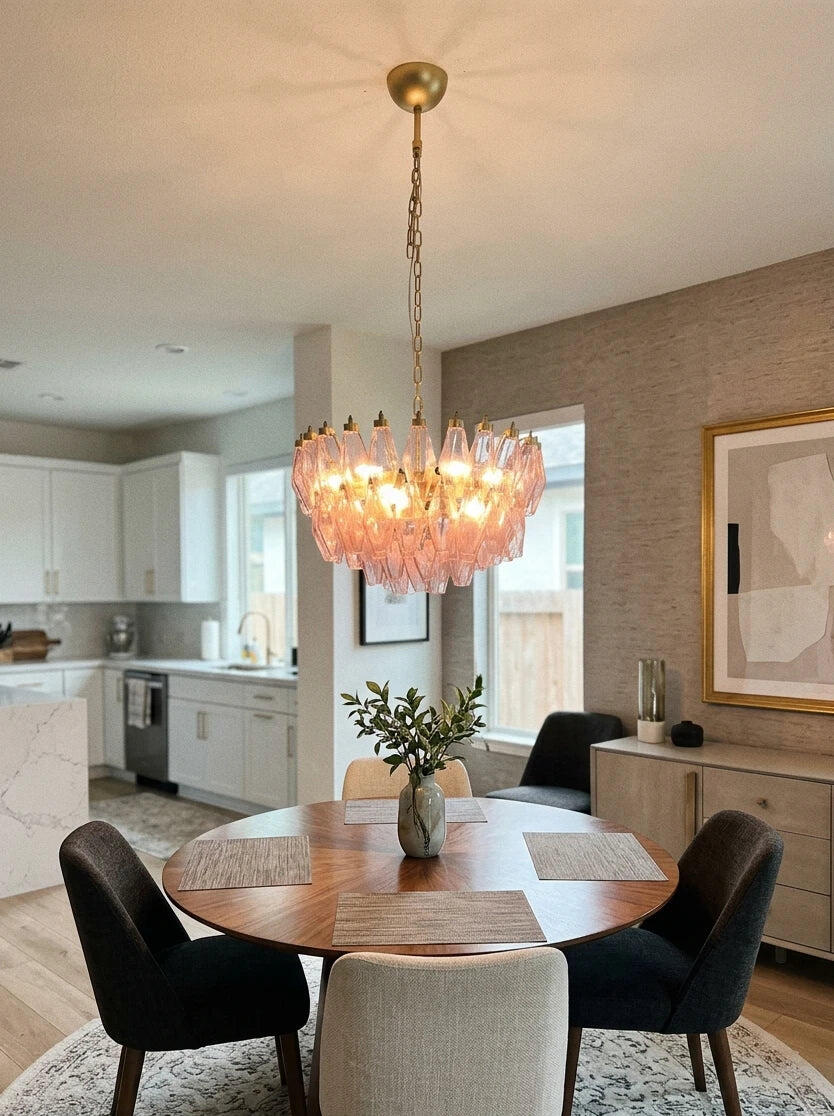
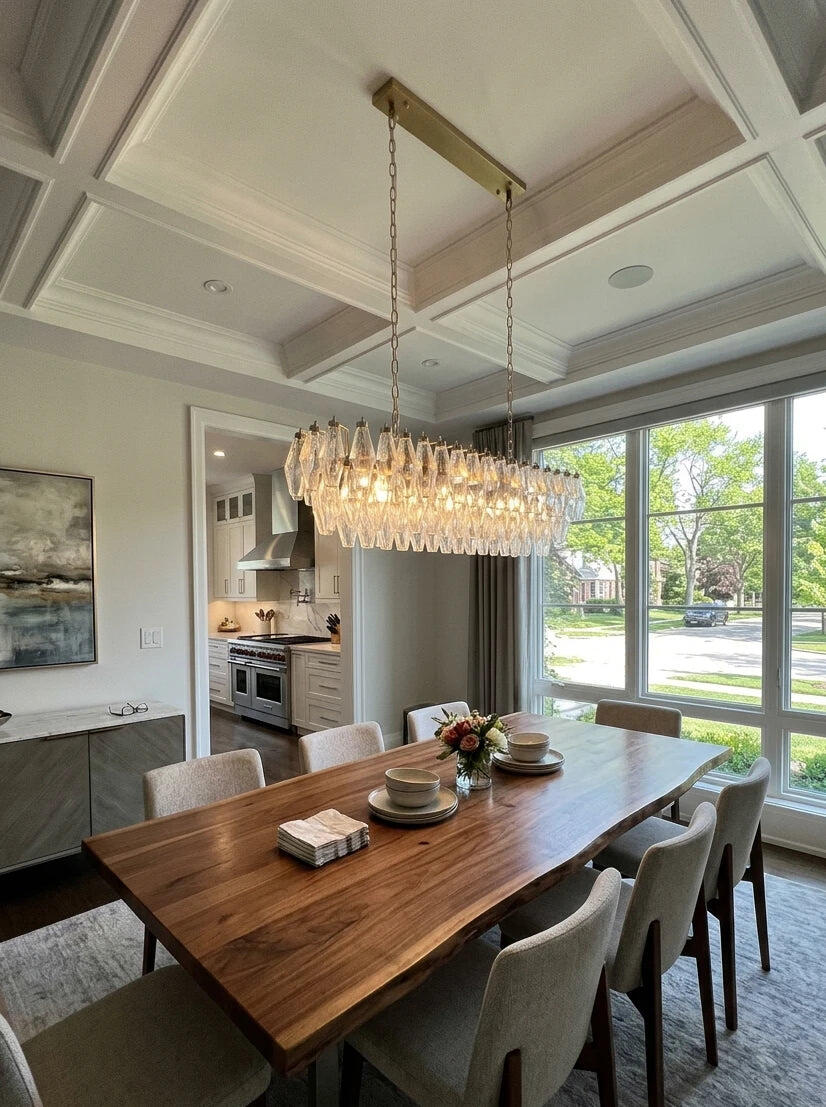
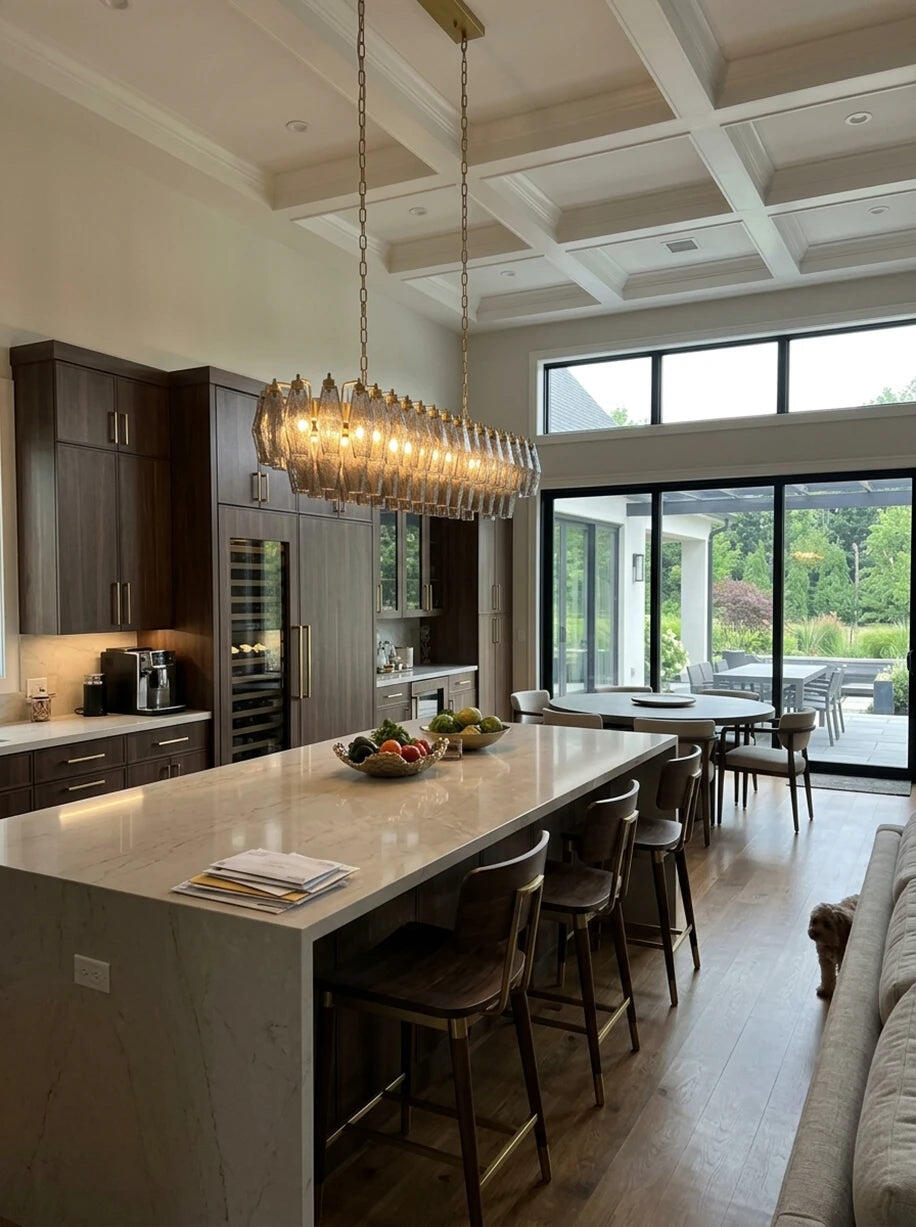
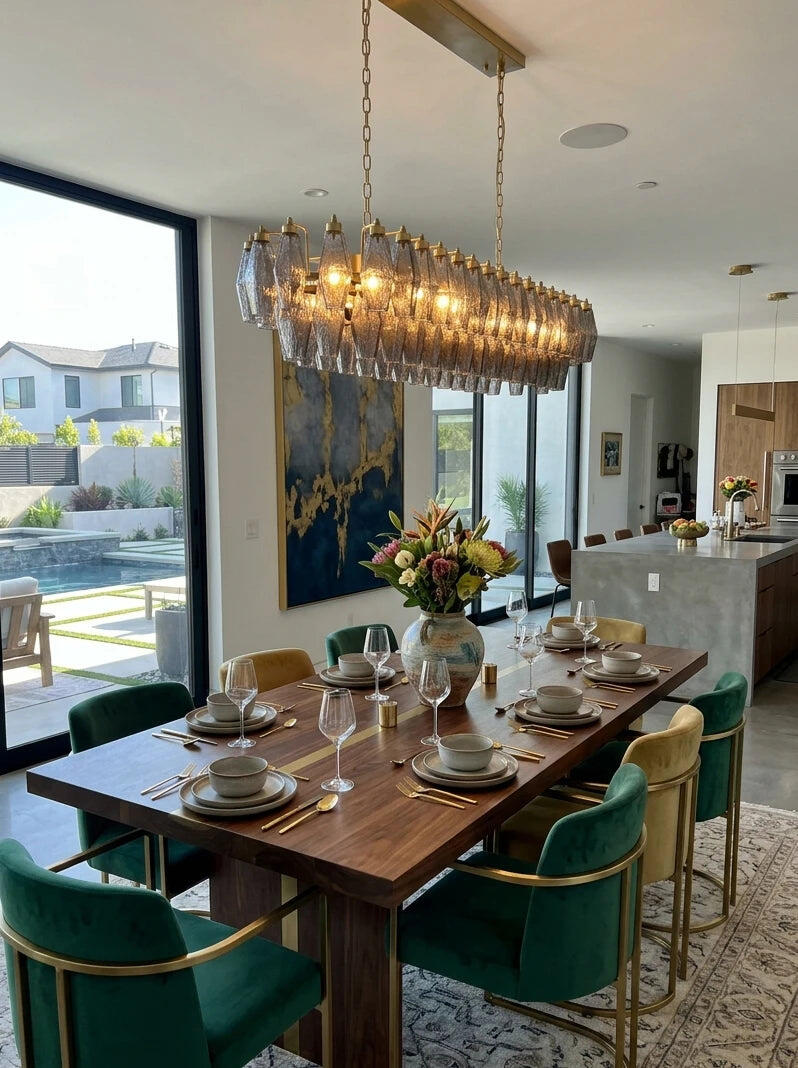
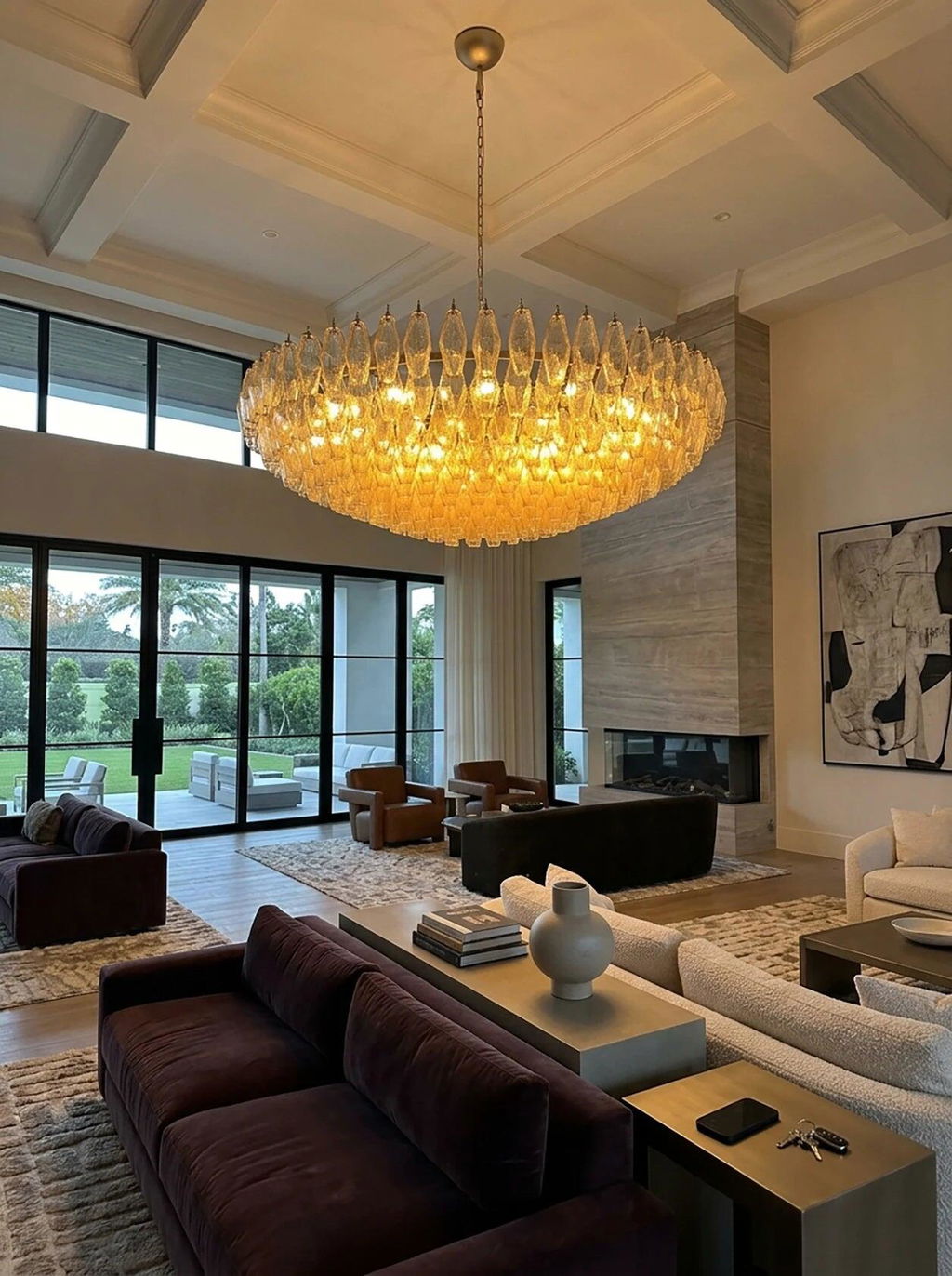
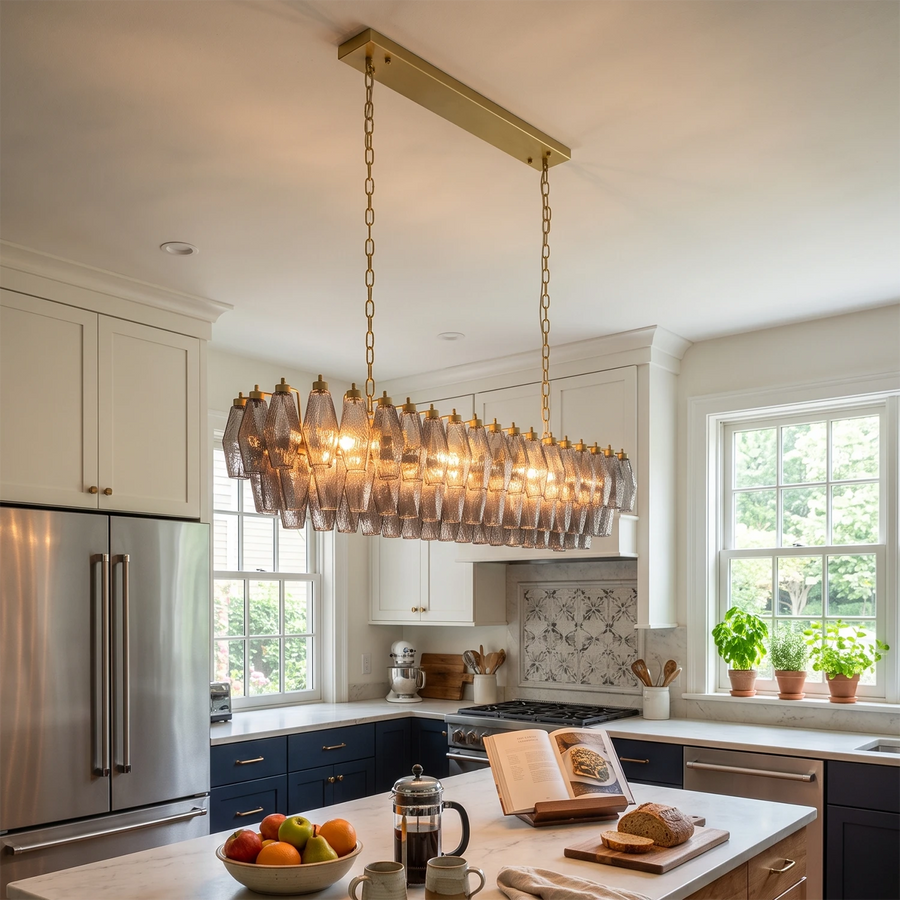
The Stellan Faceted Glass Tiered Chandelier hangs hammered glass facets in descending tiers from a gold-tone frame, narrowing to a point at the bottom. Each piece is cut to an angular, tapered form — closer to a rough-cut gem than to a shade.
Colour is worked into the molten glass rather than applied to the surface, which is why it deepens where the facet thickens and lifts almost to clear at the tip. Lit, that texture does the real work: light entering a faceted piece is turned at every plane and again at every dimple, so a single bulb becomes hundreds of small points of light instead of one glowing shade.
Part of our hand-blown glass series, which comes down to three ways of shaping the same material. The Camellia glass petal chandelier curves it — thick at the spine, thinning to a soft lip, so the light comes back diffused and sourceless. The Addis star-shaped glass tubes chandelier draws it straight — cut square and set in tiers, so each tube carries light down its own length. This one facets it: angular planes that turn light rather than softening or directing it.
Made to Order
Hand-Blown Faceted Glass, Made to Order
Exclusive Customization
Make It Uniquely Yours
Love the design but need it tailored to your space? We offer comprehensive customization — dimensions, surface finishes, chain and wire lengths, and more. Tell us your vision, and we'll take care of the rest.
Custom SizeGlass | Lamp Body ColourChain / Wire LengthTier Count
1
Share Your Idea
Message us online for an immediate response to your brief.
2
Expert Consultation
We advise on size, colour, and finish for your room.
3
We Craft It
Made to spec and inspected before it ships.
support@Vidirlighting.com
The Craft
Shaped by Breath & Fire, Not a Machine
Every faceted piece is mouth-blown by hand — which is exactly why the light looks the way it does.
Hand-Blown Glass
Molten Glass, Shaped by Hand
Each facet begins as a glowing gather of molten glass on the end of a blowpipe. A glassmaker breathes it into shape by hand, drawing out the tapered form and working the angular planes and hammered dimples into the wall while the glass is still soft. It's slow, skilled work — and it leaves each piece with a life that machine-pressed glass simply can't have.
Facets That Turn the Light
Light entering a faceted piece is turned at every plane and again at every dimple, so one bulb becomes hundreds of small points of light — the same principle as cut crystal, delivered warm rather than cold.
Depth & Clarity
Hand-blown glass carries a substantial, thick-walled clarity with real depth — it refracts a soft glow even in daylight, never the thin, hollow look of acrylic.
Made, Not Manufactured
Every facet is the trace of a maker's hand and breath — an artisan piece, not a molded copy stamped out by the thousand.
The same glass, shaped three ways. Curve it and the light diffuses; draw it straight and the light travels; facet it and the light turns.
MaterialHand-blown Faceted Glass · Metal Frame Each piece is blown by hand and the planes and dimples worked in while the glass is still molten.
FinishGold
Glass colourwaysClearPinkAmberSmoke Grey Colour is worked into the molten glass, so it deepens where the facet thickens and lifts almost to clear at the tip.
Light sourceLED or Edison bulb E12 / E14 base. Warm white (2700K) recommended — cooler light flattens the facets and drains the tint.
BulbsE12 / E14 Bulbs not included.
PowerMax 40W
VoltageAC 110–240V
ControlWall switch Dimmable when fitted with a compatible dimmable bulb on a dimmer circuit.
Suspension150 cm / 59″ Chain — adjustable at installation Links can be removed on site to set the drop to your ceiling; extra length supplied on request.
MountingCeiling — hardwired Mounts to a standard junction box. No cord or plug; professional installation recommended.
EnvironmentIndoor only · dry locations
Preparation time5–10 days Made and inspected at our own workshop before dispatch.
Good to Know
Need a longer wire?
Every fixture ships with a 150 cm / 59″ wire. For a tall stairwell, foyer, or atrium, contact us before ordering and we'll lengthen it for you.
What each colourway does to the light
Clear adds nothing and simply sparkles — the brightest of the four. Smoke grey is close to neutral; it dims more than it colours. Blush pink returns the light rose-gold and is flattering rather than obviously pink. Amber is the strongest cast and pushes a whole room toward evening. If colour accuracy matters in the space — a kitchen work surface, a room where you match fabrics — choose clear or smoke.
About dimming
Dimming depends on the bulb, not the fixture. Fit dimmable E12 / E14 bulbs on a compatible dimmer and it will dim smoothly. Standard bulbs are not dimmable, so order dimmable ones separately.
Size Guide
Which Size for Your Space
Six configurations in two forms — four round and two linear. Match the form to the shape of the furniture beneath it, then size it. Every version hangs on chain that shortens on site.
RoundFor round tables, open rooms and entries
∅ 22.4″
∅ 22.4″ × H 13″∅ 57 × H 33 cm
Best forRound table 30–33″ · bedroom · entry hall · small dining room
The smallest round — and the same length as the small linear version.
∅ 24.8″Popular
∅ 24.8″ × H 13″∅ 63 × H 33 cm
Glass74 faceted pieces
Bulbs9 × E12 / E14
Best forRound dining table 33–37″ · living room · main bedroom
Nine bulbs behind 74 facets — the most forgiving size in the range.
∅ 35.4″
∅ 35.4″ × H 14.6″∅ 90 × H 37 cm
Glass184 faceted pieces
Bulbs15 × E12 / E14
Best forRound table 47–53″ · open-plan living · double-height entry
184 pieces — this is where the fixture stops being furniture and becomes the room.
∅ 59″
∅ 59″ × H 17.7″∅ 150 × H 45 cm
Best forHotel lobby · restaurant · full double-height entry · banquet-scale round table
Nearly five feet across. Confirm the ceiling structure with an engineer, not just an electrician.
LinearFor kitchen islands and rectangular tables
L 22.4″
L 22.4″ × W 15.3″ × H 13″L 57 × W 39 × H 33 cm
Glass48 faceted pieces
Bulbs6 × E12 / E14
Best forCompact island · breakfast bar · rectangular table 40–55″ long
The round ∅ 22.4″ stretched into an oval — same length, same height, different frame.
L 30.7″
L 30.7″ × W 15.7″ × H 11.8″L 78 × W 40 × H 30 cm
Best forKitchen island · rectangular dining table 60–84″ long · long console
The shallowest of the six at 11.8″ tall — the easiest to live under.
Sizing Tip
Choose the form before the size, and choose it from the furniture rather than the room. A round fixture over a rectangular island always looks undersized at the ends; a linear fixture over a round table always looks like it is pointing somewhere. Round goes with round tables, open rooms and entries. Linear goes with islands, bars and rectangular tables.
Then size it, and the two forms use different rules. For a round fixture over a round table, take two thirds to three quarters of the table diameter — a 35 in table wants roughly 24 in. In an open room instead, add the length and width in feet and read the sum as inches. For a linear fixture, take one third to two thirds of the table or island length, and keep the fixture width to no more than half the surface width.
The design
Light Turned Twice
Once by the facets. Again by the hammered skin.
An angular piece of glass turns light at every plane it has. That much is the crystal principle, and it has been understood for centuries — cut the surface into planes and a single source becomes many. But polished crystal stops there. The planes are smooth, the deflection is clean, and what comes back is bright, precise and slightly cold.
These facets do not stop there. While the glass is still molten, the wall is worked over into a fine hammered dimple — so the surface is textured rather than polished, and light already turned once by the geometry is turned again by the skin. One large deflection, then hundreds of tiny ones, at a completely different scale. The second texture softens exactly what the first one sharpened. That is the whole reason a faceted fixture can read warm instead of glittering.
— Faceted, then hammered. Sharp, then softened. —
Why this chandelier
Two Forms, Two Textures
01
Round or Linear, Not Six Sizes of One
Four configurations are round — for round tables, open rooms and entries. Two are linear — for kitchen islands and rectangular tables. It matters more than it sounds: a round fixture over a long island always looks undersized at the ends, and a linear one over a round table always looks like it is pointing somewhere. Choose the form from the furniture beneath it, then choose the size.
02
Faceted Glass, Turned Twice
An angular piece turns light at every plane it has — that much is the crystal principle. But polished crystal stops there, and what comes back is bright and slightly cold. Here the wall is hammered into a fine dimple while the glass is still molten, so light already turned by the geometry is turned again by the surface: hundreds of tiny deflections at a completely different scale. The second texture softens exactly what the first one sharpened.
03
Colour Worked Into the Glass
The tint enters the molten batch rather than a spray booth, so it deepens where a facet thickens and lifts almost to clear at the tip — nothing to chip, nothing to fade. Clear adds nothing and simply sparkles. Smoke grey stays near neutral and dims more than it colours. Blush pink returns the light rose-gold. Amber pushes a whole room toward evening. One fixture, four completely different rooms.
Materials
Why Hand-Blown Facets
Faceted fixtures are easy to imitate in a mould. Here is what a hand-blown facet does that a moulded one cannot.
Hand-Blown FacetsMoulded / Pressed Facets
The planesEach piece's angles vary slightly, so reflections land unpredictably and never fall into a patternIdentical angles across every piece — the reflections repeat in a visible grid once you notice it
The surfaceHammered into a fine dimple while molten, giving a second scale of refraction on top of the planesPolished smooth or lightly embossed — one scale only, brighter but colder
Tint depthColour in the melt, so it pools dark at the thick spine and lifts almost to clear at the tipSprayed or filmed on — flat and even across the whole piece, and able to chip at an edge
Switched offThick glass holds real depth; the facets catch daylight and read as an objectThin-walled or acrylic, and hollow-looking the moment the light is off
Unique nessNo two facets identical in wall thickness, dimple depth or saturationCast from one die; identical to the millimetre, the same piece repeated
Over timeGlass will not yellow or grow brittle from bulb heat; the colour is the materialAcrylic yellows and stiffens with heat and age; surface tints fade unevenly
Construc tionEach facet seats on its own collar, so a damaged one is replaced on its ownSealed into a moulded assembly; damage usually means replacing the fixture
In the handCool to the touch and heavy for its sizeWarm, light, and unmistakably plastic once you handle it
Questions, Answered
Common Questions
Is this crystal?
No — and it is worth being clear about it. This is hand-blown glass, not lead crystal. The angular form borrows the crystal principle, which is that a faceted surface turns light at every plane, but the material and the result are different.
Cut crystal gives you brilliance: hard, precise, colourless sparkle. This gives you the same multiplication of light delivered warm and soft-edged, because the facets are hammered rather than polished and because the glass is thicker. If you want icy brilliance, crystal is the right material. If you want a room that feels warmer with the light on, this is.
What is the hammered texture for?
It is the second half of how this fixture works. The angular planes turn light once, at a large scale. The hammered dimples turn it again, hundreds of times, at a much smaller one.
That second pass is what stops a faceted fixture from glittering coldly. The surface texture softens exactly what the geometry sharpened — and because the dimples are worked in while the glass is still molten, the texture is in the wall of the piece rather than on it. Nothing to scratch off, nothing to wear away.
Is the glass really hand-blown?
Yes. Every facet is gathered molten, inflated by breath and shaped by hand — never pressed cold from a die and never acrylic. The planes are drawn out and the dimples worked in while the glass is soft, and colour enters the molten batch rather than being sprayed onto a finished surface. It is why no two facets are identical and why a lit fixture never falls into a repeating pattern.
Which colourway should I choose?
Clear adds nothing to the light and simply sparkles — the brightest of the four and the safest in any palette. Smoke grey is close to neutral; it dims more than it colours, and it sits well with cool greys, black metal and marble. Blush pink returns the light rose-gold — flattering rather than obviously pink, and at home with cream, oak and plaster. Amber is the strongest cast and pushes a whole room toward evening; it belongs with walnut, leather and terracotta.
One rule: if colour accuracy matters in the space — a kitchen work surface, a room where you match fabrics, a mirror you get ready at — choose clear or smoke.
Will the tinted versions make my room look coloured?
Less than you would expect, and it depends on the tint. Because the colour sits deep in the thick part of each facet and thins almost to clear at the tip, the light leaving the fixture is far less saturated than the glass looks unlit. Amber is the one that genuinely shifts a room, and it does so warmly rather than yellowly. Blush reads as warmth on skin more than as pink on walls. Smoke barely colours at all.
Round or linear — which do I need?
Take the form from the furniture beneath it, not from the room. Round suits round tables, open rooms and entries. Linear suits kitchen islands, bars and rectangular tables. The mismatch is more obvious than people expect: a round fixture over a long island always looks undersized at the ends, and a linear one over a round table always looks as though it is pointing somewhere.
How bright is it?
Each configuration is lamped for its scale — six bulbs on the smallest linear, nine on the popular round, fifteen on the large round — so this is a genuine room light rather than an accent. Fitted with warm-white LEDs the larger sizes carry a dining room or living room on their own.
Colour affects output: clear transmits the most, smoke a little less, amber least of the four, since tinted glass absorbs as well as colours. If the room needs maximum brightness, choose clear.
What bulbs does it take, and can it be dimmed?
Standard E12 / E14 candelabra-base bulbs, LED or Edison style, not included. Dimming depends on the bulb rather than the fixture: fit dimmable bulbs on a compatible dimmer and the whole fixture dims together. A warm white around 2700K suits this glass best — cooler light flattens the facets and drains the tint. With fifteen bulbs, check the total wattage against your dimmer's rating before installing.
How high should I hang it?
Over a dining table or island, hang the lowest facet 30–36″ (75–90 cm) above the surface — lower than instinct suggests is usually right, since nobody walks underneath. In any walkway or entry, keep at least 7 ft (2.1 m) of floor clearance. For open rooms, allow roughly 2.5–3″ of drop per foot of ceiling height. The chain shortens on site by removing links, and extra length is supplied on request.
Can I install it on a sloped or vaulted ceiling?
Yes — a chain-hung fixture is the easiest type to do it with. Because the whole piece hangs from a single point, it stays level no matter what angle the ceiling above it sits at.
The only part to handle is the canopy. A standard canopy sits flush on a shallow pitch only; anything steeper needs a sloped-ceiling adapter, an angled kit that lets the canopy sit flat while the chain hangs plumb. Tell us the pitch before ordering and we will confirm whether one is needed and supply it.
Will my ceiling take the weight?
Check before ordering, not after. Dozens of solid glass facets on a metal frame is considerably heavier than it looks — the large round carries a hundred and eighty-four pieces. Confirm that your junction box is rated for the fixture's weight and that there is structural support above it; a standard box carries far less than most people assume, and the larger sizes may need a brace or a heavier-rated box.
For the ∅ 59″ configuration, have the ceiling structure confirmed by an engineer, not only an electrician. Net and shipping weights are available on request for every size.
How do I clean it, and what if a facet breaks?
A soft dry cloth for dust, barely damp for fingerprints, supporting each piece with your other hand. Work from the top tier down so dust falls away from what you have cleaned. Avoid abrasive pads, solvents and glass sprays containing ammonia — a hammered surface traps residue. Switch off and let the bulbs cool completely first.
Every facet is individually wrapped and foam-seated for shipping, with the frame boxed separately. If something arrives damaged, send photographs within 24 hours of delivery and the affected part is replaced. Because each facet seats on its own collar, a single broken piece never means returning the whole fixture.
— Hand-blown faceted glass on a gold-tone frame —
Installation
The Complete Installation Guide
Not sure how to wire it, how high to hang it, or whether you need an electrician? Our full guide walks through every step for US homes.
01
Power Off First
Switch off at the breaker and confirm before you touch any wiring.
02
Check the Box
Make sure your junction box is standard, secure, and rated for the weight.
03
Match the Wires
Black to black, white to white, ground to ground — the US standard explained.
04
Set the Height
Mounting heights and clearances for sconces, pendants, and chandeliers.
✦
With a brand-new lighting ambiance, let's usher in a hopeful 202610% Off All Lighting✦
Still deciding
Between two sizes? Size up.
The gaps between the tubes let the ceiling show through, so this one reads lighter than its measured diameter. Our field notes work through the rest — the sizing formulas for round and rectangular tables, hanging heights by ceiling, and how the tube form compares to a petal one.
Standard US delivery orders typically arrive within 20–30 calendar days.
2. Can I get expedited shipping?
Yes. You can contact our customer service team during checkout to arrange for expedited shipping for an additional fee. This service is not available for oversized items.
3. Can the wire/rod be lengthened or customized?
Yes, we offer custom wire and rod lengths for many of our light fixtures. If you have other specific needs, please contact our customer service team before placing your order and we will assist you with the customization.
4. What materials and light bases are the fixtures made of?
The materials for each light fixture can be found in the product description or specification sheet.
5. What if my item is damaged during shipping?
We take great care with our packaging. In the unlikely event that you receive a damaged product, please contact our customer service team within 24 hours of delivery. Provide photos of the damaged item and its packaging, and we will assist you as soon as possible.
6. Do you ship to countries other than the United States?
Yes, we offer international shipping to select countries.
It looks more beautiful in reality than in the website photos.
Seeing the light pass through the multifaceted glass in person reveals just how exquisite it is. The glass has a very solid feel, and every facet is polished very smoothly, making it one of the most eye-catching hard decorations in the home.
C
Cheryl Leacock
The perfect pendant light for over the dining table.
It is a perfect match for our long dining table. The multi-tiered design creates beautiful layers of light. We paired it with warm-toned bulbs to create a dining atmosphere that feels both cozy and sophisticated.
A
Antonia Ramsden
Gorgeous light refraction effects.
I was truly amazed the moment I turned it on. The cut glass diffuses the light evenly and softly—never harsh—casting elegant patterns of light onto the ceiling and walls. It instantly transforms the home's ambiance.
S
Sebastiane Parker
A perfect blend of modern and classic styles.
Many multi-tiered chandeliers can look dated, but the geometric cut glass here gives this piece a clean, modern aesthetic. It instantly elevates the style of the entire dining room.
R
Ruby Duncan
It is absolutely the visual focal point of the living room!
The glass facets are exquisitely crafted; whether catching the sunlight or illuminated at night, the fixture casts a soft, shimmering glow throughout the room.
Every glass shade in this series is made by hand. Artisans gather molten glass, then turn, stretch and shape it with heat and hand tools until the form feels just right.
No two pieces leave the workshop exactly alike. The small differences in curve, thickness and tone are what give handmade glass its warmth and depth.
Formed in the heat
The glass is worked while it is still molten, so every curve is guided by eye and feel instead of being stamped out as identical parts.
Shaped with hand tools
Traditional tools are used to pull, pinch and smooth the glass, leaving the subtle marks of the maker's hand in the finished piece.
Cooled slowly for strength
Finished pieces are cooled gradually so the glass settles evenly, helping it stay strong and stable in everyday use.
Tiny bubbles, faint swirls and slight shifts in color are natural in handmade glass, and they make each piece one of a kind.
Many Colors, Many Styles
Our glass comes in a wide range of colors and shapes, from deep ruby and ocean blue to soft pearl and warm amber. Pair the tone you love with the form that suits your space, and create a lamp that feels truly yours.
Every shade begins as molten glass and is shaped, colored and finished by hand. Swirled glass bodies and fluted shades are then brought together into lamps that glow with depth, texture and a character no two pieces share exactly.
Shaped by hand
Each glass piece is formed and finished by skilled artisans, so every curve and edge carries its own gentle character.
Swirls of color
Soft ribbons of color run through the glass, shifting in tone and glowing warmly once the light is on.
Fluted texture
Fine fluted ribs catch the light and diffuse it, softening glare while adding depth and rhythm to the shade.
Assembled to pair
Swirled glass bodies and fluted shades are fitted together, so each lamp brings two textures into one design.
The beauty of handmade
Because every piece is shaped by hand, tiny bubbles, gentle shifts in color and slight differences in thickness are natural. They are signs of real craftsmanship, and they make each lamp one of a kind.
Looking for a different glass color?
Tell us the color you have in mind and we will let you know what is possible for your lamp. Email support@vidirlighting.com
Custom Glass Lighting, Made for You
Have a color, shape or size in mind? We create handmade glass chandeliers and wall sconces to your specifications, so the finished piece fits your room and your style exactly.
What you can customize
Glass color
Pick from our palette or share a color reference, from clear and amber to deep jewel tones.
Shape and texture
Choose faceted, fluted, tapered, swirled or round glass forms, or combine several in one piece.
Size and scale
Share your ceiling height and room size, and we will scale the fixture to suit the space.
Layout and light count
Decide how many glass pieces or lights the fixture has and how they are arranged.
Every order over $100 is 10% off, applied automatically at checkout. Leave your email to see new alabaster, travertine and glass pieces from our workshop first.
No code to enter
First to hear about sales
Early look at new arrivals
We never share your email. Unsubscribe any time.
You're subscribed
Thank you for joining
We'll send new arrivals and sale news your way. Your 10% off is applied automatically at checkout on orders over $100.
A flawless product, and the customer service was highly professional!
Before purchasing, I had some questions about the adjustable length of the suspension rods. I reached out to customer service, and they were quick, patient, and provided a detailed response. The quality of the goods I received fully met my expectations. The stone is warm and textured, and I am very satisfied with this shopping experience!
The natural alabaster shade diffuses light beautifully. It casts a soft, warm glow both upward and downward, with no exposed LED bulbs in sight. It’s a very comfortable visual experience.
The entire process, from placing the order to installation and use, was excellent. The actual product even felt more premium, the packaging was excellent, and the installation went smoothly.
The finish on the metal suspension cables and ceiling canopy is perfectly even, and the edges of the alabaster shades are polished smooth, with no rough spots. The overall design is simple and elegant, which perfectly matches my aesthetic.
It's practically the soul of the entire space! the hammered metal takes on distinct light-and-shadow textures depending on whether it’s viewed in natural daylight or under artificial light at night.