The CurveandThe Line
Two new chandeliers, built from the same material by opposite means. One softens glass into petals. The other cuts it into tubes and lets geometry do the work. Choosing between them is not a matter of taste — it is a matter of what your room already is.
Six axes, two answers
Grown, not drawn
Each element is a curved petal, thicker along its spine and thinning to a soft lip. Nothing is straight. The silhouette reads as a bloom opening outward and downward.
Drawn, not grown
Straight glass tubes, cut to length and set in tiers that step outward. From directly below the arrangement resolves into a rounded star — pure geometry, no organic line anywhere.
Scatter
Curved glass bends light in every direction at once. The petals hand it off to one another, so the fixture glows as a whole mass rather than as a set of parts. Soft-edged shadows.
light does
Column
A tube behaves like a lens with a direction. Each one lights along its own length and throws a defined shaft, so the fixture reads as many distinct points of light. Crisp, faceted sparkle.
Soft rooms
Bedrooms, dressing rooms, round dining tables, anywhere with textiles, plaster, upholstery and curves already present. It joins a conversation rather than starting one.
belongs
Hard rooms
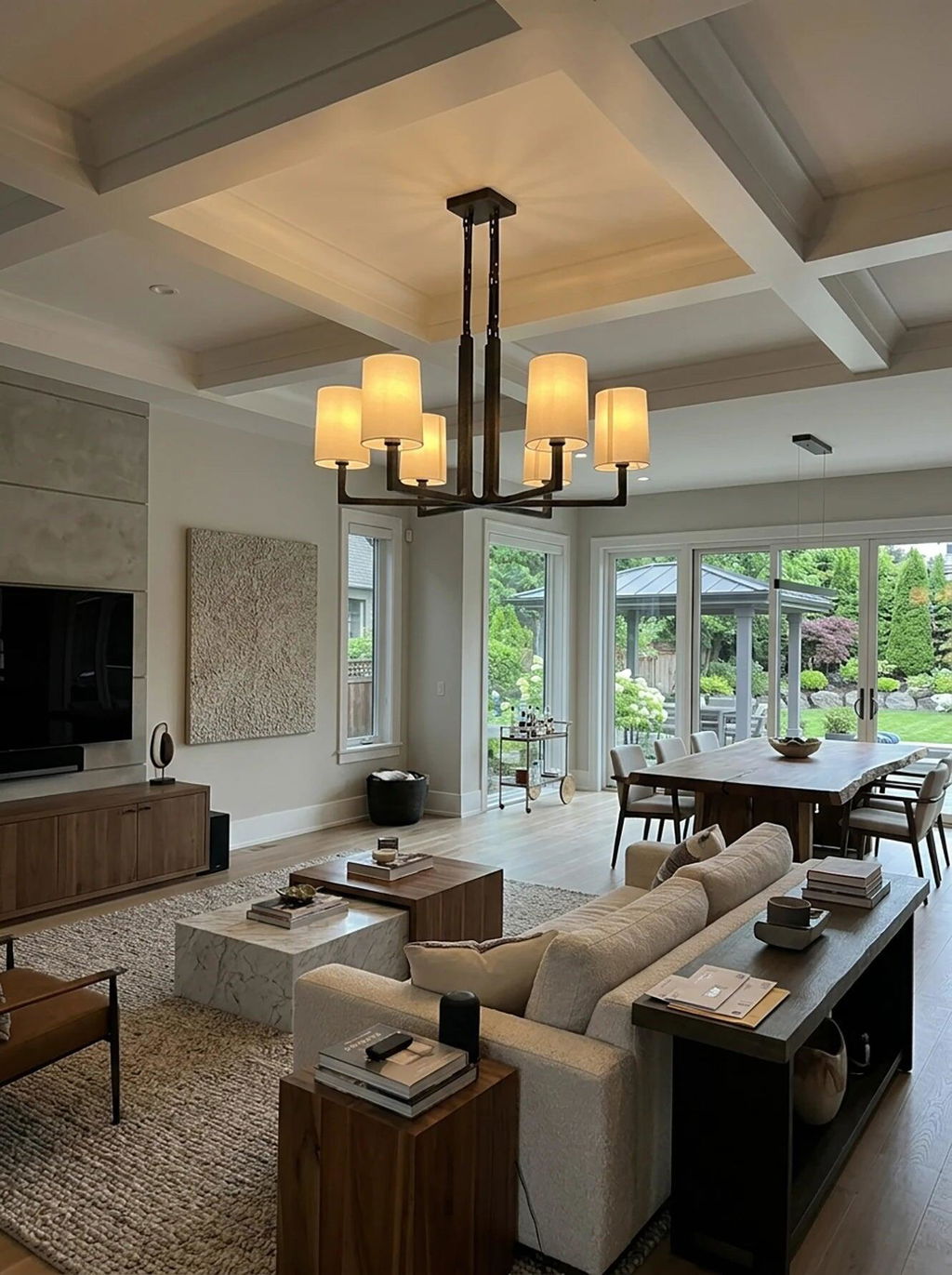
Entries, stairwells, rectangular tables, rooms with stone, glass, steel or strong architectural lines. It answers structure with structure.
Reads larger
Overlapping curves fill visual space generously — a petal fixture looks bigger than its measured diameter. Size down slightly if you are between two options.
weight
Reads lighter
Gaps between tubes let the ceiling show through, so the fixture occupies its diameter without filling it. Size up rather than down; a tube chandelier can be surprisingly modest in place.
Romantic, considered
Reads feminine, warm and slightly historical without pastiche. Sits comfortably in transitional and classically furnished rooms.
Mid-century, graphic
Reads architectural and confidently modern. Belongs with walnut, tan leather, travertine and mid-century silhouettes.
Many small parts
Every petal is a separate piece with its own edges. Dusting takes patience — worth knowing before you hang one over a table you use daily.
with it
Fewer, simpler parts
Tubes are smooth cylinders. A cloth down each one and you are finished, which makes this the easier of the two to keep looking new.
Give two glassmakers the same molten gather and the same brief — make something that hangs from a ceiling and holds light — and they will diverge almost immediately.
One will soften it. Curve it, thin its edges, let gravity pull a lip into shape, and repeat until there are enough pieces to assemble something that looks grown rather than built. The other will discipline it. Draw it into a straight tube, cut the tube square, and set the pieces in a strict arrangement where the interest comes not from any single element but from how the elements are ordered.
Both approaches are ancient and both are still practised by hand. What matters for a room is that they produce fundamentally different light. Curved glass diffuses; straight glass directs. A petal chandelier fills a room with a soft, sourceless warmth. A tube chandelier hangs a constellation of distinct bright points overhead and lets them read individually.
Which is why the useful question isn't which is more beautiful. It is: does your room need to be softened, or does it need to be given structure? Answer that and the choice below makes itself.
Camellia — the curve
Camellia Glass Petal Chandelier
Handmade glass · warm metal frame · three sizesThe Camellia is built from individually formed glass petals, each one pinned to a metal frame and layered against its neighbours so the tiers overlap the way a real bloom's do — densest at the crown, opening as they fall. No two petals are quite the same shape, because a petal is finished by hand while the glass is still soft; the lip is drawn out and allowed to settle rather than pressed to a die.
Unlit it is a piece of sculpture with a pale, botanical quiet to it. Lit, the petals stop being separate objects and become one glowing mass.
That transformation is the whole point of curved glass. Because each petal is thick at the spine and thin at the edge, light passing through it is bent by different amounts across its width — bright at the thin lip, deeper and warmer through the body. Multiply that across every petal and the fixture produces light with no visible origin. You cannot point at where it is coming from, which is precisely what makes a room feel softened rather than lit.
It is a warm-register piece. In a bedroom or a dressing room it does something practical as well as pretty: diffused light arriving from a wide surface is flattering in a way that a small bright source never is. Over a round dining table it reads well from every seat, since a bloom has no front.

- Glass
- Hand-blown petal glass, natural variation piece to piece
- Sizes
- ∅ 26.6″ · ∅ 31.5″ · ∅ 47.2″ — further sizes available to order
- Finish options
- Gold · Nickel
- Bulb
- E12 or E14 · dimmable with a dimmable bulb on a compatible dimmer
- Rod
- Adjustable at installation; extra length available on request
- Wiring
- Hardwired to a junction box — professional installation recommended
- Best in
- Bedroom · dressing room · round dining table · powder room · landing
Addis — the line
Addis Star-Shaped Glass Tubes Chandelier
Handmade glass · polished metal frame · four sizesThe Addis takes the opposite route. Its elements are straight glass tubes — drawn to an even bore, cut square at both ends, and finished with a fine vertical texture that runs the length of the wall. They are mounted in stepped tiers of decreasing radius, and the tiers are offset so that when you stand beneath it the outline resolves into a rounded star. From the side it is a stack of horizons. From below it is a single graphic figure.
The star is not carved into anything. It is what happens when identical parts are arranged with enough precision.
A tube lights differently from a petal, and the difference is easy to see. Glass with parallel walls behaves like a short lens: it takes light in at one end and carries it along its own length, so each tube glows as a discrete bright column with a defined edge. Where the Camellia gives you one soft mass, the Addis gives you dozens of separate points of light held in formation — closer in feeling to a constellation than to a cloud. The vertical texture on the outer wall breaks the surface just enough to add sparkle without turning it into a crystal fixture.
That crispness is what makes it an architectural piece rather than a romantic one. It suits a rectangular table, a stairwell where you see it from two levels, or an entry where the first thing a guest should register is that the house has been considered. It also handles a cool palette that would defeat a warm curved fixture: stone, steel, glazing, black joinery.

- Glass
- Hand-blown textured glass tubes, cut and finished by hand
- Sizes
- ∅ 11″ · ∅ 25.6″ · ∅ 31.5″ · ∅ 41.3″ — further sizes available to order
- Finish options
- Gold · Nickel
- Bulb
- E12 or E14 · dimmable with a dimmable bulb on a compatible dimmer
- Rod
- Adjustable at installation; suits sloped ceilings
- Wiring
- Hardwired to a junction box — professional installation recommended
- Best in
- Dining room · entry · stairwell · living room · rectangular table
Blown by hand, five stages deep
Every petal on the Camellia and every tube on the Addis is hand-blown — gathered molten on the end of a hollow steel pipe, inflated by breath, and shaped with hand tools while the glass is still soft enough to move. Not pressed cold in a die. Not moulded from acrylic. Not printed with a surface pattern.
It is the oldest way to make a hollow glass object and still the only one that leaves a human record in the material. For a light fixture that matters more than it would for a vase: every mark a hand leaves in hot glass becomes visible the moment a bulb goes on behind it. Pressed glass gives an even, anonymous glow. Hand-blown glass gives something that changes as you walk past it.

The gather
A preheated blowpipe is dipped into the furnace and turned steadily to collect an even mass of molten glass — the gather. The rotation is not for show; stop turning and gravity pulls the glass off-centre within seconds. Colour enters here, worked into the body of the molten batch rather than applied to a finished surface. It is why tinted glass deepens where it thickens.
Marvering, and the first breath
The gather is rolled across a marver — a flat steel table — which chills the outer skin and sets the starting cylinder. Then the first puff of air opens a cavity inside. Thin glass cools faster than thick glass, so the wall regulates itself as it inflates, which is how a blown shade holds an even thickness without ever being machined to one.
Where the two pieces part ways
This is the stage that decides everything. For the Camellia, the form is opened, curved and split into petals, each lip drawn out by hand and allowed to relax where it wants to. For the Addis, the form is drawn long into a tube of even bore and rolled against a textured surface to lay in the fine vertical grain. Between steps both return to a reheating furnace — the glory hole — because glass stays workable only inside a narrow band of heat.
Cutting and cold work
Petals and tubes are cut from the blown form, then every edge is ground and smoothed by hand. On the Addis this step is doing double duty: a cleanly finished tube end catches light and draws a bright line, which is a real part of how that fixture reads once lit.
Annealing — the stage nobody photographs
Finished glass goes into a lehr, a temperature-controlled cooling oven, and comes down slowly over hours. Rushed, the outside sets before the inside and locks permanent stress into the piece — glass that leaves the factory intact and then fails in transit or on the ceiling. This is the least glamorous stage of glassmaking and the one that decides whether a chandelier lasts.
What this means for the piece you receive
Hand-blown glass carries real tolerance. Expect small differences in wall thickness, tint depth and texture path between elements — and more variation than a machine-pressed part would ever show. Silhouette, dimensions, finish and colour family are held consistent; individual pieces are not. It is the reason two Camellias lit side by side never look identical, and it is the material behaving exactly as it should rather than a fault.
Choose from a variety of glass tints, or select your own custom shade.
Because colour goes into the glass while it is molten, a hand-blown range can be tinted to almost anything. The tones below are the ones held in regular production. Availability varies by design — not every fixture is stocked in every colour, but either piece can be made in any of them, and in tones outside the range as well.
Worth knowing how tint interacts with these two forms. On the Camellia, a warm tone such as blush or amber compounds the softness and is the reason it reads romantic. On the Addis, clear and smoke keep the geometry legible, while a strong warm tint will pull it away from architectural and toward decorative. Pick the colour after you have picked the form, not before.

Screen colour is indicative only. Tinted glass reads deeper where the piece is thicker, so the same tone looks stronger on a petal spine than on a petal lip. Ask us for a photograph of the actual colour under a warm bulb before you commit.
Send whatever you have
A product link, a photograph, a screenshot, or a sketch on paper. Add the dimensions you need — width, depth, height — plus glass tone, metal finish and your ceiling height. A hand-drawn sketch is enough; our team works from far less every week.
We draw it before we build it
A detailed drawing or plan is prepared for your approval, so proportion, light count and drop length are settled on paper first. Nothing enters production until you have signed off on that drawing — which is also the point at which we will tell you if a proportion won't work in your room.
Confirm, then produce
Once the drawing is approved the order is confirmed and the piece is made to it. Because both designs are hand-blown from the start, a change of size or colour is a change of specification, not a special process — which is why custom work here does not carry the lead times it would at a factory built around moulds.
What can change
Diameter and height · glass tone · metal finish · number of lights · rod or chain length. Style variations within the same series are possible too, and if the design you want isn't on the site at all, send the idea. Write to support@vidirlighting.com to start.
If your room is this, take that

Sizing, without guessing
| Application | Rule | Worked example |
|---|---|---|
| Open room | Add room length + width in feet; read the sum as inches | 14 ft × 16 ft → 30 in diameter |
| Round table | Two thirds to three quarters of the table diameter | 48 in table → 32–36 in fixture |
| Rectangular table | One quarter to one half the width; one third to two thirds the length | 40 × 96 in table → 10–20 in × 32–64 in |
| Fixture height | Ceiling height in feet × 2.5 to 3, read as inches | 9 ft ceiling → 23–27 in tall |
| Above a table | Lowest point 30–36 in above the tabletop | Add ~3 in per foot of ceiling above 8 ft |
| Any walkway | Minimum 7 ft floor clearance to the lowest point | Non-negotiable — check before ordering |
Two adjustments specific to these pieces: size the Camellia down a step if you are between options, because overlapping curves read larger than they measure. Size the Addis up a step, because the gaps between tubes let it read lighter than its diameter suggests.
What each one wants around it

Before you order either

Is the glass genuinely hand-blown?
Yes — both pieces come from our handmade glass series. Each petal and each tube is gathered molten, inflated by breath and finished by hand rather than stamped cold from a die. That is why the two look so different from one another: a hand-finished lip settles into its own shape, and a hand-drawn tube carries a texture no mould would repeat exactly.
It also means expect variation. Wall thickness, tint depth and texture path differ slightly between elements. Silhouette, dimensions, finish and colour family are held consistent; individual pieces are not, and that is the material behaving as it should.
Which gives more light?
For the same bulb count, the Addis puts more usable light into a room. Tubes direct light along their length with little loss, whereas curved petal glass diffuses in every direction — beautiful, but a proportion of it ends up washing the fixture itself rather than the room.
Neither is task lighting. Plan both as the ambient layer and add downlights, table lamps or under-cabinet light wherever you actually need to see detail.
How high should it hang?
Over a table, the lowest point sits 30–36 in (75–90 cm) above the tabletop, and you can go lower than instinct suggests because nobody walks underneath. In any walkway or open area, keep 7 ft (2.1 m) of clearance from the floor. In an open room, allow roughly 2.5–3 in of drop per foot of ceiling height. Above 8 ft, add about 3 in of hang height per additional foot.
Rods are adjustable at installation on both pieces, and extra length can be supplied — tell us your ceiling height when you order rather than after.
Can I change the size, glass colour or number of lights?
Yes. Diameter, height, glass tone, metal finish, light count, and rod or chain length can all be specified. Send the dimensions you need — width, depth, height — along with a photo of the space, and a drawing is prepared for your approval before anything is built.
Because both pieces are hand-blown from the start, a change of size or colour is a change of specification, not a special process.
Will my ceiling take the weight?
Check before ordering, not after. Confirm that the junction box is rated for the fixture's weight and that there is structural support above it — a standard box carries far less than most people assume, and a multi-tier glass fixture may need a brace or a heavier-rated box. Your electrician can confirm in minutes. Net and shipping weights are available on request for either piece.
Are they suitable for a sloped ceiling?
The Addis is, because a tiered fixture hanging from a single point stays level regardless of the ceiling plane above it — a sloped-ceiling adapter is all that is required. The Camellia depends on the size and the angle; send us the pitch and we will confirm. Neither should be mounted flush to a sloped surface.
How do I clean them?
A soft dry cloth for dust, barely damp for marks, and always with the fixture switched off and the bulbs cold. Avoid solvents, abrasive pads and household glass sprays containing ammonia. On the Addis, wipe down the length of each tube. On the Camellia, work outward from the crown and support each petal with one hand while you clean it — the layered edges are where dust collects and also where impatience causes chips.
What happens if glass arrives broken?
Every element is individually wrapped and seated in protective foam, with metalwork boxed separately. In the rare case something arrives damaged, send photographs within 24 hours of delivery and the affected part or fixture is replaced. Spare petals and tubes are held for both pieces, so a single broken element does not mean returning the whole chandelier.
Soften the room, or give it structure.
There is no third option, and there is no wrong answer — only the one that agrees with what your room already is.
Undecided? Send your ceiling height, table or room dimensions and a photo of the space to support@vidirlighting.com