See It In Motion
Watch the Light Come to Life
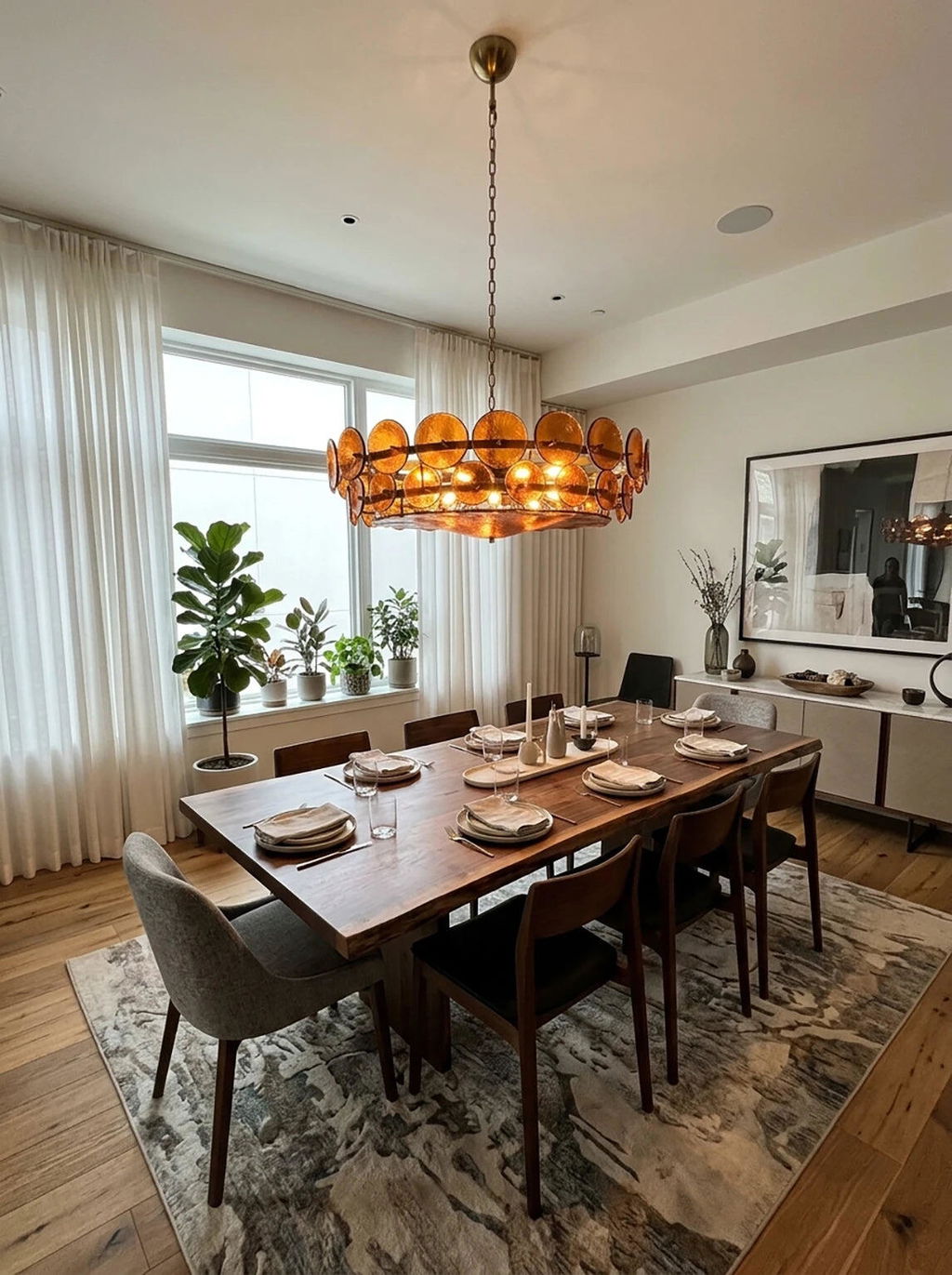
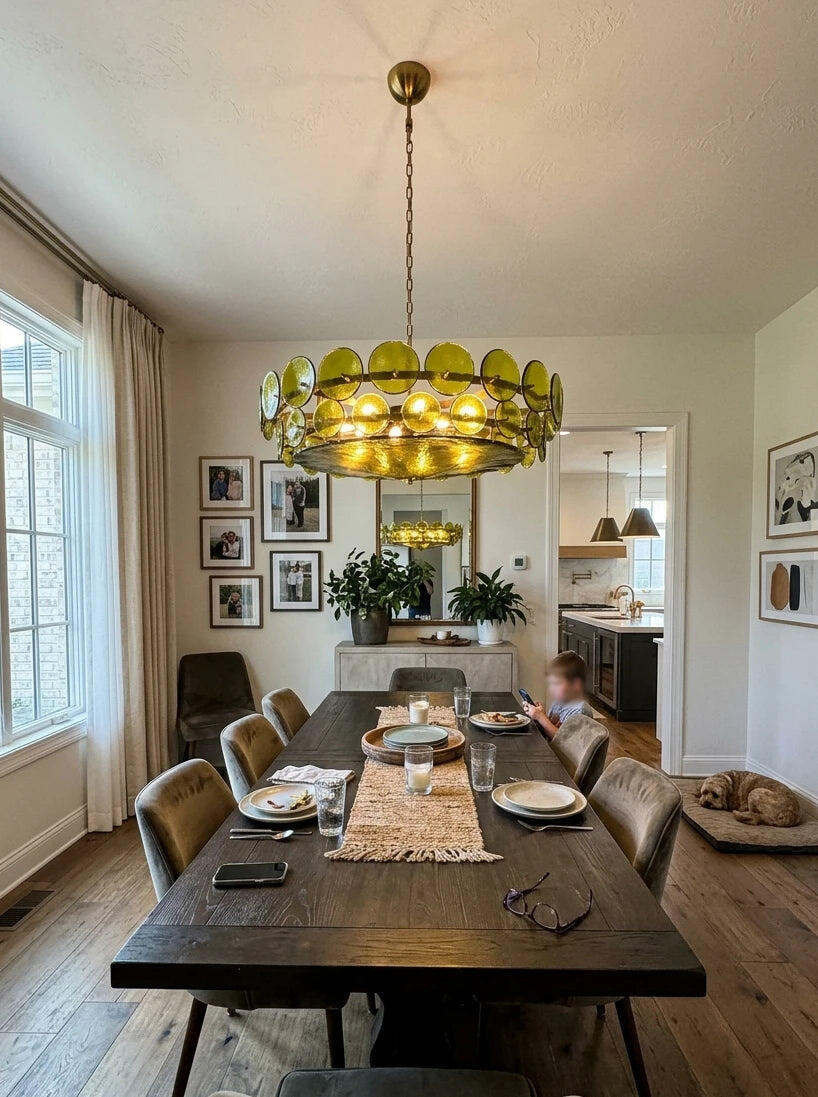
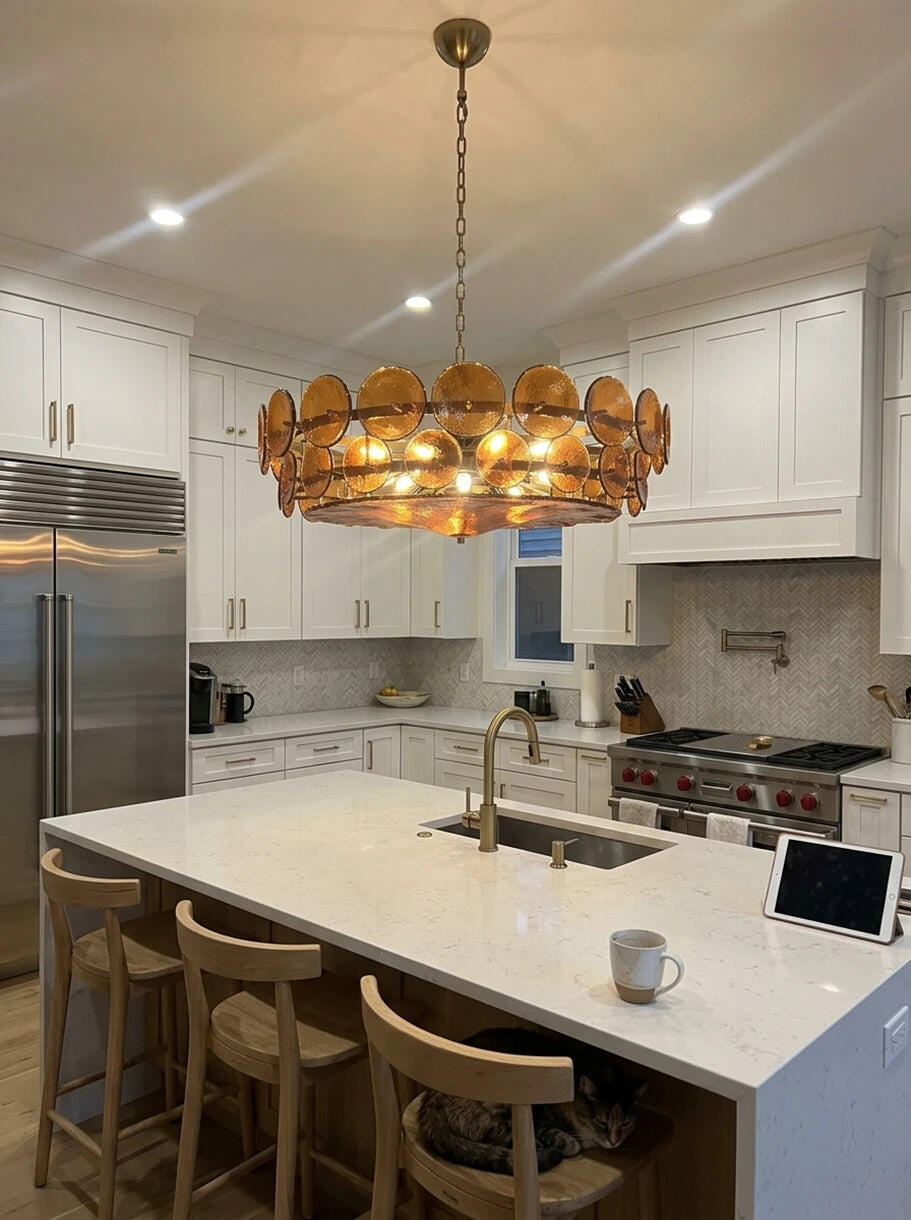
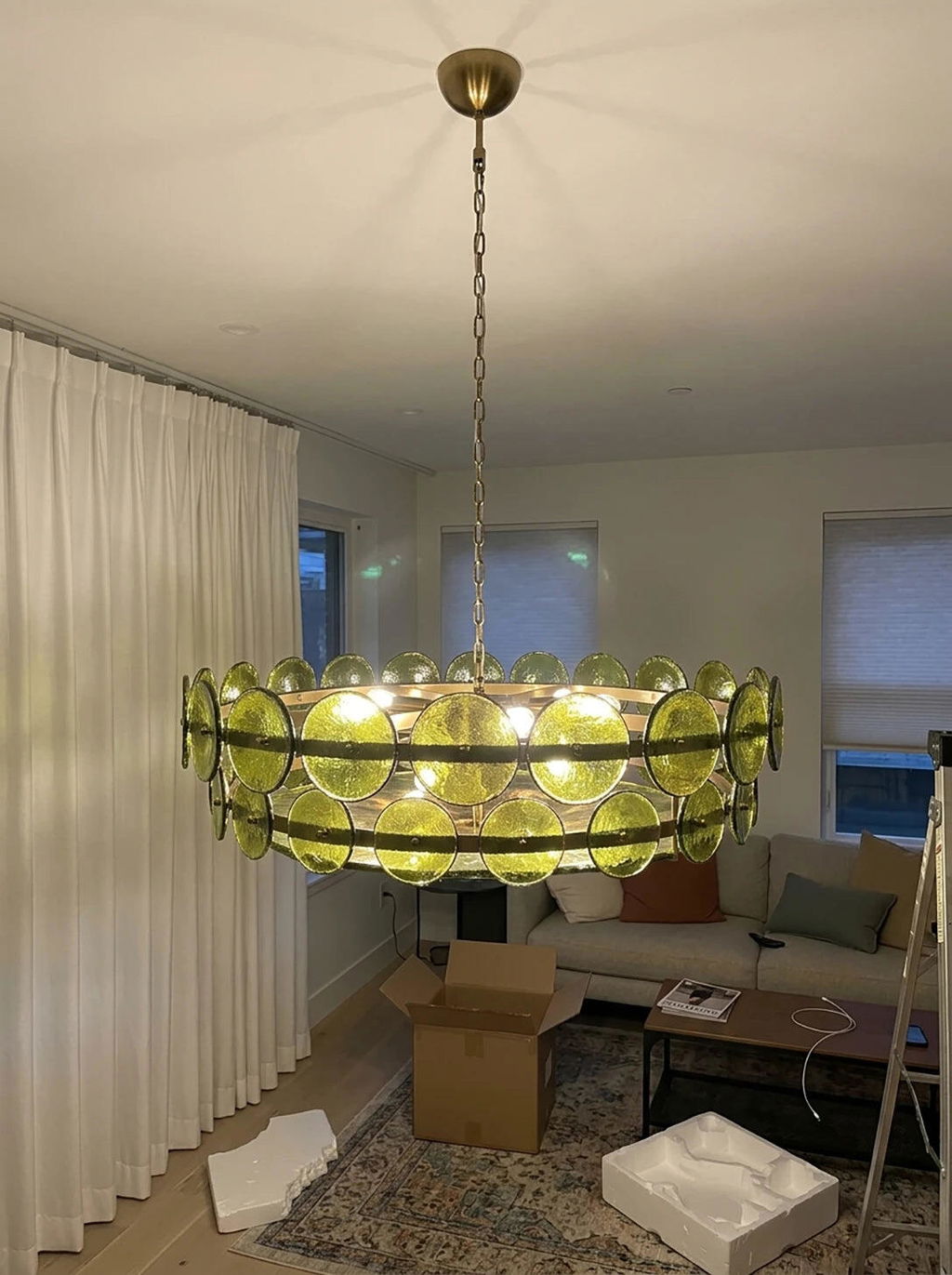
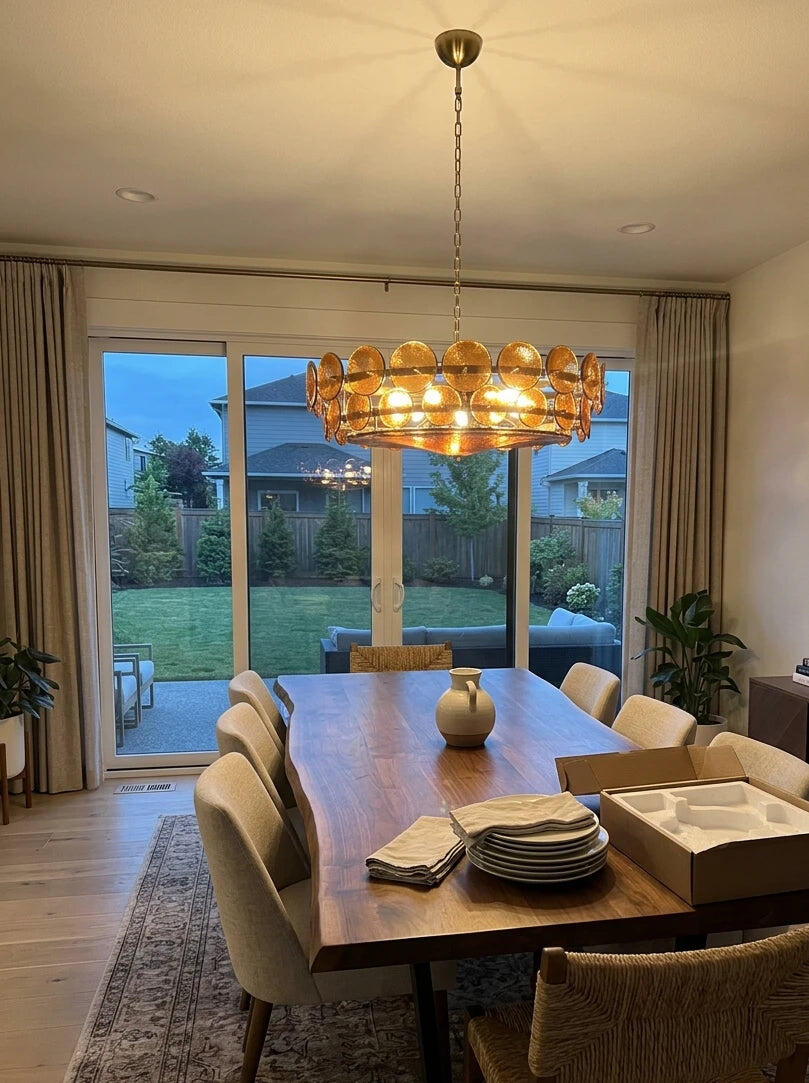
The Ivor Discus Glass Ring Chandelier sets hand-textured glass discs in two rings around a Gold-tone frame — each one a shallow dish, turned outward, with a wide diffuser bowl closing the fixture underneath.
The discs are not shades. They are reflectors. The light sits behind them on the frame, so each disc catches it on its inner face and throws it back out into the room. What you see from across a room is a ring of small lit dishes rather than a bulb behind coloured glass — and the colour reads as depth, because you are looking at light that has bounced rather than light that has passed straight through.
Underneath, a single wide bowl of textured glass does the opposite job. It collects the light that goes downward and spreads it across a table or a floor, soft and even, with nothing to look into. So the fixture works on two levels at once: discs throwing colour outward at eye height, a bowl pouring warm light down.
The Details
Good to Know
Two disc sizes, and one bowl that never changes
Every version uses two sizes of disc — ∅ 4.7″ and ∅ 5.5″ — set in two rings, which is what stops the ring reading as a flat band of identical circles. The larger discs catch the light head-on while the smaller ones hold it at a slant, so walking past changes what you see.
The diffuser bowl underneath is ∅ 17.3″ on all three sizes. That is worth knowing if you are choosing the smallest: the downward light is not scaled down with the fixture, so the ∅ 23.6″ version still pours the same generous pool onto a table.
Hand-textured glass varies disc to disc
The surface of every disc is worked by hand, so the depth of the texture and the saturation of the colour differ slightly from one to the next. The piece you receive will not match the photographs exactly — silhouette, dimensions, finish and colour family stay consistent, individual discs do not. From across the room the ring reads as one form; stand close and every disc is its own.
Which Size for Your Space
Three diameters, and the count of glass tells you more than the inches do — twenty-five discs at the smallest, forty-one at the largest. Every version is shallow for its width, so going larger costs you almost nothing in headroom.

Sizing Tip
For a round table, select a diameter that is two-thirds to three-quarters of the table's width. If the table is in an open-plan room, add the length and width (in feet) together and convert the sum into inches.
One thing that argues for the smallest, and nobody else will tell you: the diffuser bowl underneath is ∅ 17.3 in on every version. The downward light is not scaled down with the fixture, so the ∅ 23.6 in still pours the same generous pool onto a table as the ∅ 39.4 in does. What you gain by going larger is the ring — more discs, more reflected colour, more presence in the room.
Shaped by Breath & Fire, Not a Machine
Every ribbed glass tube is shaped by hand — which is exactly why the light looks the way it does.

Ribs That Catch the Light
Shaped by hand, the fluted ribs bend and scatter every beam, casting rippling patterns of light and shadow across your walls — a texture flat glass can't reproduce.
Depth & Clarity
The glass carries a substantial, thick-walled clarity with real depth — it refracts a soft glow even in daylight, never the thin, hollow look of acrylic.
Made, Not Manufactured
Every ribbed tube carries the trace of a maker's hand and breath — an artisan piece, not a molded copy stamped out by the thousand.
A Ring That Performs, a Bowl That Works
Two rings of hand-textured discs turned outward, and a single wide diffuser underneath doing an entirely different job.
Two Jobs, Two Sets of Glass
Most chandeliers ask the same glass to look good and to light a table, and one of the two ends up compromised. This one splits the work. The discs face outward and hold the light on their faces — that is what you see from across a room. The bowl underneath faces straight down and spreads a wide, even pool onto whatever is beneath it. Show above, work below.
Two Disc Sizes, Staggered
Every version uses two sizes of disc in equal numbers, set in two rings rather than one — larger above, smaller below, offset from each other. That is what stops the ring reading as a band of identical circles: some discs catch the light head-on while others hold it at a slant, so walking past changes what you are looking at. The hammered surface does the rest, breaking what each one holds into dozens of small bright points rather than one flat sheen.
Amber or Olive, Two Different Rooms
Amber warms everything it touches and pushes a room toward evening — the safer choice, and the one that suits oak, cream and warm stone. Olive green is the rarer decision: cooler, stranger, and almost nobody in lighting makes it, which is precisely why a room with one in it does not look like anyone else's. Both sit on the same brushed gold frame, and in both the colour pools dark where the glass runs thick and lifts almost clear at the centre, so every disc carries its own gradient.
— Hand-textured glass, set in two rings on brushed gold —
Textured by Hand, Not by Machine
Most coloured glass discs on the market are pressed in a mould, a thousand at a time. Here is what changes when the texture is worked in by hand instead — including the one thing pressed glass does better.
Common Questions
Will mine look exactly like the photographs?
Very close, but not identical — and that is the point of hand-worked glass. The texture and the depth of colour vary slightly from disc to disc, so no two fixtures leave the workshop the same.
What stays consistent: the size, the shape, the finish and the colour family. What varies: the individual discs. From across a room the ring reads as one form; stand underneath and every disc is its own.
How bright is it?
Nine, twelve or sixteen bulbs depending on size — a generous number, and a necessary one, because coloured glass absorbs light as well as colouring it. Fitted with warm-white bulbs, any of the three lights a dining room comfortably as the main fixture.
The wide bowl underneath does most of the practical work: it spreads an even pool downward with no bright spot and nothing to look into. The discs around the ring are what you see rather than what you read by.
Amber or olive green?
What bulbs does it take?
Can it be dimmed?
Which size should I choose?
Will my ceiling take the weight?
How do I clean it?
A soft dry cloth for dust, barely damp for marks, wiping each disc and the bowl underneath. Work from the top down so dust falls away from what you have already cleaned. Avoid scouring pads and ammonia sprays — the hammered surface holds residue.
Switch off and let the bulbs cool completely first. Once or twice a year is plenty.
Ivor Discus Glass Ring Chandelier
The price includes tax, and free standard shipping within the U.S. is provided.

Free Shipping on all orders
Hassle-free return within 30 days
Payment Security
Pairs Well With
See It In Motion
Watch the Light Come to Life
The Ivor Discus Glass Ring Chandelier sets hand-textured glass discs in two rings around a Gold-tone frame — each one a shallow dish, turned outward, with a wide diffuser bowl closing the fixture underneath.
The discs are not shades. They are reflectors. The light sits behind them on the frame, so each disc catches it on its inner face and throws it back out into the room. What you see from across a room is a ring of small lit dishes rather than a bulb behind coloured glass — and the colour reads as depth, because you are looking at light that has bounced rather than light that has passed straight through.
Underneath, a single wide bowl of textured glass does the opposite job. It collects the light that goes downward and spreads it across a table or a floor, soft and even, with nothing to look into. So the fixture works on two levels at once: discs throwing colour outward at eye height, a bowl pouring warm light down.
The Details
Good to Know
Two disc sizes, and one bowl that never changes
Every version uses two sizes of disc — ∅ 4.7″ and ∅ 5.5″ — set in two rings, which is what stops the ring reading as a flat band of identical circles. The larger discs catch the light head-on while the smaller ones hold it at a slant, so walking past changes what you see.
The diffuser bowl underneath is ∅ 17.3″ on all three sizes. That is worth knowing if you are choosing the smallest: the downward light is not scaled down with the fixture, so the ∅ 23.6″ version still pours the same generous pool onto a table.
Hand-textured glass varies disc to disc
The surface of every disc is worked by hand, so the depth of the texture and the saturation of the colour differ slightly from one to the next. The piece you receive will not match the photographs exactly — silhouette, dimensions, finish and colour family stay consistent, individual discs do not. From across the room the ring reads as one form; stand close and every disc is its own.
Which Size for Your Space
Three diameters, and the count of glass tells you more than the inches do — twenty-five discs at the smallest, forty-one at the largest. Every version is shallow for its width, so going larger costs you almost nothing in headroom.
Sizing Tip
For a round table, select a diameter that is two-thirds to three-quarters of the table's width. If the table is in an open-plan room, add the length and width (in feet) together and convert the sum into inches.
One thing that argues for the smallest, and nobody else will tell you: the diffuser bowl underneath is ∅ 17.3 in on every version. The downward light is not scaled down with the fixture, so the ∅ 23.6 in still pours the same generous pool onto a table as the ∅ 39.4 in does. What you gain by going larger is the ring — more discs, more reflected colour, more presence in the room.
Shaped by Breath & Fire, Not a Machine
Every ribbed glass tube is shaped by hand — which is exactly why the light looks the way it does.
Ribs That Catch the Light
Shaped by hand, the fluted ribs bend and scatter every beam, casting rippling patterns of light and shadow across your walls — a texture flat glass can't reproduce.
Depth & Clarity
The glass carries a substantial, thick-walled clarity with real depth — it refracts a soft glow even in daylight, never the thin, hollow look of acrylic.
Made, Not Manufactured
Every ribbed tube carries the trace of a maker's hand and breath — an artisan piece, not a molded copy stamped out by the thousand.
A Ring That Performs, a Bowl That Works
Two rings of hand-textured discs turned outward, and a single wide diffuser underneath doing an entirely different job.
Two Jobs, Two Sets of Glass
Most chandeliers ask the same glass to look good and to light a table, and one of the two ends up compromised. This one splits the work. The discs face outward and hold the light on their faces — that is what you see from across a room. The bowl underneath faces straight down and spreads a wide, even pool onto whatever is beneath it. Show above, work below.
Two Disc Sizes, Staggered
Every version uses two sizes of disc in equal numbers, set in two rings rather than one — larger above, smaller below, offset from each other. That is what stops the ring reading as a band of identical circles: some discs catch the light head-on while others hold it at a slant, so walking past changes what you are looking at. The hammered surface does the rest, breaking what each one holds into dozens of small bright points rather than one flat sheen.
Amber or Olive, Two Different Rooms
Amber warms everything it touches and pushes a room toward evening — the safer choice, and the one that suits oak, cream and warm stone. Olive green is the rarer decision: cooler, stranger, and almost nobody in lighting makes it, which is precisely why a room with one in it does not look like anyone else's. Both sit on the same brushed gold frame, and in both the colour pools dark where the glass runs thick and lifts almost clear at the centre, so every disc carries its own gradient.
— Hand-textured glass, set in two rings on brushed gold —
Textured by Hand, Not by Machine
Most coloured glass discs on the market are pressed in a mould, a thousand at a time. Here is what changes when the texture is worked in by hand instead — including the one thing pressed glass does better.
Common Questions
Will mine look exactly like the photographs?
Very close, but not identical — and that is the point of hand-worked glass. The texture and the depth of colour vary slightly from disc to disc, so no two fixtures leave the workshop the same.
What stays consistent: the size, the shape, the finish and the colour family. What varies: the individual discs. From across a room the ring reads as one form; stand underneath and every disc is its own.
How bright is it?
Nine, twelve or sixteen bulbs depending on size — a generous number, and a necessary one, because coloured glass absorbs light as well as colouring it. Fitted with warm-white bulbs, any of the three lights a dining room comfortably as the main fixture.
The wide bowl underneath does most of the practical work: it spreads an even pool downward with no bright spot and nothing to look into. The discs around the ring are what you see rather than what you read by.
Amber or olive green?
What bulbs does it take?
Can it be dimmed?
Which size should I choose?
Will my ceiling take the weight?
How do I clean it?
A soft dry cloth for dust, barely damp for marks, wiping each disc and the bowl underneath. Work from the top down so dust falls away from what you have already cleaned. Avoid scouring pads and ammonia sprays — the hammered surface holds residue.
Switch off and let the bulbs cool completely first. Once or twice a year is plenty.