


A new perspective
Light changes everything
Discover sculptural lighting designed to bring warmth, character, and atmosphere to every room.
Free standard shipping, all orders support 30-day returns
The Special Sale: a hand-picked edit for the darker months. Ends November 2


Verena Stacked Alabaster Column Floor Lamp. The shade is built from a stack of alabaster rings, each one slightly proud of the next, so the whole column has a ribbed, coiled profile — like a rope wound around itself, or a column left unfinished on purpose. The second is the stone itself. Every ring is cut from quarried alabaster, and because they are separate pieces, the veining changes as it climbs — dense caramel in one band, pale and nearly translucent in the next. Unlit, in daylight, it reads as carved architecture: a pale fluted column on a dark stem. Lit, the veins surface like ink in water and each ring glows a little differently from the one below.
The stem is the counterweight to all that texture. Slim, dark bronze, deliberately plain — a fluted rod on a low round base, and nothing else. Against a pale wall the metal recedes and the lit column appears to float. That contrast is the whole composition: a quiet dark line, and one bright thing at the top of it.
No two pieces of stone are ever the same
Alabaster is a natural stone, so every piece carries its own veining and subtle variation in color. The fixture you receive may therefore differ slightly from the images shown.

No reaching up into a paper shade, no feeling around a wall for a plate that isn't there. The switch sits on the cord, on the floor, where your foot already is.
Which matters more than it sounds on a lamp like this. A tall paper column has nothing you would want to reach into — and because it plugs in rather than wires in, it usually stands somewhere with no wall switch anywhere near it. One tap with your toe, on your way past.
A round pedal switch you can find without looking down — no small rocker to hunt for in the dark, and no need to bend.
Turn it on carrying a cup, a book, or a laundry basket. Nothing to hold, nothing to put down first.
It plugs into any socket and brings its own switch with it — so it works in a corner no wall switch reaches.
The standard fixture runs on an ordinary wall switch. Because the LED is integrated rather than a replaceable bulb, a dimmable version cannot be retrofitted later — not by changing a bulb, and not by changing the switch. It has to be designed dimmable from the start. Tell us when you order and we will build the dimmable version and confirm which dimmer models work with it.

Beside low furniture — a sofa arm, a side table, a low armchair. The lit column sits level with anyone seated, which is why the room feels warm rather than lit from above.
Furniture beside it under 28″ tall
Beside taller furniture — a sofa back, a console, a wingback chair. The extra 4.5″ keeps the whole lit column visible instead of half-hidden behind a cushion.
Furniture beside it 30–36″ tall
Not above your head. Level with your face.
Standard floor lamps are between 58 and 64 inches tall, and nobody ever asks why. The answer is that they were designed to light a book held by someone sitting upright in a wing chair — a posture almost nobody adopts any more. What that height actually does in a modern room is put a bright source above everyone's head, leaving faces in shadow and the ceiling doing the glowing.
This one stops at 49.8″. That is not a smaller version of a floor lamp; it is a different instrument. The lit shade lands at roughly seated eye level, which changes what the light does to a room and to the people in it.
The shade is a single piece of natural alabaster — quarried, not manufactured, so the veining belongs to one block of stone and no other. That matters more at this height than it would overhead. You are not looking up at it from across a room; you are sitting beside it. Unlit, it reads as pale closed stone. Lit, the veins surface like ink in water, and at eighteen inches from your shoulder you can see every one of them.
The body is brass, kept deliberately slender. A wide base and a heavy stem would make this a piece of furniture; a narrow one at 7.9″ across slips between a sofa arm and a wall, where the corner that needs light usually is. And it plugs in — no junction box, no electrician, and it moves with you when the room does.
The things people ask before they order.
Every plate is different, so the one that arrives won't match these photographs exactly. That is what real stone does.
If you want it paler and more even, or with more grey movement, or warmer in tone — tell us before you order and we'll select the stone to suit. Send a photo of your room and we'll pick something that sits with it.
What we can't do is copy a picture. We can choose a direction, not reproduce a pattern. Email support@vidirlighting.com

Not sure how to wire it, how high to hang it, or whether you need an electrician? Our full guide walks through every step for US homes.
Switch off at the breaker and confirm before you touch any wiring.
Make sure your junction box is standard, secure, and rated for the weight.
Black to black, white to white, ground to ground — the US standard explained.
Mounting heights and clearances for sconces, pendants, and chandeliers.


The same stacked rings, brought down to table height. Close enough that you see every seam and every change in the veining — which is where this construction is most worth looking at.
Choose this if you have a console, sideboard or nightstand and no floor to spare.

The column on the wall instead of the floor. It takes no floor space at all, which is what a narrow hallway or a tight bedside actually needs — and a pair reads as architecture rather than as two lamps.
Choose this if the floor is full, or you want a matched pair either side of a bed or mirror.
The price includes tax, and free standard shipping within the U.S. is provided.

Free Shipping on all orders
Hassle-free return within 30 days
Payment Security
Verena Stacked Alabaster Column Floor Lamp. The shade is built from a stack of alabaster rings, each one slightly proud of the next, so the whole column has a ribbed, coiled profile — like a rope wound around itself, or a column left unfinished on purpose. The second is the stone itself. Every ring is cut from quarried alabaster, and because they are separate pieces, the veining changes as it climbs — dense caramel in one band, pale and nearly translucent in the next. Unlit, in daylight, it reads as carved architecture: a pale fluted column on a dark stem. Lit, the veins surface like ink in water and each ring glows a little differently from the one below.
The stem is the counterweight to all that texture. Slim, dark bronze, deliberately plain — a fluted rod on a low round base, and nothing else. Against a pale wall the metal recedes and the lit column appears to float. That contrast is the whole composition: a quiet dark line, and one bright thing at the top of it.
No two pieces of stone are ever the same
Alabaster is a natural stone, so every piece carries its own veining and subtle variation in color. The fixture you receive may therefore differ slightly from the images shown.
No reaching up into a paper shade, no feeling around a wall for a plate that isn't there. The switch sits on the cord, on the floor, where your foot already is.
Which matters more than it sounds on a lamp like this. A tall paper column has nothing you would want to reach into — and because it plugs in rather than wires in, it usually stands somewhere with no wall switch anywhere near it. One tap with your toe, on your way past.
A round pedal switch you can find without looking down — no small rocker to hunt for in the dark, and no need to bend.
Turn it on carrying a cup, a book, or a laundry basket. Nothing to hold, nothing to put down first.
It plugs into any socket and brings its own switch with it — so it works in a corner no wall switch reaches.
The standard fixture runs on an ordinary wall switch. Because the LED is integrated rather than a replaceable bulb, a dimmable version cannot be retrofitted later — not by changing a bulb, and not by changing the switch. It has to be designed dimmable from the start. Tell us when you order and we will build the dimmable version and confirm which dimmer models work with it.
Beside low furniture — a sofa arm, a side table, a low armchair. The lit column sits level with anyone seated, which is why the room feels warm rather than lit from above.
Furniture beside it under 28″ tall
Beside taller furniture — a sofa back, a console, a wingback chair. The extra 4.5″ keeps the whole lit column visible instead of half-hidden behind a cushion.
Furniture beside it 30–36″ tall
Not above your head. Level with your face.
Standard floor lamps are between 58 and 64 inches tall, and nobody ever asks why. The answer is that they were designed to light a book held by someone sitting upright in a wing chair — a posture almost nobody adopts any more. What that height actually does in a modern room is put a bright source above everyone's head, leaving faces in shadow and the ceiling doing the glowing.
This one stops at 49.8″. That is not a smaller version of a floor lamp; it is a different instrument. The lit shade lands at roughly seated eye level, which changes what the light does to a room and to the people in it.
The shade is a single piece of natural alabaster — quarried, not manufactured, so the veining belongs to one block of stone and no other. That matters more at this height than it would overhead. You are not looking up at it from across a room; you are sitting beside it. Unlit, it reads as pale closed stone. Lit, the veins surface like ink in water, and at eighteen inches from your shoulder you can see every one of them.
The body is brass, kept deliberately slender. A wide base and a heavy stem would make this a piece of furniture; a narrow one at 7.9″ across slips between a sofa arm and a wall, where the corner that needs light usually is. And it plugs in — no junction box, no electrician, and it moves with you when the room does.
The things people ask before they order.
Every plate is different, so the one that arrives won't match these photographs exactly. That is what real stone does.
If you want it paler and more even, or with more grey movement, or warmer in tone — tell us before you order and we'll select the stone to suit. Send a photo of your room and we'll pick something that sits with it.
What we can't do is copy a picture. We can choose a direction, not reproduce a pattern. Email support@vidirlighting.com
Not sure how to wire it, how high to hang it, or whether you need an electrician? Our full guide walks through every step for US homes.
Switch off at the breaker and confirm before you touch any wiring.
Make sure your junction box is standard, secure, and rated for the weight.
Black to black, white to white, ground to ground — the US standard explained.
Mounting heights and clearances for sconces, pendants, and chandeliers.
The same stacked rings, brought down to table height. Close enough that you see every seam and every change in the veining — which is where this construction is most worth looking at.
Choose this if you have a console, sideboard or nightstand and no floor to spare.
The column on the wall instead of the floor. It takes no floor space at all, which is what a narrow hallway or a tight bedside actually needs — and a pair reads as architecture rather than as two lamps.
Choose this if the floor is full, or you want a matched pair either side of a bed or mirror.

Natural stone lighting

The Vidir lighting edit
Most shades block light and let it out at the edges. Yet, this stone-textured lampshade manages to achieve exactly that.
Alabaster is translucent. Switch it on and the whole shade lights up from within, veining and all, instead of glowing only where the bulb sits. There is no bright spot to look at, because the light source is the entire surface.
The veining was decided underground, long before anyone cut it. Every shade carries its own pattern and its own faint colour shift — so the piece that arrives is not the piece in the photograph, and that is the point.
Resin and acrylic imitations go amber and brittle within a few years of sitting next to a warm bulb. Stone does not age that way. The shade you unpack is the shade you will have in twenty years.
Designed for better living
Use warm white (2700K). The stone itself has an off-white, creamy tone; cool light passing through it makes it look grayish and dingy, whereas warm light brings out that honey-like hue seen in the photos.
Alabaster is a natural stone that absorbs water and cleaning agents, which can leave permanent stains. Disconnect the power, let the bulb cool down, and then wipe the fixture with a soft, dry cloth—do not use water or spray cleaners.
The density of the stone is far greater than that of a glass shade of the same size; ensure the ceiling's load-bearing capacity is sufficient for safety.

A new perspective
Discover sculptural lighting designed to bring warmth, character, and atmosphere to every room.
 Our product
Alabaster Cylindrical Chain Chandelier
Our product
Alabaster Cylindrical Chain Chandelier
Alabaster is translucent, so the light travels through the stone rather than escaping at the edges — the whole shade glows, veining and all. Every piece carries a pattern that was decided underground, which is why no two are alike.
Resin is cast in moulds, so the "veining" repeats from one shade to the next and the light passes through evenly with no depth to it. It also ages differently: sitting close to a warm bulb, resin tends to amber and grow brittle within a few years.
THE ART OF ALABASTER
The natural texture of alabaster brings a warm, mineral quality to the space. (Please contact us if you require a specific texture.)

A pure white texture reminiscent of fresh snow—warm, smooth, and refined.

Deep, inky patterns flow across a white base.

A dynamic pattern resembling a bolt of lightning streaking across the sky.

Fine, intricate cracks evoking the aesthetic beauty of a sheet of ice at the moment it shatters.

A pattern as light and airy as falling snowflakes, with every single flake unique.
Material · Method · Light
Every texture tells a story of natural light and patient craftsmanship.
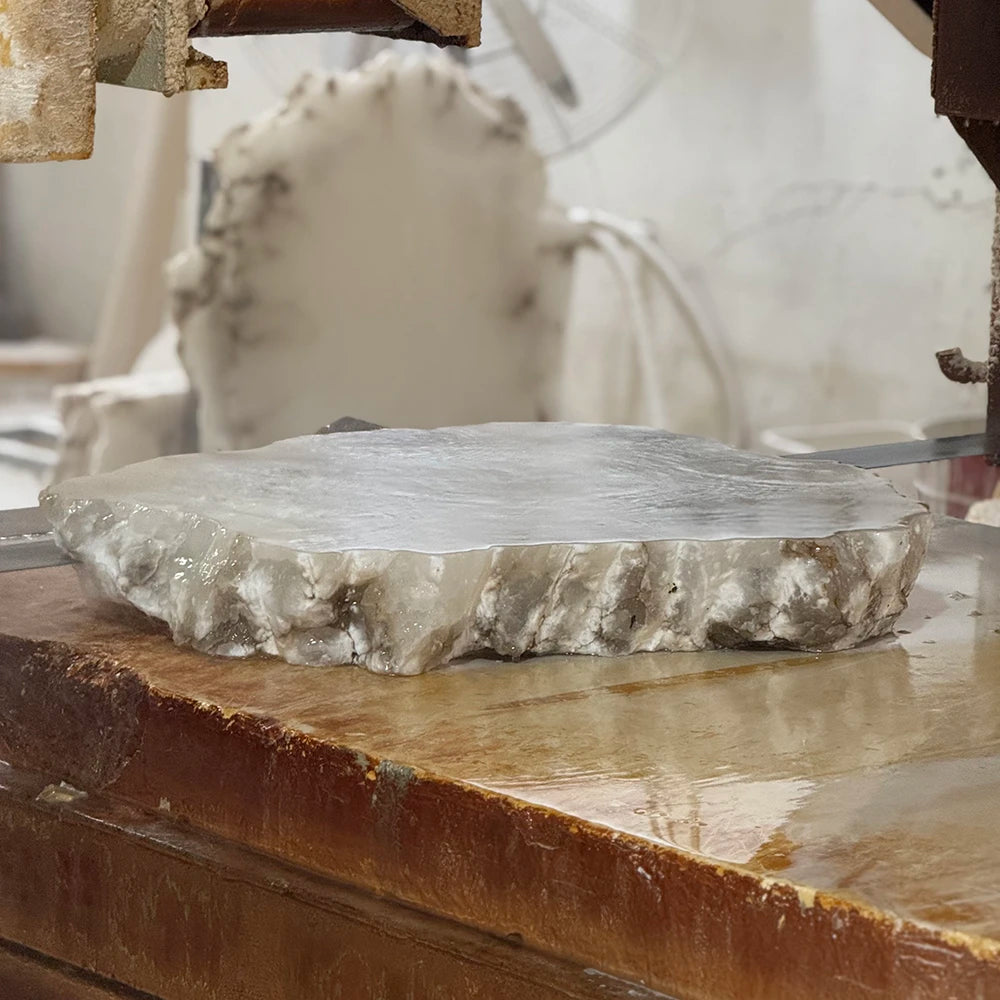
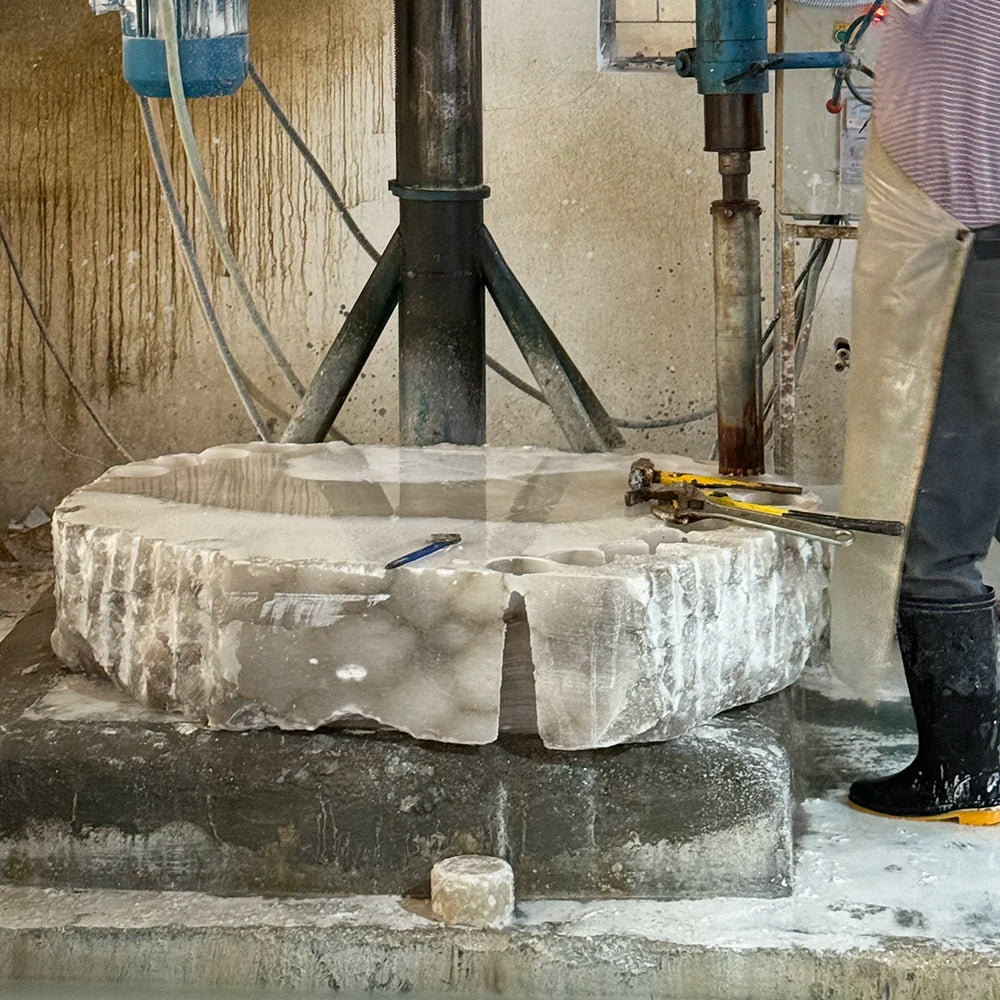
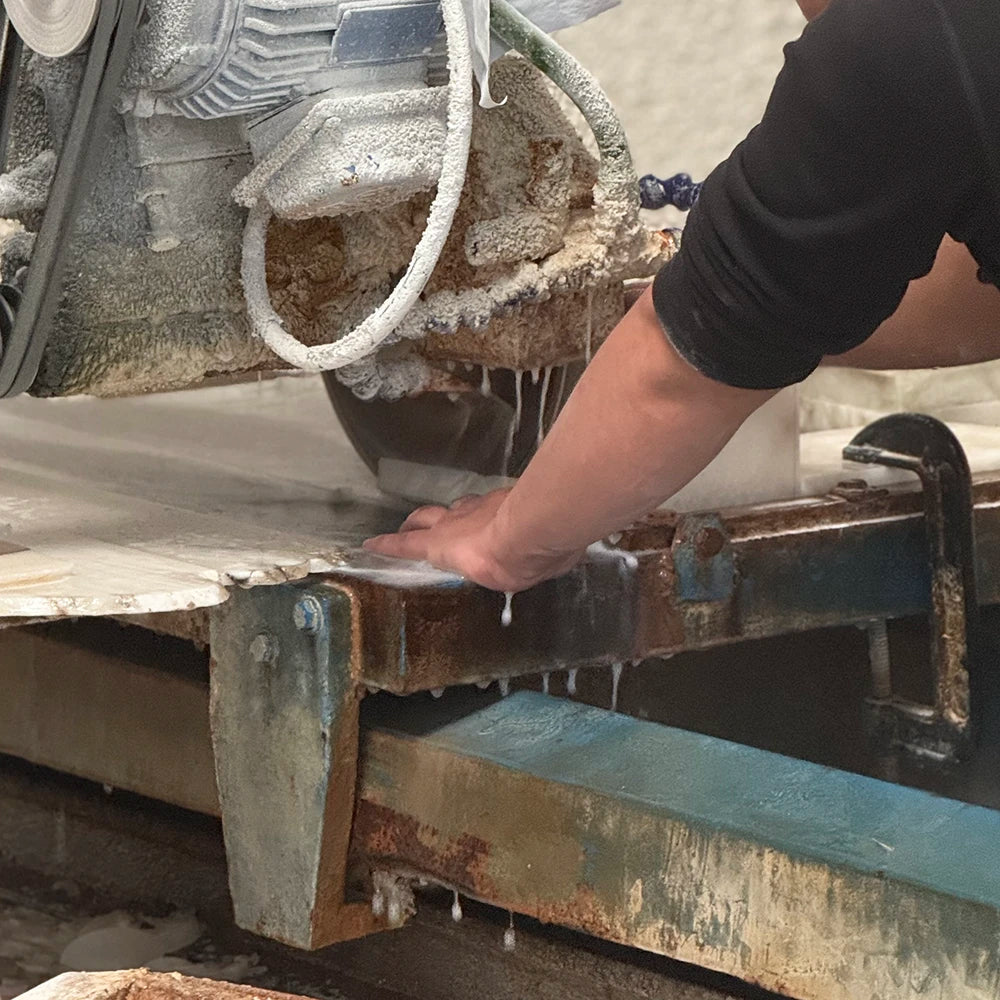
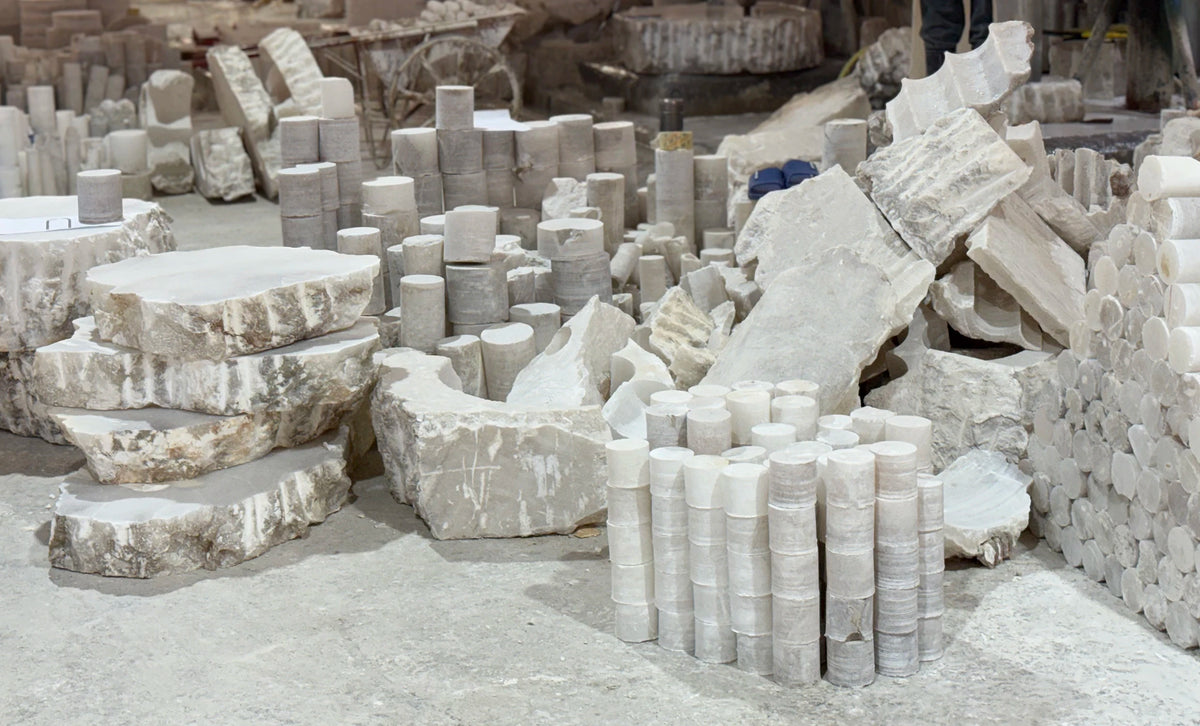
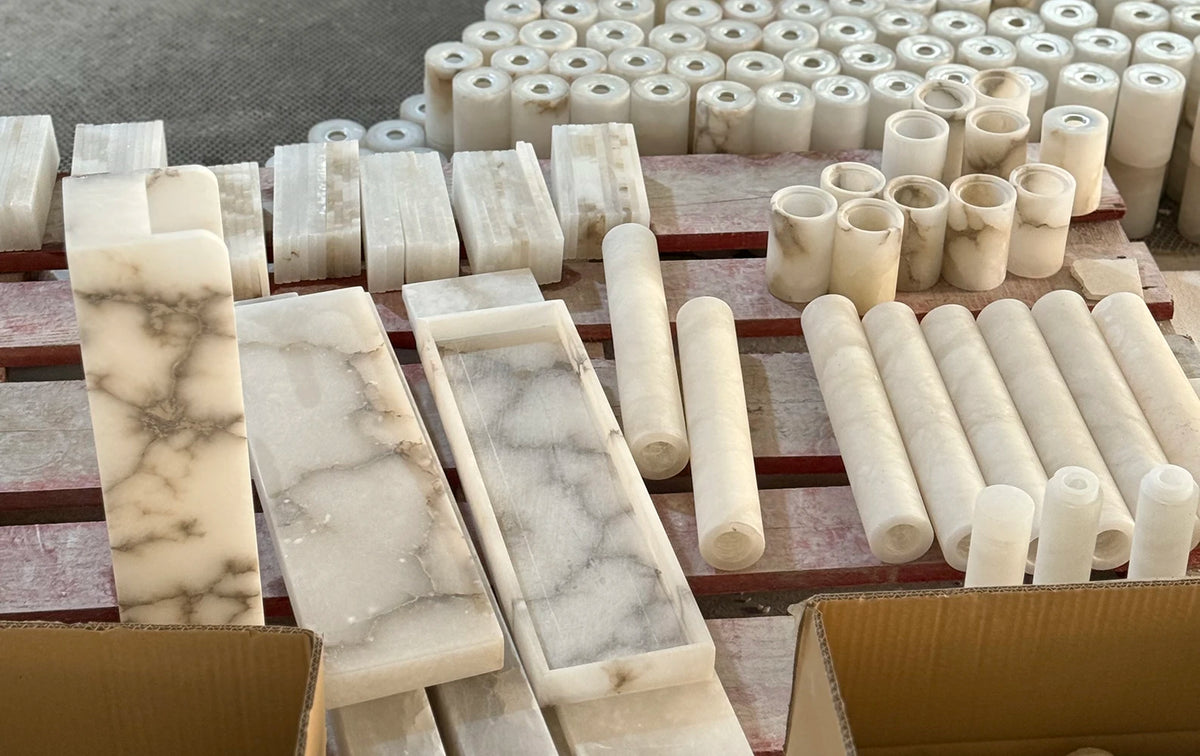
Crafted from select natural alabaster, preserving its unique veining.
Meticulously cut and shaped by artisans.
Repeatedly ground and polished for a smooth, refined texture.
Carefully assembled and quality-inspected.
Custom Stone Lighting

SHOP BY CATEGORY
Six major categories, one workshop — find the fixture that fits your room.
The Halloween sale
Applied automatically at checkout. No code needed.
Each one handles light differently once the room goes dim. Pick the glow first, then the shape.
 503 pieces
AlabasterLight passes through the stone and lifts its veining into view.Shop the series
503 pieces
AlabasterLight passes through the stone and lifts its veining into view.Shop the series
 36 pieces
Handmade glassShaped by hand, so each shade scatters light its own way.Shop the series
36 pieces
Handmade glassShaped by hand, so each shade scatters light its own way.Shop the series
 46 pieces
PaperMulberry paper shades that glow evenly, like a lantern.Shop the series
46 pieces
PaperMulberry paper shades that glow evenly, like a lantern.Shop the series
 27 pieces
ShellCapiz shell discs that catch and scatter light as they move.Shop the series
27 pieces
ShellCapiz shell discs that catch and scatter light as they move.Shop the series
 217 pieces
TravertinePorous and sculptural, it throws light down and keeps shadows deep.Shop the series
217 pieces
TravertinePorous and sculptural, it throws light down and keeps shadows deep.Shop the series
 23 pieces
MarblePolished stone whose veining softens under a warm bulb.Shop the series
23 pieces
MarblePolished stone whose veining softens under a warm bulb.Shop the series
 56 pieces
BrassSolid metal with a warm sheen that deepens in lamplight.Shop the series
56 pieces
BrassSolid metal with a warm sheen that deepens in lamplight.Shop the series
 31 pieces
CrystalCut crystal that breaks the light into small, bright sparks.Shop the series
31 pieces
CrystalCut crystal that breaks the light into small, bright sparks.Shop the series
The Halloween sale
Up to 20% off
$930.75$1,095.00with 15% off at checkout
Add $905 more to your order to reach 18% off.
Applied automatically at checkout. No code needed.


