Unlock Savings: Get 10% Off Automatically on Every Order!

Free standard shipping, all orders support 30-day returns

Your cart

Your cart is empty

Build Your Chandelier

Star-Shaped Glass Tube Chandelier

Glass Detail
Textured cast glass, single tronchi

⌀ 11″ × H 14.6″

8 glass pieces · 1 bulb

Amber

Tea Brown

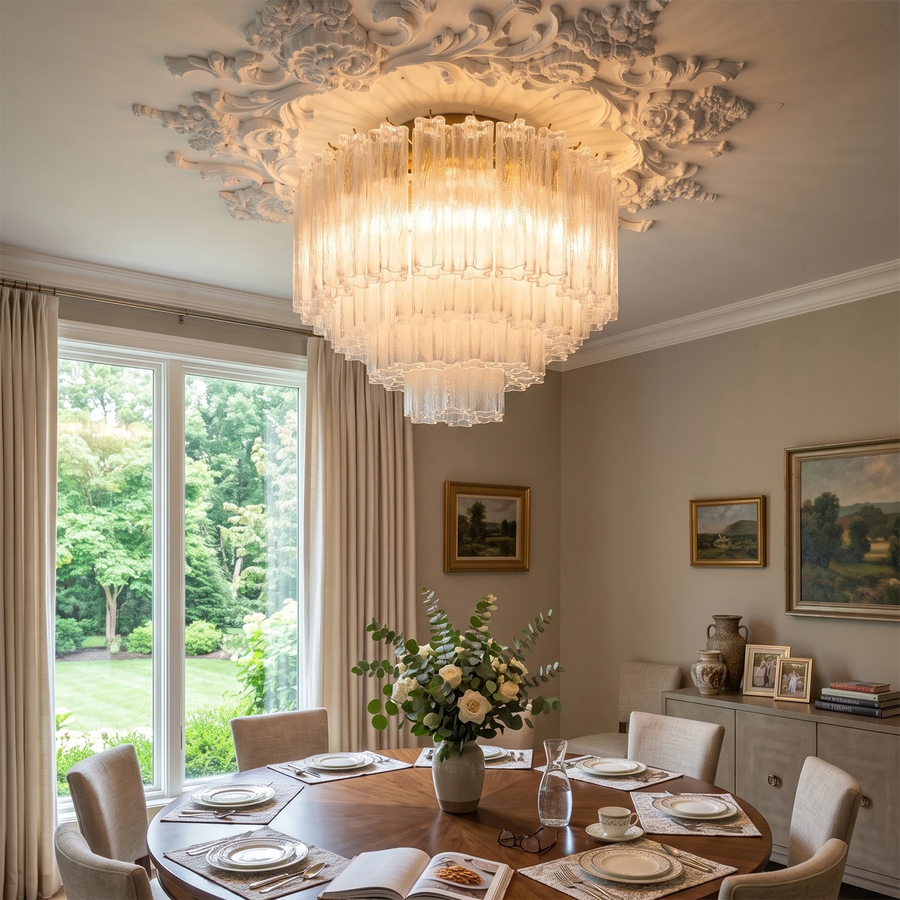
The Solaine Tiered Glass Tube Flush Mount steps three rows of hand-blown glass tubes outward from a gold-tone ceiling canopy, each tube hung on its own small hook. Every tube carries a deep bark-like texture worked into the glass while it was still molten — closer to weathered wood than to anything cut.

Lit, the texture takes over. Light travels down the length of every tube and catches in the vertical grain, throwing a soft radial pattern onto the ceiling around the canopy — the detail you only notice once it's installed, and the reason a textured glass ceiling light reads warmer than a flat diffuser ever does.

Handmade glass lighting fixtures shown in a range of colours — Vidirlighting custom glass palette Made to Order
Our Handmade Glass Colour Palette
Exclusive Customization

Make It Uniquely Yours

Love the design but need it tailored to your space? We offer comprehensive customization — dimensions, surface finishes, chain and wire lengths, and more. Tell us your vision, and we'll take care of the rest.

Custom Size Glass | Lamp Body Colour Chain / Wire Length Tier Count
1

Share Your Idea

Message us online for an immediate response to your brief.

2

Expert Consultation

We advise on size, colour, and finish for your room.

3

We Craft It

Made to spec and inspected before it ships.

support@Vidirlighting.com
The Craft

Shaped by Breath & Fire, Not a Machine

Every ribbed glass tube is mouth-blown by hand — which is exactly why the light looks the way it does.

Hand-Blown Glass

Molten Glass, Shaped by Hand

Each ribbed tube begins as a glowing gather of molten glass on the end of a blowpipe. A glassmaker breathes it into shape by hand, turning and drawing the fluted ribs while the glass is still soft. It's slow, skilled work — and it leaves each piece with a life that machine-pressed glass simply can't have.

Ribs That Catch the Light

Blown by hand, the fluted ribs bend and scatter every beam, casting rippling patterns of light and shadow across your walls — a texture flat glass can't reproduce.

Depth & Clarity

Hand-blown glass carries a substantial, thick-walled clarity with real depth — it refracts a soft glow even in daylight, never the thin, hollow look of acrylic.

Made, Not Manufactured

Every ribbed tube is the trace of a maker's hand and breath — an artisan piece, not a molded copy stamped out by the thousand.

The same hand-blown tubes, arranged two ways — stepped in tiers overhead, or hung in a single row on the wall.

What You See Is What You Get

Real Photo Hand-blown rippled glass tubes for the Solaine ceiling light in red, white and blue colourways Rippled glass tubes in every colourway — up close
Real Photo Brass-tone hardware and flush-mount base plate of the Solaine tiered glass tube ceiling light The flush-mount base plate and hardware, in detail

Described Honestly

Materials, sizes and finishes are listed exactly as they are — including where hand-blown glass varies from piece to piece.

Genuine Materials

Real hand-blown glass and metal hardware — never acrylic, never plated plastic. Photographed as it leaves our workshop, not rendered.

Safely Packed

Every tube is checked, individually wrapped in thick protective foam, and boxed separately from the canopy and hardware to survive the journey.

Specifications

The Details

Material Metal Frame · Hand-blown Glass Tubes Each tube is blown by hand and the vertical grain worked in while the glass is still molten.
Finish Gold
Glass colourways Pink  Blue Clear Colour is worked into the molten glass, so it deepens where the tube wall runs thick.
Light source LED or Edison bulb E12 / E14 base. Warm white (2700K) recommended — cooler light flattens the glass.
Bulbs 3, 6, 9 × E12 / E14 Bulbs not included.
Power Max 40W
Voltage AC 110–240V
Control Wall switch Dimmable when fitted with a compatible dimmable bulb on a dimmer circuit.
Mounting Flush to ceiling — hardwired Mounts to a standard junction box. All hardware included; professional installation recommended.
Environment Indoor only · IP20
Preparation time 5–10 days Made and inspected at our own workshop before dispatch.

Good to Know

Made for low ceilings

Because the tiers step outward rather than downward, this piece has the mass of a tiered chandelier while sitting tight against the ceiling. It suits 8 ft ceilings, bedrooms, hallways and anywhere people walk directly underneath — the rooms where a hanging fixture would crowd the space or catch a head.

About dimming

Dimming depends on the bulb, not the fixture. Fit dimmable E12 / E14 bulbs on a compatible dimmer and it will dim smoothly.

Sloped or vaulted ceilings

Worth knowing before you order: a flush mount sits parallel to the ceiling, so on a sloped ceiling the whole fixture tilts with the slope rather than hanging level. A chain-hung fixture is the better choice there. Tell us the pitch before ordering and we will advise — on a very shallow slope this design still reads correctly, but beyond that it will look wrong. (Explore the matching chain-hung chandelier)

Size Guide

Which Size for Your Space

Three sizes, from a compact hallway fixture to one that anchors a whole room. Every one sits flush to the ceiling — no rod, no chain, no drop to calculate.

∅ 14.2″
∅ 14.2″ × H 15.7″ ∅ 36 × H 40 cm
Glass19 hand-blown tubes
Bulbs3 × E12 / E14
Best forHallway · powder room · small bedroom · walk-in closet · landing

On an 8 ft ceiling this leaves about 6'8″ of headroom beneath it.

∅ 19.7″Popular
∅ 19.7″ × H 17.3″ ∅ 50 × H 44 cm
Glass38 hand-blown tubes
Bulbs6 × E12 / E14
Best forBedroom · dining room · entry hall · home office · guest room

The most forgiving of the three — right for most rooms in a house.

∅ 25.6″
∅ 25.6″ × H 20.1″ ∅ 65 × H 51 cm
Glass63 hand-blown tubes
Bulbs9 × E12 / E14
Best forLiving room · main bedroom · open-plan space · over a dining table

Leaves about 6'4″ beneath on an 8 ft ceiling — centre it, don't put it in a doorway.

Sizing Tip

With a flush mount, diameter is the decision and drop is not — there is no rod or chain to work out. Add your room's length and width in feet and read the sum as inches: a 9 × 11 ft room points at roughly 20 in, a 12 × 14 ft room at roughly 26 in. Over a dining table instead of open floor, take two thirds to three quarters of the table width.

Then check headroom, because it is the one number people forget. On a standard 8 ft ceiling these leave 6'8″, 6'7″ and 6'4″ of clearance underneath, smallest to largest. That is comfortable over a bed, a sofa, a table or the middle of a room — but it is not enough directly in a doorway or a walkway someone tall passes through. On a 9 ft ceiling all three clear 7 ft easily.

Between two sizes, go larger if the ceiling is 9 ft or more, smaller if it is 8 ft and the fixture sits anywhere people walk. The tiers step outward rather than downward, so extra diameter costs you nothing in headroom.

The design

Made for the Ceiling You Actually Have

All the presence. None of the drop.

Most decorative lighting is designed for houses with height to give — double-height entries, stairwell voids, ten-foot dining rooms. If your ceilings are eight feet, which most ceilings are, you are usually handed a flat disc and told to make do. The Solaine began in that gap.

The move was to rotate the growth. Instead of tiers falling one below the next, they step outward — three widening rings of hand-blown glass tubes hung from a single canopy, each tube on its own small hook. The mass comes from diameter rather than drop, which is how you get the rhythm and depth of a tiered chandelier in a piece that sits barely more than a foot from the ceiling.

The light follows the same logic. Each tube carries light down its own length and catches in the grain worked into the glass, throwing a soft radial fan across the ceiling around the canopy — the detail nobody photographs and everybody notices once it is up. You get the piece, and you still get to walk underneath it.

— Grown outward, not down. —
Why this ceiling light

Chandelier Presence, Without the Drop

Three tiers of hand-blown glass that grow outward instead of downward — built for the ceilings most houses actually have.

01

Three Sizes, Nineteen to Sixty-Three Tubes

The design scales by widening rather than lengthening. The smallest carries nineteen hand-blown tubes and suits a hallway or powder room; the largest carries sixty-three and anchors a living room or main bedroom. A compact guest room and an open-plan space can share the same language without either looking borrowed from the other.

02

Colour Worked Into the Glass

The tint enters the molten batch rather than being sprayed onto a finished surface, so it deepens where the tube wall runs thick and lifts where it thins. In the pink colourway that reads as a true ombré — warm blush at the canopy fading to lilac at the lowest tier. Aqua keeps a room cool and clean; clear works through texture alone. Nothing to chip, nothing to fade.

03

Hand-Blown Glass, Hung Tube by Tube

Every tube is blown by hand and the vertical grain worked in while the glass is still molten, so the texture sits in the material rather than on it — nothing to scratch off, nothing to wear away. Each one hangs from its own small hook along the gold-tone canopy, nothing sealed into a housing, which gives the tiers a natural unevenness no mould can copy and means a single damaged tube is replaced on its own.

— Hand-blown glass tubes, hung on a gold-tone canopy —

Materials

Why Hand-Blown Glass

Glass is not one material. What breath and hand tools give you, a steel mould cannot.

Hand-Blown Glass Pressed Glass / Acrylic
The light Each tube carries light down its own length and catches in the grain, throwing a soft radial fan across the ceiling — no hotspot anywhere A flat diffused panel, or a bare bright source visible through thin material
Unique
ness
Wall thickness and grain depth wander tube to tube — no two identical, no two fixtures either Stamped from one die; identical down to the millimetre
The colour Worked into the molten glass, so it deepens where the wall runs thick — which is what makes the pink read as a true ombré Sprayed or filmed onto the surface — flat, even, and able to chip or peel at an edge
The texture Vertical grain worked in while the glass is still soft — the texture is the material itself Embossed or printed after the fact, and able to scuff off with cleaning
Construc
tion
Every tube hooks onto its own point — a single damaged tube is replaced on its own Sealed into one moulded housing; damage usually means replacing the whole fixture
Over time Glass will not yellow, cloud or off-gas; the colour is as permanent as the material Acrylic yellows and scratches with age and bulb heat; surface tints fade
In the hand Cool, smooth, with real weight to every tube Lightweight and hollow-feeling
Questions, Answered

Common Questions

Will this work with an 8 ft ceiling?

Yes — that is exactly what it was drawn for. Because the tiers step outward rather than downward, the mass comes from diameter instead of drop, so you get the presence of a tiered chandelier without giving up headroom.

The real numbers: on a standard 8 ft ceiling this leaves 6'8″ under the smallest size, 6'7″ under the middle, and 6'4″ under the largest. That is comfortable over a bed, a sofa, a table, or the centre of a room. It is not enough directly in a doorway or a narrow walkway a tall person passes through — put the larger sizes where people gather rather than where they walk. On a 9 ft ceiling all three clear 7 ft easily.

Is the glass really hand-blown?
Yes. Every tube is gathered molten, inflated by breath and shaped by hand — never pressed cold from a die, and never acrylic. The vertical grain is worked in while the glass is still soft, and colour enters the molten batch rather than being applied to a finished surface.
Can I install it on a sloped or vaulted ceiling?

This is the one place a flush mount is at a disadvantage, and it is worth knowing before you order. A flush mount sits parallel to the ceiling, so on a slope the whole fixture tilts with the slope rather than hanging level. A chain-hung fixture hangs plumb no matter what the ceiling does; this one does not.

On a very shallow pitch it still reads correctly. Beyond that it will look wrong, and no adapter fixes it — an angled canopy kit only makes the base sit flat, which is the opposite of what you need here. Send us the pitch of your ceiling before ordering and we will tell you honestly whether this is the right fixture or whether you want a chain-hung piece instead.

Why aren't the tubes identical to each other?
Because a hand cannot repeat itself to the millimetre, and it is not meant to. Wall thickness wanders, grain depth varies, and colour pools deeper where the glass runs thick. Silhouette, dimensions, finish and colour family stay consistent; individual tubes do not. From the doorway the tiers read as one mass; stand underneath and every tube is its own.
Will the pink ombré look the same as the photographs?
The gradient direction and colour family will match — warm blush at the canopy lifting to lilac at the lowest tier. The exact point where one tone becomes the other will differ slightly, because the shift comes from the thickness of hand-blown glass rather than from a printed gradient. Screen colour is also indicative only; if the exact tone matters to your room, ask us for a photograph of the actual glass under a warm bulb before you commit.
How bright is it?

Each size is lamped for its diameter — 3, 6 and 9 bulbs from smallest to largest — so this is a genuine room light rather than an accent piece. Fit warm-white LEDs and the largest size will comfortably carry a living room.

Colour makes a difference worth knowing: clear transmits the most light, aqua a little less, and the pink ombré least of the three, since tinted glass absorbs as well as colours. If the room needs maximum output, choose clear; if it needs atmosphere, choose the tint.

What bulbs does it take, and can it be dimmed?
It takes E12 / E14 candelabra-base bulbs — 3, 6 or 9 depending on size, LED or Edison style, not included. Dimming depends on the bulb, not the fixture: fit dimmable bulbs on a compatible dimmer circuit and it will dim smoothly. A warm white around 2700K suits this glass best; anything cooler flattens the grain and drains the warmth out of the pink.
Which size should I choose?
Add your room's length and width in feet and read the sum as inches — a 6 × 8 ft room points at roughly 14 in, a 9 × 11 ft room at 20 in, a 12 × 14 ft room at 26 in. Over a dining table instead of open floor, take two thirds to three quarters of the table width. Because there is no drop to worry about, extra diameter costs you nothing in headroom — so go larger on a 9 ft ceiling, and smaller on an 8 ft ceiling if the fixture sits anywhere people walk.
Is it difficult to install?
It is a hardwired flush-mount fixture and mounts to a standard junction box — no rod or chain to measure, which makes it simpler than a hanging piece. The canopy goes up first, then the tubes are hooked on tier by tier. With up to sixty-three of them on the largest size this takes patience more than skill, and two people make it far easier: one holding, one hooking. Work from the outer tier inward, and switch off power at the breaker first. Professional installation is recommended.
How do I clean it, and what if a tube breaks?

A soft dry cloth for dust, barely damp for marks, wiping down the length of each tube rather than across it. Avoid abrasive pads, solvents and glass sprays containing ammonia — the grain traps residue. Always switch off and let the bulbs cool completely first.

Every tube is individually wrapped and foam-seated for shipping, with the canopy and hardware boxed separately. If something arrives damaged, send photographs within 24 hours of delivery and the affected part is replaced. Because each tube hooks on independently, a single broken tube never means returning the whole fixture.

Installation

The Complete Installation Guide

Not sure how to wire it, how high to hang it, or whether you need an electrician? Our full guide walks through every step for US homes.

01

Power Off First

Switch off at the breaker and confirm before you touch any wiring.

02

Check the Box

Make sure your junction box is standard, secure, and rated for the weight.

03

Match the Wires

Black to black, white to white, ground to ground — the US standard explained.

04

Set the Height

Mounting heights and clearances for sconces, pendants, and chandeliers.

Read the Full Installation Guide

Free guide · Written for US homes · Opens in a new tab

Solaine Tiered Glass Tube Ceiling Light

SKU: V-GLCL2607291-1
Regular price $495.00
Unit price
per 

The price includes tax, and free standard shipping within the U.S. is provided.

Availability
 
Tax & Shipping calculated at checkout.
With a brand-new lighting ambiance, let's usher in a hopeful 2026 10% Off All Lighting

Free Shipping on all orders

Hassle-free return within 30 days

Payment Security

Build Your Chandelier

Star-Shaped Glass Tube Chandelier

Glass Detail
Textured cast glass, single tronchi

⌀ 11″ × H 14.6″

8 glass pieces · 1 bulb

Amber

Tea Brown

The Solaine Tiered Glass Tube Flush Mount steps three rows of hand-blown glass tubes outward from a gold-tone ceiling canopy, each tube hung on its own small hook. Every tube carries a deep bark-like texture worked into the glass while it was still molten — closer to weathered wood than to anything cut.

Lit, the texture takes over. Light travels down the length of every tube and catches in the vertical grain, throwing a soft radial pattern onto the ceiling around the canopy — the detail you only notice once it's installed, and the reason a textured glass ceiling light reads warmer than a flat diffuser ever does.

Handmade glass lighting fixtures shown in a range of colours — Vidirlighting custom glass palette Made to Order
Our Handmade Glass Colour Palette
Exclusive Customization

Make It Uniquely Yours

Love the design but need it tailored to your space? We offer comprehensive customization — dimensions, surface finishes, chain and wire lengths, and more. Tell us your vision, and we'll take care of the rest.

Custom Size Glass | Lamp Body Colour Chain / Wire Length Tier Count
1

Share Your Idea

Message us online for an immediate response to your brief.

2

Expert Consultation

We advise on size, colour, and finish for your room.

3

We Craft It

Made to spec and inspected before it ships.

support@Vidirlighting.com
The Craft

Shaped by Breath & Fire, Not a Machine

Every ribbed glass tube is mouth-blown by hand — which is exactly why the light looks the way it does.

Hand-Blown Glass

Molten Glass, Shaped by Hand

Each ribbed tube begins as a glowing gather of molten glass on the end of a blowpipe. A glassmaker breathes it into shape by hand, turning and drawing the fluted ribs while the glass is still soft. It's slow, skilled work — and it leaves each piece with a life that machine-pressed glass simply can't have.

Ribs That Catch the Light

Blown by hand, the fluted ribs bend and scatter every beam, casting rippling patterns of light and shadow across your walls — a texture flat glass can't reproduce.

Depth & Clarity

Hand-blown glass carries a substantial, thick-walled clarity with real depth — it refracts a soft glow even in daylight, never the thin, hollow look of acrylic.

Made, Not Manufactured

Every ribbed tube is the trace of a maker's hand and breath — an artisan piece, not a molded copy stamped out by the thousand.

The same hand-blown tubes, arranged two ways — stepped in tiers overhead, or hung in a single row on the wall.

What You See Is What You Get

Real Photo Hand-blown rippled glass tubes for the Solaine ceiling light in red, white and blue colourways Rippled glass tubes in every colourway — up close
Real Photo Brass-tone hardware and flush-mount base plate of the Solaine tiered glass tube ceiling light The flush-mount base plate and hardware, in detail

Described Honestly

Materials, sizes and finishes are listed exactly as they are — including where hand-blown glass varies from piece to piece.

Genuine Materials

Real hand-blown glass and metal hardware — never acrylic, never plated plastic. Photographed as it leaves our workshop, not rendered.

Safely Packed

Every tube is checked, individually wrapped in thick protective foam, and boxed separately from the canopy and hardware to survive the journey.

Specifications

The Details

Material Metal Frame · Hand-blown Glass Tubes Each tube is blown by hand and the vertical grain worked in while the glass is still molten.
Finish Gold
Glass colourways Pink  Blue Clear Colour is worked into the molten glass, so it deepens where the tube wall runs thick.
Light source LED or Edison bulb E12 / E14 base. Warm white (2700K) recommended — cooler light flattens the glass.
Bulbs 3, 6, 9 × E12 / E14 Bulbs not included.
Power Max 40W
Voltage AC 110–240V
Control Wall switch Dimmable when fitted with a compatible dimmable bulb on a dimmer circuit.
Mounting Flush to ceiling — hardwired Mounts to a standard junction box. All hardware included; professional installation recommended.
Environment Indoor only · IP20
Preparation time 5–10 days Made and inspected at our own workshop before dispatch.

Good to Know

Made for low ceilings

Because the tiers step outward rather than downward, this piece has the mass of a tiered chandelier while sitting tight against the ceiling. It suits 8 ft ceilings, bedrooms, hallways and anywhere people walk directly underneath — the rooms where a hanging fixture would crowd the space or catch a head.

About dimming

Dimming depends on the bulb, not the fixture. Fit dimmable E12 / E14 bulbs on a compatible dimmer and it will dim smoothly.

Sloped or vaulted ceilings

Worth knowing before you order: a flush mount sits parallel to the ceiling, so on a sloped ceiling the whole fixture tilts with the slope rather than hanging level. A chain-hung fixture is the better choice there. Tell us the pitch before ordering and we will advise — on a very shallow slope this design still reads correctly, but beyond that it will look wrong. (Explore the matching chain-hung chandelier)

Size Guide

Which Size for Your Space

Three sizes, from a compact hallway fixture to one that anchors a whole room. Every one sits flush to the ceiling — no rod, no chain, no drop to calculate.

∅ 14.2″
∅ 14.2″ × H 15.7″ ∅ 36 × H 40 cm
Glass19 hand-blown tubes
Bulbs3 × E12 / E14
Best forHallway · powder room · small bedroom · walk-in closet · landing

On an 8 ft ceiling this leaves about 6'8″ of headroom beneath it.

∅ 19.7″Popular
∅ 19.7″ × H 17.3″ ∅ 50 × H 44 cm
Glass38 hand-blown tubes
Bulbs6 × E12 / E14
Best forBedroom · dining room · entry hall · home office · guest room

The most forgiving of the three — right for most rooms in a house.

∅ 25.6″
∅ 25.6″ × H 20.1″ ∅ 65 × H 51 cm
Glass63 hand-blown tubes
Bulbs9 × E12 / E14
Best forLiving room · main bedroom · open-plan space · over a dining table

Leaves about 6'4″ beneath on an 8 ft ceiling — centre it, don't put it in a doorway.

Sizing Tip

With a flush mount, diameter is the decision and drop is not — there is no rod or chain to work out. Add your room's length and width in feet and read the sum as inches: a 9 × 11 ft room points at roughly 20 in, a 12 × 14 ft room at roughly 26 in. Over a dining table instead of open floor, take two thirds to three quarters of the table width.

Then check headroom, because it is the one number people forget. On a standard 8 ft ceiling these leave 6'8″, 6'7″ and 6'4″ of clearance underneath, smallest to largest. That is comfortable over a bed, a sofa, a table or the middle of a room — but it is not enough directly in a doorway or a walkway someone tall passes through. On a 9 ft ceiling all three clear 7 ft easily.

Between two sizes, go larger if the ceiling is 9 ft or more, smaller if it is 8 ft and the fixture sits anywhere people walk. The tiers step outward rather than downward, so extra diameter costs you nothing in headroom.

The design

Made for the Ceiling You Actually Have

All the presence. None of the drop.

Most decorative lighting is designed for houses with height to give — double-height entries, stairwell voids, ten-foot dining rooms. If your ceilings are eight feet, which most ceilings are, you are usually handed a flat disc and told to make do. The Solaine began in that gap.

The move was to rotate the growth. Instead of tiers falling one below the next, they step outward — three widening rings of hand-blown glass tubes hung from a single canopy, each tube on its own small hook. The mass comes from diameter rather than drop, which is how you get the rhythm and depth of a tiered chandelier in a piece that sits barely more than a foot from the ceiling.

The light follows the same logic. Each tube carries light down its own length and catches in the grain worked into the glass, throwing a soft radial fan across the ceiling around the canopy — the detail nobody photographs and everybody notices once it is up. You get the piece, and you still get to walk underneath it.

— Grown outward, not down. —
Why this ceiling light

Chandelier Presence, Without the Drop

Three tiers of hand-blown glass that grow outward instead of downward — built for the ceilings most houses actually have.

01

Three Sizes, Nineteen to Sixty-Three Tubes

The design scales by widening rather than lengthening. The smallest carries nineteen hand-blown tubes and suits a hallway or powder room; the largest carries sixty-three and anchors a living room or main bedroom. A compact guest room and an open-plan space can share the same language without either looking borrowed from the other.

02

Colour Worked Into the Glass

The tint enters the molten batch rather than being sprayed onto a finished surface, so it deepens where the tube wall runs thick and lifts where it thins. In the pink colourway that reads as a true ombré — warm blush at the canopy fading to lilac at the lowest tier. Aqua keeps a room cool and clean; clear works through texture alone. Nothing to chip, nothing to fade.

03

Hand-Blown Glass, Hung Tube by Tube

Every tube is blown by hand and the vertical grain worked in while the glass is still molten, so the texture sits in the material rather than on it — nothing to scratch off, nothing to wear away. Each one hangs from its own small hook along the gold-tone canopy, nothing sealed into a housing, which gives the tiers a natural unevenness no mould can copy and means a single damaged tube is replaced on its own.

— Hand-blown glass tubes, hung on a gold-tone canopy —

Materials

Why Hand-Blown Glass

Glass is not one material. What breath and hand tools give you, a steel mould cannot.

Hand-Blown Glass Pressed Glass / Acrylic
The light Each tube carries light down its own length and catches in the grain, throwing a soft radial fan across the ceiling — no hotspot anywhere A flat diffused panel, or a bare bright source visible through thin material
Unique
ness
Wall thickness and grain depth wander tube to tube — no two identical, no two fixtures either Stamped from one die; identical down to the millimetre
The colour Worked into the molten glass, so it deepens where the wall runs thick — which is what makes the pink read as a true ombré Sprayed or filmed onto the surface — flat, even, and able to chip or peel at an edge
The texture Vertical grain worked in while the glass is still soft — the texture is the material itself Embossed or printed after the fact, and able to scuff off with cleaning
Construc
tion
Every tube hooks onto its own point — a single damaged tube is replaced on its own Sealed into one moulded housing; damage usually means replacing the whole fixture
Over time Glass will not yellow, cloud or off-gas; the colour is as permanent as the material Acrylic yellows and scratches with age and bulb heat; surface tints fade
In the hand Cool, smooth, with real weight to every tube Lightweight and hollow-feeling
Questions, Answered

Common Questions

Will this work with an 8 ft ceiling?

Yes — that is exactly what it was drawn for. Because the tiers step outward rather than downward, the mass comes from diameter instead of drop, so you get the presence of a tiered chandelier without giving up headroom.

The real numbers: on a standard 8 ft ceiling this leaves 6'8″ under the smallest size, 6'7″ under the middle, and 6'4″ under the largest. That is comfortable over a bed, a sofa, a table, or the centre of a room. It is not enough directly in a doorway or a narrow walkway a tall person passes through — put the larger sizes where people gather rather than where they walk. On a 9 ft ceiling all three clear 7 ft easily.

Is the glass really hand-blown?
Yes. Every tube is gathered molten, inflated by breath and shaped by hand — never pressed cold from a die, and never acrylic. The vertical grain is worked in while the glass is still soft, and colour enters the molten batch rather than being applied to a finished surface.
Can I install it on a sloped or vaulted ceiling?

This is the one place a flush mount is at a disadvantage, and it is worth knowing before you order. A flush mount sits parallel to the ceiling, so on a slope the whole fixture tilts with the slope rather than hanging level. A chain-hung fixture hangs plumb no matter what the ceiling does; this one does not.

On a very shallow pitch it still reads correctly. Beyond that it will look wrong, and no adapter fixes it — an angled canopy kit only makes the base sit flat, which is the opposite of what you need here. Send us the pitch of your ceiling before ordering and we will tell you honestly whether this is the right fixture or whether you want a chain-hung piece instead.

Why aren't the tubes identical to each other?
Because a hand cannot repeat itself to the millimetre, and it is not meant to. Wall thickness wanders, grain depth varies, and colour pools deeper where the glass runs thick. Silhouette, dimensions, finish and colour family stay consistent; individual tubes do not. From the doorway the tiers read as one mass; stand underneath and every tube is its own.
Will the pink ombré look the same as the photographs?
The gradient direction and colour family will match — warm blush at the canopy lifting to lilac at the lowest tier. The exact point where one tone becomes the other will differ slightly, because the shift comes from the thickness of hand-blown glass rather than from a printed gradient. Screen colour is also indicative only; if the exact tone matters to your room, ask us for a photograph of the actual glass under a warm bulb before you commit.
How bright is it?

Each size is lamped for its diameter — 3, 6 and 9 bulbs from smallest to largest — so this is a genuine room light rather than an accent piece. Fit warm-white LEDs and the largest size will comfortably carry a living room.

Colour makes a difference worth knowing: clear transmits the most light, aqua a little less, and the pink ombré least of the three, since tinted glass absorbs as well as colours. If the room needs maximum output, choose clear; if it needs atmosphere, choose the tint.

What bulbs does it take, and can it be dimmed?
It takes E12 / E14 candelabra-base bulbs — 3, 6 or 9 depending on size, LED or Edison style, not included. Dimming depends on the bulb, not the fixture: fit dimmable bulbs on a compatible dimmer circuit and it will dim smoothly. A warm white around 2700K suits this glass best; anything cooler flattens the grain and drains the warmth out of the pink.
Which size should I choose?
Add your room's length and width in feet and read the sum as inches — a 6 × 8 ft room points at roughly 14 in, a 9 × 11 ft room at 20 in, a 12 × 14 ft room at 26 in. Over a dining table instead of open floor, take two thirds to three quarters of the table width. Because there is no drop to worry about, extra diameter costs you nothing in headroom — so go larger on a 9 ft ceiling, and smaller on an 8 ft ceiling if the fixture sits anywhere people walk.
Is it difficult to install?
It is a hardwired flush-mount fixture and mounts to a standard junction box — no rod or chain to measure, which makes it simpler than a hanging piece. The canopy goes up first, then the tubes are hooked on tier by tier. With up to sixty-three of them on the largest size this takes patience more than skill, and two people make it far easier: one holding, one hooking. Work from the outer tier inward, and switch off power at the breaker first. Professional installation is recommended.
How do I clean it, and what if a tube breaks?

A soft dry cloth for dust, barely damp for marks, wiping down the length of each tube rather than across it. Avoid abrasive pads, solvents and glass sprays containing ammonia — the grain traps residue. Always switch off and let the bulbs cool completely first.

Every tube is individually wrapped and foam-seated for shipping, with the canopy and hardware boxed separately. If something arrives damaged, send photographs within 24 hours of delivery and the affected part is replaced. Because each tube hooks on independently, a single broken tube never means returning the whole fixture.

Installation

The Complete Installation Guide

Not sure how to wire it, how high to hang it, or whether you need an electrician? Our full guide walks through every step for US homes.

01

Power Off First

Switch off at the breaker and confirm before you touch any wiring.

02

Check the Box

Make sure your junction box is standard, secure, and rated for the weight.

03

Match the Wires

Black to black, white to white, ground to ground — the US standard explained.

04

Set the Height

Mounting heights and clearances for sconces, pendants, and chandeliers.

Read the Full Installation Guide

Free guide · Written for US homes · Opens in a new tab

Customer Reviews