


See It In Motion
Watch the Light Come to Life
The Rainer Faceted Crystal Bar Sconce runs a single faceted crystal column down a slim metal backplate — and does not sit it flat against the wall. The glass stands proud of the plate, offset so light leaves the column on every side, including the side facing the wall.
That gap is the design. A conventional bar sconce presses its diffuser to a plate and sends light forward; there is nothing behind it and the wall stays dark. Here the light escapes down the space between glass and metal and washes the wall on both sides of the fixture — so what you see is a bright vertical line with a soft field of light around it, rather than a lit object on a blank surface. The column is faceted rather than round. Cut planes run the full length of the glass, so light travelling through it is turned at every face and the bar reads as a line of small bright breaks rather than one continuous tube.
Buying a Pair?
Select the size marked (*2) — two together come at a better price than buying them separately.
What You See Is What You Get
 A single faceted bar, up close — the cut planes run the full length of the prism
Described Honestly
Materials, sizes and finishes are listed exactly as they are — and photographed close enough that you can count the facets rather than take our word for them.
Crystal and Brass
Solid faceted crystal with brass hardware — never acrylic, never a printed facet pattern on a moulded tube. The planes are cut through the material, which is why they catch daylight with the fixture switched off.
Safely Packed
The crystal bar is wrapped and foam-seated on its own, with the backplate and brass hardware boxed apart from it — so nothing travels pressed against the glass.
The Details
Good to Know
Why vertical beats horizontal at a mirror
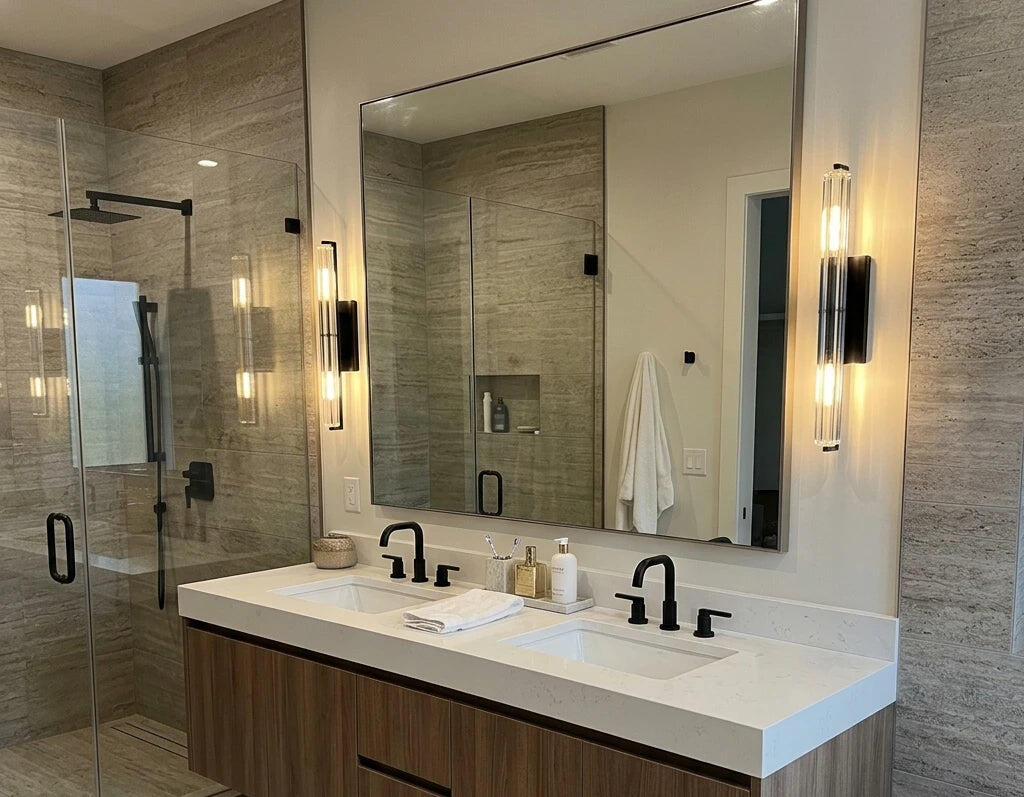
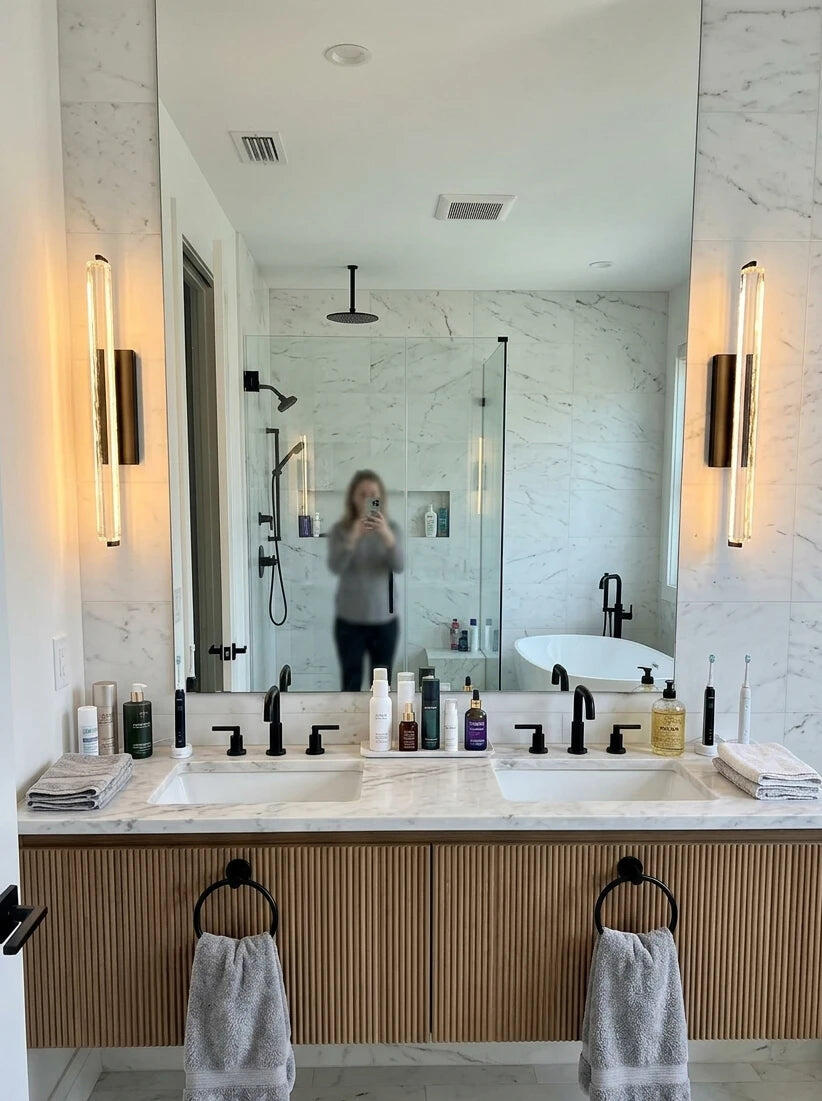
This is the argument for a bar sconce over a light bar above the glass, and it is worth knowing. A fixture mounted above a mirror lights the top of a face and leaves shadow under the brow, the nose and the chin — the reason so much bathroom lighting is unflattering.
A pair mounted vertically either side, at roughly face height, lights from both sides at once and cancels those shadows. It is what portrait photographers do and what lighting designers specify. If you are lighting a mirror you actually use, buy two.
What an integrated LED means
The light source is built into the fixture rather than screwed into a socket. The advantage: nothing to buy, nothing to replace, and an unbroken line of light down the full length of the bar rather than a bulb glowing at one point in it.
The trade-off is worth knowing before you order. The colour temperature is fixed at manufacture and cannot be changed later the way a bulb can. And dimming needs a dimmer designed for LED drivers — a standard incandescent dimmer will flicker or buzz. Tell us what dimmer you have and we will confirm compatibility.
Two Widths, Three Heights
Six versions of the same fixture. Pick the width first — it sets how much presence the bar has on the wall — then pick the height to suit what it sits beside.
The mirror size. Buy two.
The most forgiving of the six — right in most rooms.
Check what sits above it. At a 66″ centre the top reaches nearly 79″.

Squarer in proportion than the narrow version; reads as a block rather than a line.
Check the projection against your corridor width before choosing this width.
Needs a clear span of plain wall. Give it 24″ of clear space either side.

Width First, Then Height
Width sets presence. The ∅ 3.9″ version reads as a line and disappears into a scheme; the ∅ 5.9″ version reads as a block and holds a wall on its own. In a narrow corridor or on a slim strip of wall beside a mirror, take the narrow one — and check the [__]″ projection against your corridor width before you commit to the wide.
Height follows what it sits beside. At a mirror, take 15″ — mounted at a 64″ centre it spans roughly 56–72″, which brackets a face without running past the top of a standard mirror. For general use, 18.9″ is the most forgiving. 25.2″ is architecture: over two feet of vertical line that wants a tall, plain wall and nothing competing with it.
One check before ordering the tallest: at a 66″ centre a 25.2″ fixture reaches nearly 79″ at the top — higher than a standard door head. Cut a paper strip at the height you are considering, tape it to the wall, and look at it from where you will actually stand. Settle the height before the junction box is roughed in; it is the only part that is expensive to change afterwards.
The Gap Is the Whole Idea
The crystal does not touch the wall. Everything follows from that.
A wall light is normally pressed flat to its plate. The diffuser meets the metal, the metal meets the wall, and every photon that leaves the fixture leaves it forwards. The wall behind stays dark, which is why so many sconces read as a bright object stuck onto a blank surface — lit thing, unlit wall, a hard edge between them.
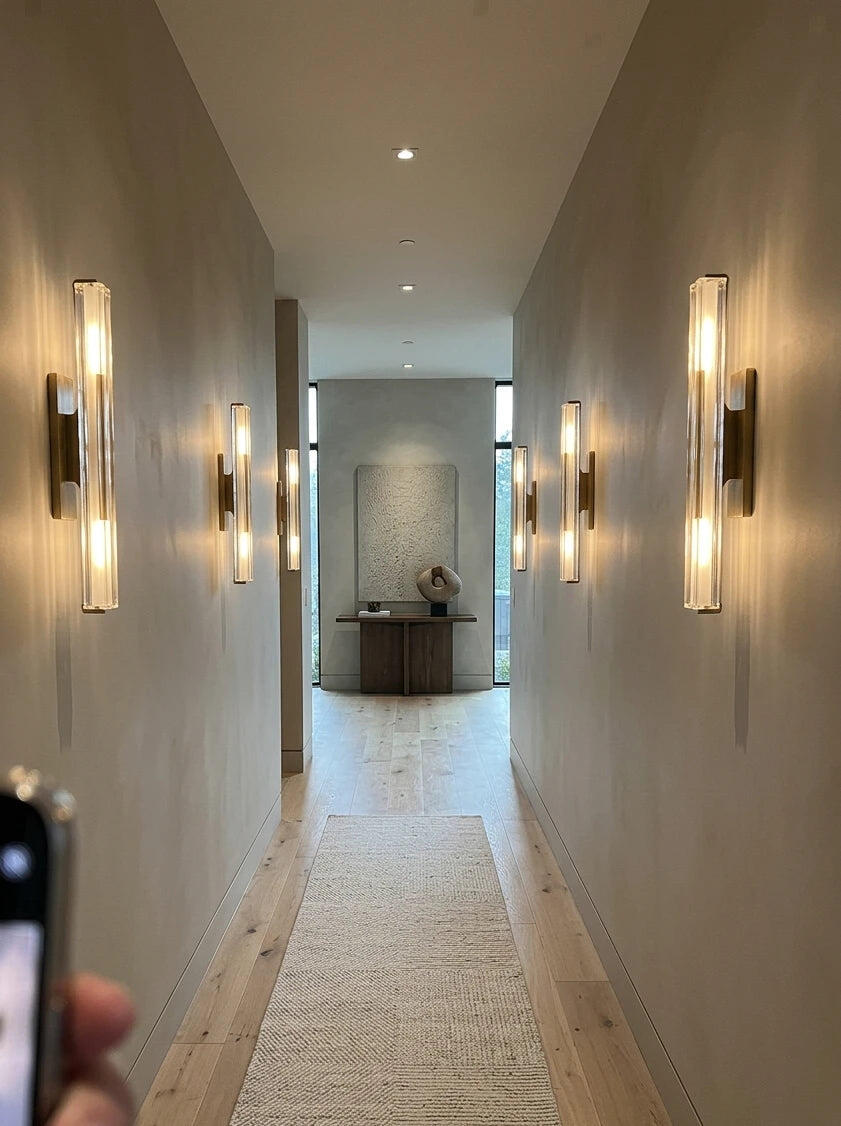
Here the crystal bar is set proud of the backplate, standing off it with a gap running the full length. Light escapes down that gap and spreads across the plaster on both sides. The wall stops being a background and becomes a second, softer source — so what you see is a bright vertical line sitting inside a broad field of glow, with no edge anywhere.
Notice what it does not do: there is no pattern. Nothing is projected, nothing is drawn. It is simply that the wall is lit as well as the fixture, and a lit wall is the oldest trick in architectural lighting for making a room feel larger and softer than it is.
Why Solid Cut Crystal
Most bar sconces at this shape are an acrylic tube with facet lines pressed onto the outside. Here is what changes when the facets go through the material instead.
Common Questions
Do I need one or a pair?
At a mirror, always a pair. One sconce lights half a face and leaves the other half in shadow. Space them 36–40″ (90–100 cm) apart with both centres at the same height, and set them to sit just outside the edges of the glass.
Beside a bed, a pair unless only one side is used. In a hallway, one every 8–10 ft. A single works well in an alcove, above a console, or at the end of a hall.
Is it real crystal?
What do the facets actually do?
Which finish should I choose?
Which size, and will it fit a narrow hallway?
Width first. The narrow bar reads as a line and settles into a room; the wide one reads as a block and holds a wall on its own. Then height: the shortest is the mirror size, the middle suits most rooms, and the tallest is a statement that needs a plain wall to itself.
For a corridor, the number that matters is the [__]″ projection from the wall, not the width of the fixture. In a corridor under 36″ (90 cm) wide, keep to one wall and choose the narrow bar.
Can I change the bulb?
Can it be dimmed?
Is it hard to install?
Can I use it in a bathroom?
How do I clean it, and what if it arrives damaged?
A soft dry cloth down the length of the bar, or barely damp for fingerprints. Cut facets show marks sooner than a smooth surface does — that is the price of the sparkle — so a quick pass every few weeks keeps it right. Avoid abrasive pads and ammonia-based sprays, and switch off and let it cool first.
The crystal bar is wrapped and foam-seated on its own, with the backplate and brass hardware packed apart from it. If something arrives damaged, send photographs within 24 hours of delivery and the affected part is replaced.
Rainer Faceted Crystal Bar Sconce
The price includes tax, and free standard shipping within the U.S. is provided.

The beauty of a fixture is easy to photograph. What matters just as much is what sits inside the canopy—the driver, the bracket, the wiring, the hardware in the box. Here is how we build for safety and longevity, so the fixture you order arrives ready to install and made to last.

An LED Driver Built to Last
We offer integrated LED drivers in a range of styles—dimmable, constant-current, and color-temperature-adjustable—so the fixture can be matched to how you actually light the room. It runs on 110–240V, works straight out of the box on standard US household power, and is rated for both dry and damp locations, so it fits wherever you'd like to install it.
A Solid Mounting Bracket
Every fixture ships with a sturdy mounting bracket sized to a standard US junction box—so it hangs true and stays secure, year after year. No improvising, no trips to the hardware store.
Everything You Need, in One Box
Open the carton and it's all there—canopy, mounting plate and bracket, screws and wall anchors, the driver, and a pair of clean cotton gloves for handling the glass. Nothing missing, nothing to source separately. It's the small stuff, packed with care, that makes installation day feel easy.
Clean, Color-Coded Wiring
Clearly labeled leads and a tidy factory harness make professional installation quick and unambiguous. Hand it to your electrician and they'll have it up in minutes—standard L / N / E hardwiring, the way a considered fixture should be.
Order with confidence: what arrives at your door is a fixture built to be lived with—considered on the inside, finished on the outside. Wiring should be carried out by a qualified electrician in line with local code.
Free Shipping on all orders
Hassle-free return within 30 days
Payment Security
Pairs Well With
See It In Motion
Watch the Light Come to Life
The Rainer Faceted Crystal Bar Sconce runs a single faceted crystal column down a slim metal backplate — and does not sit it flat against the wall. The glass stands proud of the plate, offset so light leaves the column on every side, including the side facing the wall.
That gap is the design. A conventional bar sconce presses its diffuser to a plate and sends light forward; there is nothing behind it and the wall stays dark. Here the light escapes down the space between glass and metal and washes the wall on both sides of the fixture — so what you see is a bright vertical line with a soft field of light around it, rather than a lit object on a blank surface. The column is faceted rather than round. Cut planes run the full length of the glass, so light travelling through it is turned at every face and the bar reads as a line of small bright breaks rather than one continuous tube.
Buying a Pair?
Select the size marked (*2) — two together come at a better price than buying them separately.
What You See Is What You Get
A single faceted bar, up close — the cut planes run the full length of the prism
Described Honestly
Materials, sizes and finishes are listed exactly as they are — and photographed close enough that you can count the facets rather than take our word for them.
Crystal and Brass
Solid faceted crystal with brass hardware — never acrylic, never a printed facet pattern on a moulded tube. The planes are cut through the material, which is why they catch daylight with the fixture switched off.
Safely Packed
The crystal bar is wrapped and foam-seated on its own, with the backplate and brass hardware boxed apart from it — so nothing travels pressed against the glass.
The Details
Good to Know
Why vertical beats horizontal at a mirror
This is the argument for a bar sconce over a light bar above the glass, and it is worth knowing. A fixture mounted above a mirror lights the top of a face and leaves shadow under the brow, the nose and the chin — the reason so much bathroom lighting is unflattering.
A pair mounted vertically either side, at roughly face height, lights from both sides at once and cancels those shadows. It is what portrait photographers do and what lighting designers specify. If you are lighting a mirror you actually use, buy two.
What an integrated LED means
The light source is built into the fixture rather than screwed into a socket. The advantage: nothing to buy, nothing to replace, and an unbroken line of light down the full length of the bar rather than a bulb glowing at one point in it.
The trade-off is worth knowing before you order. The colour temperature is fixed at manufacture and cannot be changed later the way a bulb can. And dimming needs a dimmer designed for LED drivers — a standard incandescent dimmer will flicker or buzz. Tell us what dimmer you have and we will confirm compatibility.
Two Widths, Three Heights
Six versions of the same fixture. Pick the width first — it sets how much presence the bar has on the wall — then pick the height to suit what it sits beside.
The mirror size. Buy two.
The most forgiving of the six — right in most rooms.
Check what sits above it. At a 66″ centre the top reaches nearly 79″.
Squarer in proportion than the narrow version; reads as a block rather than a line.
Check the projection against your corridor width before choosing this width.
Needs a clear span of plain wall. Give it 24″ of clear space either side.
Width First, Then Height
Width sets presence. The ∅ 3.9″ version reads as a line and disappears into a scheme; the ∅ 5.9″ version reads as a block and holds a wall on its own. In a narrow corridor or on a slim strip of wall beside a mirror, take the narrow one — and check the [__]″ projection against your corridor width before you commit to the wide.
Height follows what it sits beside. At a mirror, take 15″ — mounted at a 64″ centre it spans roughly 56–72″, which brackets a face without running past the top of a standard mirror. For general use, 18.9″ is the most forgiving. 25.2″ is architecture: over two feet of vertical line that wants a tall, plain wall and nothing competing with it.
One check before ordering the tallest: at a 66″ centre a 25.2″ fixture reaches nearly 79″ at the top — higher than a standard door head. Cut a paper strip at the height you are considering, tape it to the wall, and look at it from where you will actually stand. Settle the height before the junction box is roughed in; it is the only part that is expensive to change afterwards.
The Gap Is the Whole Idea
The crystal does not touch the wall. Everything follows from that.
A wall light is normally pressed flat to its plate. The diffuser meets the metal, the metal meets the wall, and every photon that leaves the fixture leaves it forwards. The wall behind stays dark, which is why so many sconces read as a bright object stuck onto a blank surface — lit thing, unlit wall, a hard edge between them.
Here the crystal bar is set proud of the backplate, standing off it with a gap running the full length. Light escapes down that gap and spreads across the plaster on both sides. The wall stops being a background and becomes a second, softer source — so what you see is a bright vertical line sitting inside a broad field of glow, with no edge anywhere.
Notice what it does not do: there is no pattern. Nothing is projected, nothing is drawn. It is simply that the wall is lit as well as the fixture, and a lit wall is the oldest trick in architectural lighting for making a room feel larger and softer than it is.
Why Solid Cut Crystal
Most bar sconces at this shape are an acrylic tube with facet lines pressed onto the outside. Here is what changes when the facets go through the material instead.
Common Questions
Do I need one or a pair?
At a mirror, always a pair. One sconce lights half a face and leaves the other half in shadow. Space them 36–40″ (90–100 cm) apart with both centres at the same height, and set them to sit just outside the edges of the glass.
Beside a bed, a pair unless only one side is used. In a hallway, one every 8–10 ft. A single works well in an alcove, above a console, or at the end of a hall.
Is it real crystal?
What do the facets actually do?
Which finish should I choose?
Which size, and will it fit a narrow hallway?
Width first. The narrow bar reads as a line and settles into a room; the wide one reads as a block and holds a wall on its own. Then height: the shortest is the mirror size, the middle suits most rooms, and the tallest is a statement that needs a plain wall to itself.
For a corridor, the number that matters is the [__]″ projection from the wall, not the width of the fixture. In a corridor under 36″ (90 cm) wide, keep to one wall and choose the narrow bar.
Can I change the bulb?
Can it be dimmed?
Is it hard to install?
Can I use it in a bathroom?
How do I clean it, and what if it arrives damaged?
A soft dry cloth down the length of the bar, or barely damp for fingerprints. Cut facets show marks sooner than a smooth surface does — that is the price of the sparkle — so a quick pass every few weeks keeps it right. Avoid abrasive pads and ammonia-based sprays, and switch off and let it cool first.
The crystal bar is wrapped and foam-seated on its own, with the backplate and brass hardware packed apart from it. If something arrives damaged, send photographs within 24 hours of delivery and the affected part is replaced.
Customer Reviews



The Craft of Brass
Every brass part is cut, shaped and refined by skilled metalworkers, then finished to bring out the warm golden glow that only brass can give.
- Precisely cut for clean edges and a perfect fit
- Curves and details sculpted by experienced artisans
- Durable, corrosion-resistant brass built to last
Lamp body material
A Lamp Body Made of Brass
We build our lamp bodies from brass, a dense and durable metal prized for its warm golden color. It all begins with raw brass rods and bars in our workshop, ready to be cut, shaped and finished into fixtures made to last.
-
Strong and stable
Brass is dense and rigid, so the lamp body holds its shape and supports the fixture securely for years.
-
Resists corrosion
Brass does not rust, which makes it a reliable, low-worry material for everyday use.
-
Warm golden tone
Its natural color brings a soft, luxurious warmth that pairs beautifully with glass, stone and fabric.
-
Refined detail
Brass cuts and polishes cleanly, allowing crisp edges, smooth curves and an even, elegant finish.
Quality you can feel
A brass body gives your lamp a reassuring weight, lasting strength and a finish that stays beautiful in everyday use.

Why We Choose Brass
The metal inside a lamp decides how long it lasts and how it looks up close. We choose brass for its strength, its natural resistance to rust and the refined finish it brings to every detail.
-

Built to carry weight
Multi-tier chandeliers depend on a strong frame, canopy and chain. Brass is dense and rigid, so every tier hangs securely and stays level.
-

Refined up close
Brushed brass details look crisp and feel substantial in the hand, and standard E12 sockets make changing bulbs simple.
-

Beautiful in any finish
Brass takes finishes well. Whether left golden or finished in matte black, the frame keeps its rings and tiers precisely in shape.
Brass vs. Other Lamp Metals
Many lamps use cheaper metals that look similar at first glance. Here is how brass compares with the materials most commonly used in lighting.
| Property | Brass | Iron | Aluminum | Zinc alloy |
|---|---|---|---|---|
| Rust resistance | Does not rust; may develop a soft patina | Rusts if the coating is scratched or worn | Does not rust, but can dull over time | Can corrode in damp conditions |
| Strength | Dense and strong, holds its shape | Strong, but heavy | Lightweight, dents more easily | More brittle, can crack under stress |
| Finish and look | Warm golden tone that polishes beautifully | Needs paint or plating to look finished | Cool tone, usually painted or anodized | Often plated to imitate brass |
| Detail | Machines cleanly for crisp, precise details | Harder to shape into fine details | Good for simple shapes | Cast shapes can look less crisp |
General material properties for reference. Actual performance also depends on thickness, finish and design.
Made to last, not to replace
Brass does not rust and holds its form over time, so your lighting keeps its strength and good looks for years to come.


