


| Why Choose Our Travertine Lamps? |
| Each lighting fixture is a one-of-a-kind piece. As we utilize natural travertine—a material characterized by its delicate pores and distinct textures—we ensure that your lamp possesses truly unique qualities. |
Details
- Material: Travertine, Metal
- Light source: LED bulb or Edison bulb
- Light source base type: E26 or E27
- Power: Max 40W
- Voltage: AC 110-240V
- Mounting: Table
- Environment: Indoor
- Factory shipment: 5–10 working days to prepare on average
- Finishes: Yellow
- Process: Frosting, Electroplating, Polishing
- Control method: Push-Button Switch (Support bulb dimming)
- Q: Does it support dimming?
- A: Whether it supports dimming depends on what type of bulb you buy. If you buy a dimming bulb, This lamp will achieve a dimming function.
- We provide 150cm / 59″ wires with switch plugs. Can be extended upon request.
Product Size
- Size: Dia 42m x H 33cm / ∅ 16.5″ x H 13″

Travertine Luna Table Lamp
The price includes tax, and free standard shipping within the U.S. is provided.

The beauty of a fixture is easy to photograph. What matters just as much is what sits inside the canopy—the driver, the bracket, the wiring, the hardware in the box. Here is how we build for safety and longevity, so the fixture you order arrives ready to install and made to last.

An LED Driver Built to Last
We offer integrated LED drivers in a range of styles—dimmable, constant-current, and color-temperature-adjustable—so the fixture can be matched to how you actually light the room. It runs on 110–240V, works straight out of the box on standard US household power, and is rated for both dry and damp locations, so it fits wherever you'd like to install it.
A Solid Mounting Bracket
Every fixture ships with a sturdy mounting bracket sized to a standard US junction box—so it hangs true and stays secure, year after year. No improvising, no trips to the hardware store.
Everything You Need, in One Box
Open the carton and it's all there—canopy, mounting plate and bracket, screws and wall anchors, the driver, and a pair of clean cotton gloves for handling the glass. Nothing missing, nothing to source separately. It's the small stuff, packed with care, that makes installation day feel easy.
Clean, Color-Coded Wiring
Clearly labeled leads and a tidy factory harness make professional installation quick and unambiguous. Hand it to your electrician and they'll have it up in minutes—standard L / N / E hardwiring, the way a considered fixture should be.
Order with confidence: what arrives at your door is a fixture built to be lived with—considered on the inside, finished on the outside. Wiring should be carried out by a qualified electrician in line with local code.
Free Shipping on all orders
Hassle-free return within 30 days
Payment Security
Pairs Well With
| Why Choose Our Travertine Lamps? |
| Each lighting fixture is a one-of-a-kind piece. As we utilize natural travertine—a material characterized by its delicate pores and distinct textures—we ensure that your lamp possesses truly unique qualities. |
Details
- Material: Travertine, Metal
- Light source: LED bulb or Edison bulb
- Light source base type: E26 or E27
- Power: Max 40W
- Voltage: AC 110-240V
- Mounting: Table
- Environment: Indoor
- Factory shipment: 5–10 working days to prepare on average
- Finishes: Yellow
- Process: Frosting, Electroplating, Polishing
- Control method: Push-Button Switch (Support bulb dimming)
- Q: Does it support dimming?
- A: Whether it supports dimming depends on what type of bulb you buy. If you buy a dimming bulb, This lamp will achieve a dimming function.
- We provide 150cm / 59″ wires with switch plugs. Can be extended upon request.
Product Size
- Size: Dia 42m x H 33cm / ∅ 16.5″ x H 13″
Customer Reviews
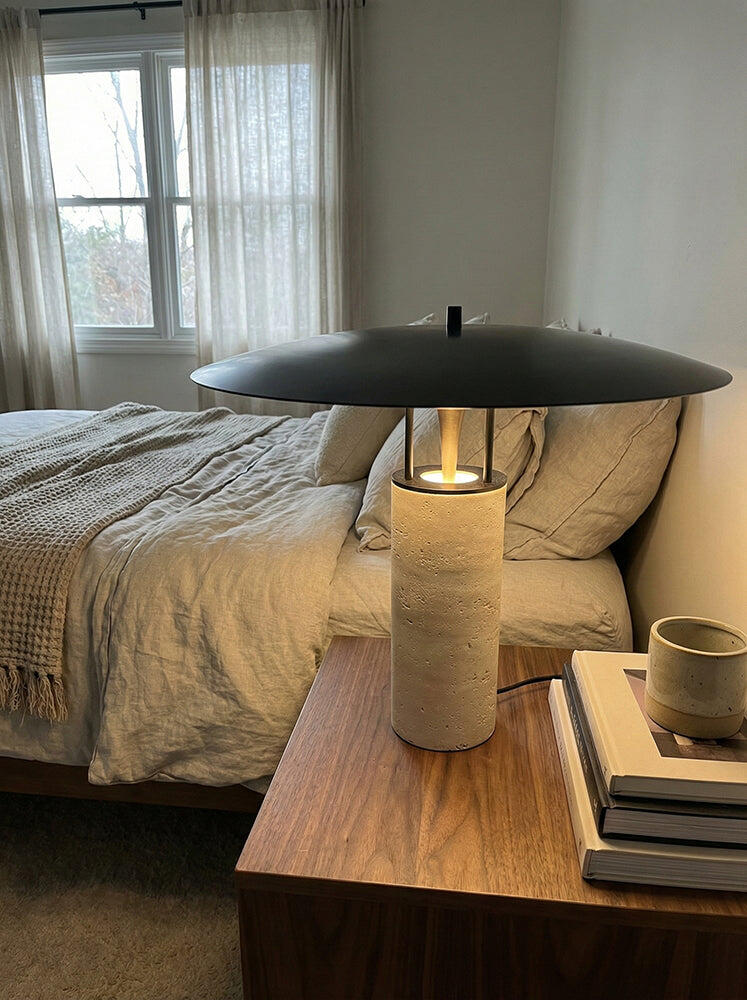
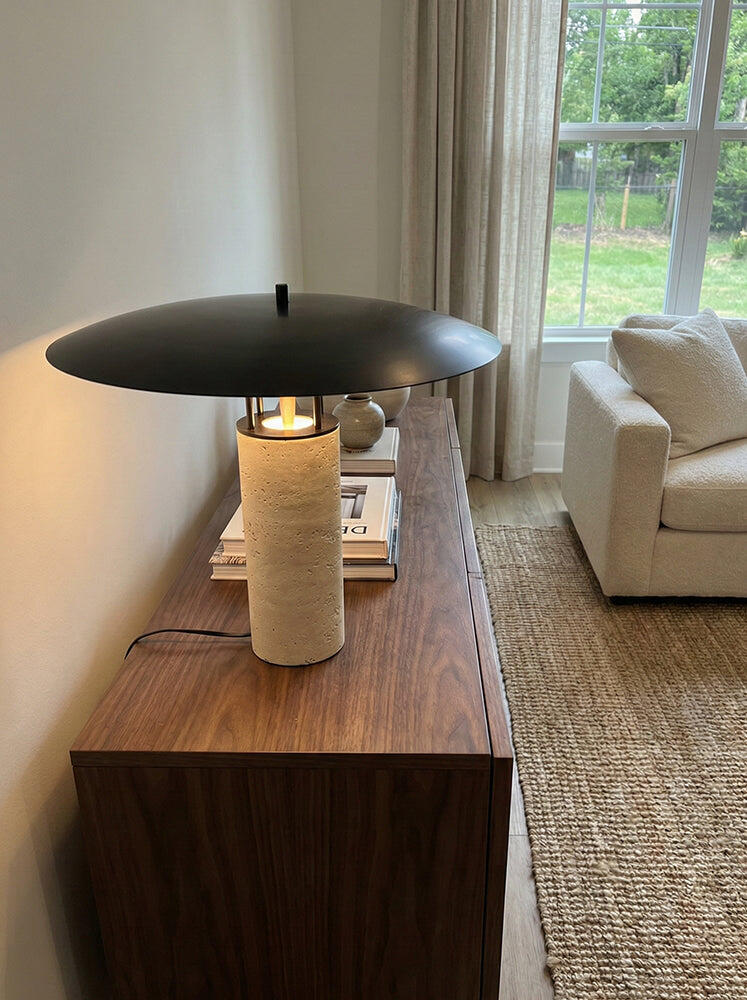
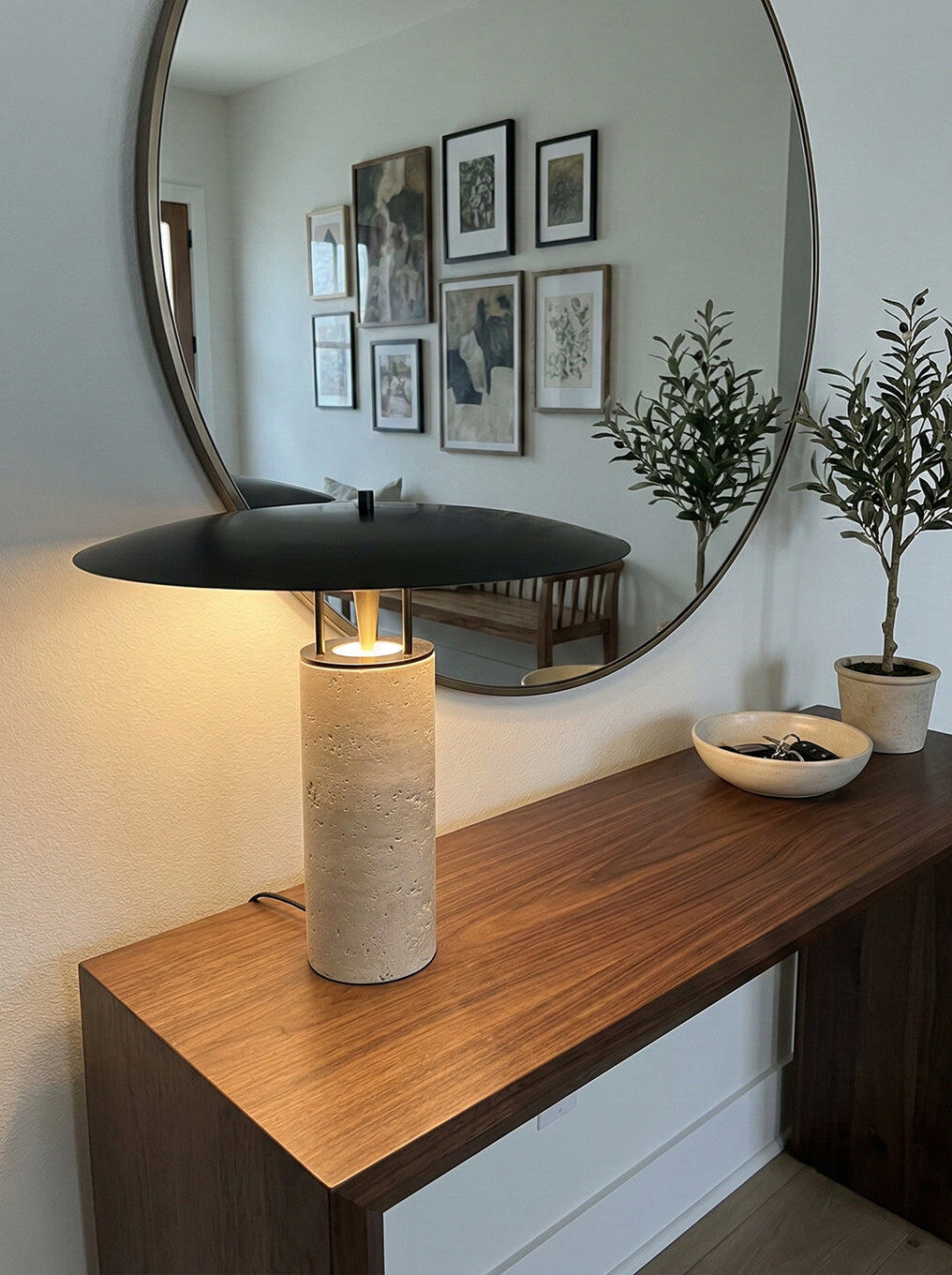
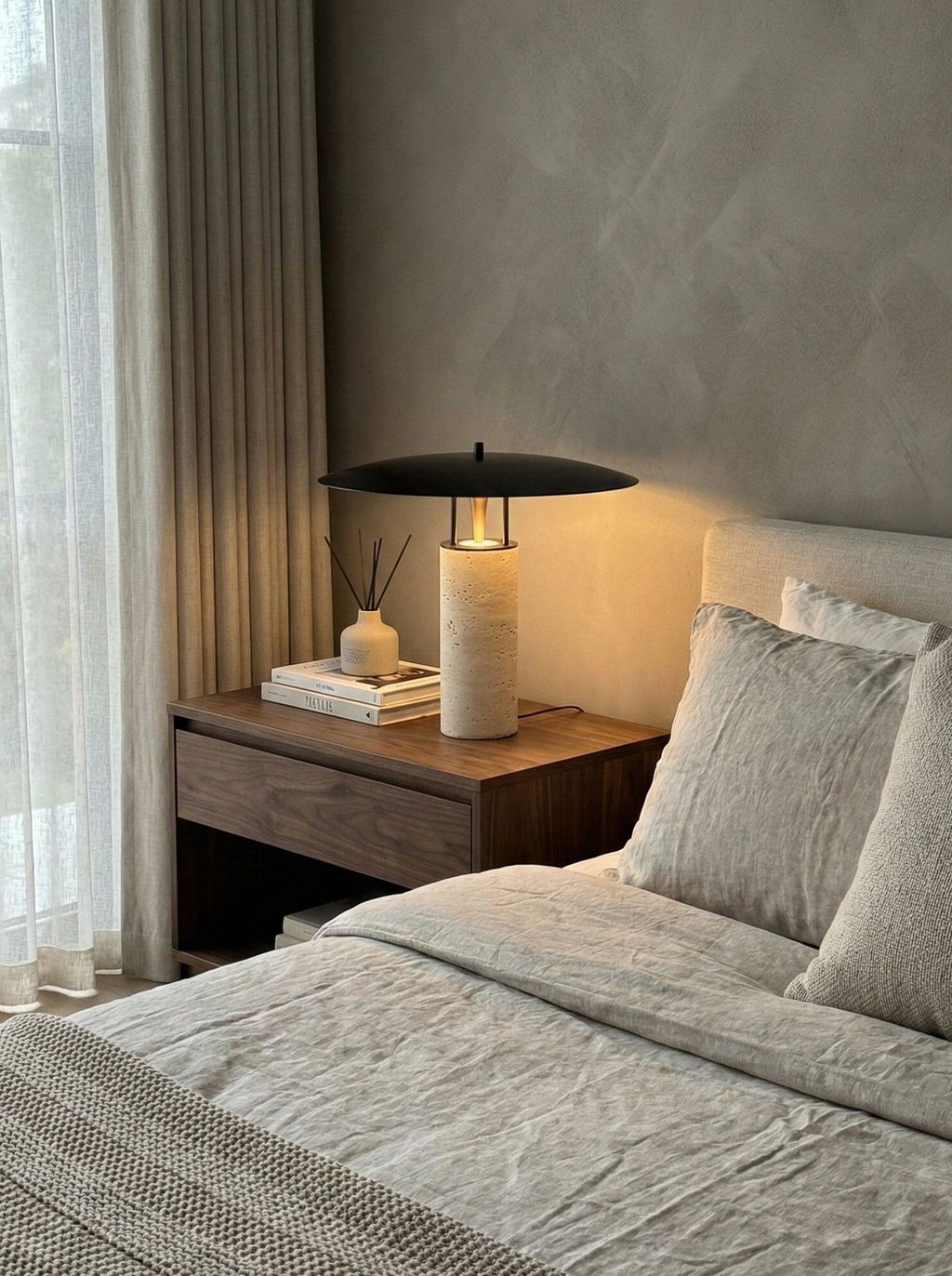

Natural stone lighting
It starts as a block this size.
Every travertine fixture we make begins in a yard like this one — a raw block chosen for its banding, sawn down, and hollowed out by hand until what is left is a shade. Nothing is cast, veneered or filled.
The material
Travertine is not manufactured. It is formed.
Laid down over thousands of years by mineral springs, then cut once and finished by hand. What arrives is a piece of that record, not a copy of it.
 Quarried stone · honed by hand
Real stone, worked by hand
Quarried, cut and honed — nothing compoundedThis is travertine out of the ground, not a compound. Engineered stone is crushed mineral bound in polymer and pressed into sheets; it can look convincing in a photograph, but the pattern repeats every metre or so and the surface is really plastic holding stone dust. Ours comes off a block cut in a quarry, and every piece carries whatever that block happened to contain.
Finishing is done by hand, grit by grit. A machine polisher would take minutes and leave a flat, glassy face — it shears off the high points, seals the pores and gives you a surface that reflects light rather than holds it. Hand honing takes hours instead, working coarse through ultra-fine until the stone is smooth to the touch but still open, with its pores and banding exactly where the block put them.
You feel the difference before you see it. The surface is cool and faintly textured, with a soft sheen rather than a shine, and small shadows that shift as you walk past. That is what stone does when it has not been filled and buffed into something else.
A machine can make stone look perfect. Only a hand can leave it looking like stone.
 Cut forms · cylinder, dome, arch, disc
Cut as sculpture, not as a shade
Hollowed from one solid blockMost stone fixtures on the market are panels bonded to a metal drum. It uses a fraction of the material and it is far quicker to build, but the banding breaks at every joint and there is always a seam somewhere that catches the eye once you have noticed it.
Ours are cored out of a single block. The banding wraps continuously around the form, the wall thickness is even the whole way round, and there is no join to find because there is no join. It costs several times the stone and a great deal more time on the lathe, and it is the difference you register from across a room without being able to name it.
Working from solid also means the geometry is open. Cylinders, domes, arches, stacked discs, tapered cones — anything that can be drawn can be cut, at the scale the room needs rather than the scale a stock mould allows.
Switched off, it is still an object in the room. Glass and metal only exist once you flip the switch.
The stone softens the light itself
Natural voids scatter the beam on its way out, so the warmth sits closer to candlelight than to a bulb: soft, slightly irregular, never clinical. No diffuser, no frosted glass and no warm-tinted lamp is doing that work — the material is.
Between cream and walnut
From pale bone through sunlit beige to deep earth brown, with the colour running through the block rather than sitting on the surface. It is a neutral that has warmth in it, which is why travertine sits as comfortably against oak and linen as it does against plaster and steel.
Made to be kept, not replaced
Stone does not yellow, sag, cloud or delaminate. It takes on a quiet patina where hands touch it and otherwise stays exactly as it arrived. That is the argument for buying one fixture properly instead of three cheaply over the same fifteen years.
How We Shape Every Travertine Lamp
Each lamp begins as a raw block of natural travertine. In our workshop, the stone is cut and finished in careful stages, so its pores and veining stay true to nature while the surface gains a soft, even finish.
-

Precision Cutting
An industrial diamond saw slices each raw travertine block into workable pieces. The fine blade leaves clean, accurate edges and helps protect the stone from chips and cracks.
-

Hand Polishing
Craftsmen polish each piece by hand, keeping the surface wet to control heat and dust. This slow finish brings out the stone's warm tone and flowing veins and gives it a smooth, refined feel.
Explore the Quiet Beauty of Our Travertine Lamps
Every travertine lamp we make begins as natural stone, formed layer by layer in mineral springs over thousands of years. Its open pores and flowing veins come straight from the earth, so no two pieces are ever quite the same.
Choose the tone that suits your room and bring a calm, organic warmth into your home.
- Natural Beige Warm sand tone with open, natural pores
- Ivory White Soft, light stone with fine linear veining
- Volcanic Black Deep, textured stone with bold contrast
Natural variation in color and veining is part of the stone, and it makes each lamp one of a kind.
Looking for another color or style?
Tell us what you have in mind and we'll help you find the right match. Email support@vidirlighting.com

Shop Travertine Lighting
From bedside sconces to statement chandeliers, find natural stone lighting for every room in your home.
View all travertine lighting-

Travertine Wall Lamps
Sconces for hallways, bedsides and bathroom vanities Shop the collection -

Travertine Pendant Lights
Warm stone pendants for kitchens, dining and bedsides Shop the collection -

Travertine Chandeliers
Statement pieces for dining and living rooms Shop the collection -

Travertine Ceiling Lights
Flush mounts with earthen stone texture for any room Shop the collection -

Travertine Table Lamps
Bedside and living room lamps in natural stone Shop the collection


