See It In Motion
Watch the Light Come to Life
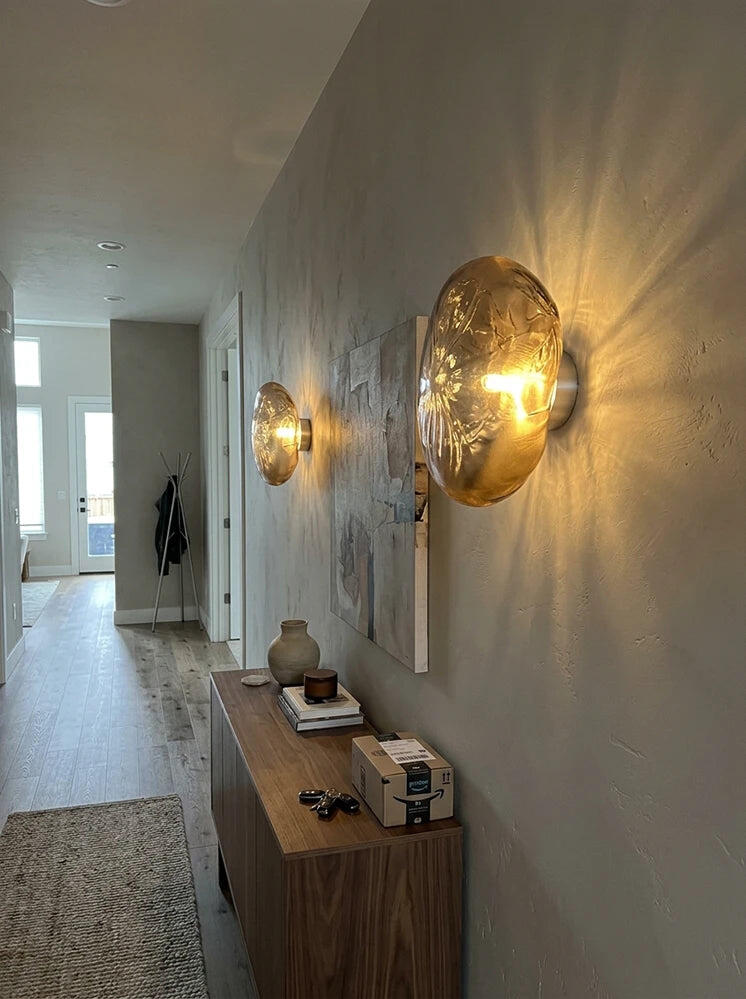
The Corvina Molten Glass Wall Sconce is a single hand-blown glass disc mounted flush to the wall, and it keeps every mark of how it was made. A fine mesh texture runs across the whole surface — the weave of the mould, pressed into the glass while it was still molten. The centre has collapsed slightly inward where the bubble gave. The edges fold and pleat where the glass met resistance and buckled.
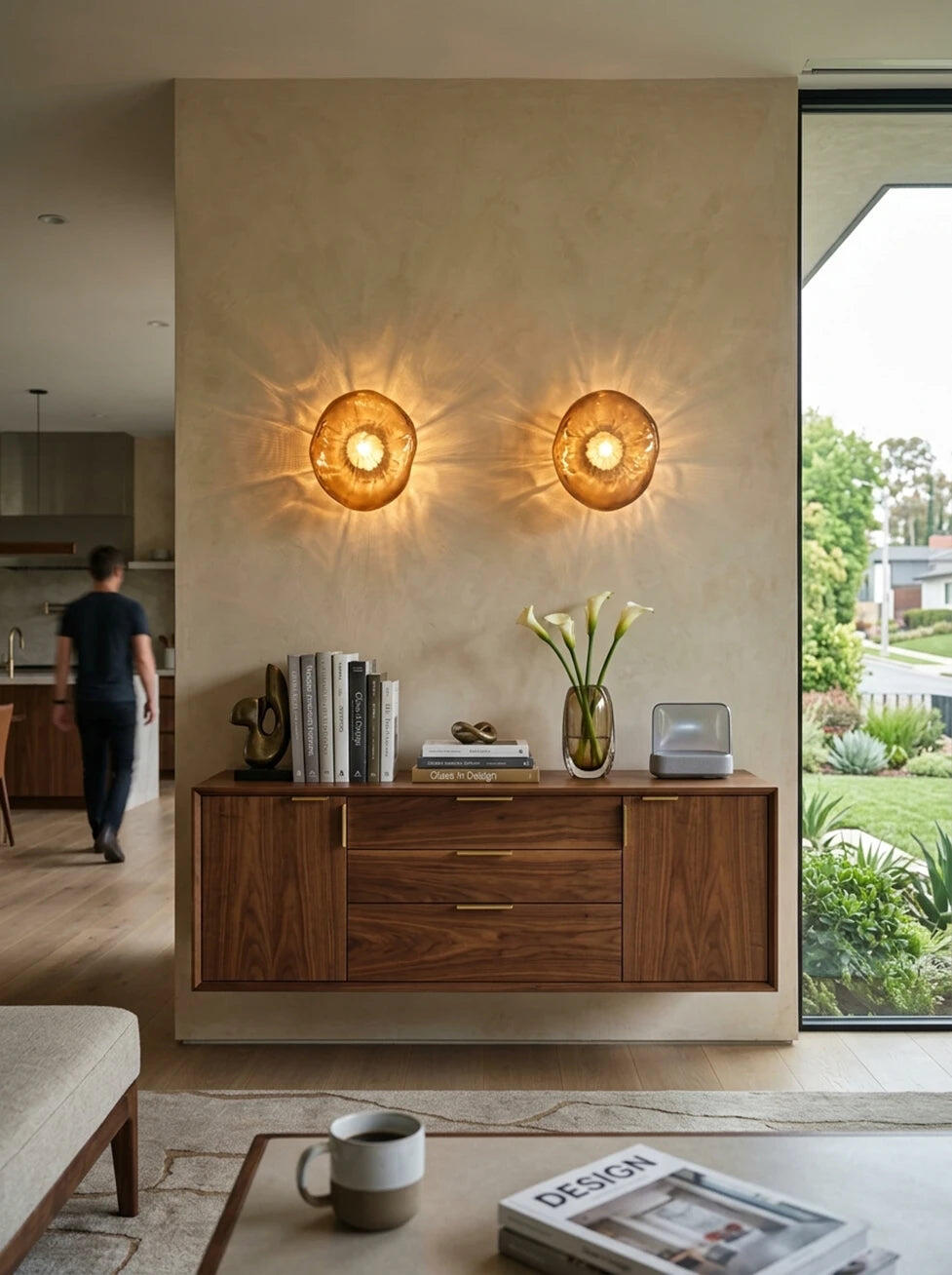
None of that was polished out. Most glassmaking is a process of erasing evidence — grind the seam, smooth the fold, make it look as though the object simply arrived. Lit, the texture does the work. Light passing through the mesh grain and the folded seams throws a rayed shadow across the wall behind it — a soft radiating pattern that changes with the shape of each individual piece. The disc glows unevenly on purpose: brighter where the glass runs thin at the folds, deeper where it thickened as it slumped.
Buying a Pair?
Select the size marked (*2) — two together come at a better price than buying them separately.
What You See Is What You Get
 The back of the shade — the side nobody styles
 The aluminium base mount and hardware, in detail
Described Honestly
Materials, sizes and finishes are listed exactly as they are — including the fact that every disc slumps its own way, so the folds and the shadow it throws are never quite the ones in the photographs.
Real Glass, Not Resin
Hand-blown glass on an aluminium mount — never moulded resin, never acrylic made to look like art glass. Photographed from the back as well as the front, because the back is where you can tell.
Aluminium Behind the Glass
The mount is aluminium rather than plated steel — it will not corrode where you cannot see it, and it keeps the fixture light enough for a standard wall box. The glass is wrapped separately and foam-seated for the journey.
The Details
Good to Know
The wall behind it is part of the fixture
Light travelling through the mesh grain and the folded seams throws a rayed shadow across the wall behind the disc. It is the best thing about this piece — and it means the wall matters as much as the sconce does.
Mount it on plain plaster or painted plasterboard and the pattern lands whole. On patterned wallpaper, panelling, tile or a textured wall it gets broken up, and you lose most of what you bought. Give it a clear span of wall on the side the light throws.
Mounting height, and buying in pairs
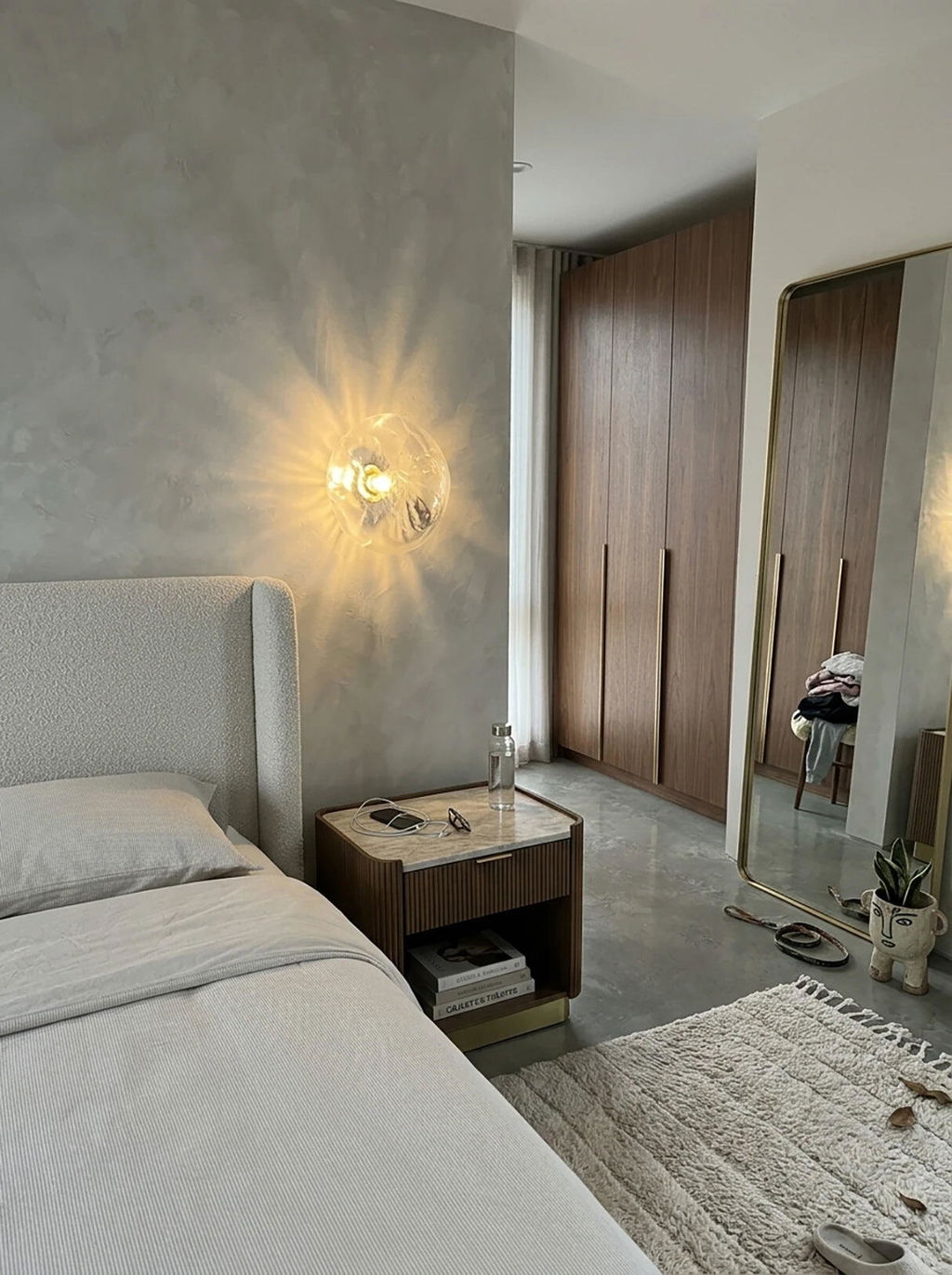
At ∅ 9.8″ this is a compact disc, so it can sit lower than a tall sconce without looking lost. Set the centre 60–66″ (152–168 cm) above the finished floor in a hallway or living room; 52–56″ beside a bed, where you are lying down rather than standing.
For a pair either side of a bed or mirror, space them 36–40″ (90–100 cm) apart and keep both centres level. Decide the height before the junction box is roughed in — it is the one thing that is expensive to change later.
Where it can and cannot go
This is an indoor, dry-location fixture: hallways, bedrooms, living rooms, stairwells, beside a mirror in a dressing room.
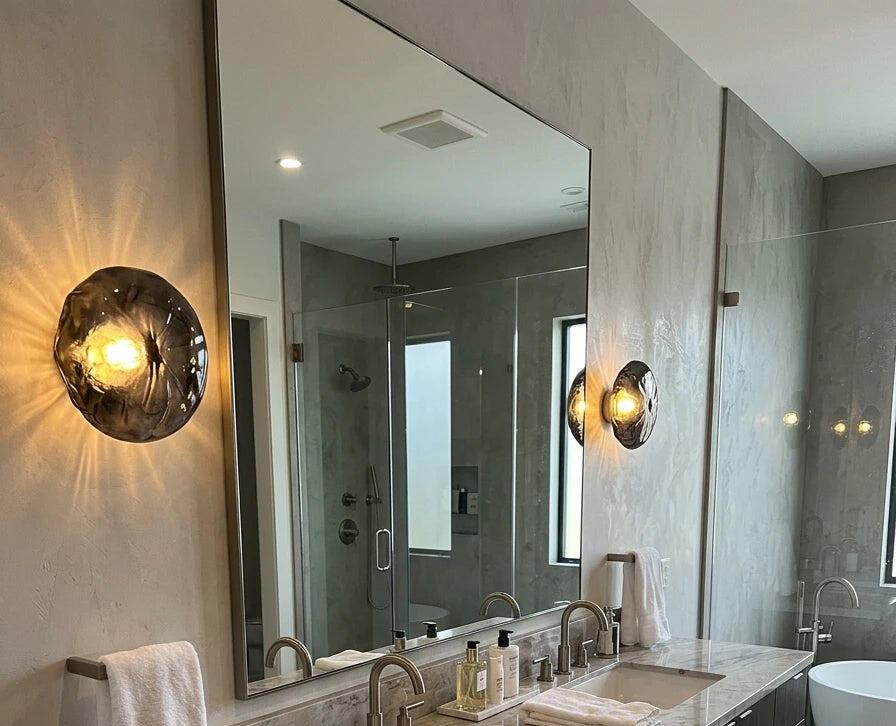
Not for a bathroom, above a bath or shower, in a laundry, or on a covered porch, even one that stays out of direct rain. Those positions need a fixture rated for damp locations.
How High, How Many, Which Wall
One size, and four ways to use it. With a sconce the decision is never which size to buy — and with this one there is a third question most fixtures do not raise, because it casts a pattern and the pattern needs somewhere to land.

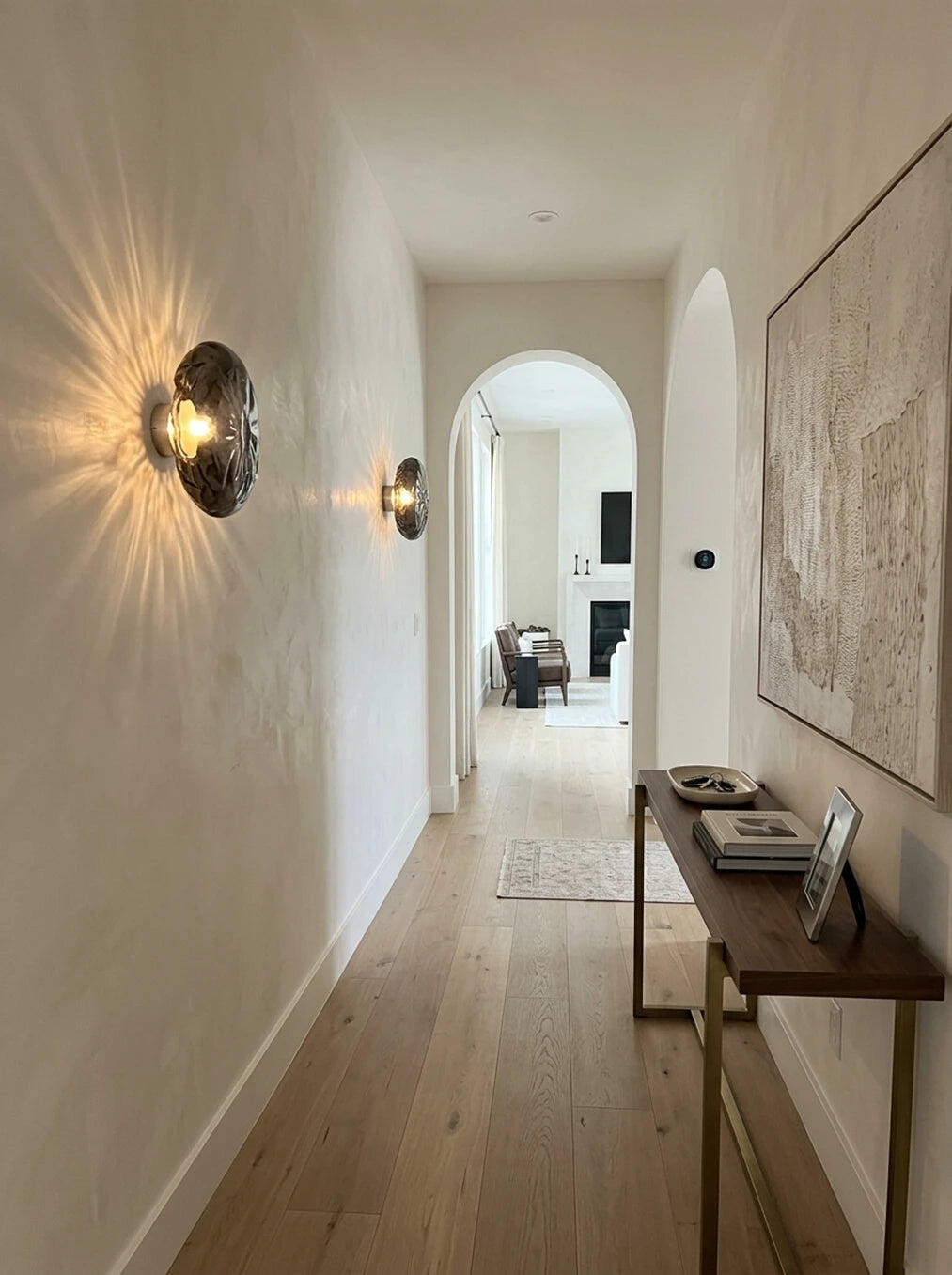
The rayed shadow reads best here — a corridor is mostly empty wall, which is exactly what this fixture wants.
Not a reading light. Keep a lamp or a swing-arm alongside if you read in bed.
Measure from the tread below each fixture, never from a single floor level.
Alone on a plain wall is the placement that shows what this piece actually does.
The Wall Matters as Much as the Sconce
Light travelling through the mesh grain and the folded seams throws a rayed pattern onto the wall behind the disc. It is the best thing about this fixture — and it means the wall is doing half the work.
Mount it on plain plaster or painted plasterboard and the pattern lands whole. On patterned wallpaper, panelling, tile or a heavily textured wall it gets broken up, and you lose most of what you bought. Leave clear wall around it: 24″ (60 cm) in every direction is a good minimum, more if you can. A frame, a shelf or a door casing sitting right beside one will crop the cast.
Then settle the height, because that is the one decision that is expensive to undo. Cut a 9.8 in circle of card, tape it up at the height you are considering, and live with it for a day — standing where you will actually stand. Decide before the electrician roughs in the box; everything else about a sconce can be changed later, but moving a box means opening a wall.
Everything You See Is Evidence
The mesh. The folds. The sunken centre. None of it was polished out.
Most glassmaking is a process of removing proof. The mould leaves a grain — grind it off. The glass buckles where it met resistance — smooth the fold. A seam shows where two things met — polish until it is gone. The finished object is supposed to look as though it simply arrived, with no account of how.
Look closely at this one and the whole account is still there. A fine mesh grain runs across the entire surface — the weave of the mould, pressed into the glass while it was soft enough to take it. The edges fold and pleat where the glass met the rim and had nowhere to go. The centre has sunk inward, at the moment the bubble stopped holding and gave. Every one of those was a real event, at a real temperature, on a particular afternoon.
Switched on, everything the maker did not smooth away is redrawn on the wall behind, several times its own size — the mesh becomes a fine rayed shadow, the folds become dark spokes running out from the centre. A record of one afternoon in a workshop, projected onto your wall every evening.
It Casts as Much as It Glows
A hand-blown disc that keeps the marks of its own making — and throws every one of them onto the wall behind it.
The Marks of Its Own Making
A fine mesh grain runs across the whole surface — the weave of the mould, pressed into the glass while it was soft enough to take it. The edges fold where the glass met the rim and had nowhere to go. The centre has sunk inward, at the moment the bubble stopped holding. Most glassmaking grinds those marks away so the object looks as though it simply arrived. This one leaves the account intact.
The Wall Does Half the Work
Light travelling through the mesh and the folds is redrawn on the wall behind, several times its own size — the grain becomes a fine rayed shadow, the folds become dark spokes running out from the centre. It is the reason this needs plain plaster or painted wall around it: on patterned paper or panelling the cast breaks up, and you lose the better half of the fixture.
Three Colourways, Three Registers
Clear is the brightest and throws the sharpest rays — choose it if the cast pattern is what you are buying. Tea amber warms the wall and pushes the whole thing toward honey, with softer rays and the warmest glow of the three. Smoke grey is the most sculptural: nearly a dark object unlit, and lit it holds most of the light inside itself. Same disc, three completely different things on a wall.
— Hand-blown glass, mounted on aluminium —
Why Freely Formed Glass
Almost every glass shade on the market is moulded to be identical. This one was allowed to find its own shape — including the one thing a moulded fixture does better.
ness Each disc slumps its own way, so the folds — and the shadow they throw — exist nowhere else Pressed from one tool; the same piece repeated, and the same shadow, if any
Common Questions
What is the mesh pattern on the glass?
It is the weave of the mould, pressed into the glass while it was still molten — soft enough to take the texture, hot enough to keep it. Nothing is printed, etched or applied afterwards.
On most fixtures that grain would be ground off and fire-polished away, because the convention is that a finished object should show no evidence of how it was made. Here it stays, and it does real work: it is what turns a plain glow into a rayed pattern on the wall behind. Run a finger across the surface and you can feel it.
Will it throw a shadow on my wall?
Yes — and that is the reason to buy it rather than something to worry about. Light travelling through the mesh grain and the folded seams is redrawn on the wall behind, several times its own size: the grain becomes a fine rayed pattern, the folds become dark spokes running out from the centre.
Which does mean the wall matters. Plain plaster or painted plasterboard and the pattern lands whole. On patterned wallpaper, panelling, tile or a heavily textured wall it breaks up and you lose most of what you paid for. Leave 24″ (60 cm) of clear wall around it where you can.
Is it real glass, or resin?
Will mine look exactly like the photographs?
Which colourway should I choose?
Choose by what you want on the wall. Clear is the brightest and throws the sharpest rays — take it if the cast pattern is the thing you are buying. Tea amber warms the wall and pushes the whole thing toward honey; the rays are softer and the glow is the warmest of the three.
Smoke grey is the most sculptural. Unlit it reads almost as a dark object on the wall; lit, it holds much of the light inside itself and gives the least cast. Take it if you want the disc itself to be the point rather than the shadow.
How bright is it?
What bulbs does it take?
G4 LED bulbs, warm white recommended, not included. A small capsule lamp is used deliberately — it sits low and out of sight inside the disc, which is part of why the glass reads as a lit object rather than a shade with a bulb in it.
One thing to watch when you buy replacements: G4 comes in two voltages that look completely identical, mains and 12V, with the same two pins and the same capsule. They are not interchangeable. This fixture takes [__ CONFIRM VOLTAGE] G4 LEDs — check the packet, and send us a photograph if you are unsure.
Can it be dimmed?
How high should I mount it, and do I need a pair?
Set the centre 60–66″ (152–168 cm) above the finished floor in a hallway, living room or stairwell. Beside a bed, drop to 52–56″ — a small disc sits lower than a tall sconce without looking lost, and you are lying down rather than standing.
A pair either side of a bed, spaced 36–40″ apart with both centres level. Singles work well in an alcove, above a console or at the end of a hall. In a corridor, run them at 8–10 ft spacing. Tell us if you are buying a pair and we will match them from the same run so they read as siblings.
Can I use it in a bathroom?
Will it fit a narrow hallway?
How do I clean it, and what if it arrives damaged?
A soft dry cloth for dust, barely damp for marks, following the folds rather than working across them. Avoid abrasive pads, solvents and glass sprays containing ammonia — the mesh grain traps residue. Switch off and let the bulb cool completely first.
The glass is wrapped separately and foam-seated, with the aluminium mount and hardware packed apart from it. If something arrives damaged, send photographs within 24 hours of delivery and the affected part is replaced — noting that a replacement disc will have its own folds, as every freely formed piece does.
The Complete Installation Guide
Not sure how to wire it, how high to hang it, or whether you need an electrician? Our full guide walks through every step for US homes.
Power Off First
Switch off at the breaker and confirm before you touch any wiring.
Check the Box
Make sure your junction box is standard, secure, and rated for the weight.
Match the Wires
Black to black, white to white, ground to ground — the US standard explained.
Set the Height
Mounting heights and clearances for sconces, pendants, and chandeliers.
Corvina Molten Glass Wall Sconce
The price includes tax, and free standard shipping within the U.S. is provided.

Free Shipping on all orders
Hassle-free return within 30 days
Payment Security
Pairs Well With
See It In Motion
Watch the Light Come to Life
The Corvina Molten Glass Wall Sconce is a single hand-blown glass disc mounted flush to the wall, and it keeps every mark of how it was made. A fine mesh texture runs across the whole surface — the weave of the mould, pressed into the glass while it was still molten. The centre has collapsed slightly inward where the bubble gave. The edges fold and pleat where the glass met resistance and buckled.
None of that was polished out. Most glassmaking is a process of erasing evidence — grind the seam, smooth the fold, make it look as though the object simply arrived. Lit, the texture does the work. Light passing through the mesh grain and the folded seams throws a rayed shadow across the wall behind it — a soft radiating pattern that changes with the shape of each individual piece. The disc glows unevenly on purpose: brighter where the glass runs thin at the folds, deeper where it thickened as it slumped.
Buying a Pair?
Select the size marked (*2) — two together come at a better price than buying them separately.
What You See Is What You Get
The back of the shade — the side nobody styles
The aluminium base mount and hardware, in detail
Described Honestly
Materials, sizes and finishes are listed exactly as they are — including the fact that every disc slumps its own way, so the folds and the shadow it throws are never quite the ones in the photographs.
Real Glass, Not Resin
Hand-blown glass on an aluminium mount — never moulded resin, never acrylic made to look like art glass. Photographed from the back as well as the front, because the back is where you can tell.
Aluminium Behind the Glass
The mount is aluminium rather than plated steel — it will not corrode where you cannot see it, and it keeps the fixture light enough for a standard wall box. The glass is wrapped separately and foam-seated for the journey.
The Details
Good to Know
The wall behind it is part of the fixture
Light travelling through the mesh grain and the folded seams throws a rayed shadow across the wall behind the disc. It is the best thing about this piece — and it means the wall matters as much as the sconce does.
Mount it on plain plaster or painted plasterboard and the pattern lands whole. On patterned wallpaper, panelling, tile or a textured wall it gets broken up, and you lose most of what you bought. Give it a clear span of wall on the side the light throws.
Mounting height, and buying in pairs
At ∅ 9.8″ this is a compact disc, so it can sit lower than a tall sconce without looking lost. Set the centre 60–66″ (152–168 cm) above the finished floor in a hallway or living room; 52–56″ beside a bed, where you are lying down rather than standing.
For a pair either side of a bed or mirror, space them 36–40″ (90–100 cm) apart and keep both centres level. Decide the height before the junction box is roughed in — it is the one thing that is expensive to change later.
Where it can and cannot go
This is an indoor, dry-location fixture: hallways, bedrooms, living rooms, stairwells, beside a mirror in a dressing room.
Not for a bathroom, above a bath or shower, in a laundry, or on a covered porch, even one that stays out of direct rain. Those positions need a fixture rated for damp locations.
How High, How Many, Which Wall
One size, and four ways to use it. With a sconce the decision is never which size to buy — and with this one there is a third question most fixtures do not raise, because it casts a pattern and the pattern needs somewhere to land.
The rayed shadow reads best here — a corridor is mostly empty wall, which is exactly what this fixture wants.
Not a reading light. Keep a lamp or a swing-arm alongside if you read in bed.
Measure from the tread below each fixture, never from a single floor level.
Alone on a plain wall is the placement that shows what this piece actually does.
The Wall Matters as Much as the Sconce
Light travelling through the mesh grain and the folded seams throws a rayed pattern onto the wall behind the disc. It is the best thing about this fixture — and it means the wall is doing half the work.
Mount it on plain plaster or painted plasterboard and the pattern lands whole. On patterned wallpaper, panelling, tile or a heavily textured wall it gets broken up, and you lose most of what you bought. Leave clear wall around it: 24″ (60 cm) in every direction is a good minimum, more if you can. A frame, a shelf or a door casing sitting right beside one will crop the cast.
Then settle the height, because that is the one decision that is expensive to undo. Cut a 9.8 in circle of card, tape it up at the height you are considering, and live with it for a day — standing where you will actually stand. Decide before the electrician roughs in the box; everything else about a sconce can be changed later, but moving a box means opening a wall.
Everything You See Is Evidence
The mesh. The folds. The sunken centre. None of it was polished out.
Most glassmaking is a process of removing proof. The mould leaves a grain — grind it off. The glass buckles where it met resistance — smooth the fold. A seam shows where two things met — polish until it is gone. The finished object is supposed to look as though it simply arrived, with no account of how.
Look closely at this one and the whole account is still there. A fine mesh grain runs across the entire surface — the weave of the mould, pressed into the glass while it was soft enough to take it. The edges fold and pleat where the glass met the rim and had nowhere to go. The centre has sunk inward, at the moment the bubble stopped holding and gave. Every one of those was a real event, at a real temperature, on a particular afternoon.
Switched on, everything the maker did not smooth away is redrawn on the wall behind, several times its own size — the mesh becomes a fine rayed shadow, the folds become dark spokes running out from the centre. A record of one afternoon in a workshop, projected onto your wall every evening.
It Casts as Much as It Glows
A hand-blown disc that keeps the marks of its own making — and throws every one of them onto the wall behind it.
The Marks of Its Own Making
A fine mesh grain runs across the whole surface — the weave of the mould, pressed into the glass while it was soft enough to take it. The edges fold where the glass met the rim and had nowhere to go. The centre has sunk inward, at the moment the bubble stopped holding. Most glassmaking grinds those marks away so the object looks as though it simply arrived. This one leaves the account intact.
The Wall Does Half the Work
Light travelling through the mesh and the folds is redrawn on the wall behind, several times its own size — the grain becomes a fine rayed shadow, the folds become dark spokes running out from the centre. It is the reason this needs plain plaster or painted wall around it: on patterned paper or panelling the cast breaks up, and you lose the better half of the fixture.
Three Colourways, Three Registers
Clear is the brightest and throws the sharpest rays — choose it if the cast pattern is what you are buying. Tea amber warms the wall and pushes the whole thing toward honey, with softer rays and the warmest glow of the three. Smoke grey is the most sculptural: nearly a dark object unlit, and lit it holds most of the light inside itself. Same disc, three completely different things on a wall.
— Hand-blown glass, mounted on aluminium —
Why Freely Formed Glass
Almost every glass shade on the market is moulded to be identical. This one was allowed to find its own shape — including the one thing a moulded fixture does better.
ness Each disc slumps its own way, so the folds — and the shadow they throw — exist nowhere else Pressed from one tool; the same piece repeated, and the same shadow, if any
Common Questions
What is the mesh pattern on the glass?
It is the weave of the mould, pressed into the glass while it was still molten — soft enough to take the texture, hot enough to keep it. Nothing is printed, etched or applied afterwards.
On most fixtures that grain would be ground off and fire-polished away, because the convention is that a finished object should show no evidence of how it was made. Here it stays, and it does real work: it is what turns a plain glow into a rayed pattern on the wall behind. Run a finger across the surface and you can feel it.
Will it throw a shadow on my wall?
Yes — and that is the reason to buy it rather than something to worry about. Light travelling through the mesh grain and the folded seams is redrawn on the wall behind, several times its own size: the grain becomes a fine rayed pattern, the folds become dark spokes running out from the centre.
Which does mean the wall matters. Plain plaster or painted plasterboard and the pattern lands whole. On patterned wallpaper, panelling, tile or a heavily textured wall it breaks up and you lose most of what you paid for. Leave 24″ (60 cm) of clear wall around it where you can.
Is it real glass, or resin?
Will mine look exactly like the photographs?
Which colourway should I choose?
Choose by what you want on the wall. Clear is the brightest and throws the sharpest rays — take it if the cast pattern is the thing you are buying. Tea amber warms the wall and pushes the whole thing toward honey; the rays are softer and the glow is the warmest of the three.
Smoke grey is the most sculptural. Unlit it reads almost as a dark object on the wall; lit, it holds much of the light inside itself and gives the least cast. Take it if you want the disc itself to be the point rather than the shadow.
How bright is it?
What bulbs does it take?
G4 LED bulbs, warm white recommended, not included. A small capsule lamp is used deliberately — it sits low and out of sight inside the disc, which is part of why the glass reads as a lit object rather than a shade with a bulb in it.
One thing to watch when you buy replacements: G4 comes in two voltages that look completely identical, mains and 12V, with the same two pins and the same capsule. They are not interchangeable. This fixture takes [__ CONFIRM VOLTAGE] G4 LEDs — check the packet, and send us a photograph if you are unsure.
Can it be dimmed?
How high should I mount it, and do I need a pair?
Set the centre 60–66″ (152–168 cm) above the finished floor in a hallway, living room or stairwell. Beside a bed, drop to 52–56″ — a small disc sits lower than a tall sconce without looking lost, and you are lying down rather than standing.
A pair either side of a bed, spaced 36–40″ apart with both centres level. Singles work well in an alcove, above a console or at the end of a hall. In a corridor, run them at 8–10 ft spacing. Tell us if you are buying a pair and we will match them from the same run so they read as siblings.
Can I use it in a bathroom?
Will it fit a narrow hallway?
How do I clean it, and what if it arrives damaged?
A soft dry cloth for dust, barely damp for marks, following the folds rather than working across them. Avoid abrasive pads, solvents and glass sprays containing ammonia — the mesh grain traps residue. Switch off and let the bulb cool completely first.
The glass is wrapped separately and foam-seated, with the aluminium mount and hardware packed apart from it. If something arrives damaged, send photographs within 24 hours of delivery and the affected part is replaced — noting that a replacement disc will have its own folds, as every freely formed piece does.
The Complete Installation Guide
Not sure how to wire it, how high to hang it, or whether you need an electrician? Our full guide walks through every step for US homes.
Power Off First
Switch off at the breaker and confirm before you touch any wiring.
Check the Box
Make sure your junction box is standard, secure, and rated for the weight.
Match the Wires
Black to black, white to white, ground to ground — the US standard explained.
Set the Height
Mounting heights and clearances for sconces, pendants, and chandeliers.