Unlock Savings: Get 10% Off Automatically on Every Order!

Free standard shipping, all orders support 30-day returns

Your cart

Your cart is empty

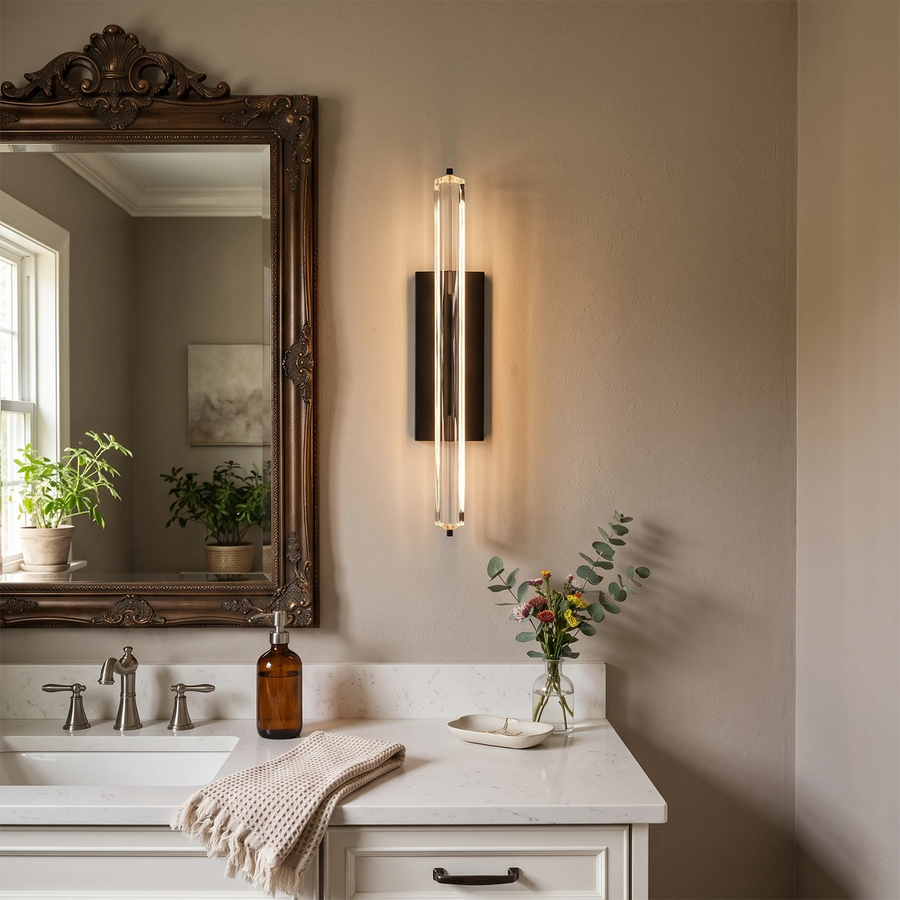
The Rainer Faceted Crystal Bar Sconce runs a single faceted crystal column down a slim metal backplate — and does not sit it flat against the wall. The glass stands proud of the plate, offset so light leaves the column on every side, including the side facing the wall.

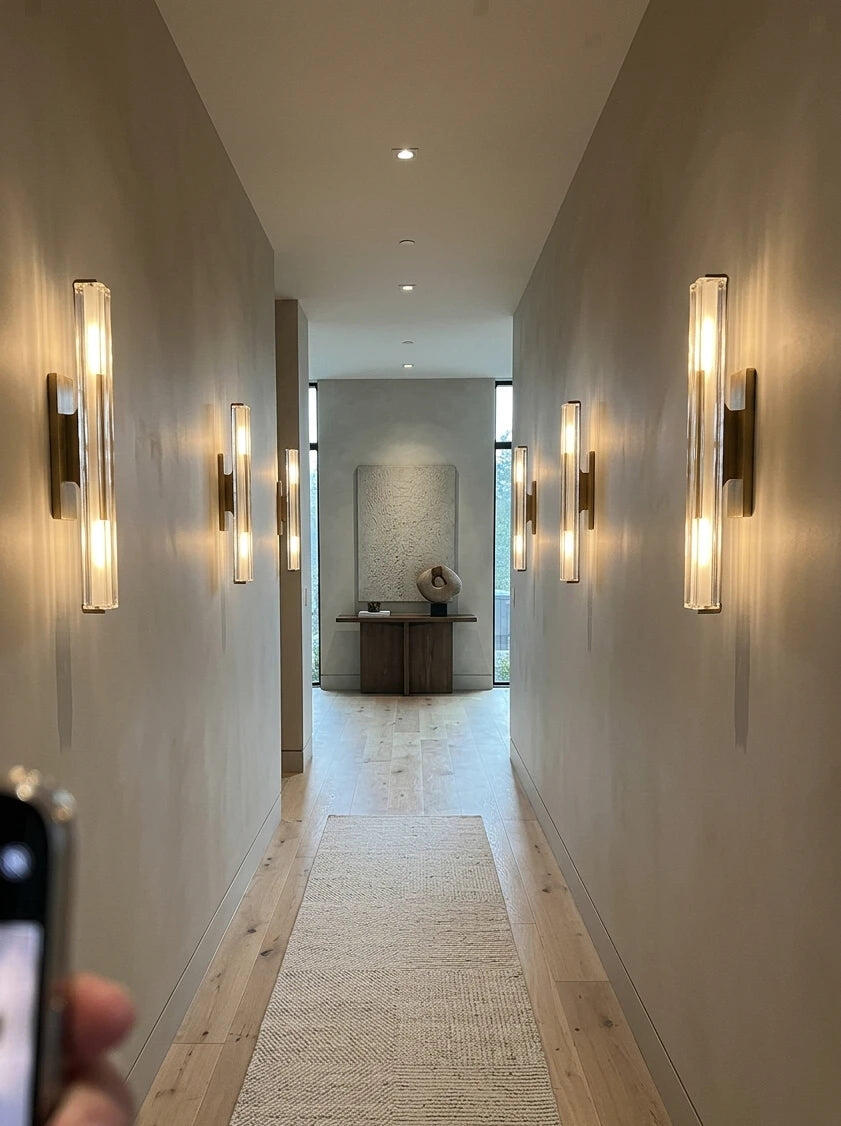
That gap is the design. A conventional bar sconce presses its diffuser to a plate and sends light forward; there is nothing behind it and the wall stays dark. Here the light escapes down the space between glass and metal and washes the wall on both sides of the fixture — so what you see is a bright vertical line with a soft field of light around it, rather than a lit object on a blank surface. The column is faceted rather than round. Cut planes run the full length of the glass, so light travelling through it is turned at every face and the bar reads as a line of small bright breaks rather than one continuous tube.

×2
Better Together

Buying a Pair?

Select the size marked (*2)two together come at a better price than buying them separately.

What You See Is What You Get

Real Photo Close-up of the faceted crystal bar showing the cut planes running the full length of the prism A single faceted bar, up close — the cut planes run the full length of the prism

Described Honestly

Materials, sizes and finishes are listed exactly as they are — and photographed close enough that you can count the facets rather than take our word for them.

Crystal and Brass

Solid faceted crystal with brass hardware — never acrylic, never a printed facet pattern on a moulded tube. The planes are cut through the material, which is why they catch daylight with the fixture switched off.

Safely Packed

The crystal bar is wrapped and foam-seated on its own, with the backplate and brass hardware boxed apart from it — so nothing travels pressed against the glass.

Specifications

The Details

Material Faceted Crystal · Brass Hardware Cut planes run the full length of the bar — through the material, not printed on it.
Finish Gold Black Nickel Gold warms the crystal; black gives the sharpest contrast against a pale wall; nickel keeps both cool and quiet.
Construction Crystal set proud of the backplate The bar stands off the plate rather than pressing flat to it, so light escapes down the gap and washes the wall behind — see the note below.
Light source Integrated LED Built in — no bulb to buy, fit or replace. See the note below on what that means in practice.
Colour temperature 3000K Fixed at manufacture on an integrated LED — worth checking before you order.
Voltage AC 110–240V
Control Wall switch Dimming needs an LED-compatible dimmer — see the note below.
Mounting Wall — hardwired Mounts to a standard wall junction box. No cord or plug; installation by a licensed electrician recommended.
Environment Indoor · dry locations
Preparation time 5–10 days Made and inspected at our own workshop before dispatch.

Good to Know

Why vertical beats horizontal at a mirror

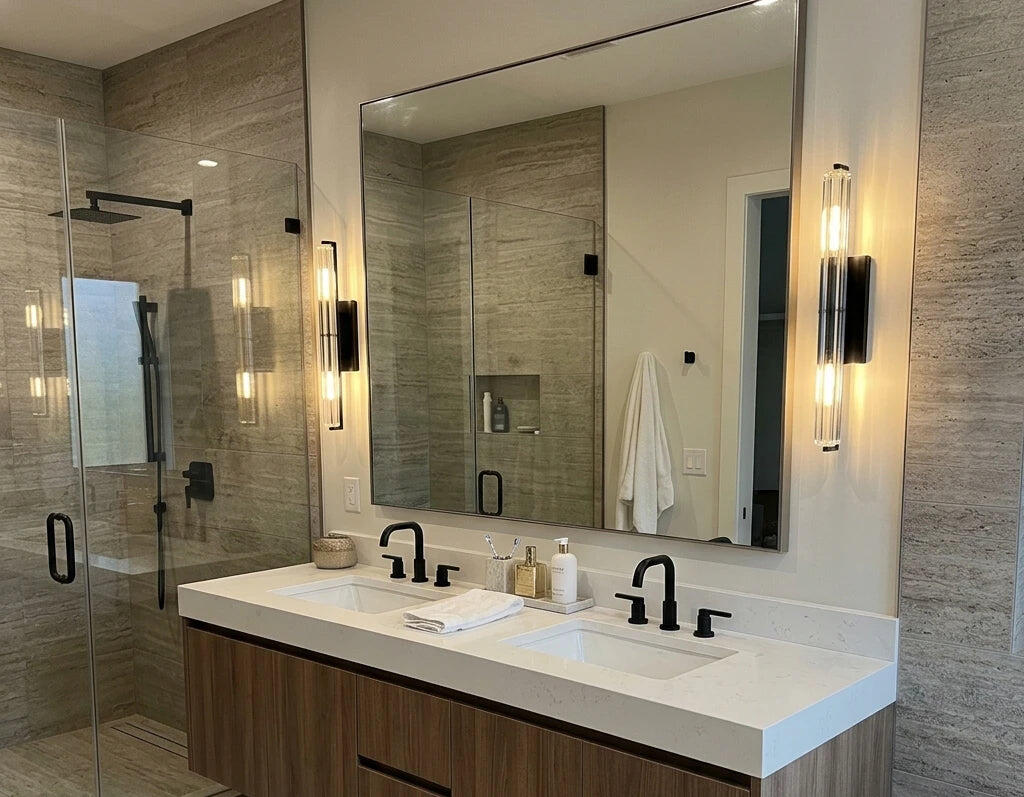
This is the argument for a bar sconce over a light bar above the glass, and it is worth knowing. A fixture mounted above a mirror lights the top of a face and leaves shadow under the brow, the nose and the chin — the reason so much bathroom lighting is unflattering.

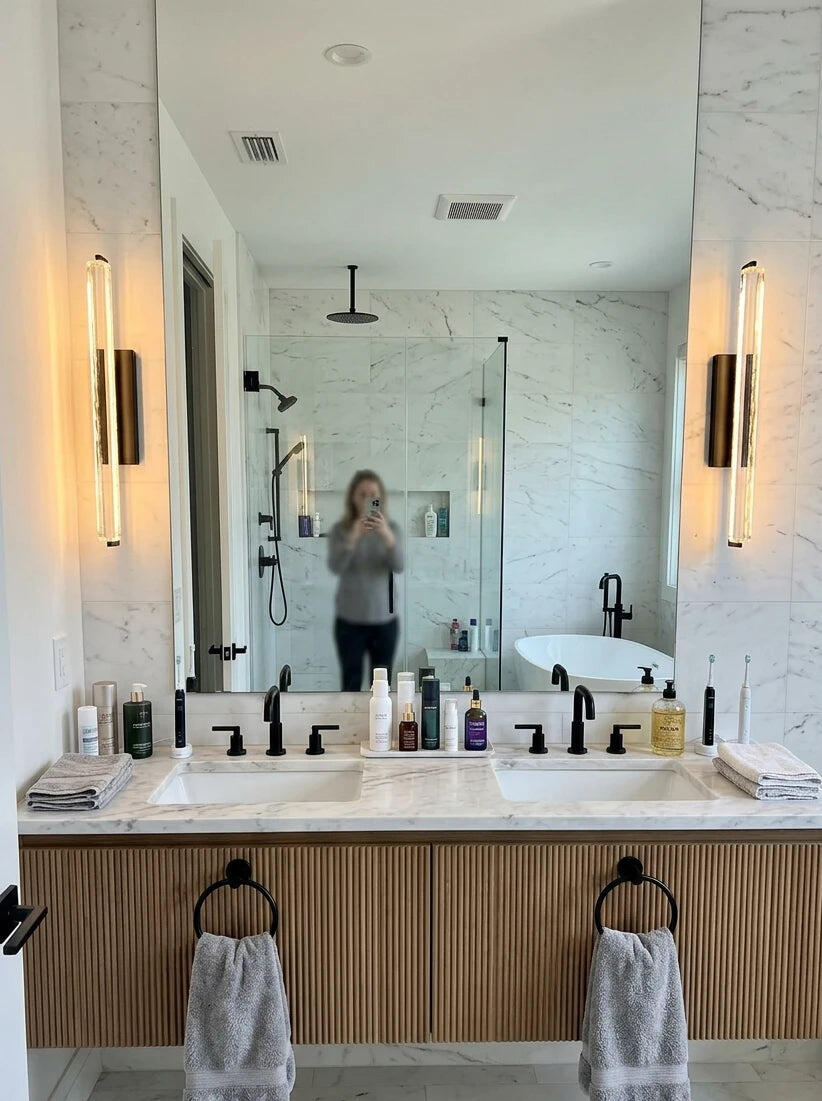
A pair mounted vertically either side, at roughly face height, lights from both sides at once and cancels those shadows. It is what portrait photographers do and what lighting designers specify. If you are lighting a mirror you actually use, buy two.

What an integrated LED means

The light source is built into the fixture rather than screwed into a socket. The advantage: nothing to buy, nothing to replace, and an unbroken line of light down the full length of the bar rather than a bulb glowing at one point in it.

The trade-off is worth knowing before you order. The colour temperature is fixed at manufacture and cannot be changed later the way a bulb can. And dimming needs a dimmer designed for LED drivers — a standard incandescent dimmer will flicker or buzz. Tell us what dimmer you have and we will confirm compatibility.

Size Guide

Two Widths, Three Heights

Six versions of the same fixture. Pick the width first — it sets how much presence the bar has on the wall — then pick the height to suit what it sits beside.

Every versionIntegrated LEDAn unbroken line of light down the full length of the bar.
FinishesGold · Black · NickelAll three finishes available in all six sizes.
∅ 3.9″ Narrow10 cm — the discreet one, for tight walls and pairs
3.9″ × 15″
∅ 3.9″ × H 15″ ∅ 10 × H 38 cm
Best forEither side of a mirror · narrow hallway · beside a doorway
Centre at64–66″
WhyAt a 64″ centre it spans roughly 56–72″ — brackets a face without overrunning a standard mirror

The mirror size. Buy two.

3.9″ × 18.9″Popular
∅ 3.9″ × H 18.9″ ∅ 10 × H 48 cm
Best forBedside · hallway run · stairwell · living room
Centre at58–66″
WhyEnough length to read as a deliberate vertical without needing a clear wall to itself

The most forgiving of the six — right in most rooms.

3.9″ × 25.2″
∅ 3.9″ × H 25.2″ ∅ 10 × H 64 cm
Best forTall entry · stairwell · a full-height wall with nothing else on it
Centre at60–66″
WhyOver two feet of vertical line — architecture rather than accent

Check what sits above it. At a 66″ centre the top reaches nearly 79″.

∅ 5.9″ Wide15 cm — more presence, more wall wash
5.9″ × 15″
∅ 5.9″ × H 15″ ∅ 15 × H 38 cm
Best forA wide vanity mirror · above a console · a short stretch of wall
Centre at64–66″
WhyThe wider plate throws a broader wash — useful where one fixture has to light more wall

Squarer in proportion than the narrow version; reads as a block rather than a line.

5.9″ × 18.9″
∅ 5.9″ × H 18.9″ ∅ 15 × H 48 cm
Best forLiving room · main bedroom · wide hallway · hospitality
Centre at60–66″
WhyThe balanced version of the wide plate — presence without dominating a normal wall

Check the projection against your corridor width before choosing this width.

5.9″ × 25.2″
∅ 5.9″ × H 25.2″ ∅ 15 × H 64 cm
Best forDouble-height entry · stairwell · restaurant or lobby wall
Centre at60–72″
WhyThe largest of the six, and the only one that can hold a tall wall on its own

Needs a clear span of plain wall. Give it 24″ of clear space either side.

Width First, Then Height

Width sets presence. The ∅ 3.9″ version reads as a line and disappears into a scheme; the ∅ 5.9″ version reads as a block and holds a wall on its own. In a narrow corridor or on a slim strip of wall beside a mirror, take the narrow one — and check the [__]″ projection against your corridor width before you commit to the wide.

Height follows what it sits beside. At a mirror, take 15″ — mounted at a 64″ centre it spans roughly 56–72″, which brackets a face without running past the top of a standard mirror. For general use, 18.9″ is the most forgiving. 25.2″ is architecture: over two feet of vertical line that wants a tall, plain wall and nothing competing with it.

One check before ordering the tallest: at a 66″ centre a 25.2″ fixture reaches nearly 79″ at the top — higher than a standard door head. Cut a paper strip at the height you are considering, tape it to the wall, and look at it from where you will actually stand. Settle the height before the junction box is roughed in; it is the only part that is expensive to change afterwards.

The design

The Gap Is the Whole Idea

The crystal does not touch the wall. Everything follows from that.

A wall light is normally pressed flat to its plate. The diffuser meets the metal, the metal meets the wall, and every photon that leaves the fixture leaves it forwards. The wall behind stays dark, which is why so many sconces read as a bright object stuck onto a blank surface — lit thing, unlit wall, a hard edge between them.

Here the crystal bar is set proud of the backplate, standing off it with a gap running the full length. Light escapes down that gap and spreads across the plaster on both sides. The wall stops being a background and becomes a second, softer source — so what you see is a bright vertical line sitting inside a broad field of glow, with no edge anywhere.

Notice what it does not do: there is no pattern. Nothing is projected, nothing is drawn. It is simply that the wall is lit as well as the fixture, and a lit wall is the oldest trick in architectural lighting for making a room feel larger and softer than it is.

— A line of light, standing just off the wall. —
Materials

Why Solid Cut Crystal

Most bar sconces at this shape are an acrylic tube with facet lines pressed onto the outside. Here is what changes when the facets go through the material instead.

Solid Cut Crystal Acrylic / Moulded Glass
The facets Cut through the material, so each plane bends light as it passes and the bar breaks into small bright highlights Pressed or printed onto a smooth tube — the lines are visible but the light passes straight through unchanged
The pattern Cut individually, so the planes vary very slightly along the bar and nothing repeats mechanically Extruded from one die — the same facet, at the same spacing, all the way down
Depth Thick solid material with visible depth — you can see into it, not just at it A hollow tube with a thin wall; there is nothing inside to look into
Over time Crystal will not yellow, cloud or go brittle from the heat of the LED behind it Acrylic yellows and clouds with heat and UV — usually within a few years, and it cannot be reversed
The hardware Brass brackets and backplate, finished in gold, black or nickel Painted or plated steel, which chips at the edges where it is handled
In the hand Cool to the touch and dense, with sharp defined edges to every plane Warm, light, with slightly rounded facet edges from the moulding process
Questions, Answered

Common Questions

Do I need one or a pair?

At a mirror, always a pair. One sconce lights half a face and leaves the other half in shadow. Space them 36–40″ (90–100 cm) apart with both centres at the same height, and set them to sit just outside the edges of the glass.

Beside a bed, a pair unless only one side is used. In a hallway, one every 8–10 ft. A single works well in an alcove, above a console, or at the end of a hall.

Is it real crystal?
Yes — the bar is solid cut crystal, not an acrylic tube with facet lines on it. Two things tell you, and both are easy to check: it is cool to the touch and heavy for its size, and the facets still catch daylight with the fixture switched off. A pressed or printed facet does neither — it feels warm and light, and it looks like a grey tube until you turn it on.
What do the facets actually do?
A round rod gives one unbroken line of light — calm, and a little dull. Cut planes run the full length of this bar, so light is turned at every face and the line breaks into a series of small bright highlights instead. Walk past it and those highlights travel with you. It is a fixture that never moves, doing something that never quite settles.
Which finish should I choose?
Gold warms the crystal and suits oak, cream and plaster rooms. Black gives the sharpest contrast — the bar reads as a bright line against a dark stroke, and it is the strongest choice on a pale wall. Nickel keeps metal and crystal equally cool and quiet, and comes closest to disappearing. All three are available in all six sizes.
Which size, and will it fit a narrow hallway?

Width first. The narrow bar reads as a line and settles into a room; the wide one reads as a block and holds a wall on its own. Then height: the shortest is the mirror size, the middle suits most rooms, and the tallest is a statement that needs a plain wall to itself.

For a corridor, the number that matters is the [__]″ projection from the wall, not the width of the fixture. In a corridor under 36″ (90 cm) wide, keep to one wall and choose the narrow bar.

Can I change the bulb?
No — the LED is built into the fixture. Nothing to buy and nothing to replace, and it is what produces an unbroken line of light down the whole bar rather than a bulb glowing at one point inside it. The trade-off is worth knowing before you order: the colour temperature is fixed at manufacture and cannot be changed later the way a bulb can.
Can it be dimmed?
Yes, with the right dimmer. A built-in LED runs on a driver, so it needs a dimmer designed for LED loads — usually a trailing-edge type. A standard old-style dimmer will make it flicker, buzz, or refuse to dim at the bottom of its range. Tell us what dimmer you have before ordering and we will confirm compatibility or advise what to fit.
Is it hard to install?
It is a hardwired fixture — no cord, no plug — and wiring should be done by a licensed electrician with the power off at the breaker. The backplate mounts to a standard wall junction box. The crystal bar is heavier than it looks, so two people make it considerably easier: one supporting the bar, one fixing the plate. Fitting a pair? Mark both heights on the wall and check them against each other before drilling anything.
Can I use it in a bathroom?
This is an indoor, dry-location fixture — hallways, bedrooms, living rooms, stairwells, or beside a mirror in a dressing room. Not above a bath or shower, and not in a laundry or on a covered porch. If you are lighting a bathroom mirror, tell us where it would sit relative to the bath and basin and we will say honestly whether it suits that position — the rules depend on distance from water, not on the room's name.
How do I clean it, and what if it arrives damaged?

A soft dry cloth down the length of the bar, or barely damp for fingerprints. Cut facets show marks sooner than a smooth surface does — that is the price of the sparkle — so a quick pass every few weeks keeps it right. Avoid abrasive pads and ammonia-based sprays, and switch off and let it cool first.

The crystal bar is wrapped and foam-seated on its own, with the backplate and brass hardware packed apart from it. If something arrives damaged, send photographs within 24 hours of delivery and the affected part is replaced.

Rainer Faceted Crystal Bar Sconce

SKU: V-CYWL2608031-1
Regular price $581.00 $415.00 -29%
Unit price
per 

The price includes tax, and free standard shipping within the U.S. is provided.

Availability
 
Tax & Shipping calculated at checkout.
With a brand-new lighting ambiance, let's usher in a hopeful 2026 10% Off All Lighting
Built Right, Inside and Out

The beauty of a fixture is easy to photograph. What matters just as much is what sits inside the canopy—the driver, the bracket, the wiring, the hardware in the box. Here is how we build for safety and longevity, so the fixture you order arrives ready to install and made to last.

Install the driver, bracket and other components - Vidirlighting
01 · The Driver

An LED Driver Built to Last

We offer integrated LED drivers in a range of styles—dimmable, constant-current, and color-temperature-adjustable—so the fixture can be matched to how you actually light the room. It runs on 110–240V, works straight out of the box on standard US household power, and is rated for both dry and damp locations, so it fits wherever you'd like to install it.

02 · The Bracket

A Solid Mounting Bracket

Every fixture ships with a sturdy mounting bracket sized to a standard US junction box—so it hangs true and stays secure, year after year. No improvising, no trips to the hardware store.

03 · The Box

Everything You Need, in One Box

Open the carton and it's all there—canopy, mounting plate and bracket, screws and wall anchors, the driver, and a pair of clean cotton gloves for handling the glass. Nothing missing, nothing to source separately. It's the small stuff, packed with care, that makes installation day feel easy.

04 · The Wiring

Clean, Color-Coded Wiring

Clearly labeled leads and a tidy factory harness make professional installation quick and unambiguous. Hand it to your electrician and they'll have it up in minutes—standard L / N / E hardwiring, the way a considered fixture should be.

Order with confidence: what arrives at your door is a fixture built to be lived with—considered on the inside, finished on the outside. Wiring should be carried out by a qualified electrician in line with local code.

Free Shipping on all orders

Hassle-free return within 30 days

Payment Security

The Rainer Faceted Crystal Bar Sconce runs a single faceted crystal column down a slim metal backplate — and does not sit it flat against the wall. The glass stands proud of the plate, offset so light leaves the column on every side, including the side facing the wall.

That gap is the design. A conventional bar sconce presses its diffuser to a plate and sends light forward; there is nothing behind it and the wall stays dark. Here the light escapes down the space between glass and metal and washes the wall on both sides of the fixture — so what you see is a bright vertical line with a soft field of light around it, rather than a lit object on a blank surface. The column is faceted rather than round. Cut planes run the full length of the glass, so light travelling through it is turned at every face and the bar reads as a line of small bright breaks rather than one continuous tube.

×2
Better Together

Buying a Pair?

Select the size marked (*2)two together come at a better price than buying them separately.

What You See Is What You Get

Real Photo Close-up of the faceted crystal bar showing the cut planes running the full length of the prism A single faceted bar, up close — the cut planes run the full length of the prism

Described Honestly

Materials, sizes and finishes are listed exactly as they are — and photographed close enough that you can count the facets rather than take our word for them.

Crystal and Brass

Solid faceted crystal with brass hardware — never acrylic, never a printed facet pattern on a moulded tube. The planes are cut through the material, which is why they catch daylight with the fixture switched off.

Safely Packed

The crystal bar is wrapped and foam-seated on its own, with the backplate and brass hardware boxed apart from it — so nothing travels pressed against the glass.

Specifications

The Details

Material Faceted Crystal · Brass Hardware Cut planes run the full length of the bar — through the material, not printed on it.
Finish Gold Black Nickel Gold warms the crystal; black gives the sharpest contrast against a pale wall; nickel keeps both cool and quiet.
Construction Crystal set proud of the backplate The bar stands off the plate rather than pressing flat to it, so light escapes down the gap and washes the wall behind — see the note below.
Light source Integrated LED Built in — no bulb to buy, fit or replace. See the note below on what that means in practice.
Colour temperature 3000K Fixed at manufacture on an integrated LED — worth checking before you order.
Voltage AC 110–240V
Control Wall switch Dimming needs an LED-compatible dimmer — see the note below.
Mounting Wall — hardwired Mounts to a standard wall junction box. No cord or plug; installation by a licensed electrician recommended.
Environment Indoor · dry locations
Preparation time 5–10 days Made and inspected at our own workshop before dispatch.

Good to Know

Why vertical beats horizontal at a mirror

This is the argument for a bar sconce over a light bar above the glass, and it is worth knowing. A fixture mounted above a mirror lights the top of a face and leaves shadow under the brow, the nose and the chin — the reason so much bathroom lighting is unflattering.

A pair mounted vertically either side, at roughly face height, lights from both sides at once and cancels those shadows. It is what portrait photographers do and what lighting designers specify. If you are lighting a mirror you actually use, buy two.

What an integrated LED means

The light source is built into the fixture rather than screwed into a socket. The advantage: nothing to buy, nothing to replace, and an unbroken line of light down the full length of the bar rather than a bulb glowing at one point in it.

The trade-off is worth knowing before you order. The colour temperature is fixed at manufacture and cannot be changed later the way a bulb can. And dimming needs a dimmer designed for LED drivers — a standard incandescent dimmer will flicker or buzz. Tell us what dimmer you have and we will confirm compatibility.

Size Guide

Two Widths, Three Heights

Six versions of the same fixture. Pick the width first — it sets how much presence the bar has on the wall — then pick the height to suit what it sits beside.

Every versionIntegrated LEDAn unbroken line of light down the full length of the bar.
FinishesGold · Black · NickelAll three finishes available in all six sizes.
∅ 3.9″ Narrow10 cm — the discreet one, for tight walls and pairs
3.9″ × 15″
∅ 3.9″ × H 15″ ∅ 10 × H 38 cm
Best forEither side of a mirror · narrow hallway · beside a doorway
Centre at64–66″
WhyAt a 64″ centre it spans roughly 56–72″ — brackets a face without overrunning a standard mirror

The mirror size. Buy two.

3.9″ × 18.9″Popular
∅ 3.9″ × H 18.9″ ∅ 10 × H 48 cm
Best forBedside · hallway run · stairwell · living room
Centre at58–66″
WhyEnough length to read as a deliberate vertical without needing a clear wall to itself

The most forgiving of the six — right in most rooms.

3.9″ × 25.2″
∅ 3.9″ × H 25.2″ ∅ 10 × H 64 cm
Best forTall entry · stairwell · a full-height wall with nothing else on it
Centre at60–66″
WhyOver two feet of vertical line — architecture rather than accent

Check what sits above it. At a 66″ centre the top reaches nearly 79″.

∅ 5.9″ Wide15 cm — more presence, more wall wash
5.9″ × 15″
∅ 5.9″ × H 15″ ∅ 15 × H 38 cm
Best forA wide vanity mirror · above a console · a short stretch of wall
Centre at64–66″
WhyThe wider plate throws a broader wash — useful where one fixture has to light more wall

Squarer in proportion than the narrow version; reads as a block rather than a line.

5.9″ × 18.9″
∅ 5.9″ × H 18.9″ ∅ 15 × H 48 cm
Best forLiving room · main bedroom · wide hallway · hospitality
Centre at60–66″
WhyThe balanced version of the wide plate — presence without dominating a normal wall

Check the projection against your corridor width before choosing this width.

5.9″ × 25.2″
∅ 5.9″ × H 25.2″ ∅ 15 × H 64 cm
Best forDouble-height entry · stairwell · restaurant or lobby wall
Centre at60–72″
WhyThe largest of the six, and the only one that can hold a tall wall on its own

Needs a clear span of plain wall. Give it 24″ of clear space either side.

Width First, Then Height

Width sets presence. The ∅ 3.9″ version reads as a line and disappears into a scheme; the ∅ 5.9″ version reads as a block and holds a wall on its own. In a narrow corridor or on a slim strip of wall beside a mirror, take the narrow one — and check the [__]″ projection against your corridor width before you commit to the wide.

Height follows what it sits beside. At a mirror, take 15″ — mounted at a 64″ centre it spans roughly 56–72″, which brackets a face without running past the top of a standard mirror. For general use, 18.9″ is the most forgiving. 25.2″ is architecture: over two feet of vertical line that wants a tall, plain wall and nothing competing with it.

One check before ordering the tallest: at a 66″ centre a 25.2″ fixture reaches nearly 79″ at the top — higher than a standard door head. Cut a paper strip at the height you are considering, tape it to the wall, and look at it from where you will actually stand. Settle the height before the junction box is roughed in; it is the only part that is expensive to change afterwards.

The design

The Gap Is the Whole Idea

The crystal does not touch the wall. Everything follows from that.

A wall light is normally pressed flat to its plate. The diffuser meets the metal, the metal meets the wall, and every photon that leaves the fixture leaves it forwards. The wall behind stays dark, which is why so many sconces read as a bright object stuck onto a blank surface — lit thing, unlit wall, a hard edge between them.

Here the crystal bar is set proud of the backplate, standing off it with a gap running the full length. Light escapes down that gap and spreads across the plaster on both sides. The wall stops being a background and becomes a second, softer source — so what you see is a bright vertical line sitting inside a broad field of glow, with no edge anywhere.

Notice what it does not do: there is no pattern. Nothing is projected, nothing is drawn. It is simply that the wall is lit as well as the fixture, and a lit wall is the oldest trick in architectural lighting for making a room feel larger and softer than it is.

— A line of light, standing just off the wall. —
Materials

Why Solid Cut Crystal

Most bar sconces at this shape are an acrylic tube with facet lines pressed onto the outside. Here is what changes when the facets go through the material instead.

Solid Cut Crystal Acrylic / Moulded Glass
The facets Cut through the material, so each plane bends light as it passes and the bar breaks into small bright highlights Pressed or printed onto a smooth tube — the lines are visible but the light passes straight through unchanged
The pattern Cut individually, so the planes vary very slightly along the bar and nothing repeats mechanically Extruded from one die — the same facet, at the same spacing, all the way down
Depth Thick solid material with visible depth — you can see into it, not just at it A hollow tube with a thin wall; there is nothing inside to look into
Over time Crystal will not yellow, cloud or go brittle from the heat of the LED behind it Acrylic yellows and clouds with heat and UV — usually within a few years, and it cannot be reversed
The hardware Brass brackets and backplate, finished in gold, black or nickel Painted or plated steel, which chips at the edges where it is handled
In the hand Cool to the touch and dense, with sharp defined edges to every plane Warm, light, with slightly rounded facet edges from the moulding process
Questions, Answered

Common Questions

Do I need one or a pair?

At a mirror, always a pair. One sconce lights half a face and leaves the other half in shadow. Space them 36–40″ (90–100 cm) apart with both centres at the same height, and set them to sit just outside the edges of the glass.

Beside a bed, a pair unless only one side is used. In a hallway, one every 8–10 ft. A single works well in an alcove, above a console, or at the end of a hall.

Is it real crystal?
Yes — the bar is solid cut crystal, not an acrylic tube with facet lines on it. Two things tell you, and both are easy to check: it is cool to the touch and heavy for its size, and the facets still catch daylight with the fixture switched off. A pressed or printed facet does neither — it feels warm and light, and it looks like a grey tube until you turn it on.
What do the facets actually do?
A round rod gives one unbroken line of light — calm, and a little dull. Cut planes run the full length of this bar, so light is turned at every face and the line breaks into a series of small bright highlights instead. Walk past it and those highlights travel with you. It is a fixture that never moves, doing something that never quite settles.
Which finish should I choose?
Gold warms the crystal and suits oak, cream and plaster rooms. Black gives the sharpest contrast — the bar reads as a bright line against a dark stroke, and it is the strongest choice on a pale wall. Nickel keeps metal and crystal equally cool and quiet, and comes closest to disappearing. All three are available in all six sizes.
Which size, and will it fit a narrow hallway?

Width first. The narrow bar reads as a line and settles into a room; the wide one reads as a block and holds a wall on its own. Then height: the shortest is the mirror size, the middle suits most rooms, and the tallest is a statement that needs a plain wall to itself.

For a corridor, the number that matters is the [__]″ projection from the wall, not the width of the fixture. In a corridor under 36″ (90 cm) wide, keep to one wall and choose the narrow bar.

Can I change the bulb?
No — the LED is built into the fixture. Nothing to buy and nothing to replace, and it is what produces an unbroken line of light down the whole bar rather than a bulb glowing at one point inside it. The trade-off is worth knowing before you order: the colour temperature is fixed at manufacture and cannot be changed later the way a bulb can.
Can it be dimmed?
Yes, with the right dimmer. A built-in LED runs on a driver, so it needs a dimmer designed for LED loads — usually a trailing-edge type. A standard old-style dimmer will make it flicker, buzz, or refuse to dim at the bottom of its range. Tell us what dimmer you have before ordering and we will confirm compatibility or advise what to fit.
Is it hard to install?
It is a hardwired fixture — no cord, no plug — and wiring should be done by a licensed electrician with the power off at the breaker. The backplate mounts to a standard wall junction box. The crystal bar is heavier than it looks, so two people make it considerably easier: one supporting the bar, one fixing the plate. Fitting a pair? Mark both heights on the wall and check them against each other before drilling anything.
Can I use it in a bathroom?
This is an indoor, dry-location fixture — hallways, bedrooms, living rooms, stairwells, or beside a mirror in a dressing room. Not above a bath or shower, and not in a laundry or on a covered porch. If you are lighting a bathroom mirror, tell us where it would sit relative to the bath and basin and we will say honestly whether it suits that position — the rules depend on distance from water, not on the room's name.
How do I clean it, and what if it arrives damaged?

A soft dry cloth down the length of the bar, or barely damp for fingerprints. Cut facets show marks sooner than a smooth surface does — that is the price of the sparkle — so a quick pass every few weeks keeps it right. Avoid abrasive pads and ammonia-based sprays, and switch off and let it cool first.

The crystal bar is wrapped and foam-seated on its own, with the backplate and brass hardware packed apart from it. If something arrives damaged, send photographs within 24 hours of delivery and the affected part is replaced.

Customer Reviews