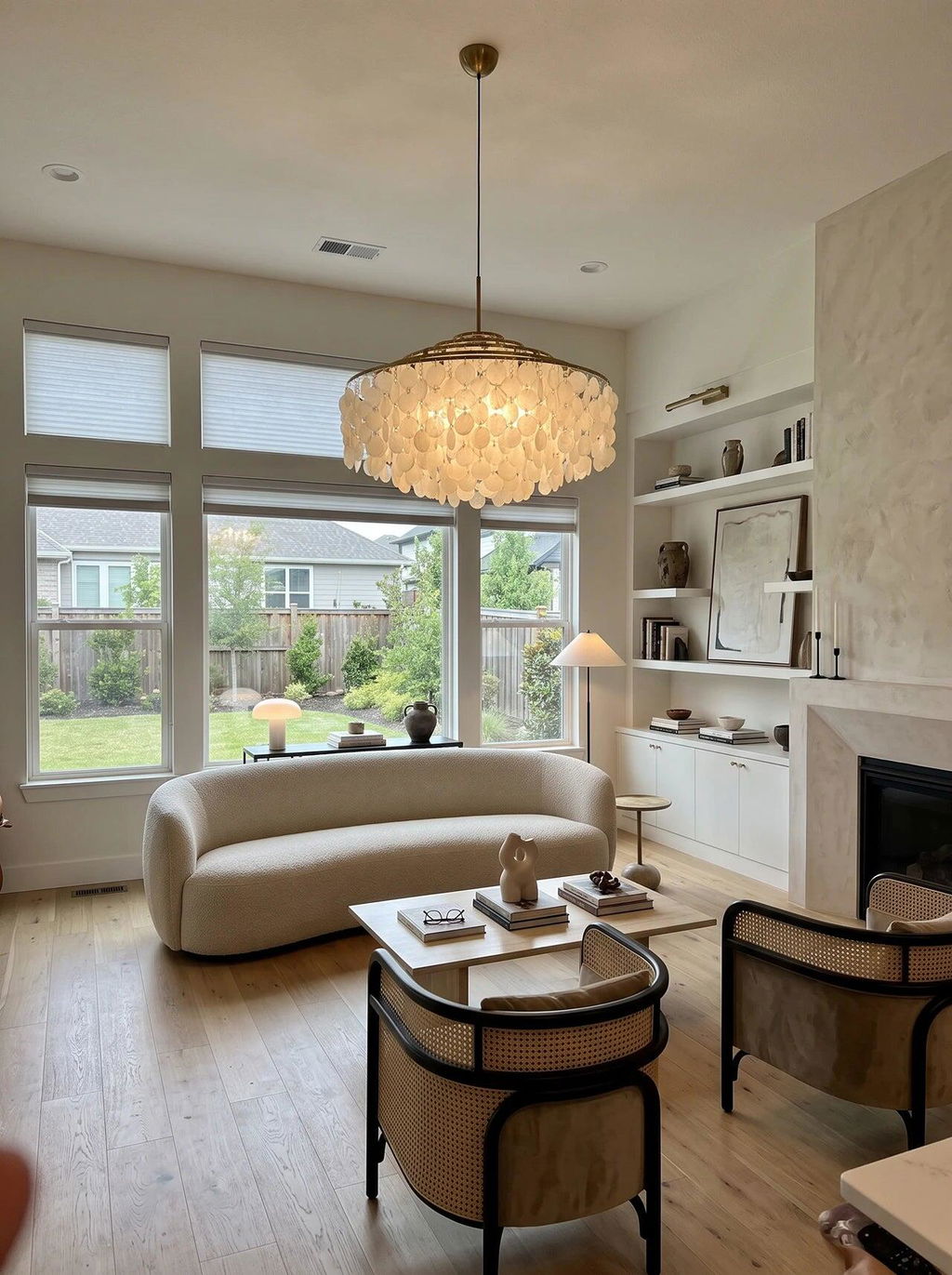
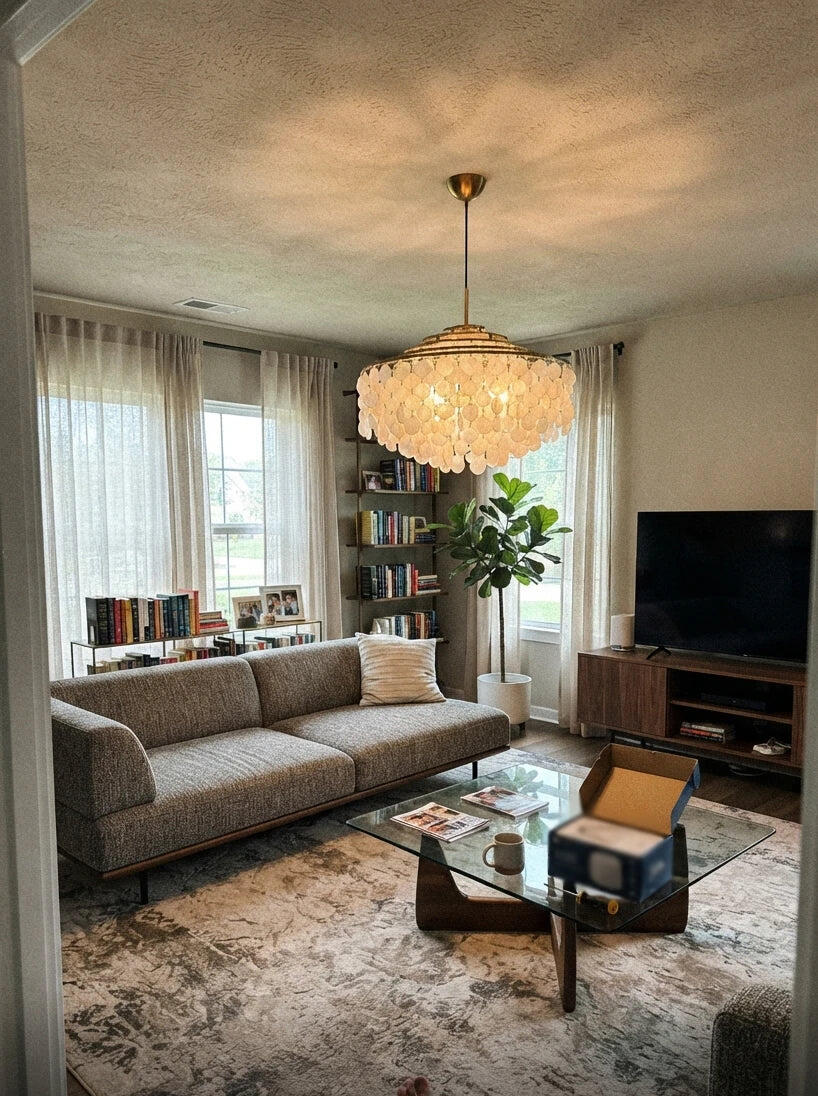
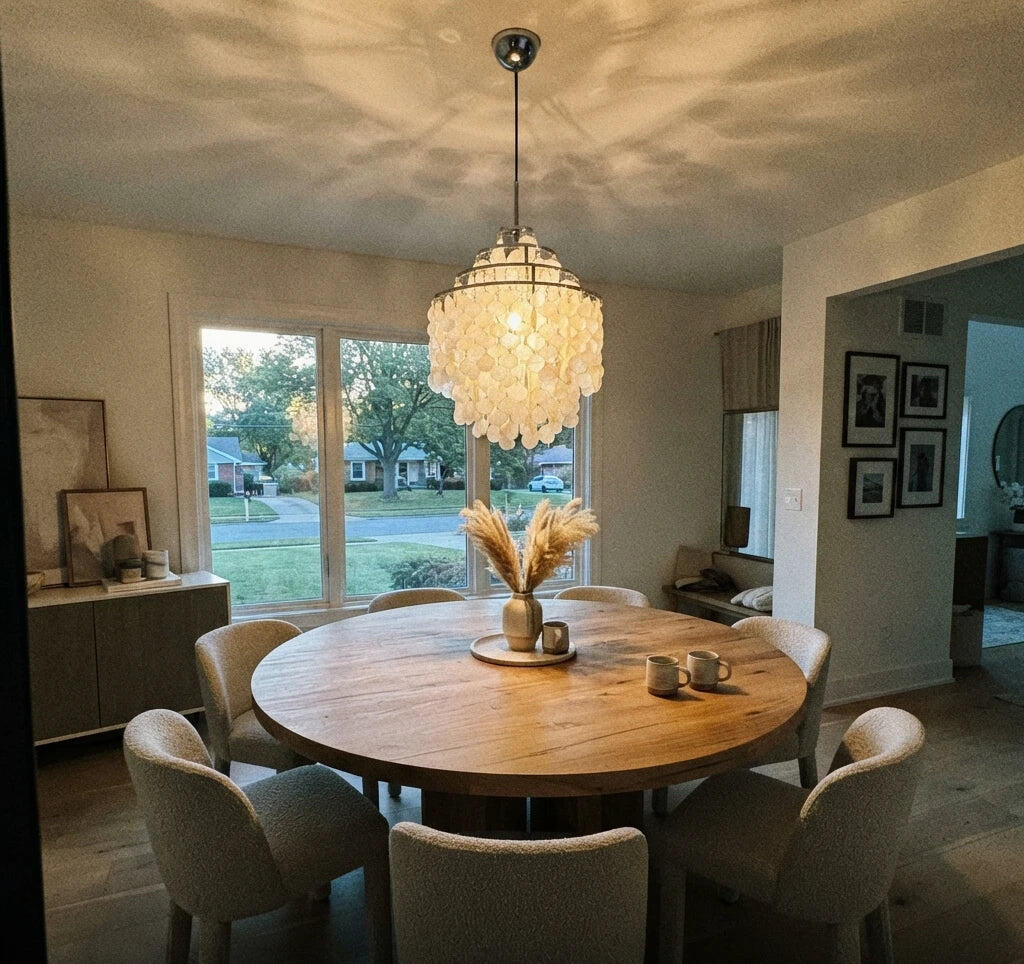
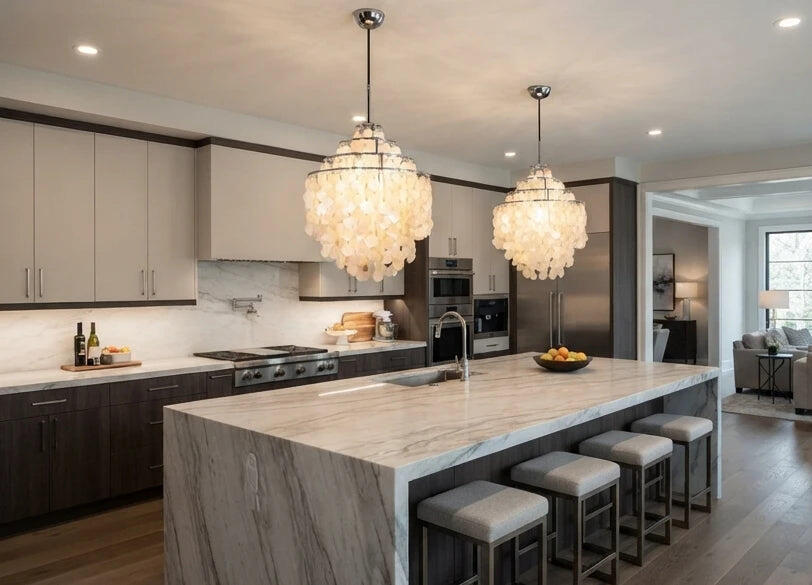
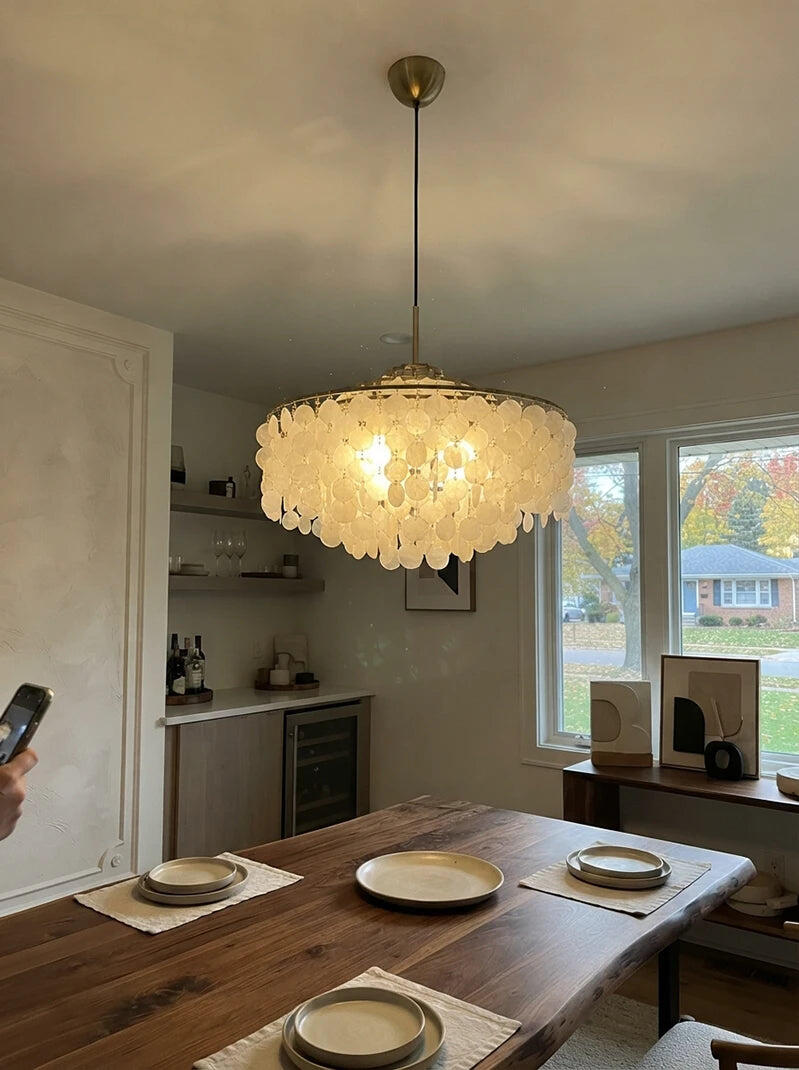
The Natural Tiered Capiz Shell Chandelier hangs hundreds of natural capiz shells in tapering tiers from a slim metal frame, each shell strung on its own small link. Capiz is thin enough to be translucent in its own right, so the light does not pass through the shade — it passes into it. so a lit capiz shell chandelier never glows evenly: some scales come up bright, others stay milky, and the surface reads as a shifting pearl-warm field rather than a single lampshade. Unlit it holds its own — cream, iridescent, quiet against a white ceiling. The tiers taper as they fall, so from across the room it resolves into one soft mass and only separates into individual shells when you stand under it.
Part of our shell lighting series, which is built to be used together rather than alone. The same tiered shells sit on a nightstand or console in the round shell tiered table lamp, and flatten against the wall in the shell wall lamp — so a bedroom can carry the material overhead, at the bedside and beside the mirror without repeating the same fixture three times.
Natural Capiz Shell
Naturally Unique Translucency
No two shells are ever the same
Capiz is a natural material, sorted and matched by hand rather than cut to a pattern. Every shell carries its own faint grain and its own degree of opacity, so a lit fixture never glows perfectly evenly — some discs come up bright, others stay milky. The piece you receive may therefore differ slightly from the images shown.
An inherent characteristic of real shell — not a quality defect.
What You See Is What You Get
Real PhotoNatural shell strands, before they go on the frame
Real PhotoThe tiered frame and hardware, laid out before assembly
Described Honestly
Materials, sizes and finishes are listed exactly as they are — including where natural shell varies in grain and opacity from piece to piece.
Real Shell, Not Resin
Natural capiz shell on an iron frame — never moulded resin, never printed plastic film made to look like shell. Photographed as it leaves our workshop, not rendered.
Ships Flat, Not Assembled
The frame travels in pieces and the shell strands are wrapped separately — exactly as shown above. A tiered shell fixture shipped assembled would not survive the journey; flat-packing is why it arrives intact.
Specifications
The Details
MaterialNatural Capiz Shell · Iron Frame · Metal Hardware Shell sorted and matched by hand — no two panels identical.
Shell colourWhite Translucent in its own right; opacity varies shell to shell.
Finish optionsChromeGold Chrome keeps the shell cool and coastal; gold warms it.
How it's madeCutting · sanding · bending · splicing
Light sourceLED or Edison bulb Warm white (2700K) recommended — cooler light drains the warmth out of the shell.
Bulb baseE26 / E27 Bulbs not included.
PowerMax 40W
VoltageAC 110–240V
ControlPush-button switch Dimmable when fitted with a dimmable bulb — see the note below.
Cable length150 cm / 59″ Shortened on site to suit your ceiling, or lengthened before dispatch on request.
MountingCeiling — hardwired Mounts to a standard junction box. All hardware included; professional installation recommended.
EnvironmentIndoor only · dry locations
Preparation time5–10 days Made and inspected at our own workshop before dispatch.
Good to Know
The shells move, and they are meant to
Strung on individual links, the shells register air movement — a door opening, someone walking past — and shift very slightly, sometimes with a soft click. Most people find this is the point of a shell fixture. If you would rather it stayed still, avoid hanging it directly beneath an air vent or in front of an open window.
Need a longer cable?
Every fixture ships with a 150 cm / 59″ cable, which shortens on site during installation. For a tall stairwell, an atrium or a double-height entry, contact us before ordering and we will lengthen it before dispatch — much easier done in the workshop than on a ladder.
About dimming
Dimming depends on the bulb, not the fixture. Fit a dimmable E26 / E27 bulb and the chandelier will dim;
Size Guide
Which Size for Your Space
Six sizes in two forms — three tall and narrow, three broad and shallow. The 150 cm cable shortens on site, and can be lengthened before dispatch on request.
∅ 11″
∅ 11″ × H 17.7″∅ 28 × H 45 cm
FormTall & narrow
Best forPowder room · narrow hallway · walk-in closet · bedside as a single pendant
Too small for a dining table on its own — hang two or three in a row instead.
∅ 17.7″
∅ 17.7″ × H 23.6″∅ 45 × H 60 cm
FormTall & narrow
Best forBedroom · breakfast nook · entry · above a console
Suits a round café table around 24–26″ across.
∅ 20.9″
∅ 20.9″ × H 27.6″∅ 53 × H 70 cm
FormTall & narrow
Best forEntry hall · stairwell landing · double-height corner · tall bedroom
The tallest of the range — it wants height above it to read properly.
∅ 23.6″Popular
∅ 23.6″ × H 16.5″∅ 60 × H 42 cm
FormBroad & shallow
Best forRound dining table · living room · main bedroom · entry
Suits a round table 32–35″ across. The most forgiving size in the range.
∅ 27.6″
∅ 27.6″ × H 18.9″∅ 70 × H 48 cm
FormBroad & shallow
Best forLarger dining table · living room · open-plan seating area
Suits a round table 37–41″ across.
∅ 31.5″
∅ 31.5″ × H 18.9″∅ 80 × H 48 cm
FormBroad & shallow
Best forLarge dining table · open-plan living · entry with floor area to spare
Suits a round table 42–47″ across. Widest in the range — it needs floor area, not ceiling height.
Sizing Tip
Decide the form before the size. The first three are taller than they are wide and fall as a column — right for an entry, a stairwell landing, a narrow hall, or anywhere the eye travels vertically. The last three are wider than they are tall and spread as tiers — right for a dining table, a seating area, or a room that needs its centre anchored. Two very different pieces from the same shells.
Then size it. For an open room, add the length and width in feet and read the sum as inches — a 11 × 13 ft room points at roughly 24 in. Over a round table, ignore the room and take two thirds to three quarters of the table diameter. Keep 7 ft (2.1 m) of floor clearance anywhere people walk, and hang the lowest shell 30–36 in above a tabletop.
Height is the easy part: the 150 cm / 59″ cable shortens on site, and we will lengthen it before dispatch for a tall stairwell if you tell us the ceiling height when you order. Diameter is the part you cannot change afterwards — so if you are between two, take the larger over a table and the smaller in a walkway.
Every Part, Photographed
The Parts We'd Want to See First
Anyone can style a hero shot. These are the five parts a chandelier is actually judged on — shell, canopy, sockets, frame and rings — photographed as they are.
01
Natural shell, disc by disc
Look closely and the discs are not identical: some read almost clear, others stay milky, and the edges carry the faint grain of a natural material. That is real capiz, not moulded resin or printed film — and it is why a lit fixture glows unevenly rather than like a plastic panel.
02
The ceiling cup
A spun metal dome, not a stamped plastic cover. It sits over a standard junction box and hides the connection completely — the part you will still be looking at years after the shells have stopped being new.
03
Socket assembly and rod
Standard E26 / E27 sockets on a metal extension rod — so you choose your own bulbs, change them yourself, and swap in dimmable ones whenever you like. Nothing here is sealed or integrated.
04
The frame, from above
Seen from the top, the tiers are concentric metal rings held on radial arms — the geometry that gives the fixture its shape. The shells hang from it; they are not what holds it together.
05
One ring per strand
Every strand hangs from its own small ring, nothing glued or crimped shut. It is why the shells move freely, why the tiers carry a natural unevenness — and why a damaged strand can be lifted off and replaced on its own.
Both finishes appear above. The canopy and frame are shown in brushed gold, the socket rod and rings in chrome — the same fixture is built in either, so you are seeing both options rather than two different products.
None of these are renders. They were taken in our own workshop before assembly, which is also the only moment most of these parts are ever visible.
The design
A Window Before It Was a Light
The shell has been filtering daylight for centuries. We only hung it up.
Capiz comes from the windowpane oyster, and the name is not decorative. For centuries, long before sheet glass was cheap or common, these shells were cut square and set into wooden window frames — thin enough to let daylight through, strong enough to hold back sun and rain. The material's first job was softening light. Everything since has been a variation on that.
Which is why it makes such an unlikely-sounding shade and such an obvious one. Every quality you would ask a shade to have, the shell already had. It is translucent but never transparent, so you get the light without ever seeing where it comes from. Each piece differs slightly in thickness and opacity, so the surface never goes flat the way a moulded panel does. And it is warm and pearl-toned rather than clear, so what passes through arrives softened before it reaches you.
The work is in the assembly: each shell cut to shape, its edge sanded smooth, curved to its tier and strung one at a time. Lit, some discs come up bright while others stay milky — and the whole thing shifts slightly when a door opens. It behaves like a material, not like a manufactured object.
— It was doing this long before we asked. —
Why this chandelier
Two Forms, From the Same Shells
A range that splits into two different fixtures — and a material that has been filtering light since long before anyone made a lamp out of it.
01
Capiz's Uneven, Pearl-Warm Glow
Shell is translucent but never transparent, so you get the light without ever seeing where it comes from. And because every disc differs slightly in thickness, some come up bright while others stay milky — the surface never goes flat the way a moulded panel does. Warm and pearl-toned rather than clear, so what passes through arrives softened before it reaches the room.
02
One Ring per Strand
Every strand hangs from its own small ring — nothing glued, nothing crimped shut. That is why the shells move freely, registering a door opening or someone walking past, and why the tiers carry a natural unevenness no mould can copy. It is also why a damaged strand lifts off and is replaced on its own, without touching the rest.
03
The shells move
Strung on individual links, the shells register air movement — a door opening, someone walking past — and shift very slightly, sometimes with a soft click. Most people find this is the point of a shell fixture.
— Natural capiz shell, hung one strand at a time —
Materials
Why Real Shell
Imitation capiz is everywhere in this category. Here is what the real material does that a moulded copy cannot.
Natural Capiz ShellResin / Printed Imitation
The lightTranslucent but never transparent — some discs come up bright, others stay milky, and the bulb is never visibleOne flat even wash, or a thin panel with the bulb showing through as a bright spot
Switched offHolds a faint pearl iridescence and real depth in daylight — it still reads as a materialReads as plastic the moment the light is off, however convincing it looks lit
Unique nessEvery disc differs in thickness, opacity and grain — no two fixtures alikeCast from one mould; identical down to the millimetre, pattern repeating across the tiers
The surfaceNatural growth grain running through the disc, visible when you look closelyGrain printed or embossed onto the surface — the same motif recurring every few pieces
Over timeShell will not yellow or grow brittle from bulb heat; its colour is the material itselfResin yellows and stiffens with heat and age; printed tints fade unevenly
MovementStrung one strand per ring, so the discs move freely and register the room around themPanels fixed into a housing — static, and silent in the dull sense
Construc tionEach strand lifts off its own ring, so a damaged one is replaced on its ownSealed into a single moulded shade; damage usually means replacing the fixture
In the handCool to the touch and rigid, with the faint sheen of a natural materialWarm, slightly flexible, and unmistakably plastic once you handle it
Questions, Answered
Common Questions
Is it real shell?
Yes. Every disc is natural capiz — never moulded resin and never printed plastic film made to look like shell. Because it is a natural material, each disc has its own thickness, opacity and faint growth grain. Look closely at a lit fixture and you will see some discs come up bright while others stay milky. That unevenness is the proof, not a flaw.
Do the shells move? Do they make a sound?
Yes to both, and it is worth knowing before you order. Each strand hangs from its own ring, so the discs register air movement — a door opening, someone walking past, a window left ajar — and shift slightly, sometimes with a soft click.
Most people find this is the point of a shell fixture rather than a drawback. If you would rather it stayed still and silent, avoid hanging it directly beneath an air vent, a ceiling fan, or in front of a window you keep open.
Are the shells fragile?
Less than people expect. Capiz is thin, but it is strung rather than rigid — the strands flex and swing rather than take an impact, and shell does not shatter the way glass does. The metal frame carries the entire weight, so the shells are only ever asked to hang.
Where they can be damaged is at the edge, from a direct knock. That is an argument for hanging it above head height and away from doorways, not against the material. Overhead in a dining room or bedroom it is very well behaved.
Will the shells yellow or discolour?
No. The colour is the material itself rather than a tint applied to a surface, so it will not yellow or grow brittle under bulb heat the way resin imitation does. Keep it out of prolonged direct sunlight and out of damp rooms and it will look the same in ten years as it does on the first day.
Will mine look exactly like the photographs?
Very close, but not identical. Silhouette, dimensions, tier count, finish and overall colour family will match what you see here. The individual discs will not, because they are sorted and matched by hand rather than cut to a pattern. From across the room the tiers read as one soft mass; the variation only shows when you are standing underneath it.
Will it be too bright or glary?
No. Shell is translucent but never transparent, so the bulb stays out of sight from any angle below and the light arrives diffused rather than direct. There is no hotspot anywhere on the fixture. It is an ambient piece — comfortable to sit under and to look at — so in a kitchen or over a work surface you will still want task lighting alongside it.
What bulbs does it take, and can it be dimmed?
It takes standard E26 / E27 bulbs, LED or Edison style, not included. Dimming depends on the bulb rather than the fixture: fit dimmable bulbs on a compatible dimmer circuit and it will dim smoothly. A warm white around 2700K suits shell best — cooler light drains the warmth out of it and makes the discs read grey.
How high should I hang it?
Over a dining table, hang the lowest shell 30–36″ (75–90 cm) above the tabletop — lower than instinct suggests is usually right, since nobody walks underneath. In any walkway or entry keep at least 7 ft (2.1 m) of floor clearance. The 150 cm / 59″ cable shortens on site, and we will lengthen it before dispatch for a tall stairwell if you tell us your ceiling height when you order.
Which size and which form should I choose?
Decide the form before the size. Three of the six are taller than they are wide and fall as a column — right for an entry, a stairwell landing or a narrow hall. The other three are wider than they are tall and spread as tiers — right for a dining table or a seating area.
Then size it: add your room's length and width in feet and read the sum as inches, or over a round table take two thirds to three quarters of the table diameter. Height is adjustable on site; diameter is not, so if you are between two, take the larger over a table and the smaller in a walkway.
Is it difficult to install?
It is a hardwired ceiling fixture and professional installation is recommended. It arrives flat-packed: the frame goes up first, then the shell strands are hung one at a time onto their rings. This takes patience rather than skill, and two people make it considerably easier — one holding, one hooking. Work from the outer tier inward, and switch off power at the breaker before starting. All hardware is included.
How do I care for it, and what if a strand breaks?
Dust with a soft dry cloth or a very light pass with a feather duster, supporting the strand with your other hand. Avoid water, solvents, abrasive pads and household sprays. Shell and damp do not mix, so this is an indoor, dry-location fixture — not one for a bathroom or a covered porch.
Every strand is wrapped separately for shipping and the frame travels in pieces. If something arrives damaged, send photographs within 24 hours of delivery and we will replace the affected part. Because each strand hangs on its own ring, a single broken strand never means returning the whole chandelier.
Installation
The Complete Installation Guide
Not sure how to wire it, how high to hang it, or whether you need an electrician? Our full guide walks through every step for US homes.
01
Power Off First
Switch off at the breaker and confirm before you touch any wiring.
02
Check the Box
Make sure your junction box is standard, secure, and rated for the weight.
03
Match the Wires
Black to black, white to white, ground to ground — the US standard explained.
04
Set the Height
Mounting heights and clearances for sconces, pendants, and chandeliers.
The Natural Tiered Capiz Shell Chandelier hangs hundreds of natural capiz shells in tapering tiers from a slim metal frame, each shell strung on its own small link. Capiz is thin enough to be translucent in its own right, so the light does not pass through the shade — it passes into it. so a lit capiz shell chandelier never glows evenly: some scales come up bright, others stay milky, and the surface reads as a shifting pearl-warm field rather than a single lampshade. Unlit it holds its own — cream, iridescent, quiet against a white ceiling. The tiers taper as they fall, so from across the room it resolves into one soft mass and only separates into individual shells when you stand under it.
Part of our shell lighting series, which is built to be used together rather than alone. The same tiered shells sit on a nightstand or console in the round shell tiered table lamp, and flatten against the wall in the shell wall lamp — so a bedroom can carry the material overhead, at the bedside and beside the mirror without repeating the same fixture three times.
Natural Capiz Shell
Naturally Unique Translucency
No two shells are ever the same
Capiz is a natural material, sorted and matched by hand rather than cut to a pattern. Every shell carries its own faint grain and its own degree of opacity, so a lit fixture never glows perfectly evenly — some discs come up bright, others stay milky. The piece you receive may therefore differ slightly from the images shown.
An inherent characteristic of real shell — not a quality defect.
What You See Is What You Get
Real PhotoNatural shell strands, before they go on the frame
Real PhotoThe tiered frame and hardware, laid out before assembly
Described Honestly
Materials, sizes and finishes are listed exactly as they are — including where natural shell varies in grain and opacity from piece to piece.
Real Shell, Not Resin
Natural capiz shell on an iron frame — never moulded resin, never printed plastic film made to look like shell. Photographed as it leaves our workshop, not rendered.
Ships Flat, Not Assembled
The frame travels in pieces and the shell strands are wrapped separately — exactly as shown above. A tiered shell fixture shipped assembled would not survive the journey; flat-packing is why it arrives intact.
Specifications
The Details
MaterialNatural Capiz Shell · Iron Frame · Metal Hardware Shell sorted and matched by hand — no two panels identical.
Shell colourWhite Translucent in its own right; opacity varies shell to shell.
Finish optionsChromeGold Chrome keeps the shell cool and coastal; gold warms it.
How it's madeCutting · sanding · bending · splicing
Light sourceLED or Edison bulb Warm white (2700K) recommended — cooler light drains the warmth out of the shell.
Bulb baseE26 / E27 Bulbs not included.
PowerMax 40W
VoltageAC 110–240V
ControlPush-button switch Dimmable when fitted with a dimmable bulb — see the note below.
Cable length150 cm / 59″ Shortened on site to suit your ceiling, or lengthened before dispatch on request.
MountingCeiling — hardwired Mounts to a standard junction box. All hardware included; professional installation recommended.
EnvironmentIndoor only · dry locations
Preparation time5–10 days Made and inspected at our own workshop before dispatch.
Good to Know
The shells move, and they are meant to
Strung on individual links, the shells register air movement — a door opening, someone walking past — and shift very slightly, sometimes with a soft click. Most people find this is the point of a shell fixture. If you would rather it stayed still, avoid hanging it directly beneath an air vent or in front of an open window.
Need a longer cable?
Every fixture ships with a 150 cm / 59″ cable, which shortens on site during installation. For a tall stairwell, an atrium or a double-height entry, contact us before ordering and we will lengthen it before dispatch — much easier done in the workshop than on a ladder.
About dimming
Dimming depends on the bulb, not the fixture. Fit a dimmable E26 / E27 bulb and the chandelier will dim;
Size Guide
Which Size for Your Space
Six sizes in two forms — three tall and narrow, three broad and shallow. The 150 cm cable shortens on site, and can be lengthened before dispatch on request.
∅ 11″
∅ 11″ × H 17.7″∅ 28 × H 45 cm
FormTall & narrow
Best forPowder room · narrow hallway · walk-in closet · bedside as a single pendant
Too small for a dining table on its own — hang two or three in a row instead.
∅ 17.7″
∅ 17.7″ × H 23.6″∅ 45 × H 60 cm
FormTall & narrow
Best forBedroom · breakfast nook · entry · above a console
Suits a round café table around 24–26″ across.
∅ 20.9″
∅ 20.9″ × H 27.6″∅ 53 × H 70 cm
FormTall & narrow
Best forEntry hall · stairwell landing · double-height corner · tall bedroom
The tallest of the range — it wants height above it to read properly.
∅ 23.6″Popular
∅ 23.6″ × H 16.5″∅ 60 × H 42 cm
FormBroad & shallow
Best forRound dining table · living room · main bedroom · entry
Suits a round table 32–35″ across. The most forgiving size in the range.
∅ 27.6″
∅ 27.6″ × H 18.9″∅ 70 × H 48 cm
FormBroad & shallow
Best forLarger dining table · living room · open-plan seating area
Suits a round table 37–41″ across.
∅ 31.5″
∅ 31.5″ × H 18.9″∅ 80 × H 48 cm
FormBroad & shallow
Best forLarge dining table · open-plan living · entry with floor area to spare
Suits a round table 42–47″ across. Widest in the range — it needs floor area, not ceiling height.
Sizing Tip
Decide the form before the size. The first three are taller than they are wide and fall as a column — right for an entry, a stairwell landing, a narrow hall, or anywhere the eye travels vertically. The last three are wider than they are tall and spread as tiers — right for a dining table, a seating area, or a room that needs its centre anchored. Two very different pieces from the same shells.
Then size it. For an open room, add the length and width in feet and read the sum as inches — a 11 × 13 ft room points at roughly 24 in. Over a round table, ignore the room and take two thirds to three quarters of the table diameter. Keep 7 ft (2.1 m) of floor clearance anywhere people walk, and hang the lowest shell 30–36 in above a tabletop.
Height is the easy part: the 150 cm / 59″ cable shortens on site, and we will lengthen it before dispatch for a tall stairwell if you tell us the ceiling height when you order. Diameter is the part you cannot change afterwards — so if you are between two, take the larger over a table and the smaller in a walkway.
Every Part, Photographed
The Parts We'd Want to See First
Anyone can style a hero shot. These are the five parts a chandelier is actually judged on — shell, canopy, sockets, frame and rings — photographed as they are.
01
Natural shell, disc by disc
Look closely and the discs are not identical: some read almost clear, others stay milky, and the edges carry the faint grain of a natural material. That is real capiz, not moulded resin or printed film — and it is why a lit fixture glows unevenly rather than like a plastic panel.
02
The ceiling cup
A spun metal dome, not a stamped plastic cover. It sits over a standard junction box and hides the connection completely — the part you will still be looking at years after the shells have stopped being new.
03
Socket assembly and rod
Standard E26 / E27 sockets on a metal extension rod — so you choose your own bulbs, change them yourself, and swap in dimmable ones whenever you like. Nothing here is sealed or integrated.
04
The frame, from above
Seen from the top, the tiers are concentric metal rings held on radial arms — the geometry that gives the fixture its shape. The shells hang from it; they are not what holds it together.
05
One ring per strand
Every strand hangs from its own small ring, nothing glued or crimped shut. It is why the shells move freely, why the tiers carry a natural unevenness — and why a damaged strand can be lifted off and replaced on its own.
Both finishes appear above. The canopy and frame are shown in brushed gold, the socket rod and rings in chrome — the same fixture is built in either, so you are seeing both options rather than two different products.
None of these are renders. They were taken in our own workshop before assembly, which is also the only moment most of these parts are ever visible.
The design
A Window Before It Was a Light
The shell has been filtering daylight for centuries. We only hung it up.
Capiz comes from the windowpane oyster, and the name is not decorative. For centuries, long before sheet glass was cheap or common, these shells were cut square and set into wooden window frames — thin enough to let daylight through, strong enough to hold back sun and rain. The material's first job was softening light. Everything since has been a variation on that.
Which is why it makes such an unlikely-sounding shade and such an obvious one. Every quality you would ask a shade to have, the shell already had. It is translucent but never transparent, so you get the light without ever seeing where it comes from. Each piece differs slightly in thickness and opacity, so the surface never goes flat the way a moulded panel does. And it is warm and pearl-toned rather than clear, so what passes through arrives softened before it reaches you.
The work is in the assembly: each shell cut to shape, its edge sanded smooth, curved to its tier and strung one at a time. Lit, some discs come up bright while others stay milky — and the whole thing shifts slightly when a door opens. It behaves like a material, not like a manufactured object.
— It was doing this long before we asked. —
Why this chandelier
Two Forms, From the Same Shells
A range that splits into two different fixtures — and a material that has been filtering light since long before anyone made a lamp out of it.
01
Capiz's Uneven, Pearl-Warm Glow
Shell is translucent but never transparent, so you get the light without ever seeing where it comes from. And because every disc differs slightly in thickness, some come up bright while others stay milky — the surface never goes flat the way a moulded panel does. Warm and pearl-toned rather than clear, so what passes through arrives softened before it reaches the room.
02
One Ring per Strand
Every strand hangs from its own small ring — nothing glued, nothing crimped shut. That is why the shells move freely, registering a door opening or someone walking past, and why the tiers carry a natural unevenness no mould can copy. It is also why a damaged strand lifts off and is replaced on its own, without touching the rest.
03
The shells move
Strung on individual links, the shells register air movement — a door opening, someone walking past — and shift very slightly, sometimes with a soft click. Most people find this is the point of a shell fixture.
— Natural capiz shell, hung one strand at a time —
Materials
Why Real Shell
Imitation capiz is everywhere in this category. Here is what the real material does that a moulded copy cannot.
Natural Capiz ShellResin / Printed Imitation
The lightTranslucent but never transparent — some discs come up bright, others stay milky, and the bulb is never visibleOne flat even wash, or a thin panel with the bulb showing through as a bright spot
Switched offHolds a faint pearl iridescence and real depth in daylight — it still reads as a materialReads as plastic the moment the light is off, however convincing it looks lit
Unique nessEvery disc differs in thickness, opacity and grain — no two fixtures alikeCast from one mould; identical down to the millimetre, pattern repeating across the tiers
The surfaceNatural growth grain running through the disc, visible when you look closelyGrain printed or embossed onto the surface — the same motif recurring every few pieces
Over timeShell will not yellow or grow brittle from bulb heat; its colour is the material itselfResin yellows and stiffens with heat and age; printed tints fade unevenly
MovementStrung one strand per ring, so the discs move freely and register the room around themPanels fixed into a housing — static, and silent in the dull sense
Construc tionEach strand lifts off its own ring, so a damaged one is replaced on its ownSealed into a single moulded shade; damage usually means replacing the fixture
In the handCool to the touch and rigid, with the faint sheen of a natural materialWarm, slightly flexible, and unmistakably plastic once you handle it
Questions, Answered
Common Questions
Is it real shell?
Yes. Every disc is natural capiz — never moulded resin and never printed plastic film made to look like shell. Because it is a natural material, each disc has its own thickness, opacity and faint growth grain. Look closely at a lit fixture and you will see some discs come up bright while others stay milky. That unevenness is the proof, not a flaw.
Do the shells move? Do they make a sound?
Yes to both, and it is worth knowing before you order. Each strand hangs from its own ring, so the discs register air movement — a door opening, someone walking past, a window left ajar — and shift slightly, sometimes with a soft click.
Most people find this is the point of a shell fixture rather than a drawback. If you would rather it stayed still and silent, avoid hanging it directly beneath an air vent, a ceiling fan, or in front of a window you keep open.
Are the shells fragile?
Less than people expect. Capiz is thin, but it is strung rather than rigid — the strands flex and swing rather than take an impact, and shell does not shatter the way glass does. The metal frame carries the entire weight, so the shells are only ever asked to hang.
Where they can be damaged is at the edge, from a direct knock. That is an argument for hanging it above head height and away from doorways, not against the material. Overhead in a dining room or bedroom it is very well behaved.
Will the shells yellow or discolour?
No. The colour is the material itself rather than a tint applied to a surface, so it will not yellow or grow brittle under bulb heat the way resin imitation does. Keep it out of prolonged direct sunlight and out of damp rooms and it will look the same in ten years as it does on the first day.
Will mine look exactly like the photographs?
Very close, but not identical. Silhouette, dimensions, tier count, finish and overall colour family will match what you see here. The individual discs will not, because they are sorted and matched by hand rather than cut to a pattern. From across the room the tiers read as one soft mass; the variation only shows when you are standing underneath it.
Will it be too bright or glary?
No. Shell is translucent but never transparent, so the bulb stays out of sight from any angle below and the light arrives diffused rather than direct. There is no hotspot anywhere on the fixture. It is an ambient piece — comfortable to sit under and to look at — so in a kitchen or over a work surface you will still want task lighting alongside it.
What bulbs does it take, and can it be dimmed?
It takes standard E26 / E27 bulbs, LED or Edison style, not included. Dimming depends on the bulb rather than the fixture: fit dimmable bulbs on a compatible dimmer circuit and it will dim smoothly. A warm white around 2700K suits shell best — cooler light drains the warmth out of it and makes the discs read grey.
How high should I hang it?
Over a dining table, hang the lowest shell 30–36″ (75–90 cm) above the tabletop — lower than instinct suggests is usually right, since nobody walks underneath. In any walkway or entry keep at least 7 ft (2.1 m) of floor clearance. The 150 cm / 59″ cable shortens on site, and we will lengthen it before dispatch for a tall stairwell if you tell us your ceiling height when you order.
Which size and which form should I choose?
Decide the form before the size. Three of the six are taller than they are wide and fall as a column — right for an entry, a stairwell landing or a narrow hall. The other three are wider than they are tall and spread as tiers — right for a dining table or a seating area.
Then size it: add your room's length and width in feet and read the sum as inches, or over a round table take two thirds to three quarters of the table diameter. Height is adjustable on site; diameter is not, so if you are between two, take the larger over a table and the smaller in a walkway.
Is it difficult to install?
It is a hardwired ceiling fixture and professional installation is recommended. It arrives flat-packed: the frame goes up first, then the shell strands are hung one at a time onto their rings. This takes patience rather than skill, and two people make it considerably easier — one holding, one hooking. Work from the outer tier inward, and switch off power at the breaker before starting. All hardware is included.
How do I care for it, and what if a strand breaks?
Dust with a soft dry cloth or a very light pass with a feather duster, supporting the strand with your other hand. Avoid water, solvents, abrasive pads and household sprays. Shell and damp do not mix, so this is an indoor, dry-location fixture — not one for a bathroom or a covered porch.
Every strand is wrapped separately for shipping and the frame travels in pieces. If something arrives damaged, send photographs within 24 hours of delivery and we will replace the affected part. Because each strand hangs on its own ring, a single broken strand never means returning the whole chandelier.
Installation
The Complete Installation Guide
Not sure how to wire it, how high to hang it, or whether you need an electrician? Our full guide walks through every step for US homes.
01
Power Off First
Switch off at the breaker and confirm before you touch any wiring.
02
Check the Box
Make sure your junction box is standard, secure, and rated for the weight.
03
Match the Wires
Black to black, white to white, ground to ground — the US standard explained.
04
Set the Height
Mounting heights and clearances for sconces, pendants, and chandeliers.
Excellent customer service and shipping experience.
The delivery was very fast from ordering to receiving the goods. I asked some installation questions along the way, and customer service responded very promptly and professionally. The lamp itself is very easy to install, and once installed, not only is the lighting effect beautiful, but the layered design of the seashells is also exquisite.
B
Baldwin Charlotte
Professionally packaged; arrived in perfect condition.
The packaging was excellent, and the lamp itself looks even more high-quality than in the photos. The effect after installation is fantastic. All the seashells were securely held in place with foam padding, without any damage.
R
Roy Eugen
Worth the price and truly unique
The product looks very natural, without excessive processing, retaining the original color of the seashells. It also makes a pleasant, crisp sound when touched or bumped. I'm very satisfied with this purchase.
B
Boris Reynolds
Seaside style decoration
Light fixtures made of seashell material always bring a refreshing and natural feeling. It's lightweight yet has a substantial feel.
T
Theodore Felix
Exquisite quality and carefully packaged.
It was very well-protected in the packaging. Installation went more smoothly than expected, though having a partner to help makes it much easier. Once installed, sunlight gives the shells a natural translucence, and it looks even more enchanting when lit up at night. Great value for money!
I installed it at the turn of the staircase—a spot that used to be dark and unremarkable. Now, it’s become the most eye-catching little corner of my home.
I was initially worried the botanical design might look too fussy, but that’s not the case at all! The brass material lends a modern touch, while the leaf contours soften the room's harder lines. The design strikes the perfect balance.
Extremely secure packaging; arrived in perfect condition.
My biggest worry when buying fragile stone lighting is shipping damage. However, the packaging was incredibly robust, and everything—from the stone components to the chains—arrived in perfect condition. Customer service was also very responsive.