Unlock Savings: Get 10% Off Automatically on Every Order!

Free standard shipping, all orders support 30-day returns

Your cart

Your cart is empty

Natural Alabaster · Adjustable Chain

Alabaster Chain Chandelier

Build your own chandelier: pick how many heads you want, then choose the stone shape — round, stacked, or square. These sizes are just popular picks, not a limit. Need more? Enter any number, or tell us your layout and we'll build it.

Drag to rotate · tap a head to change its shape
1 head
Choose Your Alabaster Shapes
Tap any hanging head above, then pick a shape below.

Finish

Specifications

Heads
1
Stone
Natural Alabaster
Light
3000K Warm
Chain
150cm · adjustable
No Head Limit
The numbers above are just popular sizes. Want 15, 20, 30 or more? Just tell us.
Longer Chains
Standard drop is 150cm / 59in. For stairwells or high ceilings we extend the chain to suit.
Two Finishes
Black or gold hardware with natural white alabaster. Need another metal? Just ask.
How Custom Orders Work
1
Send us a photo of your space. Include the ceiling, its height, and the table or island below, plus where the wiring sits. That's all we need to begin.
2
We propose a count and layout. We'll suggest the number of heads and drop heights — and let you know if fewer would look better.
3
You approve, then we build. Production starts only after you sign off on the drawing. Lead time and pricing are shown on the drawing.
— Made to order · Adjustable chains · Genuine natural stone —

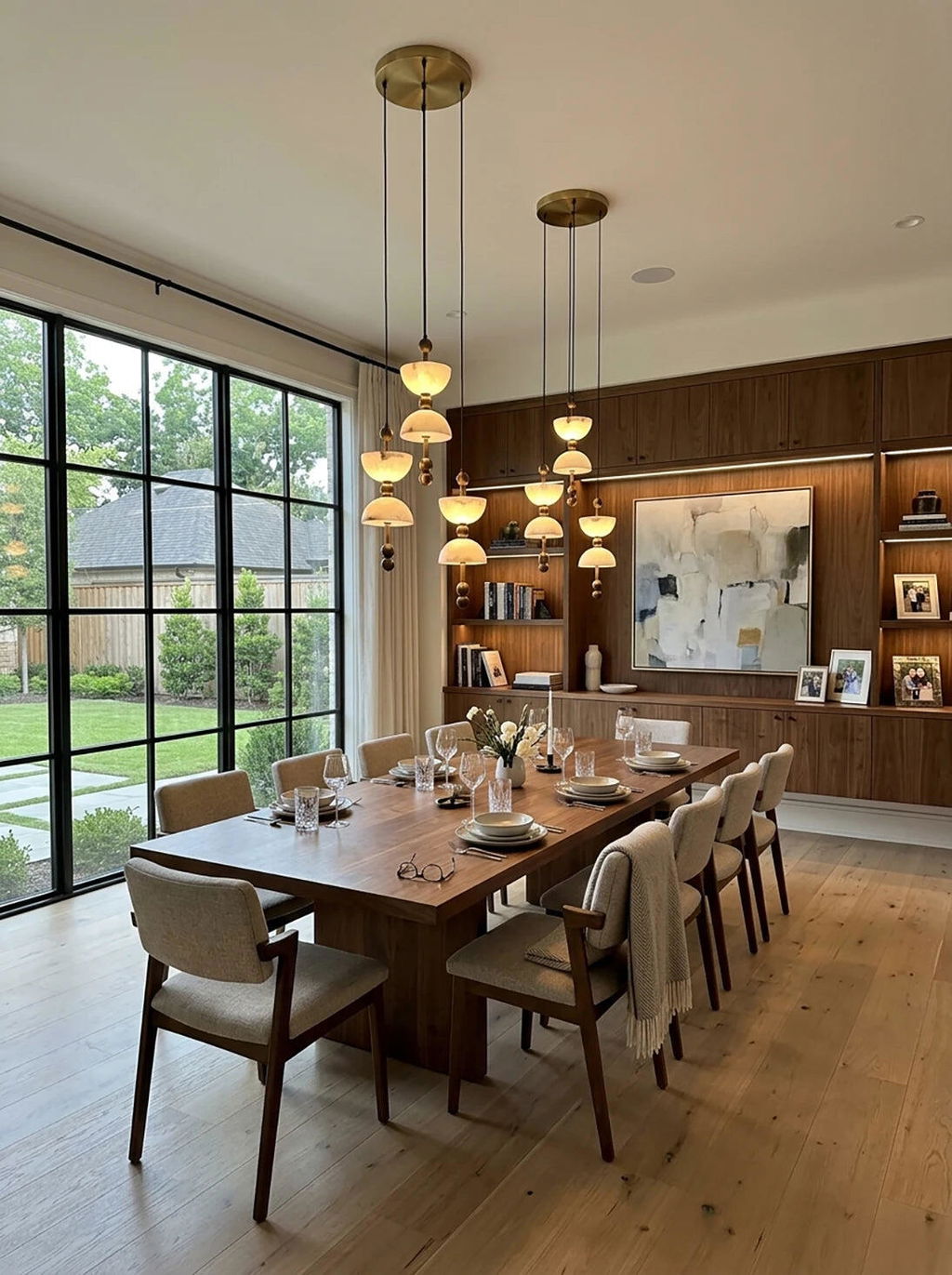
The Romilly Alabaster Cascading Cone Chain Chandelier features a distinctive design: cone-shaped shades hang from chains that extend outward from a single ceiling canopy, allowing you to position each chain exactly where you choose. Unlike most chandeliers that come in a fixed shape, this fixture is composed of individual components, giving you the freedom to create your own custom arrangement.

Look at the chains themselves and you will notice nobody drew that curve. A chain suspended between two points falls into a catenary — the shape gravity gives it and the only one it will hold. Every swag here is that same curve at a different width, which is why the arrangement looks composed however you route it. The cones drop light downward rather than outward, pooling it on a table or a bedside rather than washing the ceiling.

Part of our chain-hung series, which keeps the same swag system and changes only the shade. The alabaster cylindrical chain chandelier swaps the cone for a straight cylinder — squarer, more architectural, better against a modern kitchen. The alabaster mélange small chain chandelier mixes shade forms within one run, for a corner that wants variation rather than repetition. Same chains, same canopy, same freedom to route them.

Natural Alabaster

Naturally Unique Veining

No two pieces of stone are ever the same

Alabaster is a natural stone, so every piece carries its own veining and subtle variation in color. The fixture you receive may therefore differ slightly from the images shown.

An inherent characteristic of real stone — not a quality defect.
Specifications

The Details

Material Genuine Natural Alabaster Shade · Metal Chain & Canopy Hand-cut and hand-polished stone.
Shade finish White Natural Alabaster Unique veining on every piece.
Body finish Black · Gold
Light source LED or Edison bulb (E12 or E14)E12 or E14 base · warm white recommended.
Voltage AC 110–240V
Control Works with a common wall switch Switch not included — connects to an external wall switch for controlled power supply.
Mounting Ceiling — hardwired
Chain length 100 cm / 39.4″ Adjustable hanging height — can be extended on request.
Environment Indoor only · IP20 Damp-rated; not waterproof — for indoor use only.
Preparation time 5–10 days Made and inspected at our own workshop before dispatch.

Good to Know

The chain is part of the design

Each pendant hangs on a 100 cm / 39.4″ chain that adjusts to your ceiling height. In a multi-light cluster the chains can be draped and hooked overhead, so you decide the shape. Need it longer for a stairwell or atrium? Contact us before ordering and we'll extend it.

Bulbs & installation

Takes a standard E12 or E14 bulb — LED or Edison. We recommend warm white for the softest glow through the alabaster. It hardwires to a common wall switch, which supplies and controls the power (switch not included). For dry indoor locations only.

Size Guide

How Many Pendants for Your Space

Eight configurations, from a single drop to a thirteen-pendant sweep. The shade comes in two sizes and the ceiling plate is 5.9″ on every version — what changes is how many pendants you hang and how far you spread them.

Two shade sizes — available on every configuration below
∅ 4.7″ × H 9.7″ 12 × 24.7 cm The smaller cone. Better in multiples, over a bedside, or where several pendants need to read as a group rather than as individual lights.
∅ 6.3″ × H 15″ 16 × 38 cm The larger cone. More presence per pendant and a wider pool of light — better in low counts, over a table, or where each drop should hold its own.
Ceiling plate 5.9″ 15 cm · every configuration The same compact canopy whether you hang one pendant or thirteen. It covers a standard junction box; everything else spreads out from there.
1 Pendant
1 drop One hook, or none if hung straight down
Best forBedside · reading corner · above a nightstand · or two or three of them in a row over an island
NoteOffered as Model A or Model B — see the variant options

Swag it sideways to reach a bedside the junction box doesn't.

2 Pendants
2 drops Plan for up to 2 ceiling hooks
Best forEither side of a bed · flanking a mirror · a narrow console or hallway
SpanSet the hooks to match your nightstands — the chains do the rest

The most common bedroom configuration, and it needs no second junction box.

3 Pendants
3 drops Plan for up to 3 ceiling hooks
Best forRound dining table · breakfast nook · entry hall · small landing
SpanTight cluster, or a short line across a table up to about 4 ft

Hang them level over a table; stagger the heights in a corner.

5 PendantsPopular
5 drops Plan for up to 5 ceiling hooks
Best forDining table · living room · main bedroom · open-plan seating
SpanComfortable across a table up to about 6 ft, or clustered in a corner

The most forgiving count — enough presence for a table without crowding a normal room.

7 Pendants
7 drops Plan for up to 7 ceiling hooks
Best forLonger dining table · open-plan seating area · stairwell · double-height corner
SpanAcross a table up to about 8 ft, or falling through a stairwell void

At this count, spread them along an axis rather than around a circle.

9 Pendants
9 drops Plan for up to 9 ceiling hooks
Best forLong dining table · double-height entry · stairwell void · large open-plan room
SpanAcross a table up to about 10 ft, or a full stairwell drop

Vary the drop lengths so it reads as a cascade rather than a row of identical lamps.

11 Pendants
11 drops Plan for up to 11 ceiling hooks
Best forStatement over a long table · tall stairwell · gallery wall · hotel or restaurant
SpanWide enough to cross a room rather than sit over one piece of furniture

Mark every hook position on the ceiling before you drill the first hole.

13 Pendants
13 drops Plan for up to 13 ceiling hooks
Best forGrand entry · full-height stairwell · double-height living room · hospitality
SpanAn installation rather than a fixture — plan the routing on paper first

Two people, and a marked-out plan. Still only one 5.9″ junction box.

Sizing Tip

There is no single diameter to quote here, and that is the point. The shade size is fixed; the size of the fixture is not. You set the footprint by choosing where the ceiling hooks go — the same nine-pendant configuration can be a tight cluster in a corner or a ten-foot sweep down a dining table. So choose by pendant count and span, not by a diameter figure.

Two things do stay constant. The ceiling plate is 5.9″ on every version, even the thirteen-pendant one, so all of them cover a standard junction box and nothing more. And the shade comes in the same two sizes throughout: take the smaller cone in high counts, where the pendants should read as one group, and the larger cone in low counts, where each drop has to hold its own.

Before you order, do one thing: mark the hook positions on the ceiling with tape and live with them for a day. It costs nothing, and it is the only way to know whether five pendants or nine is right for the shape of your room.

The design

A Shape Nobody Drew

Gravity makes the curve. You decide where it falls.

Almost every chandelier arrives with its geometry already settled. The arms are where the arms are, the drop is the drop, and your only real choice is whether it fits. This one arrives as chains, shades and a decision. Hook them close together and it is a tight cluster in a corner; spread them wide and the same fixture becomes a long arc down a dining table. Where you put the hooks is the design.

The curve between them was not styled either. A chain suspended between two points falls into a catenary — the single shape it will hold under its own weight, and the same one architects have used hanging chains to find for centuries. It cannot be drawn wrong because it cannot be drawn at all. Every swag on this fixture is that curve at a different width, which is why an arrangement looks composed however you route it — you are not being asked to have good taste, only to choose a distance.

— Gravity draws it. You place it. —
Why this chandelier

The Shape Is Yours to Set

Chains that hook wherever you place them, a canopy no bigger than a junction box, and a fixture that fits the ceiling you already have.

01

You Route the Chains Yourself

Almost every chandelier arrives with its geometry already decided. This one arrives as chains, shades and a decision. Hook them close together and it is a tight cluster in a corner; spread them wide and the same fixture becomes a long arc down a dining table. The curve between hooks was never styled either — a chain hung between two points falls into the one shape it can hold under its own weight, which is why any routing reads as composed.

02

Eight Counts, Two Cone Sizes

From a single drop to thirteen pendants, with both cone sizes available on every configuration. Take the smaller cone in high counts, where the pendants should read as one group, and the larger cone in low counts, where each drop has to hold its own. A bedside pair and a full stairwell installation end up speaking the same language.

03

Every Cone on Its Own Chain

Each shade hangs independently, so you set the heights one at a time — level over a table, staggered down a stairwell. The tapered form sends light downward rather than outward, so it pools on the table or the bedside instead of washing across the ceiling, and no bulb is in view from a seated height. Nothing is fixed into a housing, so a single damaged shade is replaced on its own.

— Hung on chain, routed by you —

The Format

Why Swag Mounting

A swag fixture hangs from hooks you place, not from the box the electrician left. Here is what that changes — including the one thing it makes harder.

Swag Mounting Fixed-Canopy Chandelier
Where it hangs Wherever you set the hooks — over the table, beside the bed, into a corner Directly beneath the junction box, wherever that happens to be
Off-centre box Solved without touching the ceiling — the chain carries the drop across to where you want it Move the box and patch the ceiling, or live with a light that is not centred on anything
The shape Set on site by where the hooks go — a tight cluster or a ten-foot sweep from the same box Decided at the factory; the arms are where the arms are
Over a long table Spread the drops along the length from one wiring point One fixture centred, or a second and third junction box installed
Individual heights Each pendant set separately — level over a table, staggered down a stairwell Heights fixed by the frame; what you buy is what you hang
Installa
tion
One junction box, plus ceiling hooks that each need a joist or a rated anchor. More planning, more holes — this is genuinely the harder install One box, one bracket, finished. Simpler, and worth saying so
Changing your mind Move a hook and it is a different fixture — one small hole to fill Relocating means new wiring and a repaired ceiling
Rooms it rescues Renovations where the furniture moved and the wiring did not Rooms already built around the light position
Questions, Answered

Common Questions

What is a swag chandelier, and how does it hang?

It wires into one junction box in the usual way, and then the chains run out from that canopy to hooks you fix in the ceiling, each pendant dropping from its own hook. The canopy stays at the box; the lights hang where you decided.

That is the whole idea: the electrical connection and the position of the light are separated. A conventional chandelier ties the two together, which is why it can only hang in one place.

How many ceiling hooks do I need, and where do they go?

Plan for up to one hook per pendant — a five-pendant version needs up to five, a thirteen-pendant version up to thirteen. Chains can share a hook where two drops sit close together, so the real number is often lower.

Position is entirely yours, but do this first: mark the positions on the ceiling with tape and live with them for a day. It costs nothing, it is far easier than moving a hook afterwards, and it is the only reliable way to judge spacing in your own room rather than in a photograph.

How do I fix the hooks safely?

This matters more than anything else on this page. Each hook carries the weight of its pendant plus the sideways pull of the chain, which is a different load from a picture hook.

Fix into a ceiling joist wherever possible. Where a hook has to land between joists, use a properly rated toggle or cavity anchor sized for the load. Never use a plain plastic plug in plasterboard — it will hold for a while and then it will not. If you are unsure what is above your ceiling, have an electrician or a handyman place the hooks.

Can I install it myself?
The wiring should be done by a licensed electrician — it is a hardwired fixture and the power must be off at the breaker. The hook placement and chain routing is the part you can genuinely take on yourself, and arguably should, since you are the one who knows where the light needs to fall. Two people make it much easier: one holding the drop, one marking and fixing.
Can I change the arrangement later?
Yes, and cheaply. Unhook a chain, move it, and fill one small hole — no electrician, no wiring, no ceiling repair. It is worth knowing before you buy: if you rearrange the room in two years, the light rearranges with it. Almost nothing else on a ceiling can say that.
How many pendants should I choose?
Choose by span rather than by room area, because you control the spread. Three suits a round table or a tight cluster; five is the most forgiving over a standard dining table; seven to nine spread along a long table or fall through a stairwell; eleven and thirteen become an installation across a room rather than a fixture over a piece of furniture. Two is the classic bedside pair. And take the smaller cone in high counts, the larger cone in low counts.
What are the shades made of?
The cones are [__], with metal hardware in black or gold tone. [__ — add the two or three sentences that describe how this material behaves with light, and any natural variation the customer should expect. Do not publish this answer until the material is confirmed.]
What bulbs does it take, and can it be dimmed?
Each pendant takes a standard E26 / E27 bulb, LED or Edison style, not included. Dimming depends on the bulb rather than the fixture: fit dimmable bulbs on a compatible dimmer circuit and the whole run dims together. A warm white around 2700K suits the pale cones best. Bear in mind that a high pendant count means a high bulb count — check the total wattage against your dimmer's rating.
How high should each pendant hang?
Over a dining table, hang the bottom of the shade 30–36″ (75–90 cm) above the tabletop and keep the drops level with one another. In any walkway keep 7 ft (2.1 m) of floor clearance. Down a stairwell or in a corner, stagger the heights deliberately — a swag fixture with every pendant at the same height in an open space tends to read as a row of lamps rather than as one piece.
What if something arrives damaged?
Each shade is wrapped individually and the chains, canopy and hardware are packed separately. If something arrives damaged, send photographs within 24 hours of delivery and we will replace the affected part. Because every shade hangs on its own chain, a single damaged cone never means returning the whole fixture.
New

Romilly Alabaster Cascading Cone Chain Chandelier

SKU: V-ALCH2607292-1
Regular price $540.00
Unit price
per 

The price includes tax, and free standard shipping within the U.S. is provided.

Availability
 
Tax & Shipping calculated at checkout.
With a brand-new lighting ambiance, let's usher in a hopeful 2026 10% Off All Lighting

Free Shipping on all orders

Hassle-free return within 30 days

Payment Security

Sizing Guide

How Many Pendants Should Hang Over Your Table?

How many, how far apart, and how low — our guide answers all three with actual figures, room by room.

✦ Complete the Look

Pairs Well With

Natural Alabaster · Adjustable Chain

Alabaster Chain Chandelier

Build your own chandelier: pick how many heads you want, then choose the stone shape — round, stacked, or square. These sizes are just popular picks, not a limit. Need more? Enter any number, or tell us your layout and we'll build it.

Drag to rotate · tap a head to change its shape
1 head
Choose Your Alabaster Shapes
Tap any hanging head above, then pick a shape below.

Finish

Specifications

Heads
1
Stone
Natural Alabaster
Light
3000K Warm
Chain
150cm · adjustable
No Head Limit
The numbers above are just popular sizes. Want 15, 20, 30 or more? Just tell us.
Longer Chains
Standard drop is 150cm / 59in. For stairwells or high ceilings we extend the chain to suit.
Two Finishes
Black or gold hardware with natural white alabaster. Need another metal? Just ask.
How Custom Orders Work
1
Send us a photo of your space. Include the ceiling, its height, and the table or island below, plus where the wiring sits. That's all we need to begin.
2
We propose a count and layout. We'll suggest the number of heads and drop heights — and let you know if fewer would look better.
3
You approve, then we build. Production starts only after you sign off on the drawing. Lead time and pricing are shown on the drawing.
— Made to order · Adjustable chains · Genuine natural stone —

The Romilly Alabaster Cascading Cone Chain Chandelier features a distinctive design: cone-shaped shades hang from chains that extend outward from a single ceiling canopy, allowing you to position each chain exactly where you choose. Unlike most chandeliers that come in a fixed shape, this fixture is composed of individual components, giving you the freedom to create your own custom arrangement.

Look at the chains themselves and you will notice nobody drew that curve. A chain suspended between two points falls into a catenary — the shape gravity gives it and the only one it will hold. Every swag here is that same curve at a different width, which is why the arrangement looks composed however you route it. The cones drop light downward rather than outward, pooling it on a table or a bedside rather than washing the ceiling.

Part of our chain-hung series, which keeps the same swag system and changes only the shade. The alabaster cylindrical chain chandelier swaps the cone for a straight cylinder — squarer, more architectural, better against a modern kitchen. The alabaster mélange small chain chandelier mixes shade forms within one run, for a corner that wants variation rather than repetition. Same chains, same canopy, same freedom to route them.

Natural Alabaster

Naturally Unique Veining

No two pieces of stone are ever the same

Alabaster is a natural stone, so every piece carries its own veining and subtle variation in color. The fixture you receive may therefore differ slightly from the images shown.

An inherent characteristic of real stone — not a quality defect.
Specifications

The Details

Material Genuine Natural Alabaster Shade · Metal Chain & Canopy Hand-cut and hand-polished stone.
Shade finish White Natural Alabaster Unique veining on every piece.
Body finish Black · Gold
Light source LED or Edison bulb (E12 or E14)E12 or E14 base · warm white recommended.
Voltage AC 110–240V
Control Works with a common wall switch Switch not included — connects to an external wall switch for controlled power supply.
Mounting Ceiling — hardwired
Chain length 100 cm / 39.4″ Adjustable hanging height — can be extended on request.
Environment Indoor only · IP20 Damp-rated; not waterproof — for indoor use only.
Preparation time 5–10 days Made and inspected at our own workshop before dispatch.

Good to Know

The chain is part of the design

Each pendant hangs on a 100 cm / 39.4″ chain that adjusts to your ceiling height. In a multi-light cluster the chains can be draped and hooked overhead, so you decide the shape. Need it longer for a stairwell or atrium? Contact us before ordering and we'll extend it.

Bulbs & installation

Takes a standard E12 or E14 bulb — LED or Edison. We recommend warm white for the softest glow through the alabaster. It hardwires to a common wall switch, which supplies and controls the power (switch not included). For dry indoor locations only.

Size Guide

How Many Pendants for Your Space

Eight configurations, from a single drop to a thirteen-pendant sweep. The shade comes in two sizes and the ceiling plate is 5.9″ on every version — what changes is how many pendants you hang and how far you spread them.

Two shade sizes — available on every configuration below
∅ 4.7″ × H 9.7″ 12 × 24.7 cm The smaller cone. Better in multiples, over a bedside, or where several pendants need to read as a group rather than as individual lights.
∅ 6.3″ × H 15″ 16 × 38 cm The larger cone. More presence per pendant and a wider pool of light — better in low counts, over a table, or where each drop should hold its own.
Ceiling plate 5.9″ 15 cm · every configuration The same compact canopy whether you hang one pendant or thirteen. It covers a standard junction box; everything else spreads out from there.
1 Pendant
1 drop One hook, or none if hung straight down
Best forBedside · reading corner · above a nightstand · or two or three of them in a row over an island
NoteOffered as Model A or Model B — see the variant options

Swag it sideways to reach a bedside the junction box doesn't.

2 Pendants
2 drops Plan for up to 2 ceiling hooks
Best forEither side of a bed · flanking a mirror · a narrow console or hallway
SpanSet the hooks to match your nightstands — the chains do the rest

The most common bedroom configuration, and it needs no second junction box.

3 Pendants
3 drops Plan for up to 3 ceiling hooks
Best forRound dining table · breakfast nook · entry hall · small landing
SpanTight cluster, or a short line across a table up to about 4 ft

Hang them level over a table; stagger the heights in a corner.

5 PendantsPopular
5 drops Plan for up to 5 ceiling hooks
Best forDining table · living room · main bedroom · open-plan seating
SpanComfortable across a table up to about 6 ft, or clustered in a corner

The most forgiving count — enough presence for a table without crowding a normal room.

7 Pendants
7 drops Plan for up to 7 ceiling hooks
Best forLonger dining table · open-plan seating area · stairwell · double-height corner
SpanAcross a table up to about 8 ft, or falling through a stairwell void

At this count, spread them along an axis rather than around a circle.

9 Pendants
9 drops Plan for up to 9 ceiling hooks
Best forLong dining table · double-height entry · stairwell void · large open-plan room
SpanAcross a table up to about 10 ft, or a full stairwell drop

Vary the drop lengths so it reads as a cascade rather than a row of identical lamps.

11 Pendants
11 drops Plan for up to 11 ceiling hooks
Best forStatement over a long table · tall stairwell · gallery wall · hotel or restaurant
SpanWide enough to cross a room rather than sit over one piece of furniture

Mark every hook position on the ceiling before you drill the first hole.

13 Pendants
13 drops Plan for up to 13 ceiling hooks
Best forGrand entry · full-height stairwell · double-height living room · hospitality
SpanAn installation rather than a fixture — plan the routing on paper first

Two people, and a marked-out plan. Still only one 5.9″ junction box.

Sizing Tip

There is no single diameter to quote here, and that is the point. The shade size is fixed; the size of the fixture is not. You set the footprint by choosing where the ceiling hooks go — the same nine-pendant configuration can be a tight cluster in a corner or a ten-foot sweep down a dining table. So choose by pendant count and span, not by a diameter figure.

Two things do stay constant. The ceiling plate is 5.9″ on every version, even the thirteen-pendant one, so all of them cover a standard junction box and nothing more. And the shade comes in the same two sizes throughout: take the smaller cone in high counts, where the pendants should read as one group, and the larger cone in low counts, where each drop has to hold its own.

Before you order, do one thing: mark the hook positions on the ceiling with tape and live with them for a day. It costs nothing, and it is the only way to know whether five pendants or nine is right for the shape of your room.

The design

A Shape Nobody Drew

Gravity makes the curve. You decide where it falls.

Almost every chandelier arrives with its geometry already settled. The arms are where the arms are, the drop is the drop, and your only real choice is whether it fits. This one arrives as chains, shades and a decision. Hook them close together and it is a tight cluster in a corner; spread them wide and the same fixture becomes a long arc down a dining table. Where you put the hooks is the design.

The curve between them was not styled either. A chain suspended between two points falls into a catenary — the single shape it will hold under its own weight, and the same one architects have used hanging chains to find for centuries. It cannot be drawn wrong because it cannot be drawn at all. Every swag on this fixture is that curve at a different width, which is why an arrangement looks composed however you route it — you are not being asked to have good taste, only to choose a distance.

— Gravity draws it. You place it. —
Why this chandelier

The Shape Is Yours to Set

Chains that hook wherever you place them, a canopy no bigger than a junction box, and a fixture that fits the ceiling you already have.

01

You Route the Chains Yourself

Almost every chandelier arrives with its geometry already decided. This one arrives as chains, shades and a decision. Hook them close together and it is a tight cluster in a corner; spread them wide and the same fixture becomes a long arc down a dining table. The curve between hooks was never styled either — a chain hung between two points falls into the one shape it can hold under its own weight, which is why any routing reads as composed.

02

Eight Counts, Two Cone Sizes

From a single drop to thirteen pendants, with both cone sizes available on every configuration. Take the smaller cone in high counts, where the pendants should read as one group, and the larger cone in low counts, where each drop has to hold its own. A bedside pair and a full stairwell installation end up speaking the same language.

03

Every Cone on Its Own Chain

Each shade hangs independently, so you set the heights one at a time — level over a table, staggered down a stairwell. The tapered form sends light downward rather than outward, so it pools on the table or the bedside instead of washing across the ceiling, and no bulb is in view from a seated height. Nothing is fixed into a housing, so a single damaged shade is replaced on its own.

— Hung on chain, routed by you —

The Format

Why Swag Mounting

A swag fixture hangs from hooks you place, not from the box the electrician left. Here is what that changes — including the one thing it makes harder.

Swag Mounting Fixed-Canopy Chandelier
Where it hangs Wherever you set the hooks — over the table, beside the bed, into a corner Directly beneath the junction box, wherever that happens to be
Off-centre box Solved without touching the ceiling — the chain carries the drop across to where you want it Move the box and patch the ceiling, or live with a light that is not centred on anything
The shape Set on site by where the hooks go — a tight cluster or a ten-foot sweep from the same box Decided at the factory; the arms are where the arms are
Over a long table Spread the drops along the length from one wiring point One fixture centred, or a second and third junction box installed
Individual heights Each pendant set separately — level over a table, staggered down a stairwell Heights fixed by the frame; what you buy is what you hang
Installa
tion
One junction box, plus ceiling hooks that each need a joist or a rated anchor. More planning, more holes — this is genuinely the harder install One box, one bracket, finished. Simpler, and worth saying so
Changing your mind Move a hook and it is a different fixture — one small hole to fill Relocating means new wiring and a repaired ceiling
Rooms it rescues Renovations where the furniture moved and the wiring did not Rooms already built around the light position
Questions, Answered

Common Questions

What is a swag chandelier, and how does it hang?

It wires into one junction box in the usual way, and then the chains run out from that canopy to hooks you fix in the ceiling, each pendant dropping from its own hook. The canopy stays at the box; the lights hang where you decided.

That is the whole idea: the electrical connection and the position of the light are separated. A conventional chandelier ties the two together, which is why it can only hang in one place.

How many ceiling hooks do I need, and where do they go?

Plan for up to one hook per pendant — a five-pendant version needs up to five, a thirteen-pendant version up to thirteen. Chains can share a hook where two drops sit close together, so the real number is often lower.

Position is entirely yours, but do this first: mark the positions on the ceiling with tape and live with them for a day. It costs nothing, it is far easier than moving a hook afterwards, and it is the only reliable way to judge spacing in your own room rather than in a photograph.

How do I fix the hooks safely?

This matters more than anything else on this page. Each hook carries the weight of its pendant plus the sideways pull of the chain, which is a different load from a picture hook.

Fix into a ceiling joist wherever possible. Where a hook has to land between joists, use a properly rated toggle or cavity anchor sized for the load. Never use a plain plastic plug in plasterboard — it will hold for a while and then it will not. If you are unsure what is above your ceiling, have an electrician or a handyman place the hooks.

Can I install it myself?
The wiring should be done by a licensed electrician — it is a hardwired fixture and the power must be off at the breaker. The hook placement and chain routing is the part you can genuinely take on yourself, and arguably should, since you are the one who knows where the light needs to fall. Two people make it much easier: one holding the drop, one marking and fixing.
Can I change the arrangement later?
Yes, and cheaply. Unhook a chain, move it, and fill one small hole — no electrician, no wiring, no ceiling repair. It is worth knowing before you buy: if you rearrange the room in two years, the light rearranges with it. Almost nothing else on a ceiling can say that.
How many pendants should I choose?
Choose by span rather than by room area, because you control the spread. Three suits a round table or a tight cluster; five is the most forgiving over a standard dining table; seven to nine spread along a long table or fall through a stairwell; eleven and thirteen become an installation across a room rather than a fixture over a piece of furniture. Two is the classic bedside pair. And take the smaller cone in high counts, the larger cone in low counts.
What are the shades made of?
The cones are [__], with metal hardware in black or gold tone. [__ — add the two or three sentences that describe how this material behaves with light, and any natural variation the customer should expect. Do not publish this answer until the material is confirmed.]
What bulbs does it take, and can it be dimmed?
Each pendant takes a standard E26 / E27 bulb, LED or Edison style, not included. Dimming depends on the bulb rather than the fixture: fit dimmable bulbs on a compatible dimmer circuit and the whole run dims together. A warm white around 2700K suits the pale cones best. Bear in mind that a high pendant count means a high bulb count — check the total wattage against your dimmer's rating.
How high should each pendant hang?
Over a dining table, hang the bottom of the shade 30–36″ (75–90 cm) above the tabletop and keep the drops level with one another. In any walkway keep 7 ft (2.1 m) of floor clearance. Down a stairwell or in a corner, stagger the heights deliberately — a swag fixture with every pendant at the same height in an open space tends to read as a row of lamps rather than as one piece.
What if something arrives damaged?
Each shade is wrapped individually and the chains, canopy and hardware are packed separately. If something arrives damaged, send photographs within 24 hours of delivery and we will replace the affected part. Because every shade hangs on its own chain, a single damaged cone never means returning the whole fixture.

Customer Reviews

The quiet glow of alabaster
Vidir lighting / 01

Natural stone lighting

The quiet glow of alabaster

Sculpted by nature, refined for modern spaces. Discover light with a softer point of view.
Hand-finished in stone
The alabaster edit

The Vidir lighting edit

The only shade that glows from inside.

Most shades block light and let it out at the edges. Yet, this stone-textured lampshade manages to achieve exactly that.

01

Translucent properties

Alabaster is translucent. Switch it on and the whole shade lights up from within, veining and all, instead of glowing only where the bulb sits. There is no bright spot to look at, because the light source is the entire surface.

02

Naturally formed

The veining was decided underground, long before anyone cut it. Every shade carries its own pattern and its own faint colour shift — so the piece that arrives is not the piece in the photograph, and that is the point.

03

Durable and long-lasting

Resin and acrylic imitations go amber and brittle within a few years of sitting next to a warm bulb. Stone does not age that way. The shade you unpack is the shade you will have in twenty years.

Designed for better living

Stone Light Fixtures

Natural stone is different from metal or glass. Understanding these points before you buy ensures there won't be any surprises after installation.
01

Light Color Defines the Look

Use warm white (2700K). The stone itself has an off-white, creamy tone; cool light passing through it makes it look grayish and dingy, whereas warm light brings out that honey-like hue seen in the photos.

02

Clean Only with a Dry Cloth

Alabaster is a natural stone that absorbs water and cleaning agents, which can leave permanent stains. Disconnect the power, let the bulb cool down, and then wipe the fixture with a soft, dry cloth—do not use water or spray cleaners.

03

It is heavier than it looks.

The density of the stone is far greater than that of a glass shade of the same size; ensure the ceiling's load-bearing capacity is sufficient for safety.

Geometric Alabaster Sculptural Floor Lamp - view 10 | Vidirlighting

A new perspective

Light changes everything

Discover sculptural lighting designed to bring warmth, character, and atmosphere to every room.

01 / Natural Materials Vidir Alabaster Cylindrical Chain Chandelier Our product Alabaster Cylindrical Chain Chandelier
Our Natural Alabaster Products

Natural Alabaster Lamps

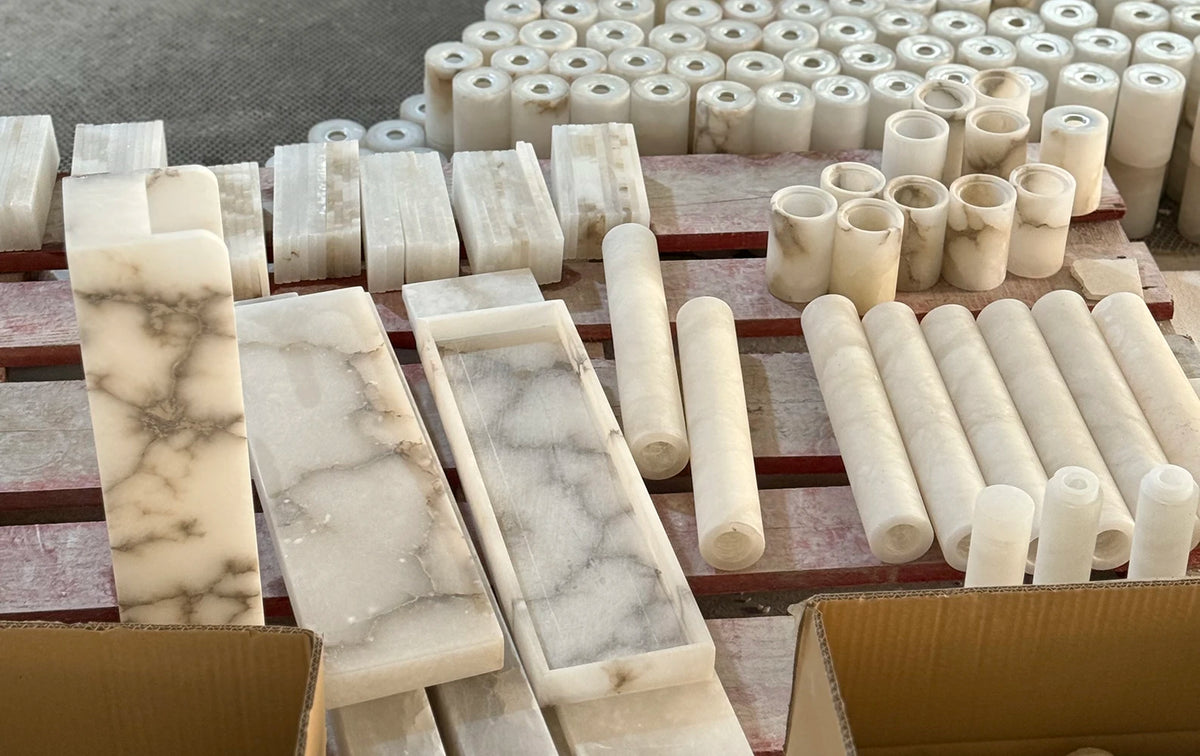
Alabaster is translucent, so the light travels through the stone rather than escaping at the edges — the whole shade glows, veining and all. Every piece carries a pattern that was decided underground, which is why no two are alike.

Unique veining Soft, natural translucency Will not yellow
02 / Resin Material
Industrially Replicated Surface

Limitations of resin

Resin is cast in moulds, so the "veining" repeats from one shade to the next and the light passes through evenly with no depth to it. It also ages differently: sitting close to a warm bulb, resin tends to amber and grow brittle within a few years.

Prone to yellowing Uniform light transmission Repeating pattern

THE ART OF ALABASTER

Light, hidden within every texture.

The natural texture of alabaster brings a warm, mineral quality to the space. (Please contact us if you require a specific texture.)

Pure
01 / 05

Pure

A pure white texture reminiscent of fresh snow—warm, smooth, and refined.

Ink-Dyed
02 / 05

Ink-Dyed

Deep, inky patterns flow across a white base.

Lightning Pattern
03 / 05

Lightning Pattern

A dynamic pattern resembling a bolt of lightning streaking across the sky.

Ice-Crackle Pattern
04 / 05

Ice-Crackle Pattern

Fine, intricate cracks evoking the aesthetic beauty of a sheet of ice at the moment it shatters.

Snowflake Pattern
05 / 05

Snowflake Pattern

A pattern as light and airy as falling snowflakes, with every single flake unique.

Material · Method · Light

The art of alabaster

Every texture tells a story of natural light and patient craftsmanship.
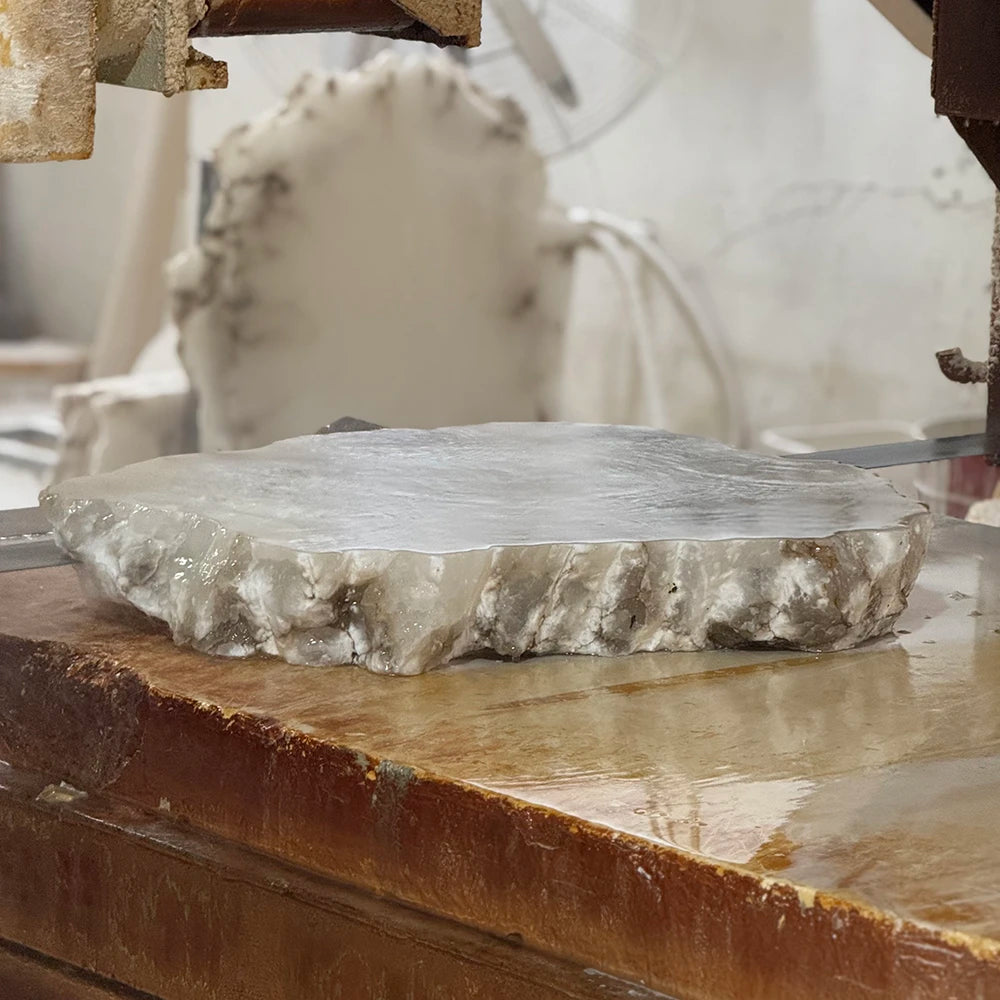
01

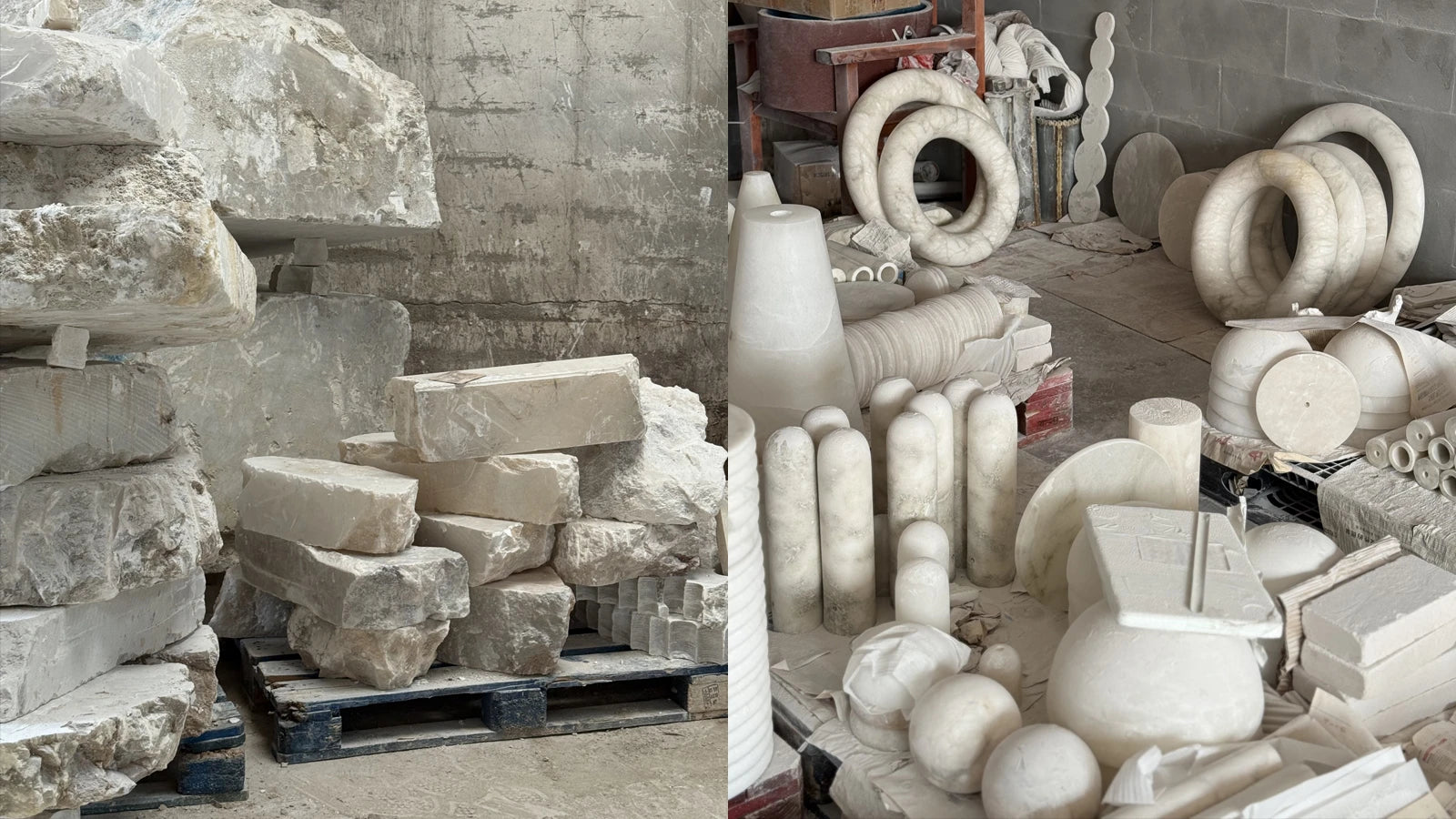
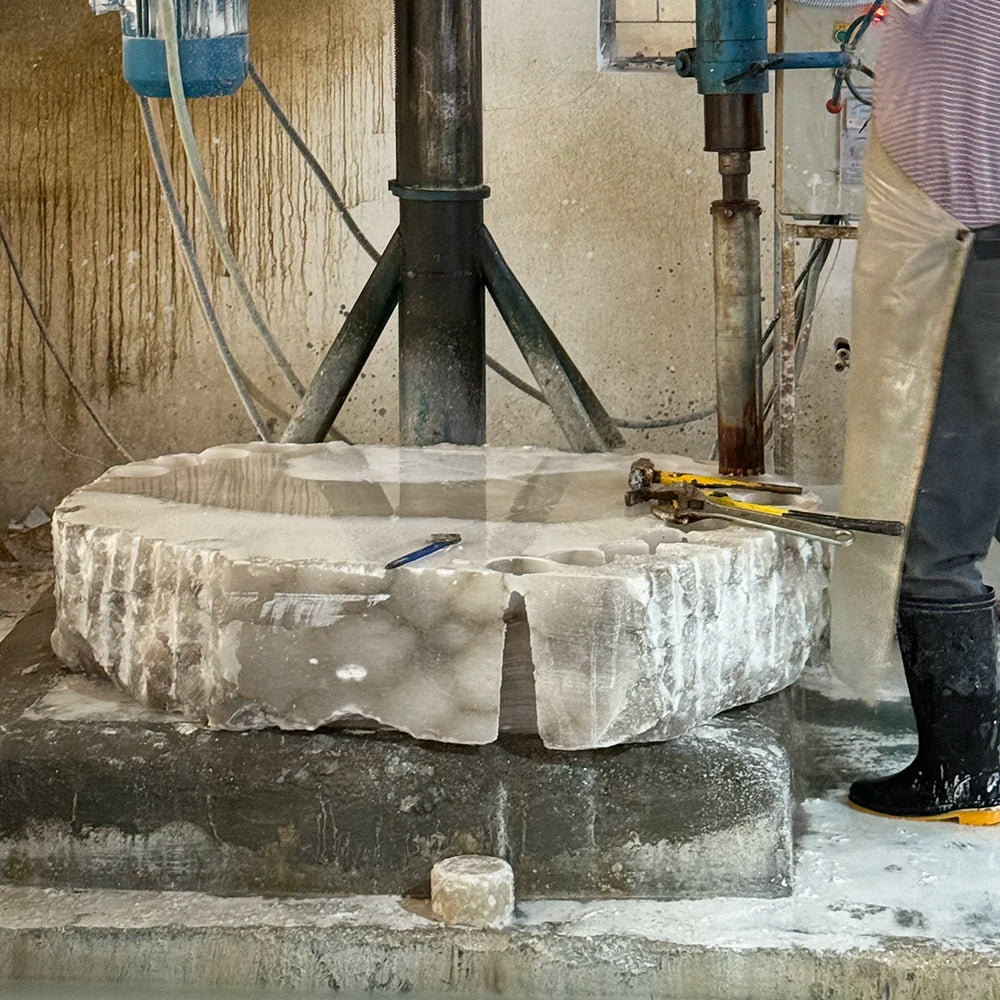
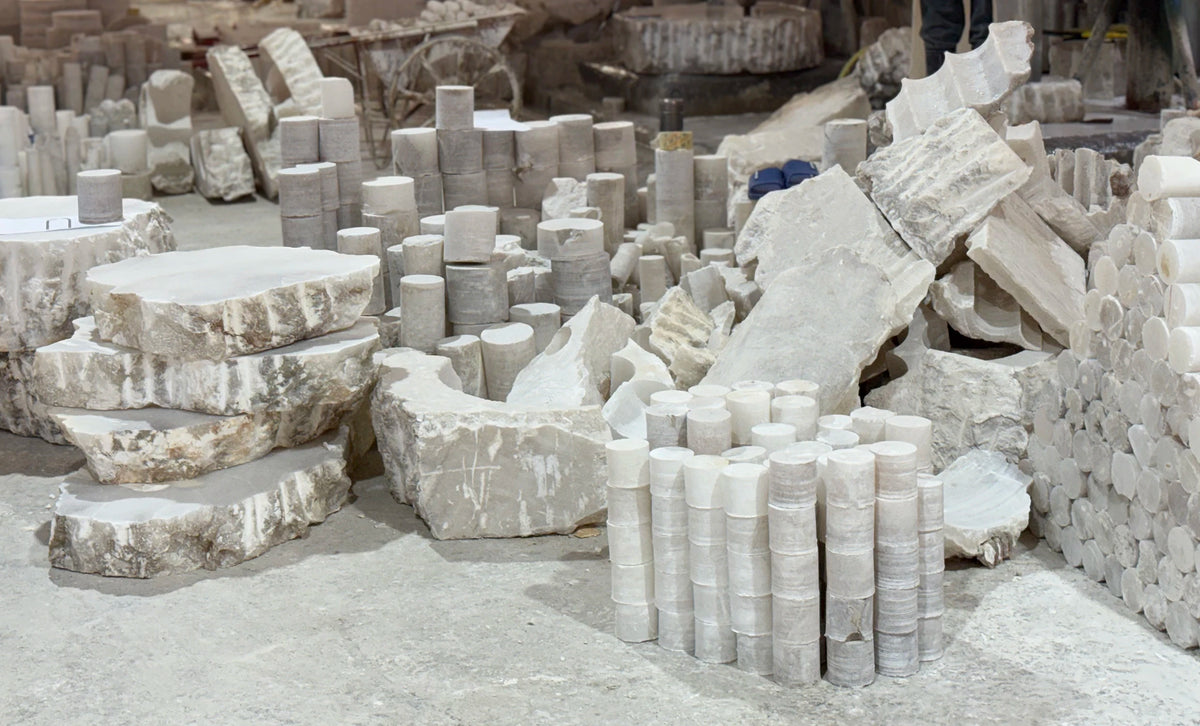
Crafted from select natural alabaster, preserving its unique veining.

02

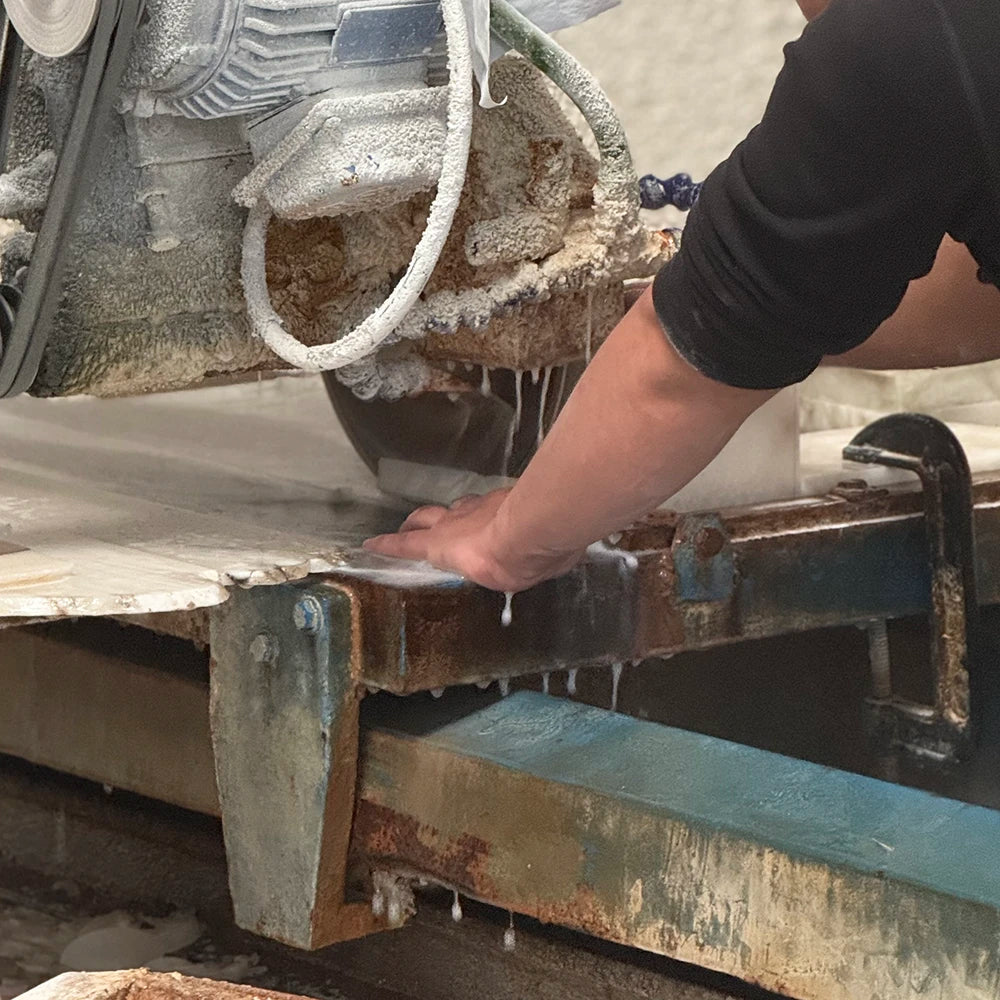
Meticulously cut and shaped by artisans.

03

Repeatedly ground and polished for a smooth, refined texture.

04

Carefully assembled and quality-inspected.

Custom Stone Lighting

Crafting Unique Stone Textures for You

We create bespoke stone lighting fixtures featuring unique textures tailored to your specifications. From one-off custom pieces to multi-unit project orders, we cater to a wide range of custom requirements for residential, hospitality, and commercial interior design.
Custom Stone From inspiration to the finished product, every detail can be customized.
Custom dimensions
Stone texture selection
Surface finishes
Shapes and profiles
Multi-piece orders
Trade and architectural projects
Stone sample service
Material study / 01Vidirlighting