


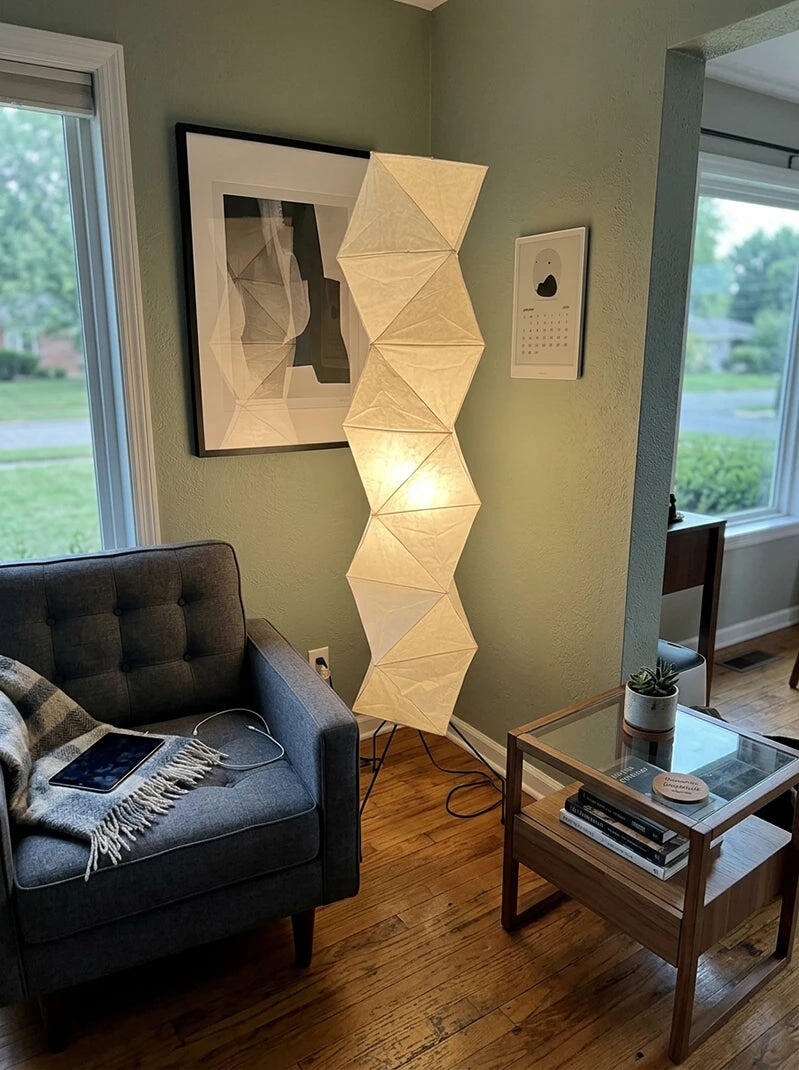
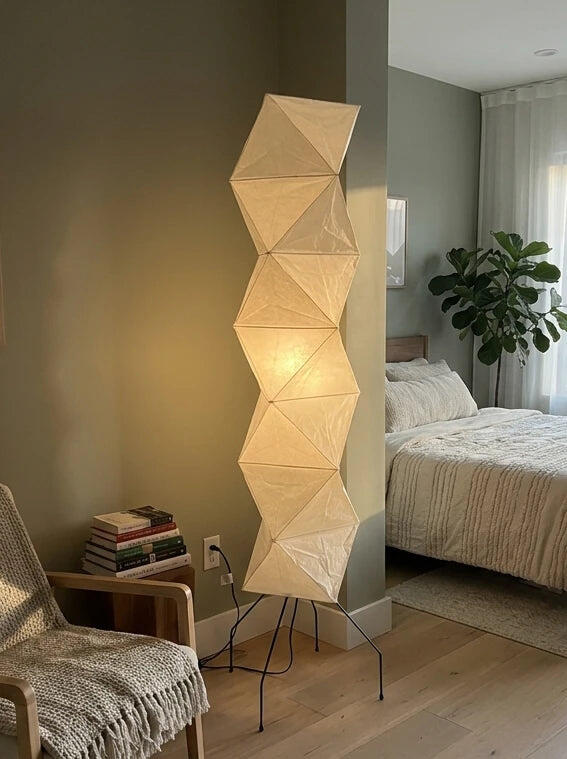
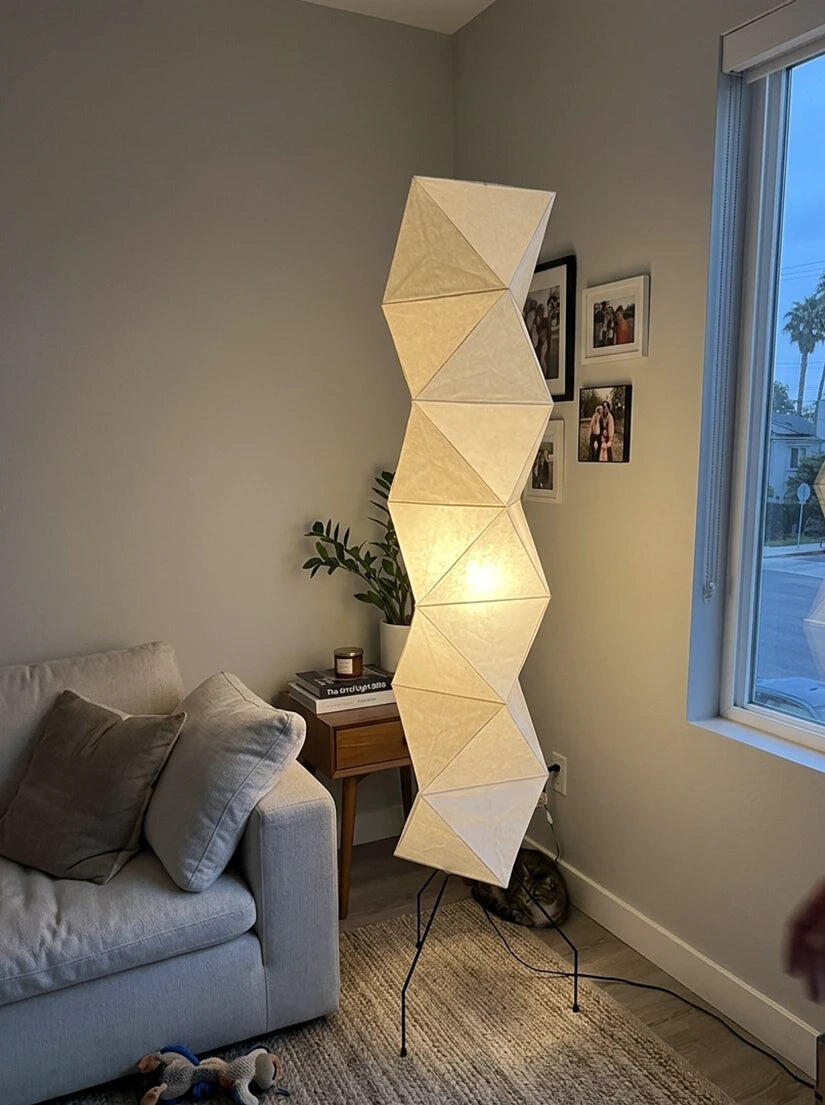
IThe Akari Rhombus Origami UF4-L8 Floor Lamp is a tall shade built entirely from folded triangular facets, stacked and alternating up the height of the column, standing on three slim wire legs that barely touch the floor. The paper is mulberry paper (washi-style) — thin enough to pass light, fibrous enough to hold a crease — and because every facet meets its neighbours at a different angle, the light hits each one differently. Some faces glow, some stay in shadow, and the pattern shifts as you move around it.
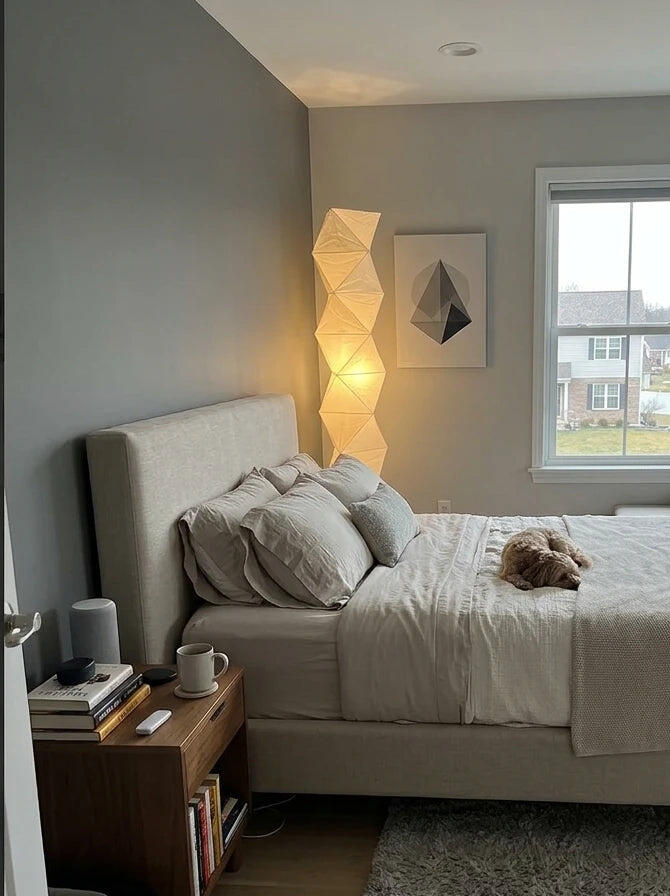
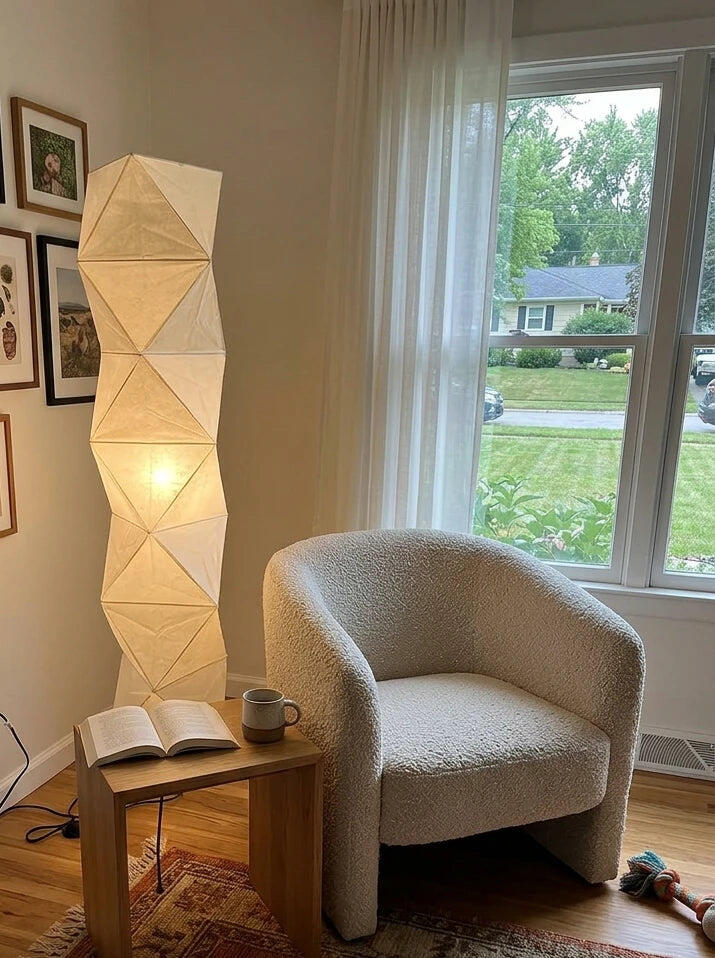
The whole thing weighs almost nothing, and that is the point. A floor lamp usually announces itself as furniture — a base, a stem, a shade, all of it visibly heavy. This one reads as a lit paper structure that happens to be standing in the room: no visible base, no thick stem, just three wire lines and a column of light. It suits a corner that needs softening rather than lighting, beside a sofa or a reading chair, in a bedroom, or anywhere a hard-edged room could use one soft object.
Paper Made From Bark, Not Pulp
The shade is mulberry paper (washi-style) — a natural paper made from the inner bark of the mulberry shrub rather than from wood pulp. That one difference decides everything about how this lamp behaves.

Bark fibres run long and cross over each other. Pulp fibres are short and lie flat — which is why ordinary paper tears in a straight line and this does not.
It Holds a Fold
Long fibres crease and stay creased. Every triangle on this shade keeps its edge instead of softening back into a curve — which is the only reason a folded structure like this can exist.
It Passes Light, Not Glare
Thin enough for light to come through the whole surface, fibrous enough to scatter it on the way. No hotspot, no visible bulb — the shade glows rather than shines.
Every Sheet Is Its Own
A natural fibre, so the paper carries faint variations in tone and texture. Lit from inside, those show as soft shifts across each facet rather than one flat surface.
Only two things, and both are easy. Keep it dry — paper absorbs water, and a damp patch cockles the surface permanently, so no bathrooms, no conservatories, and not beside an open window. And dust it dry: a soft brush, or a hairdryer on the cold setting, works far better than any cloth. Never anything damp. Handled that way, the paper holds its folds and its colour for many years.
Light Enough to Move Whenever You Feel Like It
Paper and wire weigh almost nothing, and it plugs into a socket rather than the ceiling. So its place in your home is never a decision you have to get right — carry it to a different corner tonight, and again next month.

The same lamp, carried from one spot to the next. Nothing to unscrew, nothing to patch up afterwards.
It reaches the corner nothing else can
The darkest part of most rooms is a corner with no table to stand a lamp on and no wiring anywhere near it. A tall column that carries its own height and plugs into the nearest socket solves that in about ten seconds — and solves it again in the next room when you move it.
Renting? It comes with you
No holes, no wiring, no permission needed — and when you move, it goes in the car with you. Paper and wire pack down far more easily than anything with a marble base, and there is no ceiling to make good behind you.

A Round Switch on the Floor — Turn It On With Your Foot
No reaching up into a paper shade, no feeling around a wall for a plate that isn't there. The switch sits on the cord, on the floor, where your foot already is.
Which matters more than it sounds on a lamp like this. A tall paper column has nothing you would want to reach into — and because it plugs in rather than wires in, it usually stands somewhere with no wall switch anywhere near it.
Press With Your Toe
A round pedal switch you can find without looking down — no small rocker to hunt for in the dark, and no need to bend.
Hands Stay Free
Turn it on carrying a cup, a book, or a laundry basket. Nothing to hold, nothing to put down first.
No Wall Switch Needed
It plugs into any socket and brings its own switch with it — so it works in a corner no wall switch reaches.
The Details
Good to Know
How to dim it — the switch alone will not
The push-button switch on the cord is on/off only. Fitting a dimmable bulb changes nothing on its own, because there is no dimmer for it to talk to. Two things actually work: plug the lamp into an in-line plug-in dimmer, or fit a smart bulb you dim from an app. Either is inexpensive, and worth deciding before the lamp arrives rather than after.
Six Feet Two, and Sixteen Inches Wide
Taller than you are and narrower than an armchair. Both halves of that matter — one is why it reads as a presence, the other is why it doesn't crowd the room.

At 74″ the shade rises above head height — so the light is always above your eyeline, never in it.
Where this lamp does its best work.
Not a reading light — pair it with one if you read there.
Keep it away from curtains that move in a draught.
A quiet corner is kinder to it than a busy one.
Specifications & Installation
Specification Sheet
Materials, sizes, wattage and ratings — the full technical record.
View SpecificationsInstallation Guide
Mounting heights, clearances and wiring — written for US homes.
View InstallationInstallation
Set up your Akari Rhombus in minutes
Our step-by-step guide shows how to unpack, assemble and set up your floor lamp safely, with clear pictures for every step.
Common Questions
Which bulb to use, how tall it really is, and how to look after paper.
Which bulb should I use?
The socket is a standard E26 (US) / E27 screw fitting, and bulbs aren't included.
Choose warm white, around 2700K. Cool white light through paper looks grey and clinical — it's the quickest way to make a warm lamp feel cold.
How tall is it, really?
74″ — that's 6 ft 2 in, taller than most people. Worth picturing properly before you order: this isn't a small accent lamp.
But it's only 16.1″ across, so it's a narrow column rather than a bulky object — it takes up about as much floor as a dining chair while standing a head above one. Allow around 20″ of clear floor, since the tripod legs splay wider than the shade.
Can I dim it?
Not with the switch on the cord — that's on/off only. And fitting a dimmable bulb on its own changes nothing, because there's no dimmer for it to work with.
Two things do work: plug the lamp into an in-line plug-in dimmer, or fit a smart bulb you dim from your phone. Both are inexpensive and either takes a minute — worth sorting out before the lamp arrives.
Is it bright enough to read by?
No — and it isn't meant to be. Paper spreads light across its whole surface instead of aiming it, so you get a soft even glow with no beam and no bright spot anywhere.
That makes it a lamp for atmosphere: a dark corner, beside a sofa, in a bedroom. If you also want to read in that chair, pair it with a directional reading light. Asking one soft paper lamp to do both jobs is how people end up disappointed with it.
What is the shade made of?
Mulberry paper (washi-style) — a natural paper made from the inner bark of the mulberry shrub rather than from wood pulp, on a steel wire frame.
The difference matters. Bark fibres are long and cross over each other, so a fold bends and holds instead of breaking — which is the only reason a folded structure like this stays folded. Those same fibres scatter the light on its way out, which is why the shade glows rather than shines.
How do I clean it?
Dry only. A soft brush, or a hairdryer on the cold setting, gets dust out of the folds far better than any cloth.
Never use anything damp. Paper absorbs water, and a wet patch cockles the surface permanently — there's no fixing it afterwards.
Where should I not put it?
Anywhere damp: no bathrooms, no conservatories, and not beside a window you leave open. Paper takes in moisture from the air, not just from splashes.
Out of direct sun, which will lighten the paper unevenly over months. And out of walkways — anything light enough to carry in one hand is light enough to knock over.
Does it need an electrician?
Will it fall over easily?
It stands on a three-legged wire base that spreads wider than the shade, and a tripod can't rock the way four feet can on an uneven floor. So on its own, it stands steadily.
But it's genuinely light, and light things get knocked. Stand it in a corner or beside a chair rather than in a walkway, and run the cord along the skirting board instead of across the floor.
What if the paper gets damaged?
The Same Paper, at Two Other Heights
Folded paper light overhead and on a table. Used together with the floor lamp, one room gets the same soft glow at three different levels.


Folded Paper Pendant Light
Ceiling · hardwired
The same paper, hung overhead. Where the floor lamp fills a corner, this lights the middle of a room — over a table or in an entry, with the same fully diffused glow and no bulb to look into.

Folded Paper Triangle Table Lamp
Table top · plug in
The small one. Folded from the same paper into a faceted form for a bedside, a console, or a desk corner — and like the floor lamp, it plugs in, so nothing needs wiring.
Akari Rhombus Origami UF4-L8 Floor Lamp
The price includes tax, and free standard shipping within the U.S. is provided.

Free Shipping on all orders
Hassle-free return within 30 days
Payment Security
Pairs Well With
IThe Akari Rhombus Origami UF4-L8 Floor Lamp is a tall shade built entirely from folded triangular facets, stacked and alternating up the height of the column, standing on three slim wire legs that barely touch the floor. The paper is mulberry paper (washi-style) — thin enough to pass light, fibrous enough to hold a crease — and because every facet meets its neighbours at a different angle, the light hits each one differently. Some faces glow, some stay in shadow, and the pattern shifts as you move around it.
The whole thing weighs almost nothing, and that is the point. A floor lamp usually announces itself as furniture — a base, a stem, a shade, all of it visibly heavy. This one reads as a lit paper structure that happens to be standing in the room: no visible base, no thick stem, just three wire lines and a column of light. It suits a corner that needs softening rather than lighting, beside a sofa or a reading chair, in a bedroom, or anywhere a hard-edged room could use one soft object.
Paper Made From Bark, Not Pulp
The shade is mulberry paper (washi-style) — a natural paper made from the inner bark of the mulberry shrub rather than from wood pulp. That one difference decides everything about how this lamp behaves.
Bark fibres run long and cross over each other. Pulp fibres are short and lie flat — which is why ordinary paper tears in a straight line and this does not.
It Holds a Fold
Long fibres crease and stay creased. Every triangle on this shade keeps its edge instead of softening back into a curve — which is the only reason a folded structure like this can exist.
It Passes Light, Not Glare
Thin enough for light to come through the whole surface, fibrous enough to scatter it on the way. No hotspot, no visible bulb — the shade glows rather than shines.
Every Sheet Is Its Own
A natural fibre, so the paper carries faint variations in tone and texture. Lit from inside, those show as soft shifts across each facet rather than one flat surface.
Only two things, and both are easy. Keep it dry — paper absorbs water, and a damp patch cockles the surface permanently, so no bathrooms, no conservatories, and not beside an open window. And dust it dry: a soft brush, or a hairdryer on the cold setting, works far better than any cloth. Never anything damp. Handled that way, the paper holds its folds and its colour for many years.
Light Enough to Move Whenever You Feel Like It
Paper and wire weigh almost nothing, and it plugs into a socket rather than the ceiling. So its place in your home is never a decision you have to get right — carry it to a different corner tonight, and again next month.
The same lamp, carried from one spot to the next. Nothing to unscrew, nothing to patch up afterwards.
It reaches the corner nothing else can
The darkest part of most rooms is a corner with no table to stand a lamp on and no wiring anywhere near it. A tall column that carries its own height and plugs into the nearest socket solves that in about ten seconds — and solves it again in the next room when you move it.
Renting? It comes with you
No holes, no wiring, no permission needed — and when you move, it goes in the car with you. Paper and wire pack down far more easily than anything with a marble base, and there is no ceiling to make good behind you.
A Round Switch on the Floor — Turn It On With Your Foot
No reaching up into a paper shade, no feeling around a wall for a plate that isn't there. The switch sits on the cord, on the floor, where your foot already is.
Which matters more than it sounds on a lamp like this. A tall paper column has nothing you would want to reach into — and because it plugs in rather than wires in, it usually stands somewhere with no wall switch anywhere near it.
Press With Your Toe
A round pedal switch you can find without looking down — no small rocker to hunt for in the dark, and no need to bend.
Hands Stay Free
Turn it on carrying a cup, a book, or a laundry basket. Nothing to hold, nothing to put down first.
No Wall Switch Needed
It plugs into any socket and brings its own switch with it — so it works in a corner no wall switch reaches.
The Details
Good to Know
How to dim it — the switch alone will not
The push-button switch on the cord is on/off only. Fitting a dimmable bulb changes nothing on its own, because there is no dimmer for it to talk to. Two things actually work: plug the lamp into an in-line plug-in dimmer, or fit a smart bulb you dim from an app. Either is inexpensive, and worth deciding before the lamp arrives rather than after.
Six Feet Two, and Sixteen Inches Wide
Taller than you are and narrower than an armchair. Both halves of that matter — one is why it reads as a presence, the other is why it doesn't crowd the room.
At 74″ the shade rises above head height — so the light is always above your eyeline, never in it.
Where this lamp does its best work.
Not a reading light — pair it with one if you read there.
Keep it away from curtains that move in a draught.
A quiet corner is kinder to it than a busy one.
Specifications & Installation
Specification Sheet
Materials, sizes, wattage and ratings — the full technical record.
View SpecificationsInstallation Guide
Mounting heights, clearances and wiring — written for US homes.
View InstallationInstallation
Set up your Akari Rhombus in minutes
Our step-by-step guide shows how to unpack, assemble and set up your floor lamp safely, with clear pictures for every step.
Common Questions
Which bulb to use, how tall it really is, and how to look after paper.
Which bulb should I use?
The socket is a standard E26 (US) / E27 screw fitting, and bulbs aren't included.
Choose warm white, around 2700K. Cool white light through paper looks grey and clinical — it's the quickest way to make a warm lamp feel cold.
How tall is it, really?
74″ — that's 6 ft 2 in, taller than most people. Worth picturing properly before you order: this isn't a small accent lamp.
But it's only 16.1″ across, so it's a narrow column rather than a bulky object — it takes up about as much floor as a dining chair while standing a head above one. Allow around 20″ of clear floor, since the tripod legs splay wider than the shade.
Can I dim it?
Not with the switch on the cord — that's on/off only. And fitting a dimmable bulb on its own changes nothing, because there's no dimmer for it to work with.
Two things do work: plug the lamp into an in-line plug-in dimmer, or fit a smart bulb you dim from your phone. Both are inexpensive and either takes a minute — worth sorting out before the lamp arrives.
Is it bright enough to read by?
No — and it isn't meant to be. Paper spreads light across its whole surface instead of aiming it, so you get a soft even glow with no beam and no bright spot anywhere.
That makes it a lamp for atmosphere: a dark corner, beside a sofa, in a bedroom. If you also want to read in that chair, pair it with a directional reading light. Asking one soft paper lamp to do both jobs is how people end up disappointed with it.
What is the shade made of?
Mulberry paper (washi-style) — a natural paper made from the inner bark of the mulberry shrub rather than from wood pulp, on a steel wire frame.
The difference matters. Bark fibres are long and cross over each other, so a fold bends and holds instead of breaking — which is the only reason a folded structure like this stays folded. Those same fibres scatter the light on its way out, which is why the shade glows rather than shines.
How do I clean it?
Dry only. A soft brush, or a hairdryer on the cold setting, gets dust out of the folds far better than any cloth.
Never use anything damp. Paper absorbs water, and a wet patch cockles the surface permanently — there's no fixing it afterwards.
Where should I not put it?
Anywhere damp: no bathrooms, no conservatories, and not beside a window you leave open. Paper takes in moisture from the air, not just from splashes.
Out of direct sun, which will lighten the paper unevenly over months. And out of walkways — anything light enough to carry in one hand is light enough to knock over.
Does it need an electrician?
Will it fall over easily?
It stands on a three-legged wire base that spreads wider than the shade, and a tripod can't rock the way four feet can on an uneven floor. So on its own, it stands steadily.
But it's genuinely light, and light things get knocked. Stand it in a corner or beside a chair rather than in a walkway, and run the cord along the skirting board instead of across the floor.
What if the paper gets damaged?
The Same Paper, at Two Other Heights
Folded paper light overhead and on a table. Used together with the floor lamp, one room gets the same soft glow at three different levels.
Folded Paper Pendant Light
Ceiling · hardwired
The same paper, hung overhead. Where the floor lamp fills a corner, this lights the middle of a room — over a table or in an entry, with the same fully diffused glow and no bulb to look into.
Folded Paper Triangle Table Lamp
Table top · plug in
The small one. Folded from the same paper into a faceted form for a bedside, a console, or a desk corner — and like the floor lamp, it plugs in, so nothing needs wiring.
Customer Reviews

Light, Softened by Paper
Sculptural floor, table and pendant lamps that turn warm light into a soft, even glow. Their organic shapes bring a calm, gallery-like presence to modern rooms.
Shaped from Paper and Light
Each shade stretches a light paper skin over a fine iron wire frame. The result is a lamp that feels almost weightless, lets light pass through and blends it into a warm, even glow, and folds away when you need it to.
-

High Translucency, Blended Light
The thin paper lets plenty of light pass through, then blends it into one soft, even glow without harsh glare.
-

Folds Flat, Opens Easily
The ribbed structure collapses flat for compact shipping and storage, then opens back into its full shape when you are ready to hang it.
-

Clean, Careful Seams
Paper panels are glued along the ribs and pressed into neat seams, keeping the surface smooth so light passes through evenly.
- Shade
- Paper
- Frame
- Iron wire
- Structure
- Collapsible
- Light
- Soft and diffused
Light That Adapts to Your Space
Carry a floor lamp to wherever you need it tonight, or build a pendant cluster that fits your room exactly. Our paper lighting is designed around the way you really live.

Floor lamps
Move It Wherever You Need Light
Our tripod floor lamps are light enough to lift with one hand. Pick one up and carry it from a reading corner to the sofa, the bedside or a dim entryway, and the mood of the room moves with it.
There is no hardwiring and no electrician to book. Set it down near an outlet, plug it in, and the paper shade spreads a soft, even glow across the space.
-
Lightweight build
Easy to lift, carry and reposition on your own.
-
Plug-in design
No installation needed. Use it anywhere near an outlet.
-
Steady tripod base
Three slim legs keep the lamp balanced on the floor.
-
Flexible layouts
Refresh a room arrangement without rewiring a thing.
Ideal for reading corners, living rooms, bedrooms and home offices.

Pendant lights
Mix Shapes, Build Your Own Cluster
Choose shades in different shapes and sizes, then hang them together as one grouped installation. Setting each shade at its own height creates a layered, sculptural look that draws the eye upward.
A cluster shines above a dining table, in a stairwell with a tall ceiling, or as the centerpiece of a living room, anywhere a single pendant would feel too small.
How to plan your cluster
-
Pick your styles
Browse our pendants and note the shapes and sizes you like.
-
Tell us about your space
Share your ceiling height and the area you want to light.
-
Get a suggested arrangement
We recommend a combination and hanging layout that suits your room.
Want to combine specific pendant styles?
Contact us with the styles you have in mind and we will help you plan the arrangement. Email support@vidirlighting.com
From Plant Fiber to Glowing Paper
Traditional papermaking is a slow, patient craft. Plant fibers are softened, beaten, formed and dried into thin sheets, and every stage shapes how the finished paper will hold and soften light.
-
Preparing the bark
Bundles of plant bark are soaked and stripped, leaving only the inner fibers used for paper.
-
Cooking the fibers
The fibers simmer in a large cauldron until they turn soft and pliable.
-
Pounding the pulp
Softened fibers are pounded in a stone mortar to break them into fine strands.
-
Mixing the vat
The pulp is stirred into a vat of water until the fibers float evenly throughout.
-
Forming the sheet
A screen is lifted through the vat, catching a thin, even layer of fibers as the water drains away.
-
Pressing out water
Stacks of wet sheets go into a wooden press to squeeze out the remaining water.
-
Smoothing flat
Each sheet is laid on a board and smoothed so it dries even and free of wrinkles.
-
Checking the finish
Finished sheets are held to the light to check for an even texture before they are rolled and stored.
Why it matters for light
Long fibers that overlap in every direction give the paper strength while keeping it thin. When a bulb shines through, those layers scatter the light into a warm, even glow with no harsh hot spots.
Shaped by Hand, Shade by Shade
Every paper shade takes shape at the workbench. Our artisans build the frame, lay the paper and finish each seam by hand, giving every lamp a quiet, crafted character that machines cannot copy.
-

Frames Built by Hand
Each rib is bent and set around the mold by hand, one at a time, so the frame takes on a smooth, balanced curve.
-

Paper Laid Piece by Piece
Artisans position every paper panel by hand, lining it up with the ribs before gently pressing it into place.
-

Pressed and Smoothed by Hand
Fingertips follow each curved rib, pressing the paper flat and easing out the small wrinkles a machine would miss.
-

Trimmed with Care
Every seam is trimmed by hand with scissors, leaving a clean edge and a shade that glows evenly from top to bottom.
Why handmade matters
Hands can feel what a machine cannot: where the paper needs easing, and where a seam needs one more pass.
Shaped by hand
Every frame is covered and smoothed at the workbench.
Finished seam by seam
Edges are trimmed individually for a clean line.
One of a kind
Small variations in texture and seams are part of each shade.
See the Craft in Motion
Watch how our paper lamps come together at the workbench. From the first rib on the frame to the final trimmed seam, every stage is guided by hand before the shade reaches your home.
-
Frames built by hand
Ribs are set one at a time for a smooth, balanced shape.
-
Paper smoothed by hand
Each panel is pressed along the ribs to follow every curve.
-
Seams trimmed with care
Clean edges help the finished shade glow evenly.


