What Crystal Actually Does to Light
Everyone knows crystal sparkles. Almost nobody is told why — or that the shape it is cut into decides what kind of sparkle you get, and whether your room ends up with colour flung across the ceiling or a quiet glow beside the bed.
- Crystal is not just fancy glass
- How a piece of crystal is actually made
- The cut is the instrument — four behaviours
- Crystal, glass or acrylic: what you are really choosing
- Six fixtures, six different behaviours
- How to tell good crystal from ordinary glass
- Scale: the mistake that costs the most
- Room by room: where crystal earns its place
- Bulbs: the choice that makes or ruins it
- Cleaning, honestly
- Four things people get wrong
- Before you order: seven things to check
- Questions people ask us
Crystal is not just fancy glass
Hold a piece of ordinary glass up to a window and you see the window. Hold a piece of good crystal up to the same window and something else happens — the edges catch, a thin line of colour appears where there was none, and the thing in your hand stops being transparent and starts being active.
That difference is not decoration. It is physics, and it is the entire reason anyone hangs crystal from a ceiling.
Glass and crystal both begin as silica. What separates them is what else goes into the melt. Traditional crystal contains lead oxide; modern lead-free crystal uses barium, zinc or potassium oxide instead. Either way, the additive does the same job: it raises the refractive index — how sharply the material bends light passing through it.
Ordinary window glass sits at a refractive index of roughly 1.52. Crystal runs higher — often 1.55 to 1.60 and beyond in leaded formulations. That sounds like a trivial difference on paper. In practice it is the difference between a material that lets light through and a material that takes light apart.
The two things a higher index buys you
Brighter edges. Light entering a cut face at an angle bends further before it leaves, so it concentrates at the edges rather than passing straight through. A crystal facet does not glow; it flashes. That is why a hundred small facets read as a hundred separate points of light rather than as a lit surface.
Colour from nowhere. Different wavelengths bend by different amounts, so white light separates into its spectrum as it passes through. That separation is called dispersion, and it is where the flecks of violet, gold and green on your ceiling come from. Glass disperses too — just far too weakly to see across a room.
There is a third consequence that gets less attention. The additive also makes the material softer and more workable. Crystal takes a deeper, cleaner facet than glass can hold, and polishes to a brighter edge. So composition and cut are not two separate questions: you cannot get crystal's optical behaviour out of glass, because glass will not hold the cut that produces it.

How a piece of crystal is actually made
Knowing the process makes the price make sense, and it explains why two fixtures that look similar in a photograph can feel completely different in a room.
The step that separates good crystal from ordinary is the third and fourth together. Cutting is subtractive and slow — every facet removes material that cannot be put back, and a mistake ruins the blank. Polishing is slower still. A moulded imitation skips both: it is pressed into a facet-shaped mould in one operation, which is why its edges are always slightly soft and its faces slightly cloudy.
That is also why moulded pieces are cheap and cut pieces are not. You are not paying for the material — silica is sand. You are paying for the hours of grinding and the blanks that did not survive it.

The cut is the instrument — four behaviours
Here is the part almost no product page explains. Crystal does not have one behaviour. The shape it is cut into decides what the light does, and four shapes cover nearly everything you will encounter.
Once you can name those four, a crystal fixture stops being a style choice and becomes a functional one. Do you want light thrown, scattered, dispersed, or simply held?
That question has a different answer in a dining room than beside a bed. Over a table where people sit for hours, dispersion is a pleasure — there is time to notice it. In a bedroom you use at the end of a long day, the same effect is busy, and a sphere is the better instrument. Neither is higher quality than the other. They are different tools.
A crystal fixture is not a light with decoration on it. It is an instrument for turning one bulb into hundreds of separate points of light.

Crystal, glass or acrylic: what you are really choosing
Three materials appear in fixtures that look broadly similar online, at prices that differ by an order of magnitude. They are not interchangeable, and the differences show up in ways photographs cannot capture.
Acrylic has one genuine advantage and it is worth naming: weight. On a very large fixture in a stairwell void, an acrylic version may be the only thing a ceiling will safely carry. Outside that case, the trade is poor — acrylic's yellowing is not a maintenance problem you can solve, and it starts within a few years under warm light.
Six fixtures, six different behaviours
Each of these uses crystal for a different optical job. Read them as examples of the four behaviours rather than as a catalogue.
Corwin Tiered Crystal Bar Chandelier
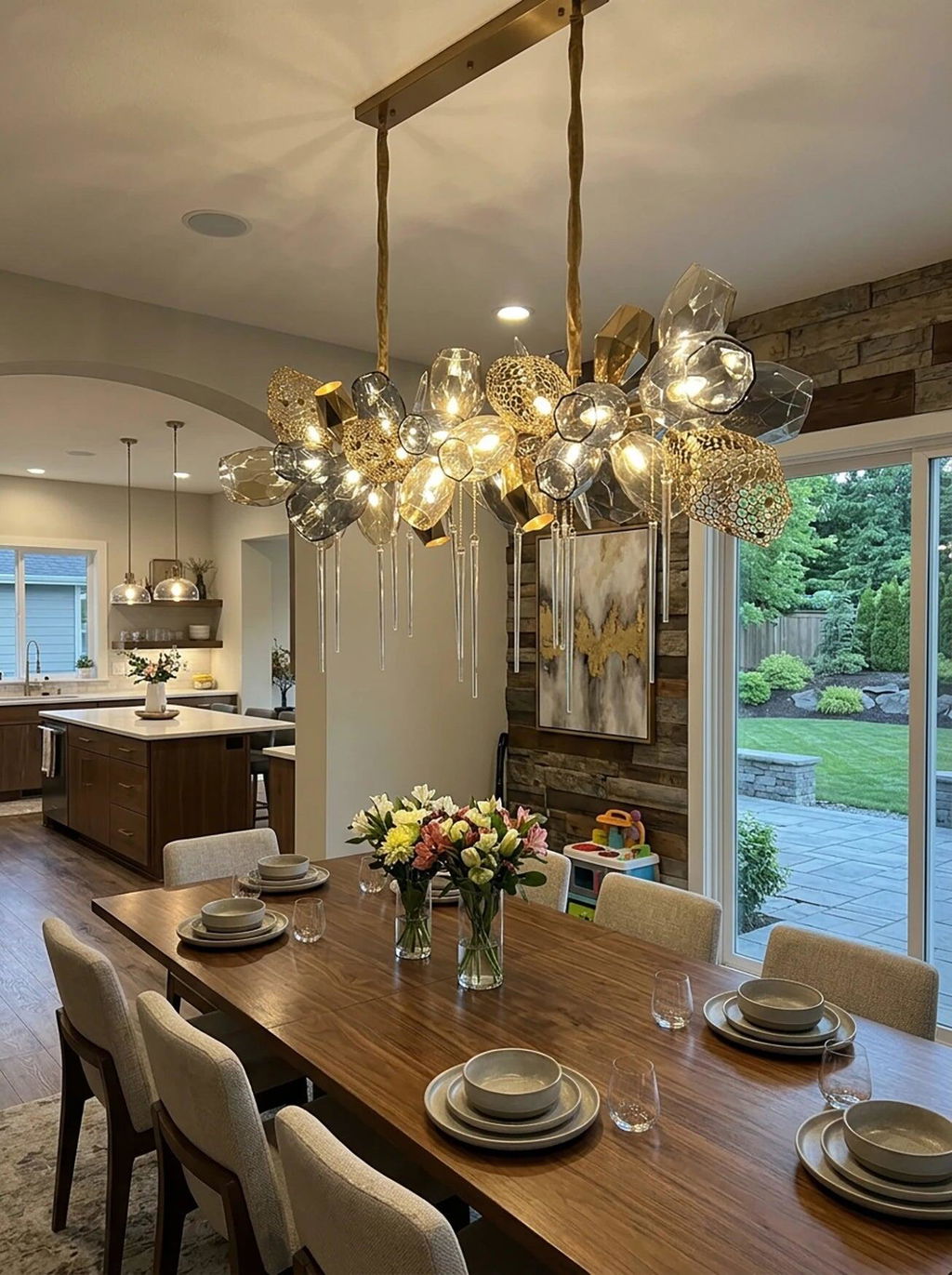
Bar-cut crystal in descending tiers. Each bar throws a vertical line of light, and because the rows overlap, those lines multiply into a mass that reads as one bright object from across a room and as hundreds of separate edges from underneath.
Stacking is what bars are for. A bar is directional along its length, so one alone is unremarkable — but a few hundred at slightly different angles fill a volume of air in a way no other cut manages. It is also the arrangement that rewards a dimmer most: at full power it is a great deal of sparkle, and at sixty percent it becomes something you can eat dinner under.

Choose it if you want a dining room fixture with real presence. Skip it if the ceiling is under 9 ft — tiered fixtures need height to read properly, and a short one looks compressed rather than grand.
Crystal Ball Round Cluster Chandelier
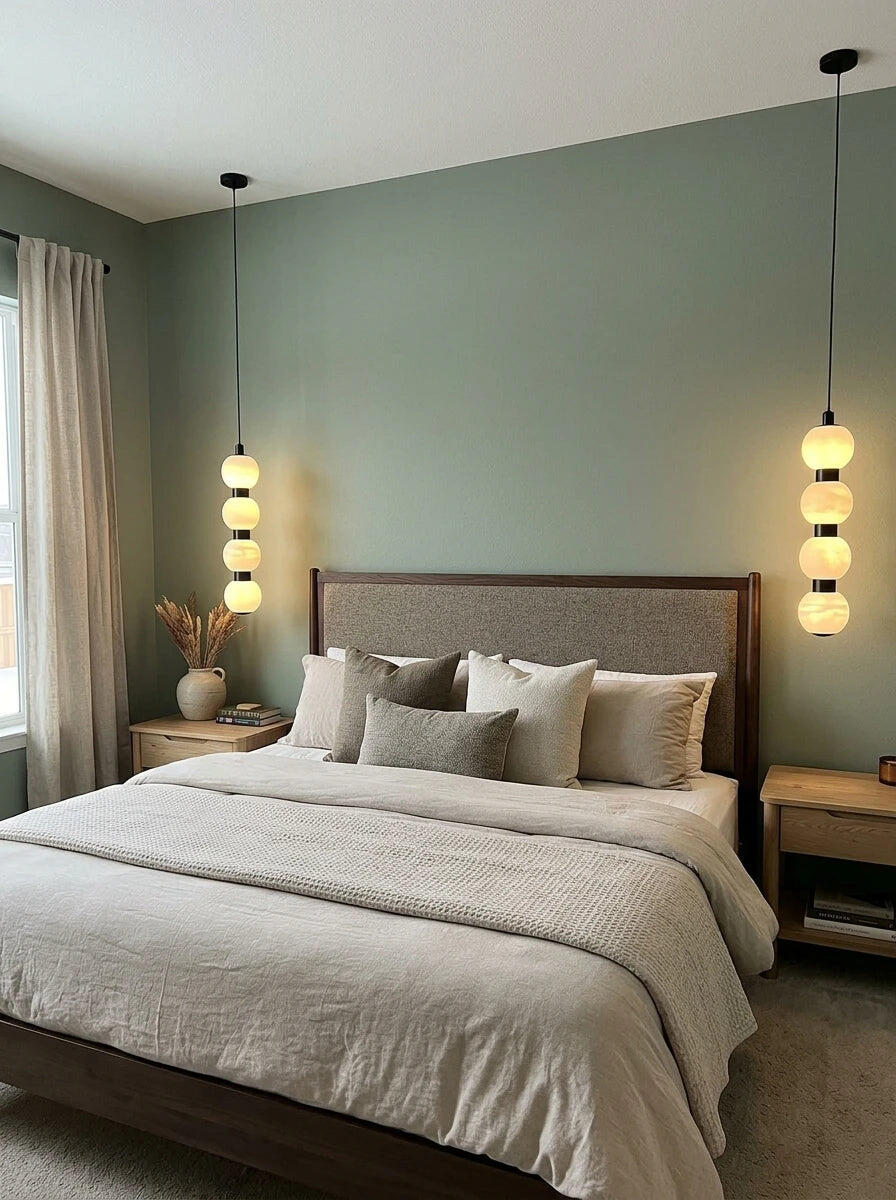
This is the gentlest way to use crystal. A sphere has no dominant edge, so instead of firing light in lines it scatters evenly in every direction — a soft, all-over shimmer rather than defined rainbows.
It is the most forgiving cut in a room you actually live in. Bars and facets can be too much over a breakfast table at seven in the morning; spheres rarely are. They also read considerably more modern than tiered crystal, because the form is geometric rather than ornamental.

Choose it if you want crystal without drama — a bedroom, a hallway, a room used in daylight as much as at night. Skip it if you specifically want colour thrown on the walls; spheres will not give you that.
Rainer Faceted Crystal Bar Sconce
Faceted bars on a wall rather than a ceiling, which changes everything about how you experience them. Overhead, facets throw light down and outward and you see the effect on surfaces. At eye level you see the crystal itself, and every facet edge is a separate point of light two feet from your face.
That is the argument for faceted crystal on a wall: it is the only position close enough to see what the cut is actually doing. The same piece on a 10 ft ceiling is a bright blur.

Choose it if you want crystal to be looked at rather than to light a room. Skip it if you need a sconce to read by — faceted crystal spreads light, it does not aim it.
Rachael Brass Sconce
The restrained end of the range. Here the metal does the structural and visual work, and crystal appears as a detail rather than as the subject — the right approach in a room that already has plenty going on, or where a fully crystal fixture would tip into formality.
It is worth knowing this option exists. A great deal of the market treats crystal as all-or-nothing, and in most houses a little of it goes considerably further than a lot. It is also the easiest way to introduce crystal into a scheme that is otherwise entirely modern.

Choose it if you want warmth and a touch of shine rather than a statement. Skip it if the crystal is the reason you are shopping.
Ottilie Sculptural Crystal Wall Sconce
The most unusual of the six, because it uses three different optical behaviours in one fixture. A pierced metal shade throws a mottled shadow pattern onto the wall beside it. A faceted form glows from within. And a long polished crystal blade — unlit, barely cut — crosses the composition diagonally, reading as an object rather than as sparkle.
It is a useful illustration of this whole guide: those three parts are not three decorations. They are three different jobs, and the fixture is composed the way it is because each one needs a different shape to do its work.

Choose it if you want a wall to have something worth looking at. Skip it if the wall is papered, panelled or dark — the shadow pattern needs plain pale plaster to show at all.
Romantic Pink Crystal Tree Branch Chandelier
Most crystal is clear, and dispersion supplies the colour. Tint the crystal itself and you get something different: the fixture reads as a colour even unlit, and the light it throws carries a consistent warm cast rather than a shifting spectrum.
Coloured crystal is a bigger commitment than clear, and worth being honest about — clear suits any scheme, pink does not. But in the right room it does something clear cannot: it has a colour by day as well as by night, which matters in a room with plenty of natural light and not much else going on.

Choose it if the room is pale and you want the fixture to be its focal point. Skip it if your walls or furnishings already carry strong colour — two competing colours in one room rarely resolves.
How to tell good crystal from ordinary glass
You cannot measure refractive index at home, but you can check the things that follow from it. Four tests, none needing equipment.
Scale: the mistake that costs the most
More returns happen over size than over anything else, and crystal is unforgiving here — a fixture that is slightly wrong looks obviously wrong, because the sparkle draws the eye straight to it.
One further note specific to crystal: a sparkling fixture reads larger than a matte one of the same dimensions. If you are between two sizes in a room that is already busy, take the smaller. If the room is plain and pale, take the larger — there is nothing else competing for attention.
Room by room: where crystal earns its place
Where it works
Over a dining table. The best room for crystal, and it is not close. People sit still, look up, and the light is on for hours. Sparkle is worth having when there is time to notice it. Bars or facets, on a dimmer.
In an entryway. A short, high-impact moment, and crystal does first impressions better than almost any other material. Height helps enormously here — a double-height entry is the one place a large tiered fixture can be read properly from two floors.
Beside a mirror or a bed. Close range, where the cut is actually visible. Most crystal is wasted at twelve feet and superb at two. Faceted sconces belong here.
In a stairwell. A crystal fixture read from three levels gives a different show from each, because your angle to every facet changes as you climb. It is the one application where the fixture is genuinely different depending on where you stand.
In a powder room. Small, dry, used briefly — the ideal place to be more dramatic than you would dare in a room you spend hours in.
Where it does not
Anywhere you need task light. Facets spread light in every direction by design, which is the opposite of what a work surface or a reading page needs. Pair crystal with something directional, or choose something else.
Over a kitchen island. Grease, not style, is the problem. Airborne cooking residue settles into every facet and dulls exactly the edges you paid for — and cleaning a hundred facets is not a five-minute job. If you want crystal in a kitchen, put it over the table rather than the hob.
In a bathroom with a shower. Most crystal fixtures are dry-rated. Steam and standard fittings are a poor combination regardless of how good the room looks.
In a low room you pass through constantly. Crystal at head height in a narrow hallway will be caught by a shoulder eventually, and crystal that has been caught by a shoulder does not recover.
Under a ceiling fan. Movement plus sparkle reads as flicker, and it is surprisingly hard to live with once you have noticed it.

Bulbs: the choice that makes or ruins it
This is the single most common way a beautiful crystal fixture ends up disappointing, and it costs nothing to get right.
Use warm white, 2700–3000K. Crystal refracts whatever it is given. Feed it cool or daylight-white and the dispersion reads blue and clinical — the fixture looks like an office and the colour flecks turn steely. Warm light produces the gold-and-amber sparkle people actually have in mind when they buy crystal.
Use a clear bulb where the bulb is hidden. A frosted bulb diffuses light before it reaches the crystal, which is precisely the wrong order of operations — the crystal is supposed to do the diffusing. A clear bulb gives the facets a sharp point source to work with, and a sharper source means brighter edges. Where the bulb is visible, frosted may still be the right call for comfort.
Use the same bulb in every socket. On a multi-light fixture, one bulb of a different colour temperature is obvious from across a room — and through refracting crystal it is worse, because the mismatch gets scattered everywhere rather than staying in one place.
Dim it if you can. Crystal at full brightness can be hard; the same fixture at sixty percent is where most people find they actually like it. Check whether dimming needs a specific bulb or driver before ordering — on an integrated LED it usually cannot be added later.
2700K, clear, identical in every socket, on a dimmer. Four decisions that cost nothing and change the fixture completely.
Cleaning, honestly
Crystal gets dusty, and dust on a facet is the one thing that genuinely kills the effect. A clean fixture and a neglected one look like different products — which is why the most common cause of "my crystal looks dull" is not the crystal.
Four things people get wrong
- "Crystal is too formal for a modern house." Crystal is a material, not a style — it takes the character of what it is mounted on. Spheres on a plain metal frame read entirely modern; tiered bars on ornate brass read traditional. Judge the frame and the cut, not the word.
- "More crystal means a better fixture." Quantity is the cheapest thing to add and the least related to quality. A hundred well-cut pieces beat four hundred moulded ones, and cost more to make. Look at one piece closely rather than counting them.
- "It will throw rainbows everywhere." Only faceted and bar cuts do that, and mostly in direct sun or with a clear bulb. Spheres and blades scatter or hold light rather than splitting it. If you want the rainbows, choose facets deliberately; if you would find them maddening, choose spheres.
- "Lead crystal is always better." It disperses slightly more, but the cut decides the outcome. A well-cut lead-free piece outperforms a badly cut leaded one, and in a lit fixture at ceiling height almost nobody can pick the composition apart.
Before you order: seven things to check
-
Which behaviour you needThrown, scattered, dispersed or held. Decide before you look at photographs — it eliminates most of the field immediately.
-
The width, against the furnitureHalf to two thirds of a table's width. For open floor, add the room's dimensions in feet and read the answer in inches.
-
The drop, and the clearance beneath it30–36″ above a tabletop; 7 ft above any floor people walk across. In a stairwell, measure from every tread it passes.
-
Whether the ceiling box can take the weightCrystal is heavy. Have an electrician confirm before delivery, not on installation day.
-
Bulb base, and whether it dimsAsk what base it takes and whether a dimmable version has to be specified when ordering. On integrated LED, it usually cannot be retrofitted.
-
Whether single pieces can be replacedOn a good fixture they hook or clip on individually. Ask, and consider keeping a spare or two for anything large.
-
How you will clean itIf it is over a stairwell or above 12 ft, work out the access before you buy. It is a real consideration, not an afterthought.
Questions people ask us
Will a crystal chandelier throw rainbows on my walls?
Is lead crystal better than lead-free?
Is crystal too formal for a modern house?
Can I replace one broken piece?
Why does my crystal look dull?
How heavy are crystal fixtures?
Can crystal go in a bathroom?
Does crystal yellow or cloud over time?
What if a piece chips?
Should I buy the bigger size or the smaller one?
The version worth remembering
Crystal is worth buying when you understand what you are buying it for. It is not a finish and not an upgrade — it is a material with a specific optical job, and the shape it is cut into decides whether that job is throwing light, scattering it, splitting it into colour, or simply holding it.
Decide which of those four your room needs. Check the width against the furniture and the drop against the ceiling. Put a warm clear bulb in it and a dimmer behind it. Clean it once a year.
Do those things and a crystal fixture will still be doing exactly what you bought it for in thirty years, long after the wiring behind it has been replaced. Get them wrong and you own something expensive that never quite does what you hoped.

Send us the room, the ceiling height, and what the light needs to do — a photo helps. We will tell you which of the six fits, and which to avoid.
Browse the Crystal Collection