A room is almost never solved by one light. Here is what each of six pieces does, the heights and spacings that make them work, and why they are better together than any of them is alone.
Most people buy lighting one fixture at a time, and the fixture they buy is almost always a ceiling light in the middle of the room. It goes up, it works, and the room stays somehow flat — evenly lit and slightly lifeless, like a shop floor after hours.
The reason is not the fixture. It is that one light source can only do one job, and a room asks for three. Lighting designers have a shorthand for this, and it is worth borrowing because it explains almost every room that feels right and every room that does not.
The six pieces below are one of each fixture type — chandelier, pendant, wall light, floor lamp, ceiling light, table lamp — and between them they cover all three layers. You do not need all six. But if a room has never felt finished no matter what you put in it, the answer is usually that it only has one layer, and it is nearly always the ambient one.

The Numbers Worth Knowing First
Almost every lighting mistake is a measurement, not a taste failure. These are the figures professionals work to, and they are worth writing on the wall before anything is drilled.
One figure that is not on the list, because it depends entirely on the piece: the depth of the fixture itself. A shallow flush light and a 25-inch cascade both hang from the same ceiling point, and only one of them fits an eight-foot room. Always measure to the bottom of the glass, never to the canopy.
The Chandelier That Goes Where You Want It

Onda Adjustable Cable Cluster Chandelier
Every renovation runs into the same problem: the ceiling box is rarely where the light needs to be. It was centred on a room that has since been rearranged, or it sits off to one side of an island added years later — and moving it means opening a ceiling and repainting.
This one solves it by refusing to be finished at the factory. The canopy takes the wiring; every cable after that is hooked wherever you place it, so the light travels to the furniture instead of the furniture arranging itself under the light. And because each head turns independently, one can point down at a worktop while another washes a wall — which quietly makes it two layers rather than one.
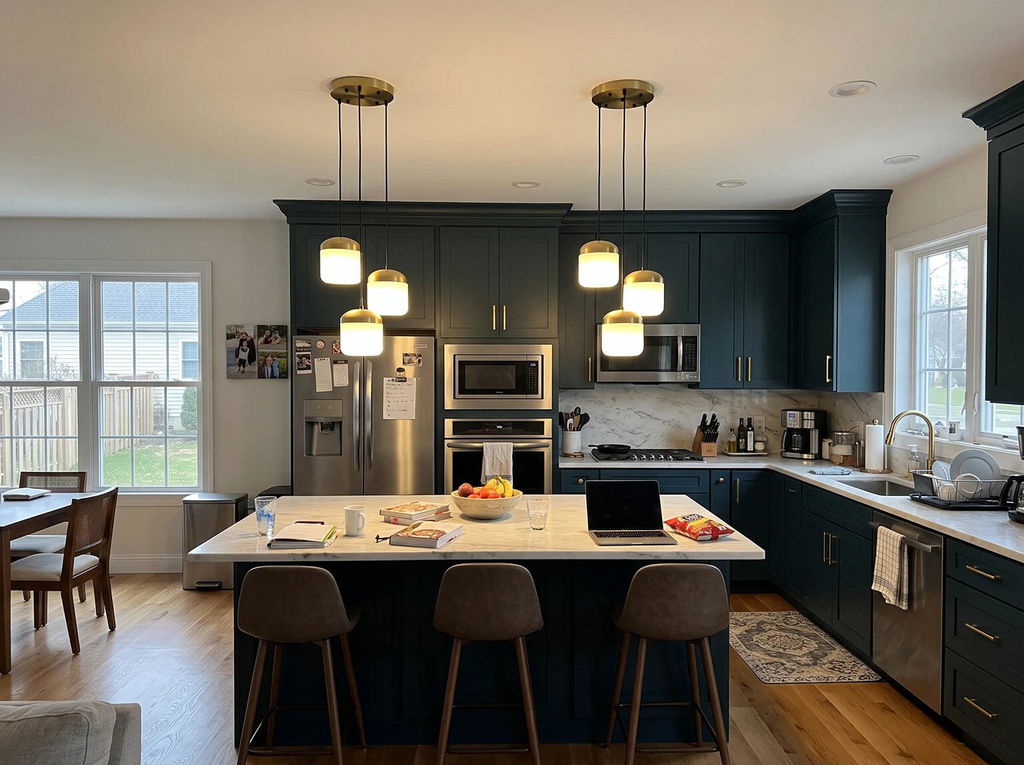
The Pendant That Is Mostly Air

Fibreglass Pendant Lamp
Wide fixtures usually mean heavy fixtures, and heavy means a rated box, a brace, and a conversation with an electrician. Fibreglass breaks that rule. It holds a large, precise shape at a fraction of the weight of metal or glass, which is why a piece this size can hang from a standard ceiling point.
What that buys you is scale without mass. It reads as a wide, generous form over a table or a seating area while barely being there — more of an outline than an object, and light passes through and around it rather than being trapped underneath. In a room with a low ceiling, that difference is the whole argument: a solid shade of the same width would feel like a lid.
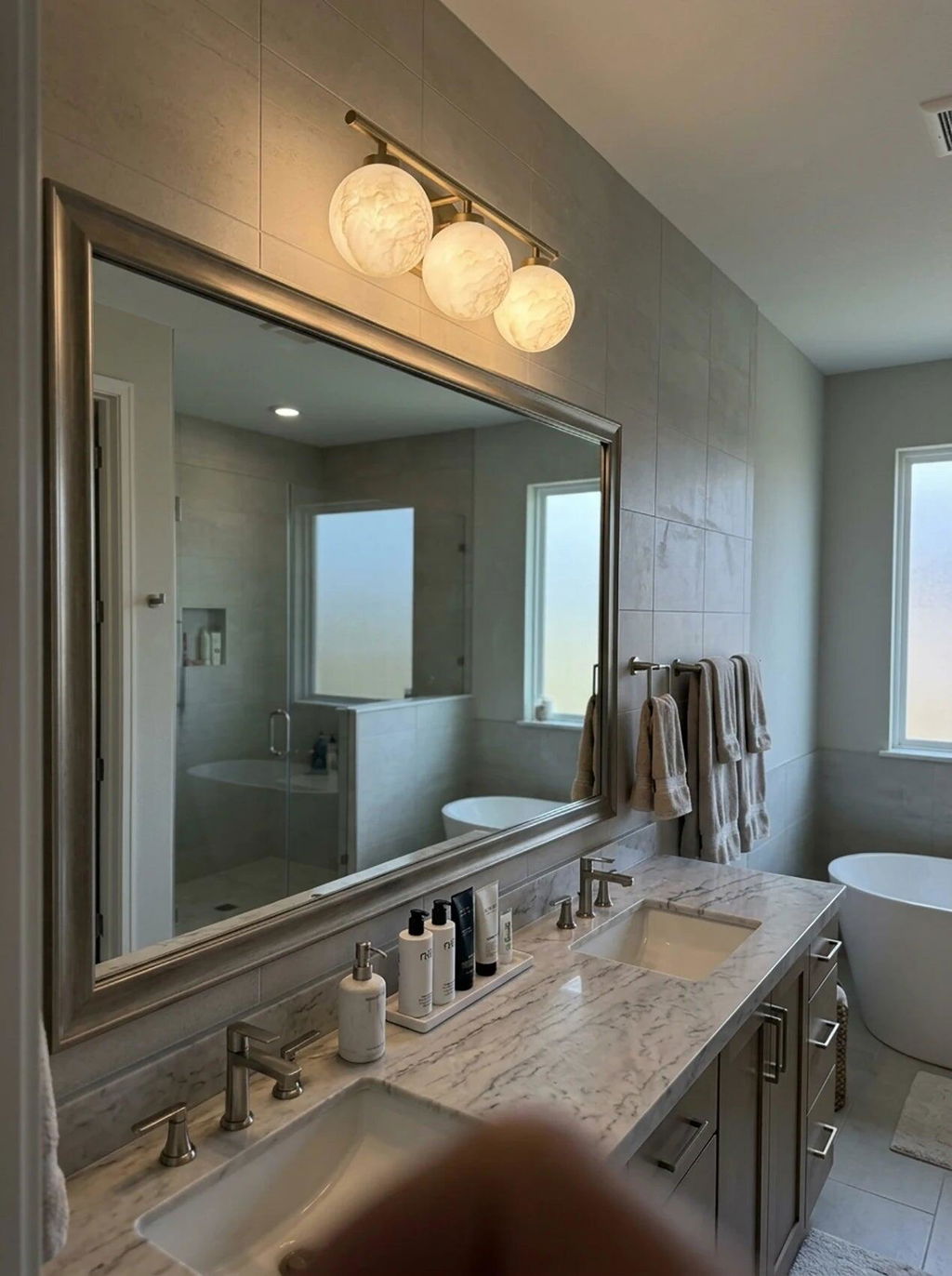
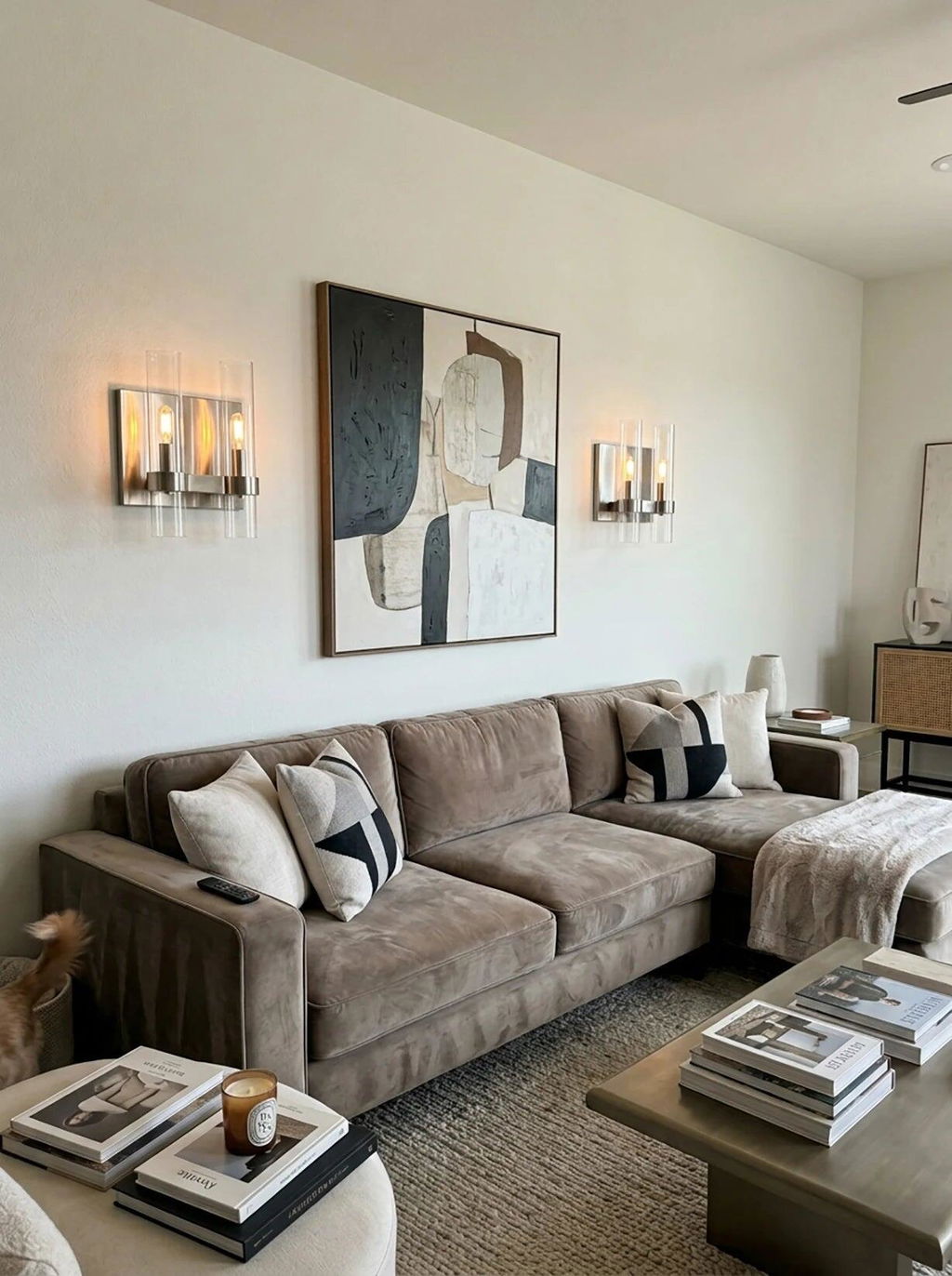
The Wall Light That Beats a Bathroom Bar

Rainer Faceted Crystal Bar Sconce
This is the piece that fixes a problem most people have accepted as normal. A light bar mounted above a mirror lights the top of a face and drops shadow under the brow, the nose and the chin — which is why so much bathroom lighting flatters nobody, and why people lean closer to the glass without knowing they are doing it.
A pair mounted vertically either side, at face height, lights from both directions and cancels those shadows. It is what portrait photographers do and what lighting designers specify. And because the crystal bar stands proud of its backplate, light escapes down the gap and washes the wall as well — task light and accent light from the same fitting.
If you are lighting a mirror you actually use, buy two. One sconce beside a mirror lights half a face.
The Floor Lamp That Needs No Electrician

Stacking Wood Floor Lamp
Every fixture above this one is hardwired: a box, a brace, an electrician, a decision you live with. A floor lamp is the only piece here you can simply put down. Plug it in, move it three times in an evening, keep the one that felt right.
Which makes it the practical answer to the missing accent layer. A dark corner, the end of a sofa, beside a reading chair — the places a ceiling light cannot reach and where nobody is going to open a wall. It is also the only piece here that a renter can take with them, which matters more than most lighting writing admits.
And in stacked timber it does the second job a floor lamp should: it is worth looking at with the light off, which a plain metal stem is not. A lamp stands in a room for sixteen hours a day and is switched on for four.
The Ceiling Light for a Normal Ceiling

Drift Adjustable Slim Lampshade Ceiling Light
Most of what gets written about lighting quietly assumes a ten-foot ceiling. Most houses do not have one. At eight feet, a pendant of any depth is either in your eyeline or in your way — and that is why so many ordinary rooms end up with a plain flush fitting nobody chose and nobody likes.
A slim shade close to the ceiling is the answer to that, and the adjustable head is what lifts it above a builder's fitting: it can be angled rather than only pointing down, so even a low ceiling gets some direction in its light instead of one flat wash. Angle it toward a wall and it stops being a ceiling light at all — it becomes a wall wash, which is a far more flattering way to fill a low room.
The Table Lamp That Is Lit Stone

Alabaster Modern Disc Table Lamp
The lowest layer, and the one that does the most for how a room feels at night. Light at table height — below the eye rather than above it — is what makes a room read as warm rather than merely lit. It is the difference between a hotel lobby at three in the afternoon and the same lobby at nine in the evening, and it is almost entirely a question of how low the light sits.
Alabaster is the right material for it because of how the light leaves. It enters the stone and comes back out softened, so the disc glows from within with no visible bulb and no hard edge anywhere. And every piece is cut from a different block, so the veining in yours exists nowhere else — unlit, it is a pale stone object on a console rather than a lamp waiting for dark.
Six Materials, Six Different Problems
A lighting range is easy to fill if every piece is metal and glass. These six are not: fibreglass, crystal, timber, alabaster, aluminium and hand-worked glass all behave differently, need different tooling, and fail in different ways. Each material was chosen because it solves a problem the others cannot — which is also why they sit together without looking like a matched set.
Fibreglass, for scale without weight
A wide fixture in metal or glass needs a rated box and often a brace. Fibreglass holds a large, precise form at a fraction of that weight, which is the only reason a piece that size can hang from an ordinary ceiling point. The material is the permission for the shape.
Cut crystal, for daylight
A printed or moulded facet reads flat and does nothing with the light off. Planes cut through the material keep working at noon — which matters on a wall fixture you look at for twelve hours and switch on for four.
Natural alabaster, for the glow
Frosted glass hides a bulb; stone does something else. Light enters alabaster and comes back out softened, so the glow is inside the material rather than on its surface. Every piece is cut from a different block, so the veining in yours exists nowhere else.
Solid timber, for the sixteen hours
A floor lamp stands in a room all day and is switched on for a few hours of it. Stacked timber is the answer to the other sixteen — an object worth looking at unlit, which a plain painted stem is not.
Aluminium, so it stays where you put it
A head that tilts has to hold its angle for years without a friction joint slipping. Aluminium keeps each shade light enough to do that on a cable; the same head in steel or glass would sag or need a rigid arm, and the adjustment would be gone.

What this costs, and what it buys. Materials like these are slower to work and less predictable than moulded acrylic or plated steel. Stone varies block to block. Hand-worked glass varies panel to panel. Neither can be made a thousand at a time from one die.
That unpredictability is the trade. You cannot have a piece that is one of a kind and also identical to the photograph — and we would rather tell you which one you are buying than let you find out on delivery. Silhouette, dimensions and finish stay consistent on every piece we ship. The material does not, and it is not supposed to.
Five Mistakes That Flatten a Room
None of these is about taste. They are all repeatable errors, and every one of them is easier to avoid than to fix.
- One fixture, dead centreA single ceiling light in the middle of a room lights the floor and the tops of things, and leaves every vertical surface dark. Rooms read as large and warm when the walls are lit, not the floor — which is why one central fixture can never be enough on its own.
- Hanging too high over a tableThe instinct is to keep a fixture out of the way, so it creeps up toward the ceiling and stops relating to the table at all. 30–36″ above the tabletop looks alarmingly low on paper and correct in the room. Nobody walks under a dining table.
- Buying too smallThe most common sizing error by a wide margin. A fixture that looks enormous in a photograph disappears in a real room, because a photograph has no ceiling in it. Use the two-thirds rule or the length-plus-width rule, and when you are between two sizes, take the larger.
- All the light on one switchLayers only pay off if you can turn some of them off. A room where the overhead, the sconces and the table lamps all rise and fall together has three fixtures and one mood.
- Mixing colour temperaturesA warm bulb next to a cool one reads as a fault even to people who cannot name what is wrong. Pick one temperature for a room — 2700K for living spaces, 3000K where you need to see detail — and use it in every fitting, including the ones you rarely switch on.
Layers Live or Die on the Switch
You can buy every fixture on this page and still end up with a flat room, because the layers were wired to one circuit. The value of having three layers is being able to use them separately — overhead light for cooking and cleaning, sconces and lamps alone for the evening, everything on for a full house.
If you are rewiring, the request to make is simple: put the overhead fixture on its own switch, and the wall lights on another. Table and floor lamps handle themselves, though a switched socket at the door is one of the few genuinely luxurious things you can ask an electrician for — it means the low layer comes on as you walk in, without crossing a dark room to find a lamp.
If you are not rewiring, a dimmer on the overhead circuit does most of the same work for far less. Dimming the ambient layer down and letting the lamps carry the evening is the single cheapest change that makes a room feel different after dark.
You Need Three, Not Six
Nobody buys six lights for one room, and we are not suggesting it. The point of the six is that each one covers a layer some other one cannot — so the useful question is not which is best, but which layers your room is missing.
A practical starting point for most rooms: one overhead piece, one at eye level, and one at table height. A chandelier or a ceiling light does the first. A pair of sconces does the second, or a floor lamp if opening a wall is not on the table. A table lamp does the third, and it is the one people skip and then wonder why the room goes flat after dark.


Start with whichever layer is missing rather than whichever fixture you like most. In a room that already has an overhead light and nothing else — which is most rooms — the piece that changes it fastest is a table lamp, and it is the cheapest of the six.
Not sure which layers you are missing?
Send us the room — its size, the ceiling height, where the junction box sits and what you actually do in there. We will tell you which two or three pieces would change it most, including when the answer is that you need fewer fixtures than you thought. Email support@vidirlighting.com.