One Junction Box, Endless Layouts: How Flexible Canopies Shape Your Light
Your ceiling box decides where the wiring lives, not where your light has to hang. Here is how five of our chandeliers use swag chains, ceiling hooks, draped straps and modular suspension to put light exactly where your room needs it, at exactly the height you want.
Most of us have lived with it: the junction box sits in the middle of the ceiling, the dining table sits somewhere else, and the chandelier ends up hanging over an empty patch of floor.
Traditional chandeliers have one canopy and one straight drop, so the box decides everything. A new generation of fixtures separates the two jobs. The canopy still connects to power at the junction box, but the light itself travels along a chain, cable or strap to wherever you want it, at whatever height you choose.
That flexibility does more than fix an awkward ceiling. It lets one fixture become a straight row over an island, a cascade down a stairwell or a soft cloud above a sofa. The same product, installed differently, can look like a completely different design.
Think about how often a room changes. You move the dining table closer to the window, add an extension leaf for the holidays, or turn a spare corner into a reading nook. A fixed chandelier stays exactly where the builder put it. A flexible one can follow you: shorten a chain, move a hook, shift an anchor, and the light lines up with the new plan.
There is a design benefit too. When pendants hang at slightly different heights and positions, the eye reads them as a composition rather than a single object. That is why designers so often specify clusters, cascades and swagged lights in restaurants and hotels, and why the same idea works beautifully at home.
The one rule to remember: the junction box sets where the power is; the chain, cable or strap sets where the light is. Plan the light first, then work back to the box.
One fixture, three completely different looks
Watch the same five-pendant chandelier rearranged three ways. Nothing changes but the chain lengths and where the pendants hang. No new wiring, no second junction box.
Straight row
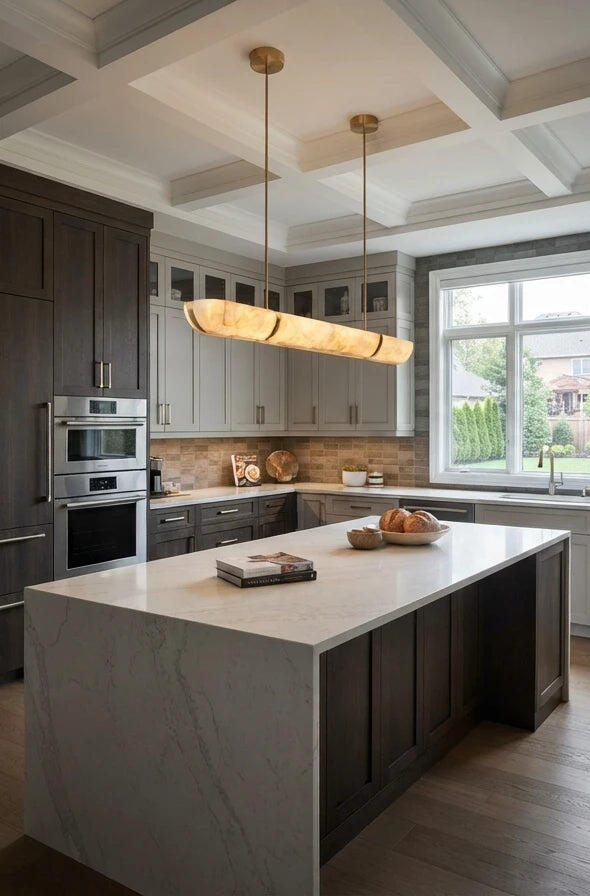
All drops level, evenly spaced over a kitchen island.
Staggered cascade
Drops vary by 6–10" for a lively group over a table.
Swagged off-center
The chain travels across the ceiling to light a corner or a table away from the box.
Four ways a chandelier can move away from the box
Each of the five chandeliers below uses one of four mounting ideas. Knowing which one you are looking at tells you how freely you can arrange it.
Swag chain
Every drop has its own plate and chain. Chains can travel across the ceiling before they fall.
Marlowe, CylindricalCanopy + hooks
One canopy at the box; cables run up to small ceiling hooks, then down to each shade.
OndaDraped anchors
Straps hang between two ceiling anchors, cradling each light in a sweep.
AnoukModular suspension
Shades of different sizes adjust in height and position as one group.
Mulberry-
Power at the box
The canopy wires into your existing junction box, as with any ceiling light.
-
Route the light
Chains, cables or straps travel to plates, hooks or anchors wherever you want light.
-
Set each height
Remove chain links, adjust cables or tighten buckles until every drop sits right.
The hardware, explained
Flexible mounting relies on a few simple parts. Here is what each one does, so you can read any installation guide with confidence.
Junction box
The electrical box in your ceiling. It supplies power and supports the main canopy. You usually need only one.
Canopy
The cover that hides wiring at the box. On flexible fixtures it is where power starts, not where light must end.
Ceiling plate
An extra plate away from the box. It anchors a chain and carries weight, but no power.
Swag hook
A small ceiling hook. The chain or cable rises to it, then drops, moving the light sideways.
Chain link
Remove links by hand to set each drop to its own height, no cutting tools needed.
Cable and joint
Each head hangs on its own cable; the joint lets you tilt the shade by hand.
Strap and buckle
Each strap has a buckle, so every light can be raised or lowered without cutting.
Anchor point
Any place the fixture fixes to the ceiling. It must go into a joist or blocking, never plasterboard alone.
Five chandeliers, five ways to arrange them

Marlowe Stacked Alabaster Chain Chandelier
Separate plate and chain for every pendant
Stacks of natural alabaster spheres hang from their own ceiling plates and chains, so each column can drop exactly where you want it. Swag the chain across the ceiling and the light no longer has to sit under the junction box.
- 59" (150 cm) of chain per pendant, shortened by removing links by hand
- 1 to 9 heads, with 2, 3 or 4 spheres per column
- Chain can swag between plates to move the light off-center
Layout recipe
- Island row: 3 pendants, 28–36" apart, all at the same height.
- Table cascade: 3–5 pendants, drops differing by 6–10".
- Foyer waterfall: 5, 7 or 9 pendants, longest drop in the center.
Tip: mix 2-, 3- and 4-sphere columns in one group for a natural rhythm.

Anouk Draped Strap Alabaster Chandelier
Multiple anchors, no single canopy
Here the straps are the structure. Each strap runs from one ceiling anchor, through an alabaster sphere and back up to a second anchor. Move the anchors closer for a deep drop, or wider for a long, shallow sweep.
- Each strap has its own buckle to raise or lower a sphere by hand
- 2 to 9 spheres, more on request
- Every anchor must be fixed to the structure above the ceiling
Layout recipe
- 9–11 ft ceiling: 3 heads Model A, 31.5" spread, 47.2" drop.
- 10–13 ft ceiling: 5 heads, 39.4" spread, 59" drop.
- 13 ft+ ceiling: 9 heads, 47.2" spread, 78.7" drop.
Tip: anchors closer together make a deeper, narrower drape; wider anchors make a long, shallow sweep.

Onda Adjustable Cable Cluster Chandelier
One canopy, cables routed to ceiling hooks
Only the round canopy attaches to the junction box. Each head runs on its own cable up to a small hook you place on the ceiling, then drops to the shade, so the cluster can spread across a table that is nowhere near the box.
- 59" of cable per head, extra cable on request
- Each head tilts by hand to point down, sideways or up
- 3 or 5 heads, 7, 9 or more on request
Layout recipe
- Table away from the box: run every cable to hooks above the table and leave the canopy where it is.
- Wall wash: tilt one or two heads sideways toward art or a feature wall.
- Island: 3 heads in a line, 30–36" above the counter.
Tip: allow generous slack, because each cable rises to its hook before it drops.

Mulberry Paper Adjustable Modular Pendant Light
Modular shades on adjustable suspension
Mulberry paper shades of different diameters hang as one composition. Adjust the height and position of each module to build a soft, layered cloud of light that suits your ceiling and room.
- 2 to 5 modules in mixed diameters
- 59" (150 cm) of wire, longer on request
- Custom combinations by email
Layout recipe
- Over a sofa: 3 modules of mixed diameters, the largest highest.
- Bedroom corner: 2 modules at different heights instead of a floor lamp.
- Open plan: 5 modules as one floating cloud.
Tip: keep the biggest shade slightly off-center for a relaxed, Japandi feel.

Alabaster Cylindrical Chain Chandelier
One junction box, many anchor plates
Carved alabaster cylinders hang on chains from individual round plates. One standard junction box powers the whole fixture, while extra plates anchor the chains wherever your layout needs them.
- Small (3.9" x 7.9") or large (7.9" x 11.8") cylinders
- 1 to 9 heads, more on request
- Each drop shortened on site by removing chain links
Layout recipe
- Dining table: 3–5 cylinders, 18–30" apart, the lowest 30–36" above the table.
- Kitchen island: 2–3 cylinders in a row, 24–36" apart.
- Stairwell: 7–9 cylinders, 36–60" apart, stepping down with the stairs.
Tip: pair small and large cylinders to add depth to a cascade.
Five layouts to try at home
Use these as starting points. Because each drop adjusts on its own, you can mix them, for example a straight row that steps down at one end.
What to hang where
Kitchen island
Choose: Marlowe or Cylindrical in a straight line, or Onda with three heads.
Hang 30–36" above the counter, 24–36" apart, at least 6" in from each end.
Dining table off the box
Choose: Onda with ceiling hooks, or Marlowe and Cylindrical with swagged chains.
Center the group over the table, not over the box; let the chain or cable travel.
Foyer or stairwell
Choose: Cylindrical or Marlowe with 7–9 heads, or Anouk with 9 heads.
Step drops down with the stairs; keep 7 ft of clearance where people walk.
Living room
Choose: Mulberry modular or Anouk as a soft focal point.
Hang over a coffee table or seating group and pair with lamps for reading.
Bedroom
Choose: Mulberry with 2 modules, or a single swagged Marlowe pendant.
Swag a pendant to hang beside the bed and free up the nightstand.
Sloped ceiling
Choose: Chain fixtures such as Marlowe and Cylindrical.
Chains hang straight from an angled plate; measure each drop on its own.
Match the layout to your ceiling height
| Ceiling height | What works best | Suggested option |
|---|---|---|
| 8 ft | Short drops, compact groups | Marlowe 2-sphere columns, Cylindrical small, Onda 3 heads |
| 9–11 ft | Rows over islands, cascades over tables | Marlowe, Cylindrical, Anouk 3 heads Model A |
| 10–13 ft | Fuller cascades and draped sweeps | Anouk 5 heads, Marlowe 5–7 heads |
| 13 ft+ | Wide waterfalls and long drapes | Anouk 9 heads, Cylindrical 7–9 heads |
| 15 ft+ / double height | Statement pieces across the space | Anouk 2 heads or 3 heads Model B, Marlowe 9 heads |
Which flexible chandelier fits your space?
| Chandelier | Mounting system | Height adjustment | Head counts | Best for |
|---|---|---|---|---|
| Marlowe Stacked Alabaster | Plate and swag chain per pendant | Remove chain links by hand | 1–9, more on request | Islands, dining tables, foyers |
| Anouk Draped Strap Alabaster | Multiple ceiling anchors | Buckle on every strap | 2–9, more on request | Statement living and dining rooms |
| Onda Cable Cluster | One canopy, cables to ceiling hooks | Cable length; heads tilt by hand | 3 or 5, more on request | Tables away from the box |
| Mulberry Paper Modular | Adjustable modular suspension | Height and position per module | 2–5 modules | Japandi living rooms and bedrooms |
| Alabaster Cylindrical Chain | One box, multiple anchor plates | Remove chain links on site | 1–9, more on request | Islands, stairwells, tall foyers |
Plan your layout in four steps
-
Mark the light, not the box
Use painter's tape on the ceiling to mark where each pendant should hang over the table, island or stair.
-
Measure the run
Measure from the junction box to each mark, then down to the hanging height. Add slack for swags and rises to hooks.
-
Count the heads
Choose a head count that fills the space without crowding. Ask us for counts beyond the listed options.
-
Check the ceiling
Every anchor, plate or hook must be fixed into the structure above the ceiling, not just plasterboard.
Safety first: all five fixtures are ceiling-mounted and made for dry indoor rooms only. We recommend a licensed electrician to confirm every fixing point and wire the canopy. Our complete installation guide for US homes covers the basics.
Five mistakes to avoid
Planning around the box
Mark the table, island or stair first. The box only tells you where power starts.
Forgetting swag length
A chain that crosses the ceiling uses length before it drops. Measure the full path.
Anchoring into plasterboard
Every plate, hook and anchor must reach a joist or blocking above.
Hanging everything level
Unless it is a clean island row, vary drops by 6–10" for a layered look.
Crowding the walkway
Keep at least 7 ft of clearance where people walk.
Styling tips for flexible lighting
- Odd numbers feel natural. Groups of 3, 5 or 7 look more relaxed than even numbers.
- Let the biggest element lead. Put the longest drop or largest shade where you want the eye to land first.
- Echo the furniture. A linear row suits a rectangular table; a round cascade suits a round table or entry.
- Keep the light color consistent. All five use warm white around 2700–3000K, so they blend in open-plan spaces.
- Repeat a material. Alabaster pairs with stone, plaster and warm wood; mulberry paper suits linen, oak and natural textures.
It grows with your home
A flexible fixture is never finished. When you move, renovate or rearrange the furniture, take a few links out of a chain, move a hook or reset a buckle, and the light follows. Need more presence later? Many of these designs can be expanded with extra heads on request. It is lighting that adapts to the way you live, not the other way around.
Flexible mounting, answered
Can a chandelier hang away from the junction box?
Yes. Swag chains, ceiling hooks and anchor plates let the light travel across the ceiling to where you want it.
Do I need more than one junction box?
Usually not. These fixtures draw power from one standard box; extra plates, hooks or anchors only carry weight.
How do I shorten the chain or cable?
Chains are shortened by removing links by hand. Cables and straps adjust at their joints or buckles.
What if my run is longer than standard?
Each drop comes with 59" (150 cm) as standard. Longer chain, cable or wire is available on request.
How many plates or hooks will I need?
Usually one per drop that sits away from the box. We can confirm the count for your layout.
Will a swagged chain look messy?
No. A swag is a deliberate design detail; keep the curve gentle and even for a tidy look.
Can I change the layout after installation?
Yes. Chains, cables and straps can be readjusted later; have an electrician check any new fixing points.
Do these work on a sloped ceiling?
Chain fixtures hang straight from angled plates. Tell us your ceiling angle so we can confirm the fit.
Can I order more heads than listed?
Yes. Email us your room size and we will quote a larger head count.
Can I mix different products in one room?
Yes. An alabaster chain chandelier over the table pairs well with a Mulberry pendant in the living area.
Is the light color the same across fixtures?
They all use warm white around 2700–3000K, so they look consistent in one room.
Can I install it myself?
We recommend a licensed electrician, especially to confirm every anchor is fixed into the ceiling structure.

Let us sketch your layout
Send a photo of your space, your ceiling height and where your junction box sits. Our team will suggest the fixture, head count and layout that fit.