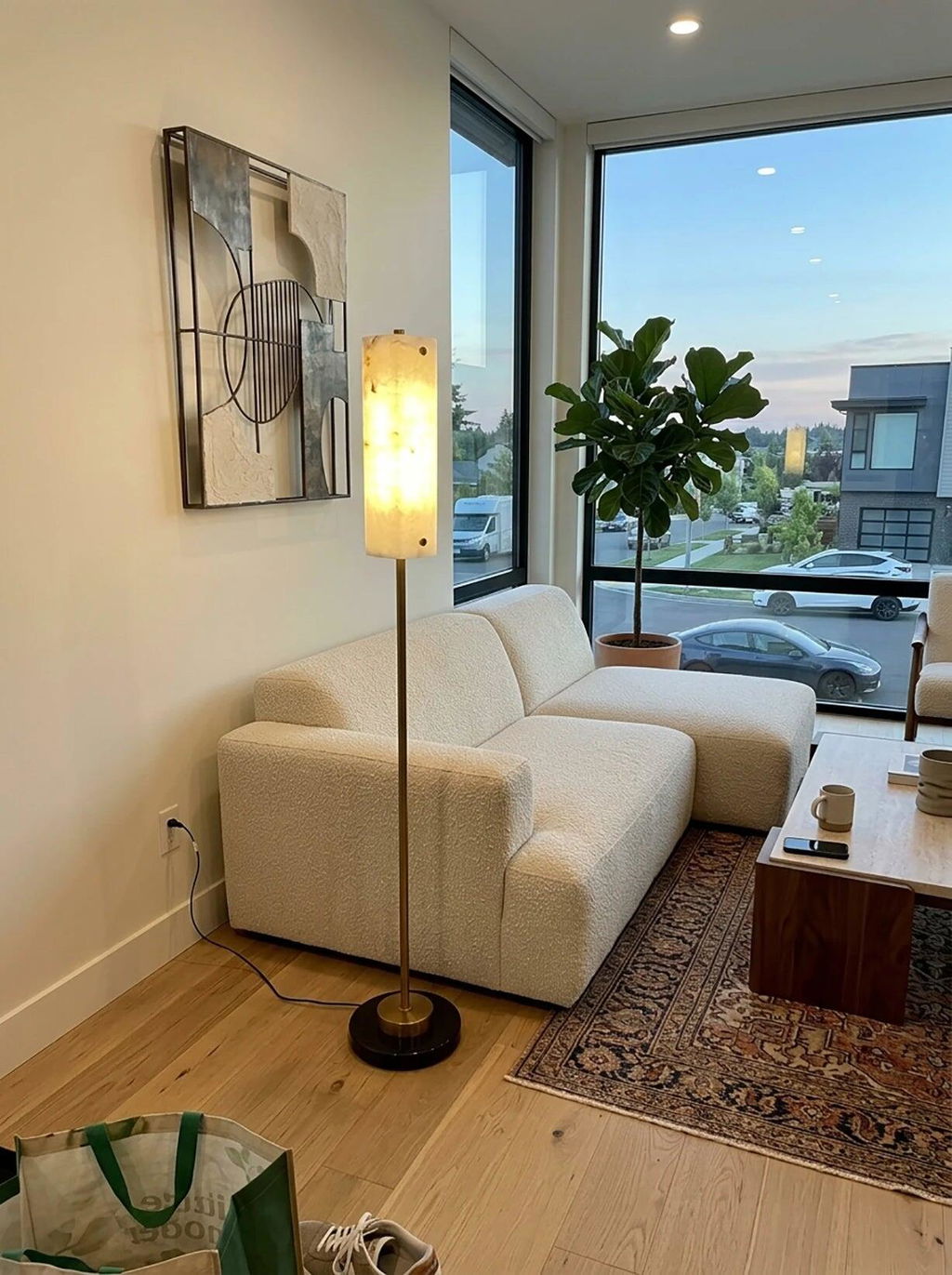
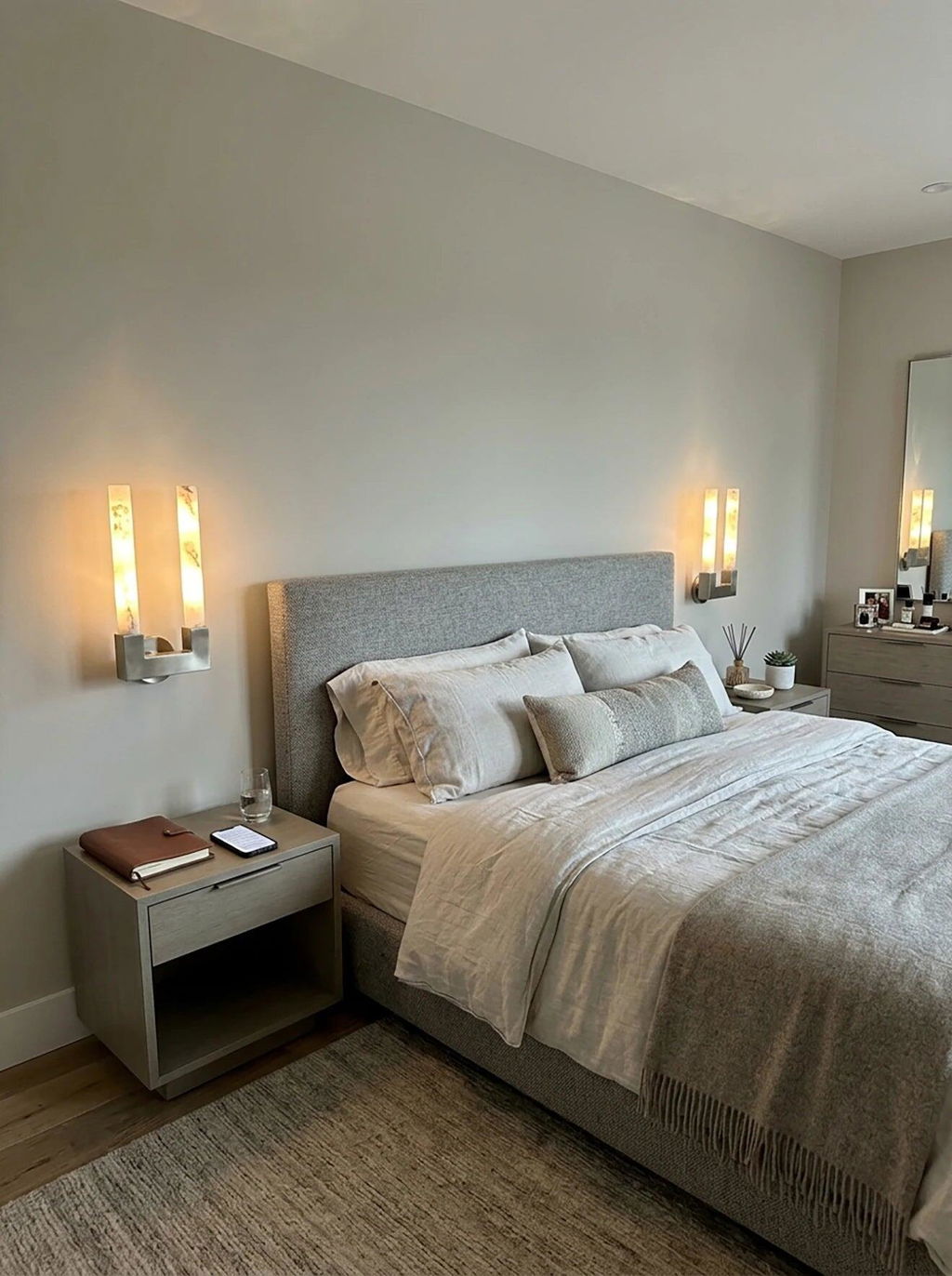
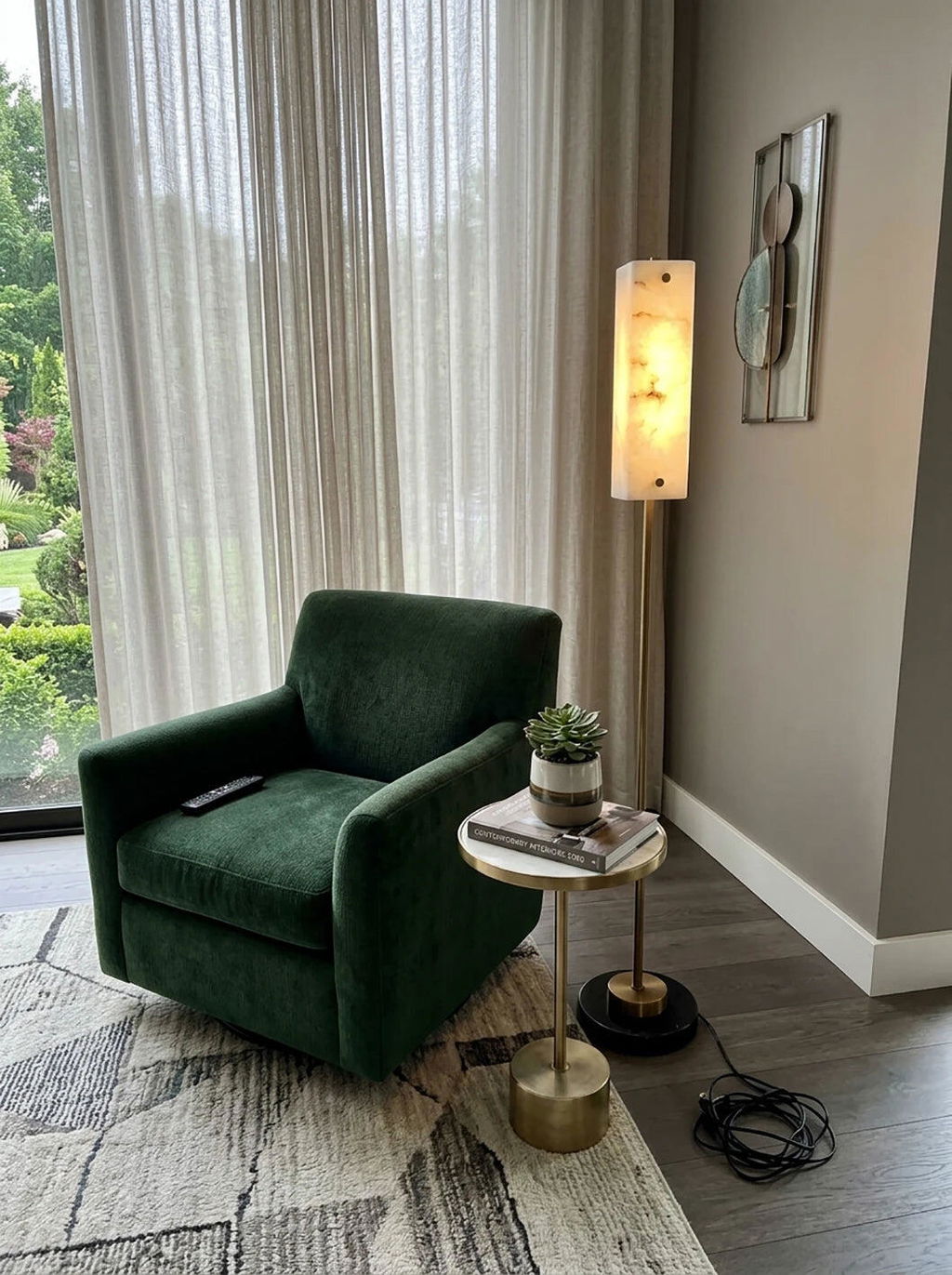
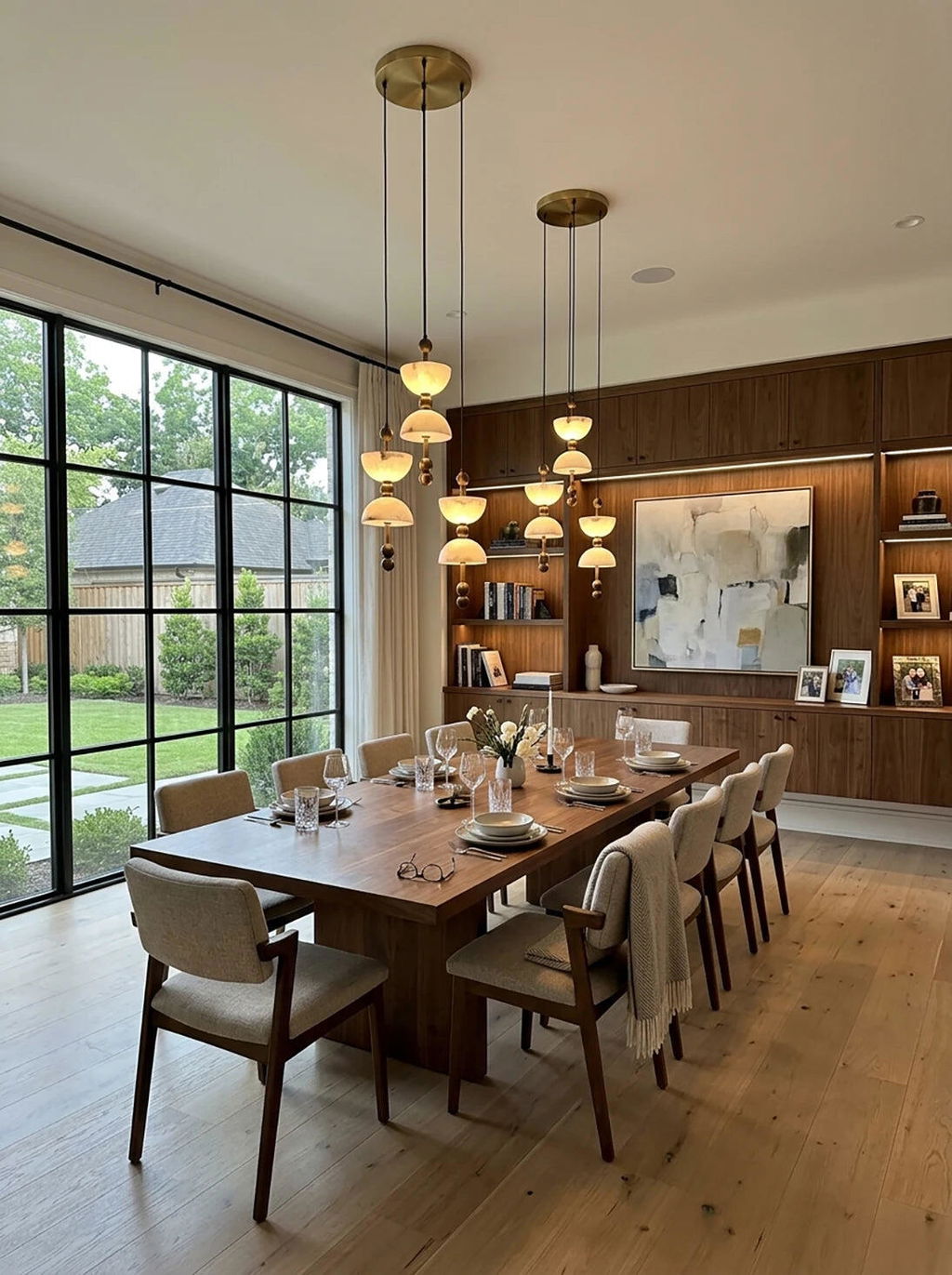
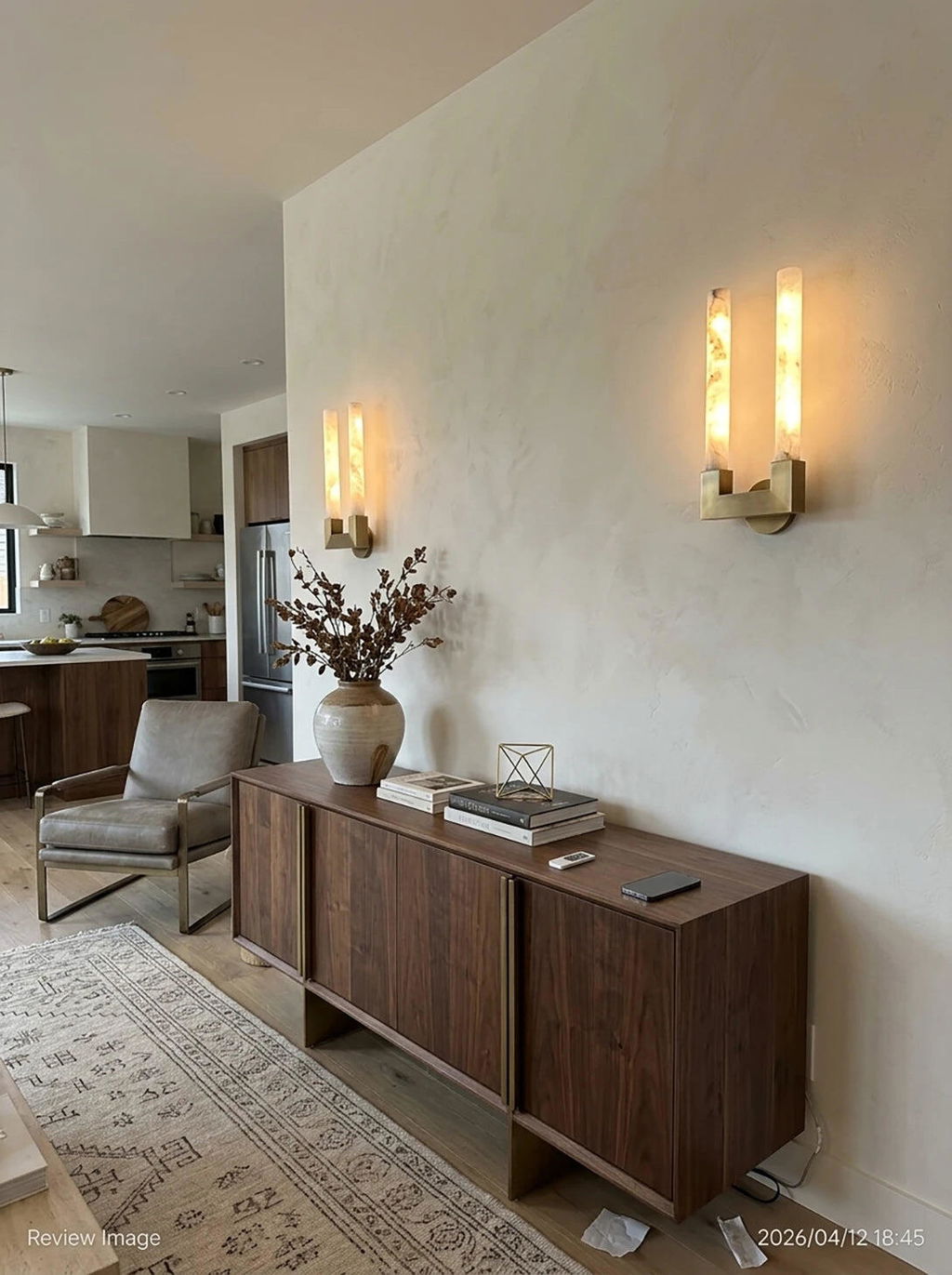
A new perspective
Light changes everything
Discover sculptural lighting designed to bring warmth, character, and atmosphere to every room.


The Thalia Cleaved Stone Cluster Chandelier hangs flat slabs of alabaster on fine cables from a single brass plate, each one crossed on the diagonal by a slim brass bar. The stone is polished on its faces but the edges are left as they broke — irregular, stepped and slightly ragged, so every slab reads as a piece split from something larger rather than a shape cut to a drawing. The bar is where the light lives: a thin line of brightness running corner to corner, with the stone glowing softly on either side of it.
Slabs hang at staggered heights and different angles, so no two face you the same way — from a distance the cluster reads as a single mass, from beneath you look up through the gaps between them. Available from a compact three-light cluster to a nine-light installation, in brass with natural white alabaster, for a dining table, an entry, or a stairwell where a group of stone can be seen from more than one level.
No two pieces of stone are ever the same
Alabaster is a natural stone, so every piece carries its own veining and subtle variation in color. The fixture you receive may therefore differ slightly from the images shown.

The versions on this page go up to 9 MAX HEADS, which suits most rooms. It is not a limit. A cluster is simply more of the same cone on more of the same cord — so if your table is longer or your stairwell taller, tell us the count you want and we'll make it.
Every cord shortens on its own during installation — so how the cluster finally looks is set in your room, not in our workshop.
Cords kept short and close, the cones within a narrow band. The group reads as one vertical object rather than several separate lights.
→ Over a round table, a stair landing, or a small entry.
Cords angled outward and set to different lengths, so the cones scatter wider. The same number of shades covers far more ceiling — and more table.
→ Over a long table, an island, or an open-plan room.
Each cord a step longer than the last, so the cones fall in a continuous diagonal. Built to be read from more than one floor at once.
→ Down a stairwell or a double-height entry.
The LED is built into the fixture, so there is no bulb to buy or replace — and no bulb to swap for a dimmable one afterwards. Please contact us if you need a dimmable version.
Cables arrive at 59″ per drop and each one adjusts independently, so you set the height of every slab in the room rather than accepting one from the factory.
Unusually, these are two separate decisions here — the same spread comes at two depths, and the same depth comes at two widths.
The tightest cluster — reads as one object.

The count most dining rooms want.

More spread than the 23.6″, and no lower — pick this if the table is wide but the ceiling isn't tall.

Six and a half feet of fixture. Measure the void, not the table.

The stone was never asked to behave.
Split a block of alabaster and it does not give you a clean face. It gives you a stepped, layered edge that follows the seams the mineral was already carrying — the record of how that particular piece of rock was built, made visible in a second. No two splits are the same, and nobody decides where the line goes. The stone does.
The faces are polished until they pass light; the edges are left exactly as they broke. Which on its own would read as rustic — a slab of raw rock on a wire, handsome and a little unresolved.
That bar is the only straight line in the entire fixture, and it changes how you read everything around it. Beside something ruled and exact, the broken edge stops looking unfinished and starts looking deliberate — the way a rough stone in a plain metal setting reads as a jewel rather than a pebble. It is also where the light lives: a bright line running corner to corner, with the alabaster glowing quietly on either side of it. Not a lit shade. A drawn line, with stone around it.
Hung in a cluster, no two slabs face you the same way — different heights, different angles, and every outline its own. From across a room they close into a single mass of light. From directly beneath you look up through the gaps between them. The geometry repeats. The stone never does.
Why the edges are rough, where the light comes from, and which size to choose.
Two separate decisions here, which is unusual. Match the width to the table — roughly half its width — then pick the drop your ceiling can carry.
19.7″ for a round table 36–48″ or an entry. 23.6″ for a dining table 48–60″. 31.5″ for 60–72″ — and this one comes at two depths, so a wide table under a normal ceiling and a stairwell void can both have it.
The deepest version is 78.7″ — six and a half feet of fixture — and needs about 13 ft of ceiling.
Yes, but you have to ask for it when you order. The LED is built into the fixture, so there's no bulb to swap for a dimmable one afterwards.
A dimmable version is available — tell us when you order.
No — and this matters more here than on most clusters. The slabs are meant to hang at different heights and different angles, so no two face you the same way.
Hang them all long first, stand back, then shorten one cable at a time. Set level and at matching angles, the cluster loses its whole effect — it stops looking arranged and starts looking like a grid.
Because they're cut from real quarried stone. Every slab has its own veining, its own broken outline, and some glow noticeably warmer than the ones beside them.
On a cluster hung side by side, that's the first thing you notice — and it's what tells you the stone is real. A set that matched perfectly would have to be moulded.
A soft dry cloth on both the stone and the brass. Keep water off the alabaster — it's porous, absorbs it, and leaves a mark that won't buff out.
Take particular care along the broken edges, which are more fragile than the polished faces. No sprays, no polish, nothing abrasive. Switch off and let it cool first.
Not sure how to wire it, how high to hang it, or whether you need an electrician? Our full guide walks through every step for US homes.
Switch off at the breaker and confirm before you touch any wiring.
Make sure your junction box is standard, secure, and rated for the weight.
Black to black, white to white, ground to ground — the US standard explained.
Mounting heights and clearances for sconces, pendants, and chandeliers.
The price includes tax, and free standard shipping within the U.S. is provided.

The beauty of a fixture is easy to photograph. What matters just as much is what sits inside the canopy—the driver, the bracket, the wiring, the hardware in the box. Here is how we build for safety and longevity, so the fixture you order arrives ready to install and made to last.

We offer integrated LED drivers in a range of styles—dimmable, constant-current, and color-temperature-adjustable—so the fixture can be matched to how you actually light the room. It runs on 110–240V, works straight out of the box on standard US household power, and is rated for both dry and damp locations, so it fits wherever you'd like to install it.
Every fixture ships with a sturdy mounting bracket sized to a standard US junction box—so it hangs true and stays secure, year after year. No improvising, no trips to the hardware store.
Open the carton and it's all there—canopy, mounting plate and bracket, screws and wall anchors, the driver, and a pair of clean cotton gloves for handling the glass. Nothing missing, nothing to source separately. It's the small stuff, packed with care, that makes installation day feel easy.
Clearly labeled leads and a tidy factory harness make professional installation quick and unambiguous. Hand it to your electrician and they'll have it up in minutes—standard L / N / E hardwiring, the way a considered fixture should be.
Order with confidence: what arrives at your door is a fixture built to be lived with—considered on the inside, finished on the outside. Wiring should be carried out by a qualified electrician in line with local code.
Free Shipping on all orders
Hassle-free return within 30 days
Payment Security
The configurations listed on this page are the ones we keep in regular production — they are not a limit. Our guide explains how to work out the count your room actually needs, the three ways the drops can be hung, and something most people never think to ask for.
The Thalia Cleaved Stone Cluster Chandelier hangs flat slabs of alabaster on fine cables from a single brass plate, each one crossed on the diagonal by a slim brass bar. The stone is polished on its faces but the edges are left as they broke — irregular, stepped and slightly ragged, so every slab reads as a piece split from something larger rather than a shape cut to a drawing. The bar is where the light lives: a thin line of brightness running corner to corner, with the stone glowing softly on either side of it.
Slabs hang at staggered heights and different angles, so no two face you the same way — from a distance the cluster reads as a single mass, from beneath you look up through the gaps between them. Available from a compact three-light cluster to a nine-light installation, in brass with natural white alabaster, for a dining table, an entry, or a stairwell where a group of stone can be seen from more than one level.
No two pieces of stone are ever the same
Alabaster is a natural stone, so every piece carries its own veining and subtle variation in color. The fixture you receive may therefore differ slightly from the images shown.
The versions on this page go up to 9 MAX HEADS, which suits most rooms. It is not a limit. A cluster is simply more of the same cone on more of the same cord — so if your table is longer or your stairwell taller, tell us the count you want and we'll make it.
Every cord shortens on its own during installation — so how the cluster finally looks is set in your room, not in our workshop.
Cords kept short and close, the cones within a narrow band. The group reads as one vertical object rather than several separate lights.
→ Over a round table, a stair landing, or a small entry.
Cords angled outward and set to different lengths, so the cones scatter wider. The same number of shades covers far more ceiling — and more table.
→ Over a long table, an island, or an open-plan room.
Each cord a step longer than the last, so the cones fall in a continuous diagonal. Built to be read from more than one floor at once.
→ Down a stairwell or a double-height entry.
The LED is built into the fixture, so there is no bulb to buy or replace — and no bulb to swap for a dimmable one afterwards. Please contact us if you need a dimmable version.
Cables arrive at 59″ per drop and each one adjusts independently, so you set the height of every slab in the room rather than accepting one from the factory.
Unusually, these are two separate decisions here — the same spread comes at two depths, and the same depth comes at two widths.
The tightest cluster — reads as one object.
The count most dining rooms want.
More spread than the 23.6″, and no lower — pick this if the table is wide but the ceiling isn't tall.
Six and a half feet of fixture. Measure the void, not the table.
The stone was never asked to behave.
Split a block of alabaster and it does not give you a clean face. It gives you a stepped, layered edge that follows the seams the mineral was already carrying — the record of how that particular piece of rock was built, made visible in a second. No two splits are the same, and nobody decides where the line goes. The stone does.
The faces are polished until they pass light; the edges are left exactly as they broke. Which on its own would read as rustic — a slab of raw rock on a wire, handsome and a little unresolved.
That bar is the only straight line in the entire fixture, and it changes how you read everything around it. Beside something ruled and exact, the broken edge stops looking unfinished and starts looking deliberate — the way a rough stone in a plain metal setting reads as a jewel rather than a pebble. It is also where the light lives: a bright line running corner to corner, with the alabaster glowing quietly on either side of it. Not a lit shade. A drawn line, with stone around it.
Hung in a cluster, no two slabs face you the same way — different heights, different angles, and every outline its own. From across a room they close into a single mass of light. From directly beneath you look up through the gaps between them. The geometry repeats. The stone never does.
Why the edges are rough, where the light comes from, and which size to choose.
Two separate decisions here, which is unusual. Match the width to the table — roughly half its width — then pick the drop your ceiling can carry.
19.7″ for a round table 36–48″ or an entry. 23.6″ for a dining table 48–60″. 31.5″ for 60–72″ — and this one comes at two depths, so a wide table under a normal ceiling and a stairwell void can both have it.
The deepest version is 78.7″ — six and a half feet of fixture — and needs about 13 ft of ceiling.
Yes, but you have to ask for it when you order. The LED is built into the fixture, so there's no bulb to swap for a dimmable one afterwards.
A dimmable version is available — tell us when you order.
No — and this matters more here than on most clusters. The slabs are meant to hang at different heights and different angles, so no two face you the same way.
Hang them all long first, stand back, then shorten one cable at a time. Set level and at matching angles, the cluster loses its whole effect — it stops looking arranged and starts looking like a grid.
Because they're cut from real quarried stone. Every slab has its own veining, its own broken outline, and some glow noticeably warmer than the ones beside them.
On a cluster hung side by side, that's the first thing you notice — and it's what tells you the stone is real. A set that matched perfectly would have to be moulded.
A soft dry cloth on both the stone and the brass. Keep water off the alabaster — it's porous, absorbs it, and leaves a mark that won't buff out.
Take particular care along the broken edges, which are more fragile than the polished faces. No sprays, no polish, nothing abrasive. Switch off and let it cool first.
Not sure how to wire it, how high to hang it, or whether you need an electrician? Our full guide walks through every step for US homes.
Switch off at the breaker and confirm before you touch any wiring.
Make sure your junction box is standard, secure, and rated for the weight.
Black to black, white to white, ground to ground — the US standard explained.
Mounting heights and clearances for sconces, pendants, and chandeliers.
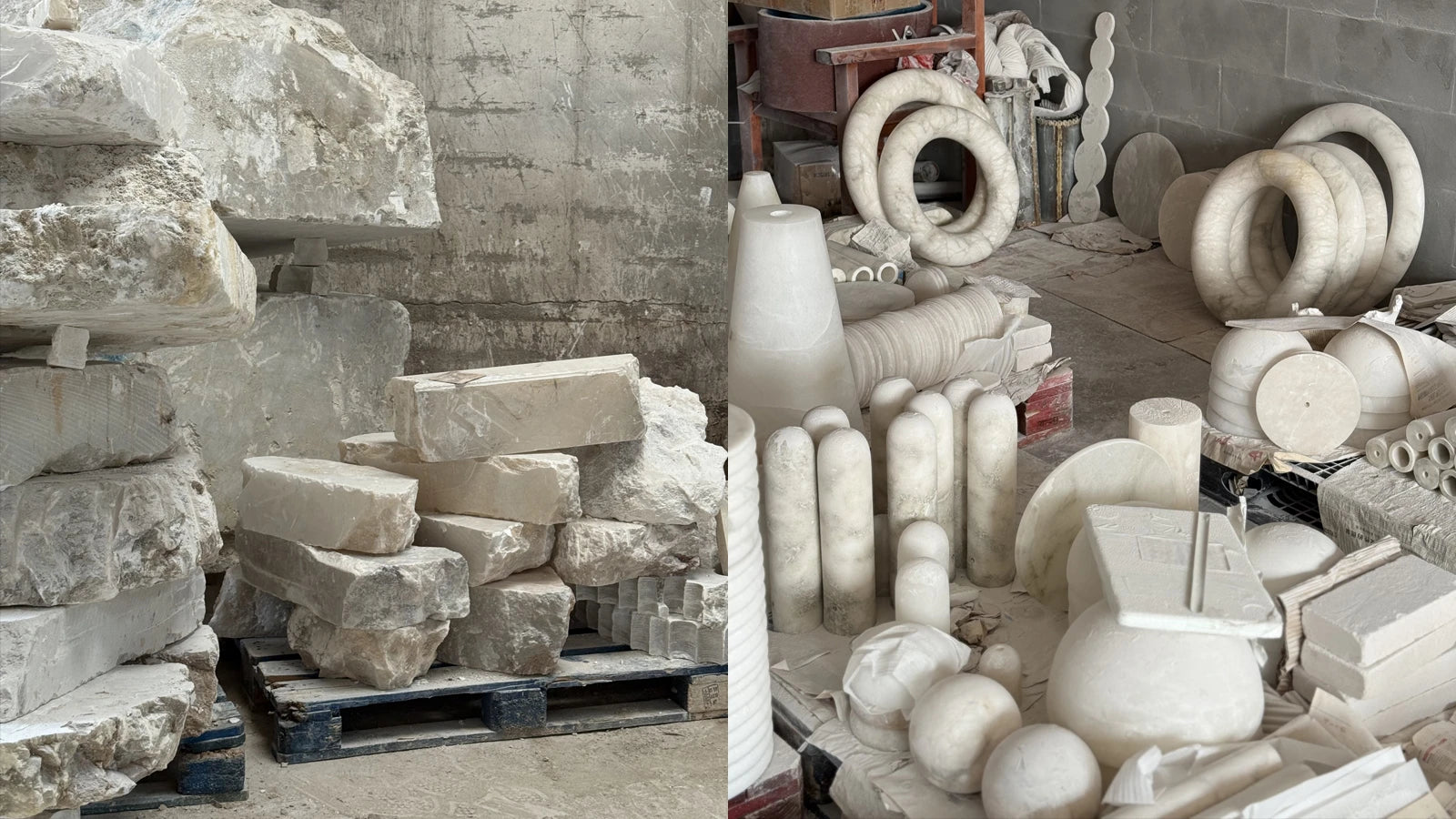
Natural stone lighting

The Vidir lighting edit
Most shades block light and let it out at the edges. Yet, this stone-textured lampshade manages to achieve exactly that.
Alabaster is translucent. Switch it on and the whole shade lights up from within, veining and all, instead of glowing only where the bulb sits. There is no bright spot to look at, because the light source is the entire surface.
The veining was decided underground, long before anyone cut it. Every shade carries its own pattern and its own faint colour shift — so the piece that arrives is not the piece in the photograph, and that is the point.
Resin and acrylic imitations go amber and brittle within a few years of sitting next to a warm bulb. Stone does not age that way. The shade you unpack is the shade you will have in twenty years.
Designed for better living
Use warm white (2700K). The stone itself has an off-white, creamy tone; cool light passing through it makes it look grayish and dingy, whereas warm light brings out that honey-like hue seen in the photos.
Alabaster is a natural stone that absorbs water and cleaning agents, which can leave permanent stains. Disconnect the power, let the bulb cool down, and then wipe the fixture with a soft, dry cloth—do not use water or spray cleaners.
The density of the stone is far greater than that of a glass shade of the same size; ensure the ceiling's load-bearing capacity is sufficient for safety.

A new perspective
Discover sculptural lighting designed to bring warmth, character, and atmosphere to every room.
 Our product
Alabaster Cylindrical Chain Chandelier
Our product
Alabaster Cylindrical Chain Chandelier
Alabaster is translucent, so the light travels through the stone rather than escaping at the edges — the whole shade glows, veining and all. Every piece carries a pattern that was decided underground, which is why no two are alike.
Resin is cast in moulds, so the "veining" repeats from one shade to the next and the light passes through evenly with no depth to it. It also ages differently: sitting close to a warm bulb, resin tends to amber and grow brittle within a few years.
THE ART OF ALABASTER
The natural texture of alabaster brings a warm, mineral quality to the space. (Please contact us if you require a specific texture.)

A pure white texture reminiscent of fresh snow—warm, smooth, and refined.

Deep, inky patterns flow across a white base.

A dynamic pattern resembling a bolt of lightning streaking across the sky.

Fine, intricate cracks evoking the aesthetic beauty of a sheet of ice at the moment it shatters.

A pattern as light and airy as falling snowflakes, with every single flake unique.
Material · Method · Light
Every texture tells a story of natural light and patient craftsmanship.
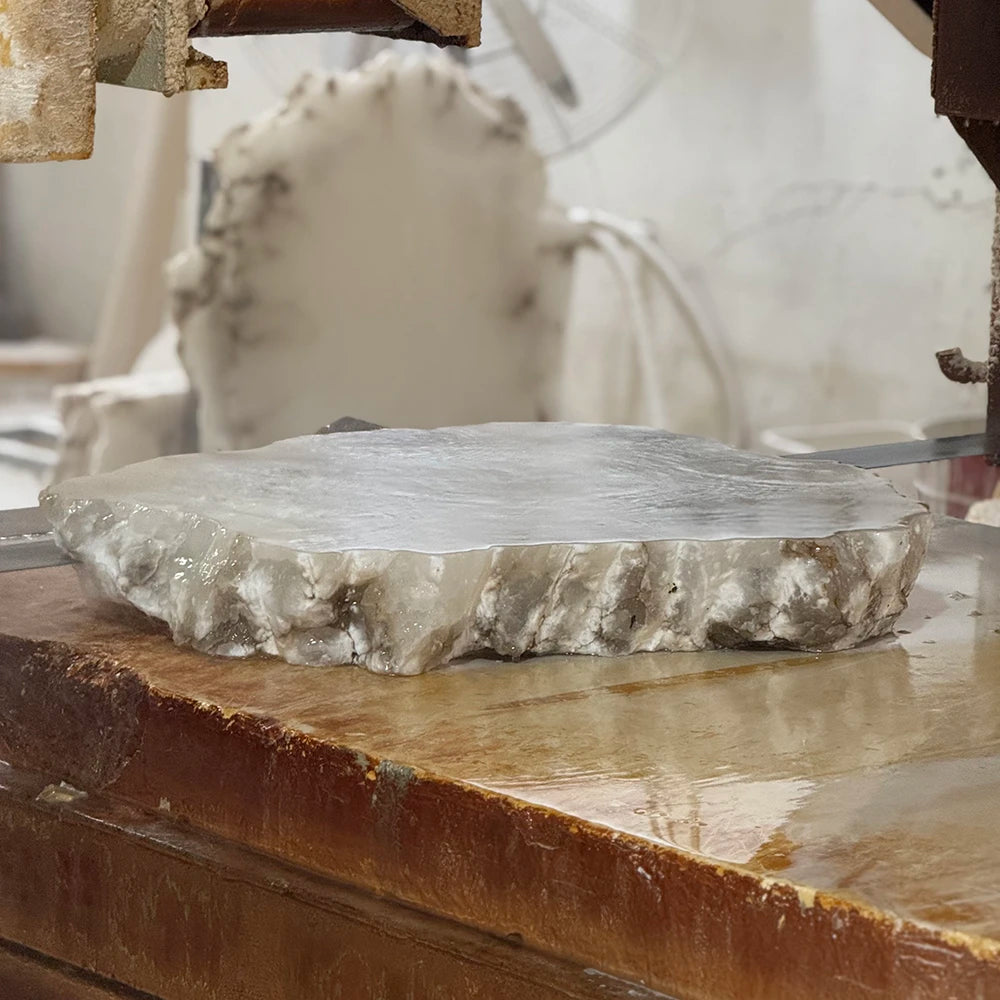
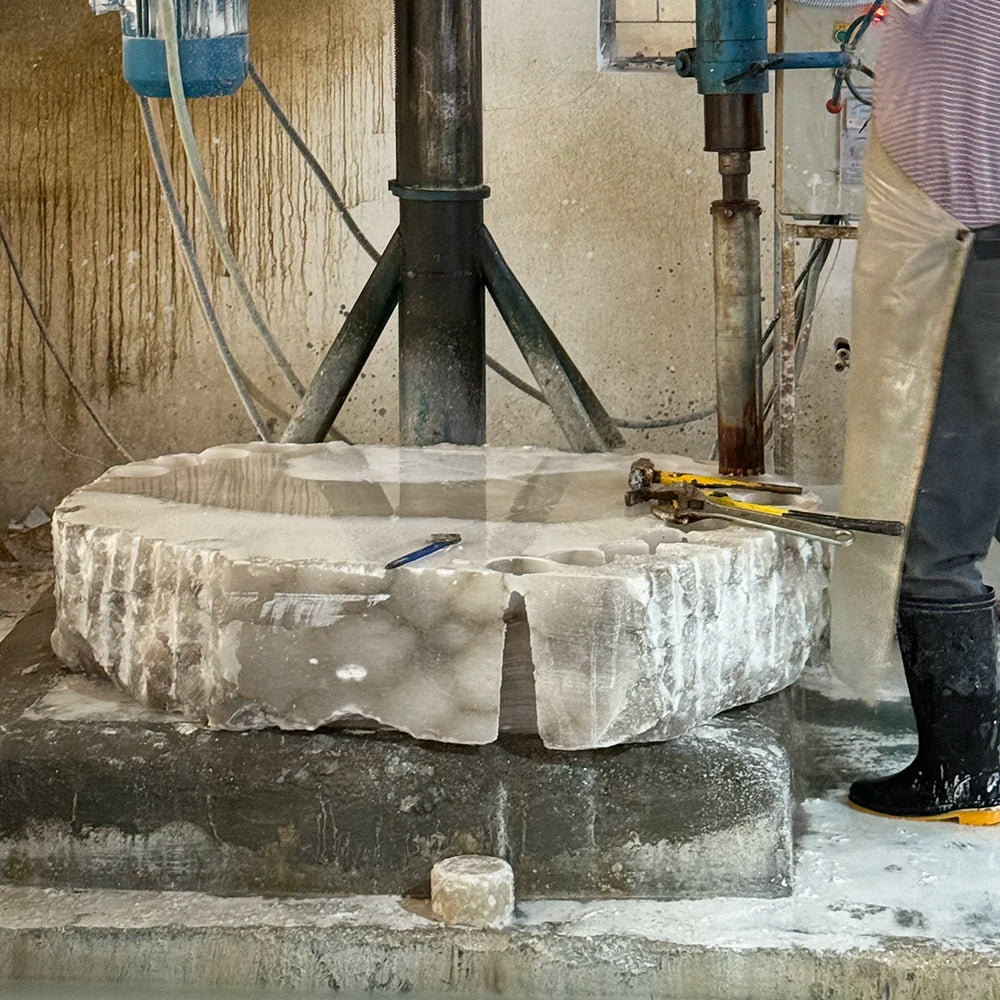
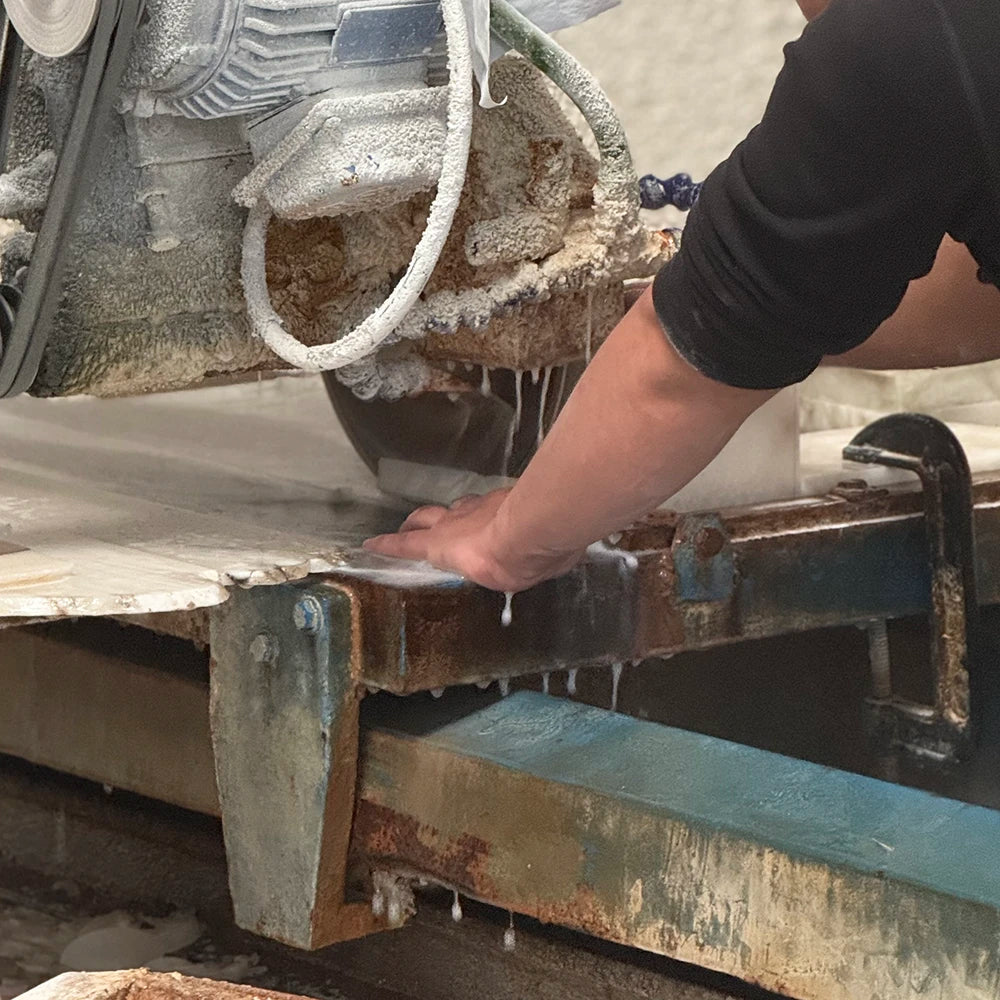
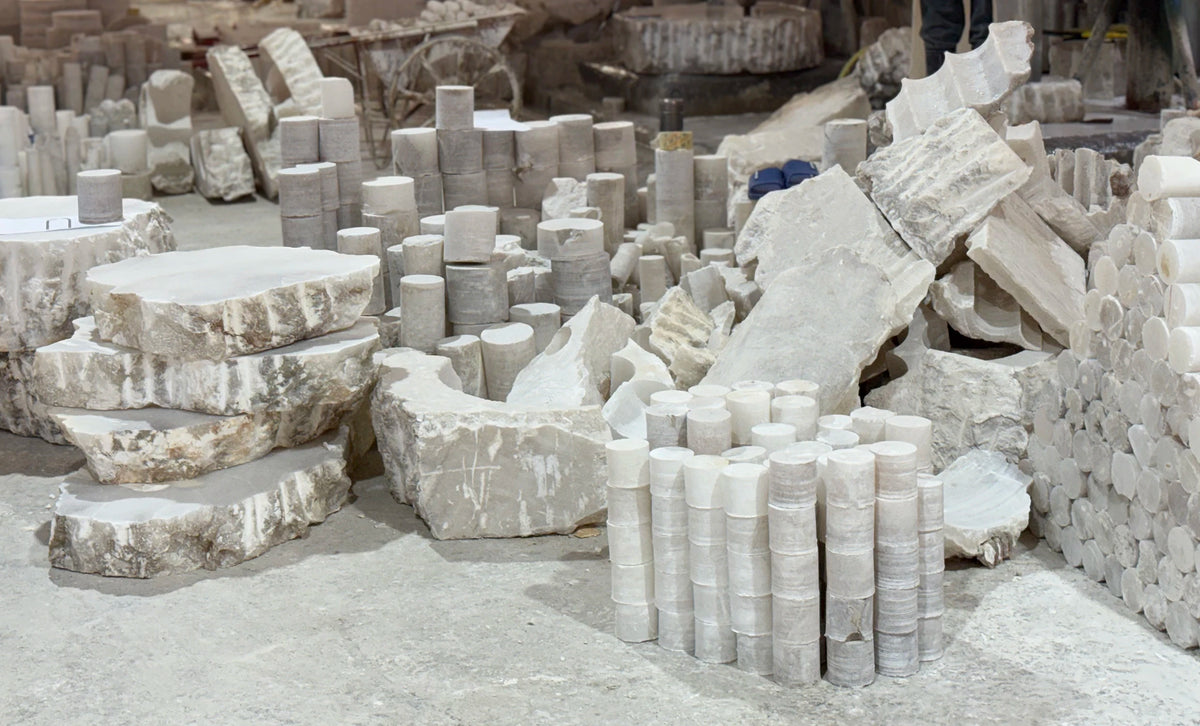
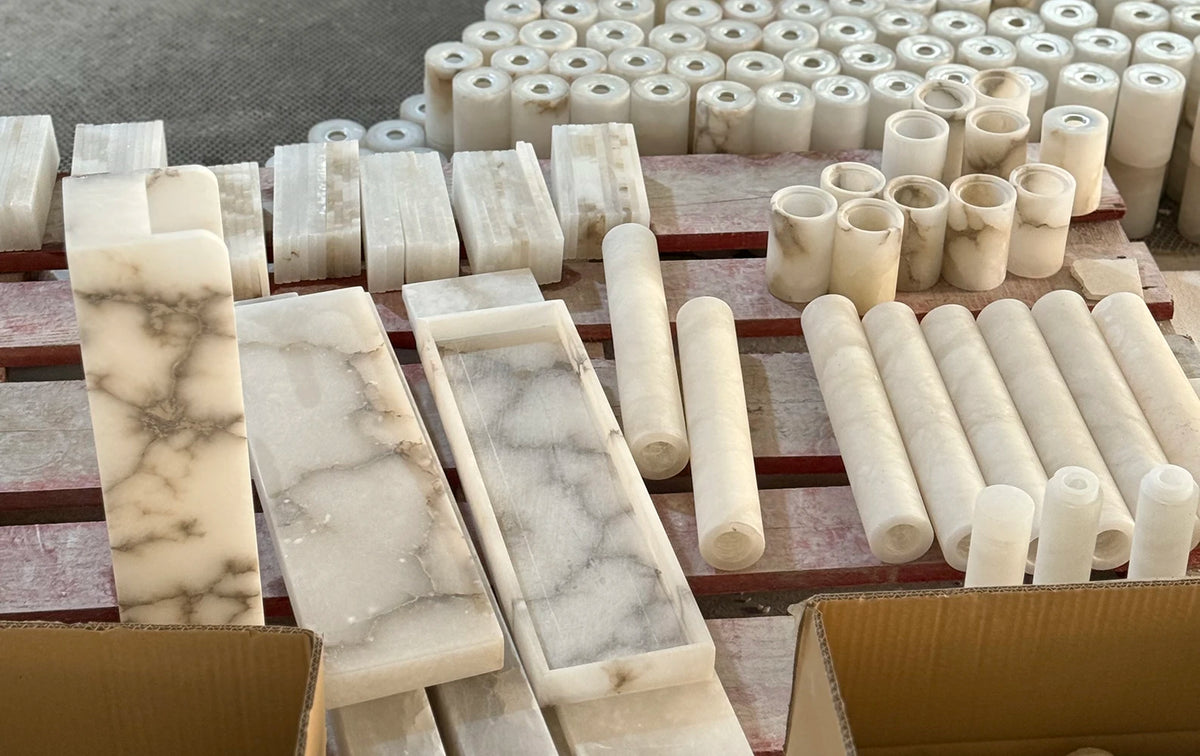
Crafted from select natural alabaster, preserving its unique veining.
Meticulously cut and shaped by artisans.
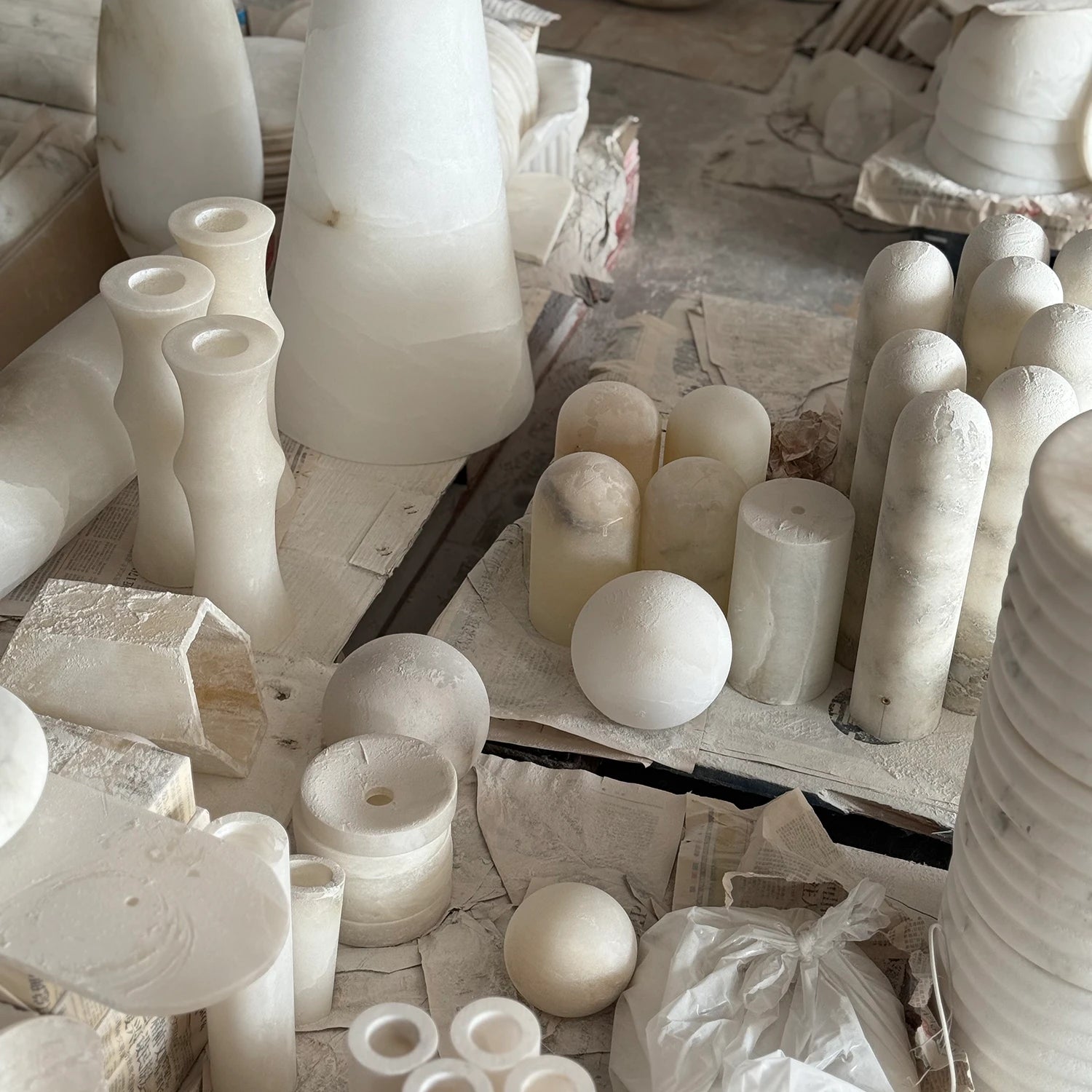
Repeatedly ground and polished for a smooth, refined texture.
Carefully assembled and quality-inspected.
Custom Stone Lighting
SHOP BY CATEGORY
Six major categories, one workshop — find the fixture that fits your room.