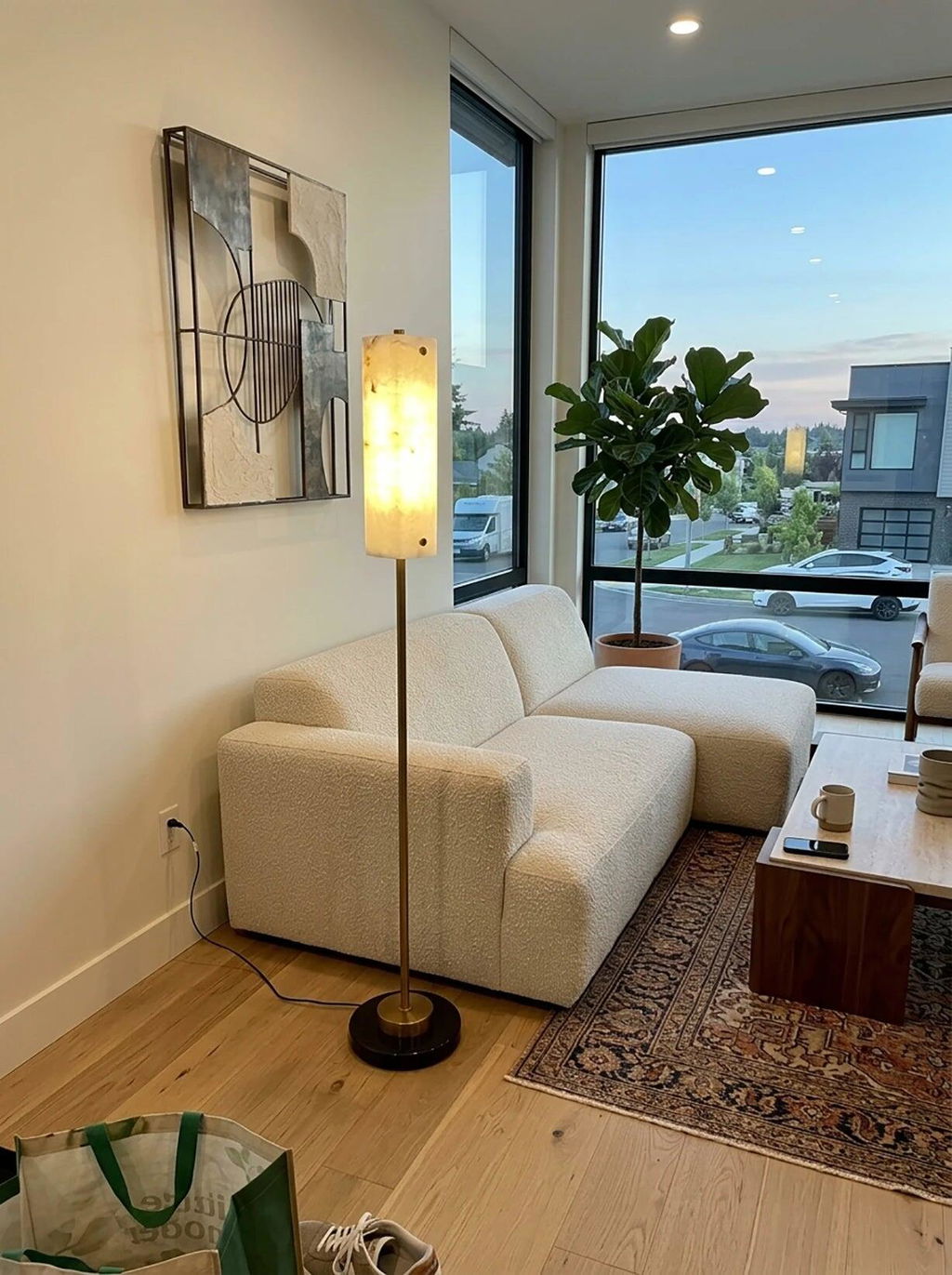
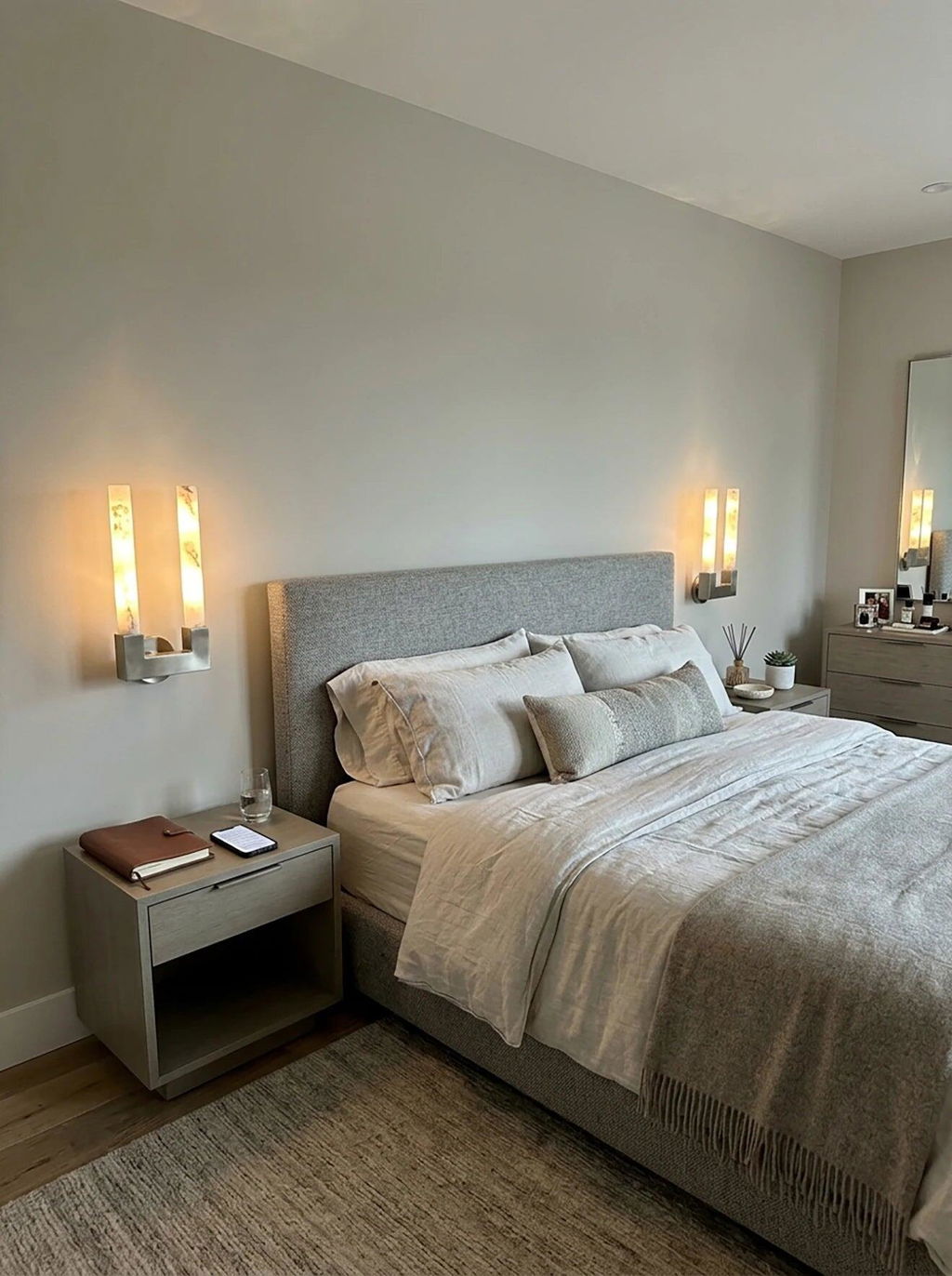
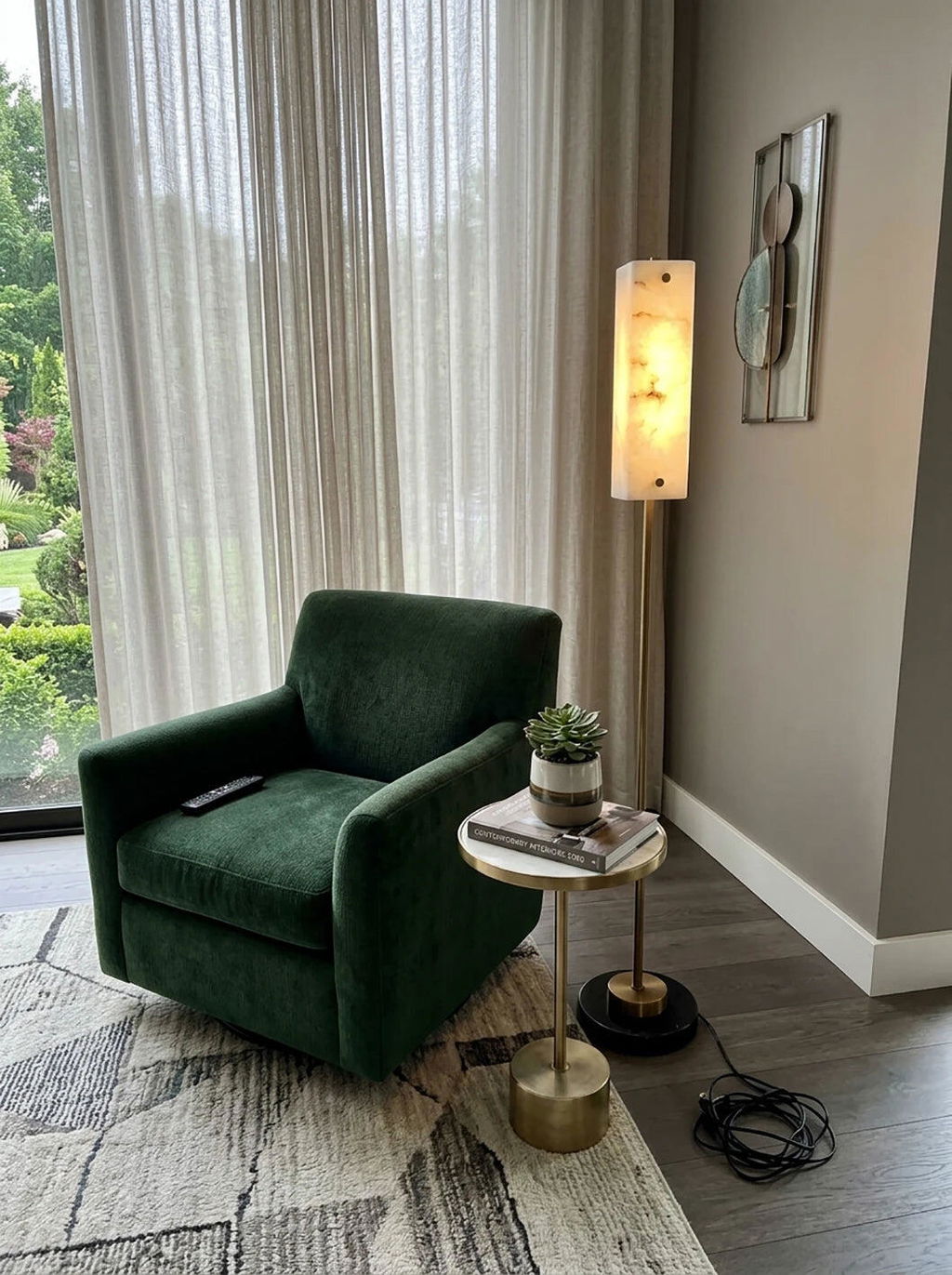
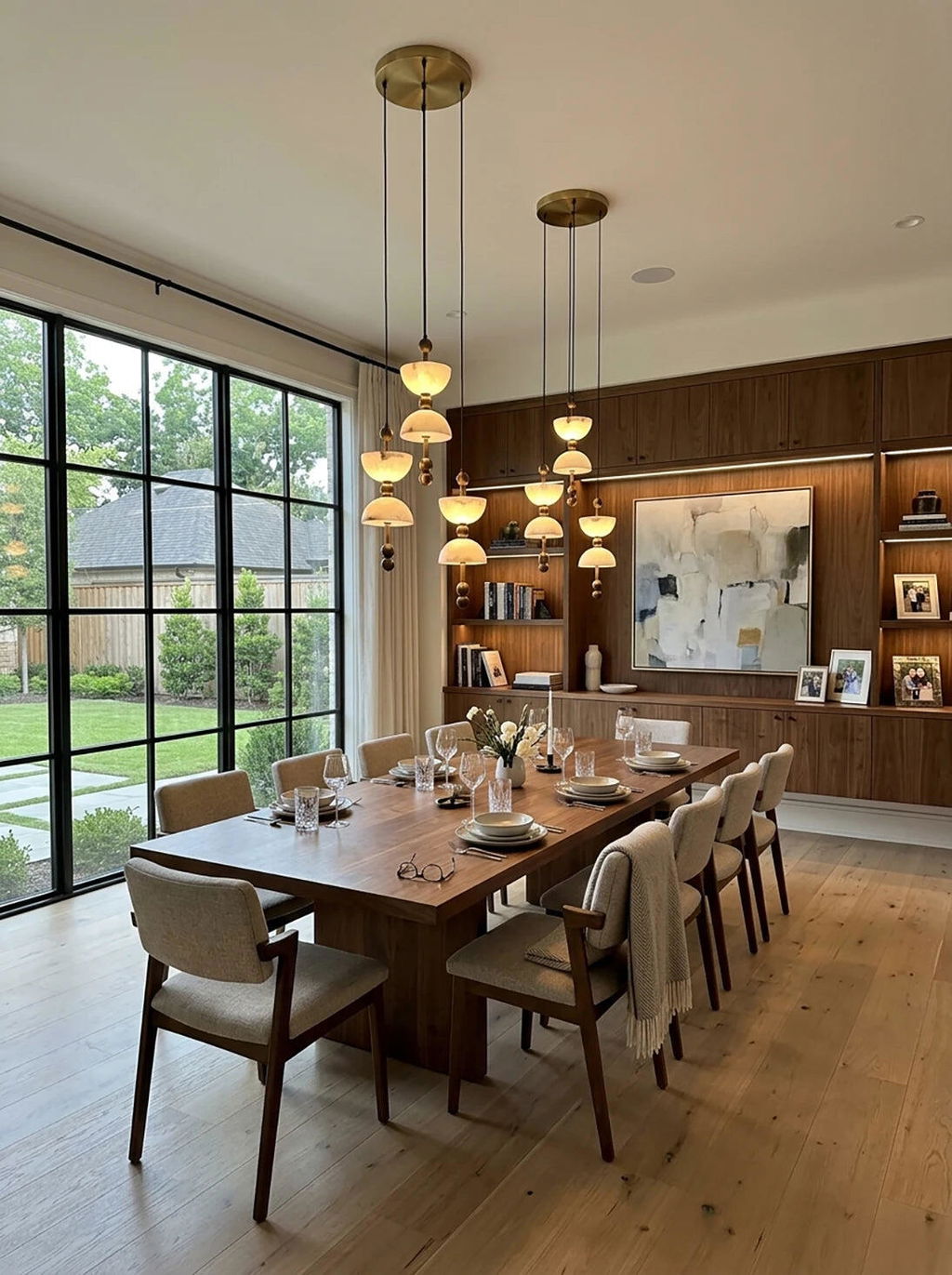
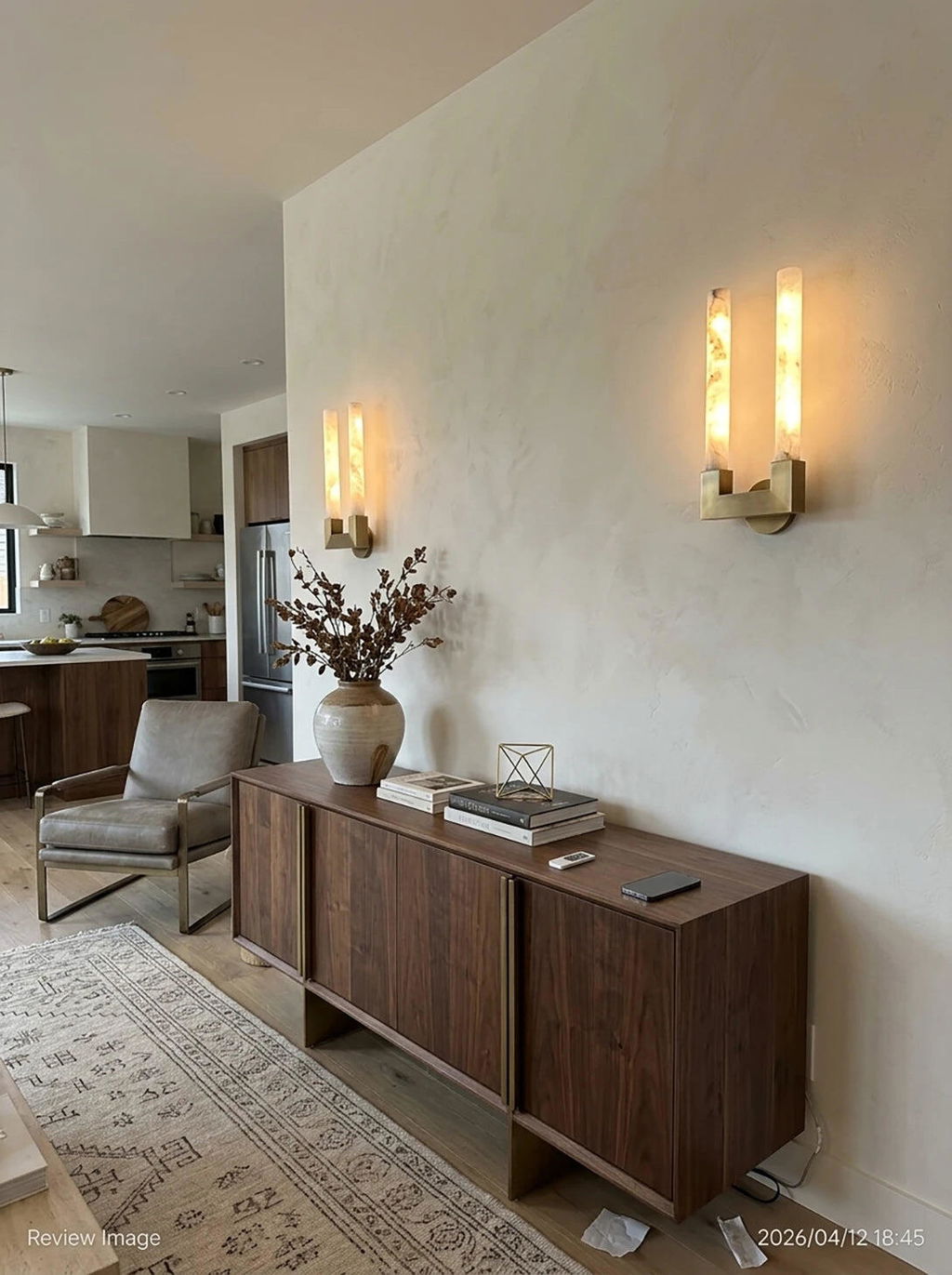
A new perspective
Light changes everything
Discover sculptural lighting designed to bring warmth, character, and atmosphere to every room.


The Maren Tiered Alabaster Tile Chandelier is built from narrow stone tiles with rounded ends, each pinned individually to a brass frame and hung in stepped tiers that draw inward as they descend. They overlap the way roof shingles do — every row lapping the one below, so the surface is layered rather than flat. Lit, each tile glows on its own and the rows read as bands of light stacked one under another, with the veining of the stone showing through differently in every piece.
Almost every tiered chandelier is round, which is fine over a round table and awkward over a long one. This one is rectangular — the frame is a rectangle, the tiers are rectangles, and the light lands as a long pool rather than a circle. That single decision is why it belongs above a rectangular dining table, a kitchen island, or a long console where a round fixture would leave the ends dark. Suspended on four brass chains from a square canopy, in warm brass against natural alabaster.
No two pieces of stone are ever the same
Alabaster is a natural stone, so every piece carries its own veining and subtle variation in color. The fixture you receive may therefore differ slightly from the images shown.

 Every tile laid out — and no two the same stone
 The brass frame underneath — what every tile pins onto
Materials, sizes and finishes listed exactly as they are — including that the base is open, and that every stone tile is a slightly different colour.
Real quarried alabaster, cut and polished — never resin, never printed stone effect. Photographed as it leaves our workshop, not rendered.
Every tile is checked, individually wrapped in protective foam, and boxed separately from the frame — stone travels better in pieces than assembled.
To enable dimming functionality—a common requirement for dining table lighting—replace all bulbs with dimmable E12 or E14 bulbs and use them with a compatible dimmer switch.
Each stone is held by its own brass pin rather than set into a sealed frame. That is what allows the rows to overlap this closely — and it means a single damaged tile is unpinned and swapped on its own, instead of a fixture this size going back with freight both ways. If anything arrives damaged, send us photos within 24 hours and we will replace the affected tiles.
Going up doesn't just widen the fixture — it adds a tier. Match the width to your table, then check you have the height for it.
The safer choice if you're unsure. It's easier to under-scale a chandelier than to over-scale one.

The one most dining rooms want, if the height is there.

The oldest way to lay a surface, turned upward and lit from within.
Long before anyone thought of it as a pattern, overlapping was simply how you kept the rain out. Slate, tile, shingle, thatch — every roofing tradition in the world arrived independently at the same solution: lay the pieces in rows, and let each row lap the one below. It is a structural answer, not a decorative one. That it happens to be beautiful is an accident we have been living with for a few thousand years.
Maren takes that logic, tilts it toward the ceiling, and puts a light behind it. Narrow alabaster tiles, each with a rounded end, pinned individually to a brass frame and hung in stepped rows that draw inward as they fall. Nothing is set into a panel. Every stone is its own piece, held by its own pin — which is the only way the rows can overlap this tightly and still be built by hand.
What overlapping does to light is different from what it does to rain. A roof is designed to stop everything passing through it; this is designed to let light out three ways at once — through the stone, around the edges of each tile, and between the rows where they step. So the fixture reads as bands of light stacked one beneath another, brightest along the lapped edges, softer through the body of each tile. A single sealed shade cannot do that. It has no edges to escape from.
And the stone keeps the pattern honest. Each tile is cut from quarried alabaster, so the veining runs differently through every one and some glow visibly warmer than their neighbours. Rows and rows of the same shape, and not one of them the same piece. It is a grid made entirely of exceptions — which is exactly what a slate roof is, and why nobody has ever tired of looking at one.
Which size to choose, what the light does, and why no two stone tiles match.
Yes, if you look straight up into it. The lowest tier draws inward but doesn't close, so the base is open rather than shut. Worth planning for rather than discovering.
Two things fix it. Hang it a little higher than you would a closed-bottom fixture — over a table, toward the 36″ end of the range rather than 30″. And fit frosted or opal bulbs instead of clear ones. A clear filament visible through an open base is the one thing that would spoil this; a frosted bulb reads as another soft glow among the stone.
20″ wide for a table or island of 36–48″, a breakfast nook, or an entry. 26″ wide for a dining table of 54–72″, a kitchen island, or an open-plan room.
But check the height too, because the bigger one is deeper as well as wider. The 20″ is 18.2″ tall; the 26″ is 25.6″ — nearly as deep as it is wide. Going up a size costs you 7½ inches of headroom, and that's the part people forget until the electrician is on the ladder.
Because they're cut from real quarried stone, not moulded from resin. Every tile has its own veining, and some glow noticeably warmer than the ones beside them.
On a fixture with this many overlapping pieces, that's the first thing you notice — and it's what tells you the stone is real. A set that matched perfectly would have to be plastic.
Warm and layered rather than one even glow. Because the tiles overlap like roof shingles, light comes out three ways at once — through the stone, around the edge of each tile, and between the rows where they step.
So you see bands of light stacked one beneath another, brightest along the lapped edges and softer through the body of each tile. A single sealed shade can't do that; it has no edges for light to escape from.
To dim it — and over a dining table most people eventually do — swap them for dimmable E12 or E14 bulbs in every socket, not just some, and pair them with a dimmer switch. Add up the total wattage of all the bulbs and check your dimmer is rated for it.
That tile is replaced on its own. Each one is held by its own brass pin rather than set into a sealed frame — which is also what lets the rows overlap this closely. A single damaged piece never means returning the whole fixture, with freight both ways and weeks of a bare ceiling.
If anything arrives damaged, send us photos within 24 hours of delivery and we'll replace the affected tiles.
A soft dry cloth on the stone, working from the top row down so dust falls away from what you've already done. Keep water off the tiles — alabaster is porous, absorbs it, and leaves a mark that won't buff out.
No sprays, no polish, nothing abrasive. The brass frame can take a barely damp cloth followed by a dry one. Switch off and let the bulbs cool first. Once or twice a year is plenty.
Kitchen island: yes, with one caveat — overlapping tiles collect cooking grease in the laps, and grease doesn't come out with dusting. If your island is next to the hob rather than across the room from it, think twice.
Bathroom: no. This is an indoor dry-room fixture with no protection against water or steam, and alabaster is porous, so damp is bad for the stone as well as the wiring.
Not sure how to wire it, how high to hang it, or whether you need an electrician? Our full guide walks through every step for US homes.
The chain sets the drop, the canopy hides the box, and two measurements decide the height — one for over a table, one for anywhere you walk.
Switch off at the breaker and confirm before you touch any wiring.
Make sure your junction box is standard, secure, and rated for the weight.
Black to black, white to white, ground to ground — the US standard explained.
Mounting heights and clearances for sconces, pendants, and chandeliers.
A standard canopy sits flat, so on a pitched ceiling the fixture hangs at an angle rather than straight down. It's an easy thing to solve and an expensive one to discover on installation day. Send us the angle of your ceiling and we'll supply the right canopy or adapter with your order — support@vidirlighting.com.
The price includes tax, and free standard shipping within the U.S. is provided.

Free Shipping on all orders
Hassle-free return within 30 days
Payment Security
The Maren Tiered Alabaster Tile Chandelier is built from narrow stone tiles with rounded ends, each pinned individually to a brass frame and hung in stepped tiers that draw inward as they descend. They overlap the way roof shingles do — every row lapping the one below, so the surface is layered rather than flat. Lit, each tile glows on its own and the rows read as bands of light stacked one under another, with the veining of the stone showing through differently in every piece.
Almost every tiered chandelier is round, which is fine over a round table and awkward over a long one. This one is rectangular — the frame is a rectangle, the tiers are rectangles, and the light lands as a long pool rather than a circle. That single decision is why it belongs above a rectangular dining table, a kitchen island, or a long console where a round fixture would leave the ends dark. Suspended on four brass chains from a square canopy, in warm brass against natural alabaster.
No two pieces of stone are ever the same
Alabaster is a natural stone, so every piece carries its own veining and subtle variation in color. The fixture you receive may therefore differ slightly from the images shown.
Every tile laid out — and no two the same stone
The brass frame underneath — what every tile pins onto
Materials, sizes and finishes listed exactly as they are — including that the base is open, and that every stone tile is a slightly different colour.
Real quarried alabaster, cut and polished — never resin, never printed stone effect. Photographed as it leaves our workshop, not rendered.
Every tile is checked, individually wrapped in protective foam, and boxed separately from the frame — stone travels better in pieces than assembled.
To enable dimming functionality—a common requirement for dining table lighting—replace all bulbs with dimmable E12 or E14 bulbs and use them with a compatible dimmer switch.
Each stone is held by its own brass pin rather than set into a sealed frame. That is what allows the rows to overlap this closely — and it means a single damaged tile is unpinned and swapped on its own, instead of a fixture this size going back with freight both ways. If anything arrives damaged, send us photos within 24 hours and we will replace the affected tiles.
Going up doesn't just widen the fixture — it adds a tier. Match the width to your table, then check you have the height for it.
The safer choice if you're unsure. It's easier to under-scale a chandelier than to over-scale one.
The one most dining rooms want, if the height is there.
The oldest way to lay a surface, turned upward and lit from within.
Long before anyone thought of it as a pattern, overlapping was simply how you kept the rain out. Slate, tile, shingle, thatch — every roofing tradition in the world arrived independently at the same solution: lay the pieces in rows, and let each row lap the one below. It is a structural answer, not a decorative one. That it happens to be beautiful is an accident we have been living with for a few thousand years.
Maren takes that logic, tilts it toward the ceiling, and puts a light behind it. Narrow alabaster tiles, each with a rounded end, pinned individually to a brass frame and hung in stepped rows that draw inward as they fall. Nothing is set into a panel. Every stone is its own piece, held by its own pin — which is the only way the rows can overlap this tightly and still be built by hand.
What overlapping does to light is different from what it does to rain. A roof is designed to stop everything passing through it; this is designed to let light out three ways at once — through the stone, around the edges of each tile, and between the rows where they step. So the fixture reads as bands of light stacked one beneath another, brightest along the lapped edges, softer through the body of each tile. A single sealed shade cannot do that. It has no edges to escape from.
And the stone keeps the pattern honest. Each tile is cut from quarried alabaster, so the veining runs differently through every one and some glow visibly warmer than their neighbours. Rows and rows of the same shape, and not one of them the same piece. It is a grid made entirely of exceptions — which is exactly what a slate roof is, and why nobody has ever tired of looking at one.
Which size to choose, what the light does, and why no two stone tiles match.
Yes, if you look straight up into it. The lowest tier draws inward but doesn't close, so the base is open rather than shut. Worth planning for rather than discovering.
Two things fix it. Hang it a little higher than you would a closed-bottom fixture — over a table, toward the 36″ end of the range rather than 30″. And fit frosted or opal bulbs instead of clear ones. A clear filament visible through an open base is the one thing that would spoil this; a frosted bulb reads as another soft glow among the stone.
20″ wide for a table or island of 36–48″, a breakfast nook, or an entry. 26″ wide for a dining table of 54–72″, a kitchen island, or an open-plan room.
But check the height too, because the bigger one is deeper as well as wider. The 20″ is 18.2″ tall; the 26″ is 25.6″ — nearly as deep as it is wide. Going up a size costs you 7½ inches of headroom, and that's the part people forget until the electrician is on the ladder.
Because they're cut from real quarried stone, not moulded from resin. Every tile has its own veining, and some glow noticeably warmer than the ones beside them.
On a fixture with this many overlapping pieces, that's the first thing you notice — and it's what tells you the stone is real. A set that matched perfectly would have to be plastic.
Warm and layered rather than one even glow. Because the tiles overlap like roof shingles, light comes out three ways at once — through the stone, around the edge of each tile, and between the rows where they step.
So you see bands of light stacked one beneath another, brightest along the lapped edges and softer through the body of each tile. A single sealed shade can't do that; it has no edges for light to escape from.
To dim it — and over a dining table most people eventually do — swap them for dimmable E12 or E14 bulbs in every socket, not just some, and pair them with a dimmer switch. Add up the total wattage of all the bulbs and check your dimmer is rated for it.
That tile is replaced on its own. Each one is held by its own brass pin rather than set into a sealed frame — which is also what lets the rows overlap this closely. A single damaged piece never means returning the whole fixture, with freight both ways and weeks of a bare ceiling.
If anything arrives damaged, send us photos within 24 hours of delivery and we'll replace the affected tiles.
A soft dry cloth on the stone, working from the top row down so dust falls away from what you've already done. Keep water off the tiles — alabaster is porous, absorbs it, and leaves a mark that won't buff out.
No sprays, no polish, nothing abrasive. The brass frame can take a barely damp cloth followed by a dry one. Switch off and let the bulbs cool first. Once or twice a year is plenty.
Kitchen island: yes, with one caveat — overlapping tiles collect cooking grease in the laps, and grease doesn't come out with dusting. If your island is next to the hob rather than across the room from it, think twice.
Bathroom: no. This is an indoor dry-room fixture with no protection against water or steam, and alabaster is porous, so damp is bad for the stone as well as the wiring.
Not sure how to wire it, how high to hang it, or whether you need an electrician? Our full guide walks through every step for US homes.
The chain sets the drop, the canopy hides the box, and two measurements decide the height — one for over a table, one for anywhere you walk.
Switch off at the breaker and confirm before you touch any wiring.
Make sure your junction box is standard, secure, and rated for the weight.
Black to black, white to white, ground to ground — the US standard explained.
Mounting heights and clearances for sconces, pendants, and chandeliers.
A standard canopy sits flat, so on a pitched ceiling the fixture hangs at an angle rather than straight down. It's an easy thing to solve and an expensive one to discover on installation day. Send us the angle of your ceiling and we'll supply the right canopy or adapter with your order — support@vidirlighting.com.

Natural stone lighting

The Vidir lighting edit
Most shades block light and let it out at the edges. Yet, this stone-textured lampshade manages to achieve exactly that.
Alabaster is translucent. Switch it on and the whole shade lights up from within, veining and all, instead of glowing only where the bulb sits. There is no bright spot to look at, because the light source is the entire surface.
The veining was decided underground, long before anyone cut it. Every shade carries its own pattern and its own faint colour shift — so the piece that arrives is not the piece in the photograph, and that is the point.
Resin and acrylic imitations go amber and brittle within a few years of sitting next to a warm bulb. Stone does not age that way. The shade you unpack is the shade you will have in twenty years.
Designed for better living
Use warm white (2700K). The stone itself has an off-white, creamy tone; cool light passing through it makes it look grayish and dingy, whereas warm light brings out that honey-like hue seen in the photos.
Alabaster is a natural stone that absorbs water and cleaning agents, which can leave permanent stains. Disconnect the power, let the bulb cool down, and then wipe the fixture with a soft, dry cloth—do not use water or spray cleaners.
The density of the stone is far greater than that of a glass shade of the same size; ensure the ceiling's load-bearing capacity is sufficient for safety.

A new perspective
Discover sculptural lighting designed to bring warmth, character, and atmosphere to every room.
 Our product
Alabaster Cylindrical Chain Chandelier
Our product
Alabaster Cylindrical Chain Chandelier
Alabaster is translucent, so the light travels through the stone rather than escaping at the edges — the whole shade glows, veining and all. Every piece carries a pattern that was decided underground, which is why no two are alike.
Resin is cast in moulds, so the "veining" repeats from one shade to the next and the light passes through evenly with no depth to it. It also ages differently: sitting close to a warm bulb, resin tends to amber and grow brittle within a few years.
THE ART OF ALABASTER
The natural texture of alabaster brings a warm, mineral quality to the space. (Please contact us if you require a specific texture.)

A pure white texture reminiscent of fresh snow—warm, smooth, and refined.

Deep, inky patterns flow across a white base.

A dynamic pattern resembling a bolt of lightning streaking across the sky.

Fine, intricate cracks evoking the aesthetic beauty of a sheet of ice at the moment it shatters.

A pattern as light and airy as falling snowflakes, with every single flake unique.
Material · Method · Light
Every texture tells a story of natural light and patient craftsmanship.
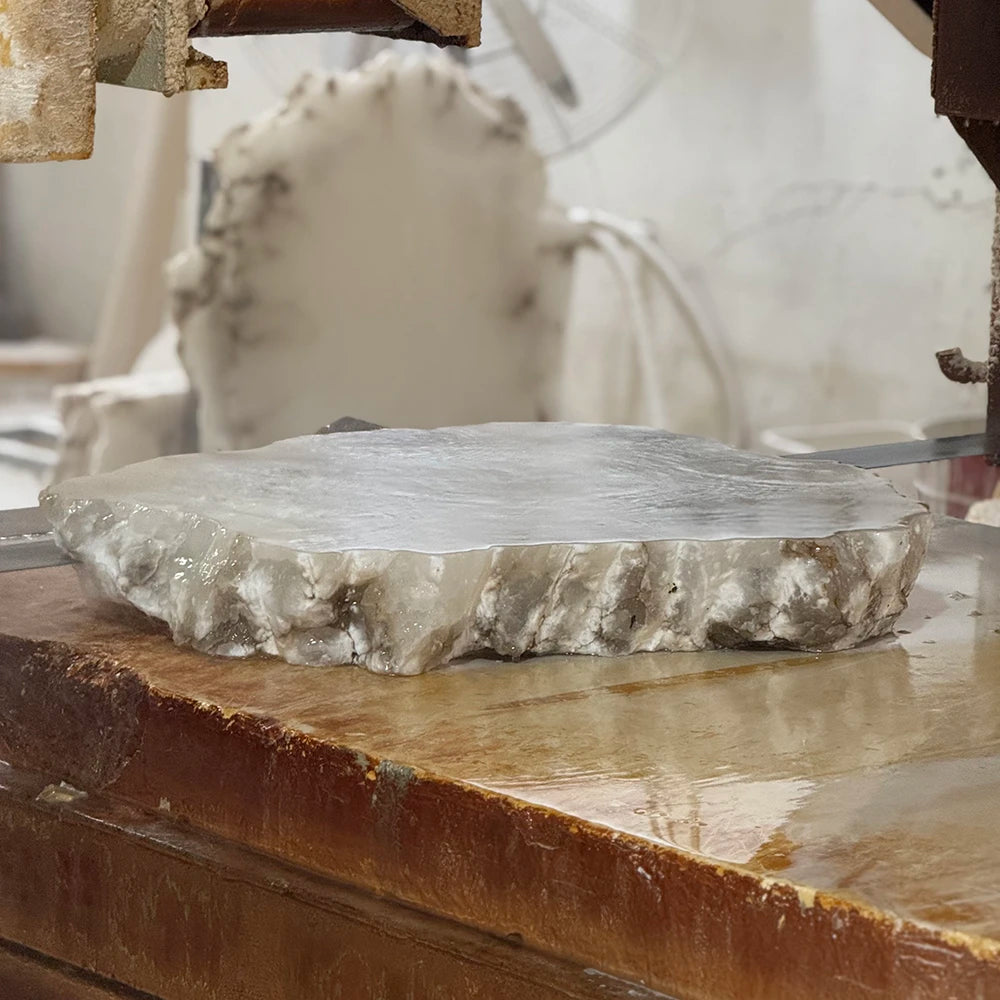


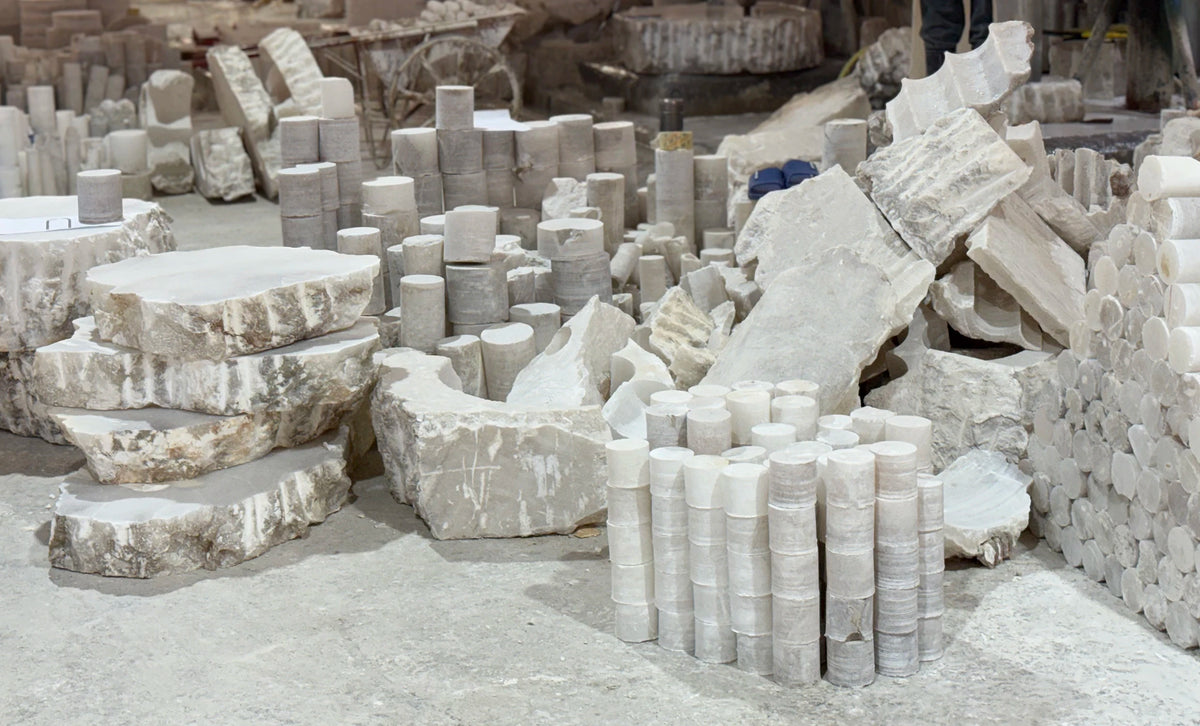

Crafted from select natural alabaster, preserving its unique veining.
Meticulously cut and shaped by artisans.
Repeatedly ground and polished for a smooth, refined texture.
Carefully assembled and quality-inspected.
Custom Stone Lighting

SHOP BY CATEGORY
Six major categories, one workshop — find the fixture that fits your room.