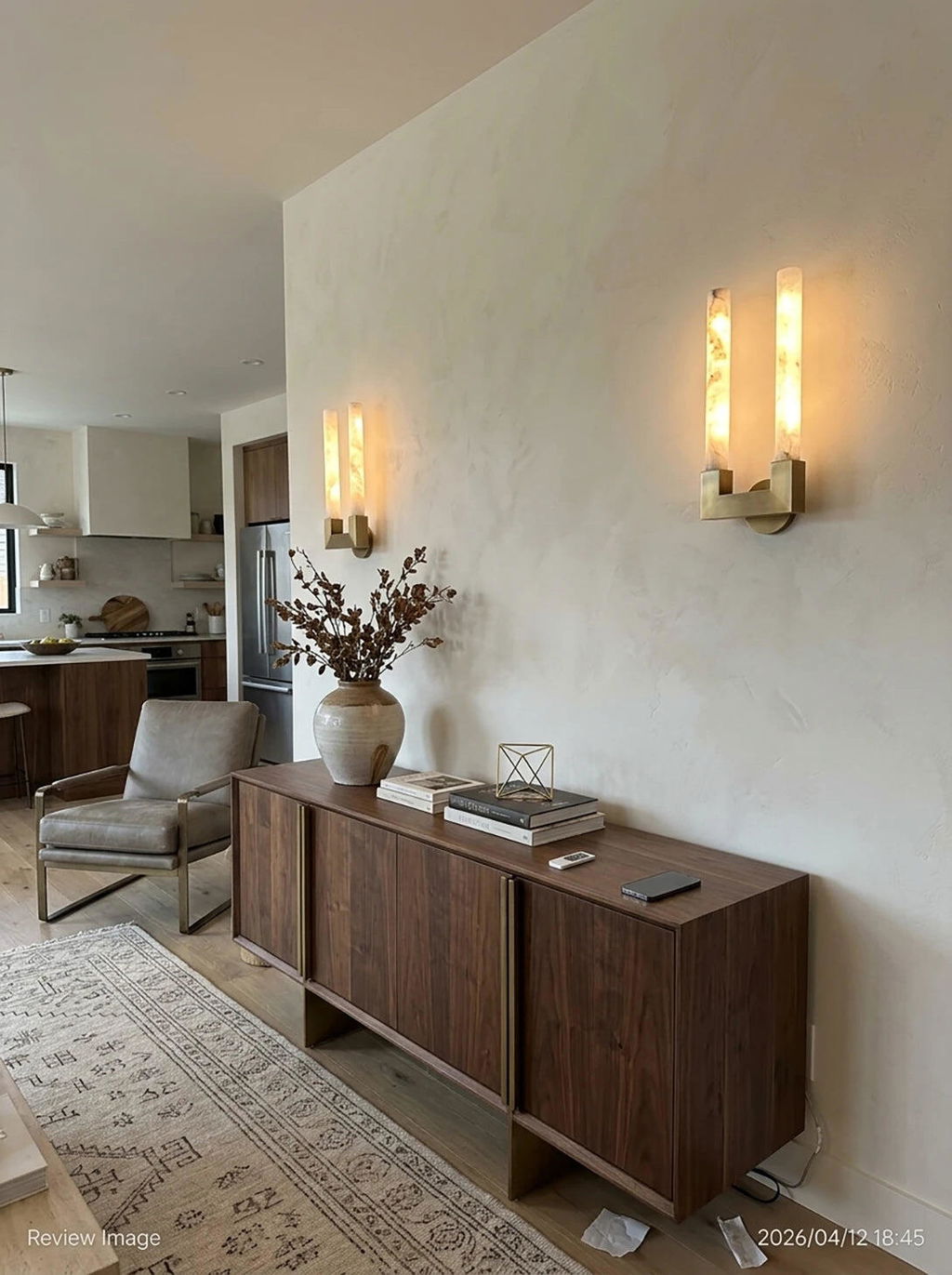
A new perspective
Light changes everything
Discover sculptural lighting designed to bring warmth, character, and atmosphere to every room.


The Isolde Draped Arc Alabaster Chandelier is built from curved metal bands suspended from several separate ceiling points, each band set with small alabaster pebbles along its length. The arcs sag between their anchors the way a swag of fabric does, one nesting inside the next, and the stones sit directly on the band rather than hanging beneath it — flush pebbles of lit alabaster held against dark metal.
Almost every chandelier is one object that arrives with its shape already decided. This one arrives as a set of curves and gets its shape from your ceiling. Because each arc hangs from its own mounting points, the depth of every sag, the distance between the tiers and the overall spread are all set during installation — spread the anchors wide and the arcs flatten into shallow sweeps; bring them close and the curves deepen into a nested cascade. It works across a long dining table, a kitchen island, or a double-height entry, and it reads differently from every position in the room because no two arcs sit in the same plane.
No two pieces of stone are ever the same
Alabaster is a natural stone, so every piece carries its own veining and subtle variation in color. The fixture you receive may therefore differ slightly from the images shown.

The bands are flexible and each hangs from a cable at either end — so the same fixture becomes three quite different objects depending on where the fixing points go.
Anchor points set in a straight row, the arcs hanging side by side at the same depth. The widest spread and the shallowest fall — light reaches the full length of a long surface.
→ Over a long dining table, a kitchen island, or a run of counter.
The inner pair of anchors set closer together than the outer, so one arc falls inside the other at a different depth. From beneath you look through the layers; from across the room they close into one draped mass.
→ Over a round or square table, an entry hall, or a room seen from two sides.
Anchors brought close together so the bands fall as deep half-ellipses rather than shallow sweeps. The narrowest footprint and the most dramatic drop — but it needs real height above it.
→ Down a stairwell void, a double-height entry, or a vaulted room.
Each band is held by a cable at either end, so the fixture anchors to separate places on your ceiling rather than a single canopy. That is exactly what lets you set the depth of every curve — but it also means several holes, several fixings and wiring run between them.
A solid metal bar holds whatever curve it was bent to at the factory. These bands are faux leather over their core, which is what allows them to drape — the sag between the two anchor points is set by how far apart you place them, not decided before it ships. That flexibility is the whole design. It also means the bands should be wiped with a dry cloth only, never soaked or treated with leather conditioner.
The LED is built into the fixture, so there is no bulb to buy, fit or replace — and no bulb to swap for a dimmable one later. (Please contact us if you require dimming functionality.)
The two sizes are almost identical in length. What changes is how far the arcs fall — so this is a ceiling-height decision, not a table-width one.
The version most dining rooms want.

Measure the void, not the table.

Every band hangs from a cable at each end, so the figures above describe the fixture at its designed shape — spread the anchor points wider and the arcs flatten; bring them closer and the curves deepen. The height you end up with is partly yours to decide, which is exactly why the ceiling layout matters more here than on a normal chandelier.
Over a table, aim for 30–36″ between the lowest stone and the tabletop. Anywhere people walk beneath it, keep 7 ft of clearance above the floor — on the large size, that alone rules out most standard ceilings.
Hang a chain between two points and gravity does the rest.
There is a curve you cannot design. Hold a chain, a rope or a necklace by both ends and let it hang — the shape it settles into is not a choice anyone made. It is the exact line every point of that chain takes when weight and tension finish arguing. Suspension bridges use it. Cathedral arches were derived from it. It appears wherever something flexible is held at two points and left alone, and the eye reads it as settled long before the mind knows why.
Each band is flexible rather than rigid, and each hangs from a cable at either end — so the arc you see was not bent into shape at our workshop. It was found in your room, by gravity, on the day it went up. Move the anchor points apart and the curve flattens into a long shallow sweep. Bring them closer and it deepens into a fall. Same fixture, two entirely different objects.
Along each band sit small pebbles of alabaster, set flush against the surface rather than hanging beneath it. Nothing dangles, nothing swings — the light appears to have grown along the curve rather than been attached to it. And because the stones are spread the whole length instead of gathered at a centre, the light arrives evenly across a long table with no single bright point to look into.
How it mounts, which size to choose, and why the curve is yours to set.
Not directly — and this is the most important thing to know before ordering.
Each band is held by a cable at either end, so the fixture anchors to several separate points on your ceiling rather than one canopy. That means new holes, new fixings, and wiring run between them. It is not a swap-out for an existing pendant.
Choose on ceiling height, not table width — and this catches people out, because it works backwards to most chandeliers.
The two sizes are almost the same length: 70.9″ and 74″, only three inches apart. What changes is depth: 23.6″ against 47.2″. The large one is nearly four feet tall on its own, before any cable.
So: small for a 9–11 ft ceiling over a dining table or island. Large for 11 ft and up — a double-height entry, a stairwell void, a vaulted room. On a standard ceiling the large version simply hangs too low.
Yes — that's the whole idea. The bands are flexible rather than rigid, so the arc isn't bent into shape at the factory. It's found by gravity once the anchor points are in your ceiling.
Set the anchors further apart and the curve flattens into a long shallow sweep. Bring them closer and it deepens into a fall. Same fixture, two quite different shapes — and the decision is made in your room on the day.
Yes, and more evenly than most chandeliers this size. The stones sit along the whole length of every band rather than gathering at a centre, so the light reaches the ends of a long table instead of pooling in the middle.
It's also comfortable to sit under: dozens of small glows rather than one bright source, so there's no single point to look into from any seat.
Because they're cut from real quarried stone, not moulded from resin. Every pebble has its own veining, and some glow noticeably warmer than the ones beside them.
On a fixture carrying this many, that's the first thing you notice — and it's what tells you the stone is real. A set that matched perfectly would have to be plastic.
No bulb — the LED is built into the fixture, running at warm white 3000K. Nothing to buy, nothing to match, and no odd one out among all those stones.
The trade-off is that there's no bulb to swap for a dimmable one later. Dimming works through a compatible LED wall dimmer on the circuit instead. (Please contact us if you require dimming functionality.)
Faux leather over a core, with metal fittings and natural alabaster stones.
That material is a deliberate choice rather than a saving. A solid metal bar holds whatever curve it was bent to at the factory — these bands flex, which is the only reason the shape can be set in your room instead of ours. Clean them with a dry cloth only: never soak them, and don't use leather conditioner.
A soft dry cloth on both the stones and the bands. Keep water off the alabaster — it's porous, absorbs it, and leaves a mark that won't buff out. The bands should stay dry too.
No sprays, no polish, nothing abrasive. Switch off and let it cool first. Once or twice a year is plenty.
Glass droplets on a flexible frame — hung from the ceiling, set against a wall, or standing on the floor. Same language, three different jobs in a room.

1–5 strands · 98.4″ or 118″
The full sculpture. Run it straight over a table, curved into a U, or staggered down a stairwell — the frame bends to whatever the room needs. Transparent or smoky grey glass.

Wall mounted · Integrated LED
The same droplets brought down to eye level. Beside a bed, a mirror, or along a hallway — where the pendant needs a ceiling and a room to fill, this needs only a wall.

Floor standing · Plug in
The one that needs no electrician and no holes in the ceiling. Plug it in beside a sofa or a reading chair — and take it with you when you move.
One idea, three heights. Every piece here uses the same glass droplets on the same flexible frame — what changes is where the light sits in the room. The pendant fills the volume overhead, the wall light brings it to eye level beside a bed or a mirror, and the floor lamp puts it beside you with nothing to wire in. They read as one family when used together, which is why they suit an open-plan space seen all at once. Tell us the rooms and we'll suggest which combination works.
The price includes tax, and free standard shipping within the U.S. is provided.

The beauty of a fixture is easy to photograph. What matters just as much is what sits inside the canopy—the driver, the bracket, the wiring, the hardware in the box. Here is how we build for safety and longevity, so the fixture you order arrives ready to install and made to last.

We offer integrated LED drivers in a range of styles—dimmable, constant-current, and color-temperature-adjustable—so the fixture can be matched to how you actually light the room. It runs on 110–240V, works straight out of the box on standard US household power, and is rated for both dry and damp locations, so it fits wherever you'd like to install it.
Every fixture ships with a sturdy mounting bracket sized to a standard US junction box—so it hangs true and stays secure, year after year. No improvising, no trips to the hardware store.
Open the carton and it's all there—canopy, mounting plate and bracket, screws and wall anchors, the driver, and a pair of clean cotton gloves for handling the glass. Nothing missing, nothing to source separately. It's the small stuff, packed with care, that makes installation day feel easy.
Clearly labeled leads and a tidy factory harness make professional installation quick and unambiguous. Hand it to your electrician and they'll have it up in minutes—standard L / N / E hardwiring, the way a considered fixture should be.
Order with confidence: what arrives at your door is a fixture built to be lived with—considered on the inside, finished on the outside. Wiring should be carried out by a qualified electrician in line with local code.
Free Shipping on all orders
Hassle-free return within 30 days
Payment Security
The Isolde Draped Arc Alabaster Chandelier is built from curved metal bands suspended from several separate ceiling points, each band set with small alabaster pebbles along its length. The arcs sag between their anchors the way a swag of fabric does, one nesting inside the next, and the stones sit directly on the band rather than hanging beneath it — flush pebbles of lit alabaster held against dark metal.
Almost every chandelier is one object that arrives with its shape already decided. This one arrives as a set of curves and gets its shape from your ceiling. Because each arc hangs from its own mounting points, the depth of every sag, the distance between the tiers and the overall spread are all set during installation — spread the anchors wide and the arcs flatten into shallow sweeps; bring them close and the curves deepen into a nested cascade. It works across a long dining table, a kitchen island, or a double-height entry, and it reads differently from every position in the room because no two arcs sit in the same plane.
No two pieces of stone are ever the same
Alabaster is a natural stone, so every piece carries its own veining and subtle variation in color. The fixture you receive may therefore differ slightly from the images shown.
The bands are flexible and each hangs from a cable at either end — so the same fixture becomes three quite different objects depending on where the fixing points go.
Anchor points set in a straight row, the arcs hanging side by side at the same depth. The widest spread and the shallowest fall — light reaches the full length of a long surface.
→ Over a long dining table, a kitchen island, or a run of counter.
The inner pair of anchors set closer together than the outer, so one arc falls inside the other at a different depth. From beneath you look through the layers; from across the room they close into one draped mass.
→ Over a round or square table, an entry hall, or a room seen from two sides.
Anchors brought close together so the bands fall as deep half-ellipses rather than shallow sweeps. The narrowest footprint and the most dramatic drop — but it needs real height above it.
→ Down a stairwell void, a double-height entry, or a vaulted room.
Each band is held by a cable at either end, so the fixture anchors to separate places on your ceiling rather than a single canopy. That is exactly what lets you set the depth of every curve — but it also means several holes, several fixings and wiring run between them.
A solid metal bar holds whatever curve it was bent to at the factory. These bands are faux leather over their core, which is what allows them to drape — the sag between the two anchor points is set by how far apart you place them, not decided before it ships. That flexibility is the whole design. It also means the bands should be wiped with a dry cloth only, never soaked or treated with leather conditioner.
The LED is built into the fixture, so there is no bulb to buy, fit or replace — and no bulb to swap for a dimmable one later. (Please contact us if you require dimming functionality.)
The two sizes are almost identical in length. What changes is how far the arcs fall — so this is a ceiling-height decision, not a table-width one.
The version most dining rooms want.
Measure the void, not the table.
Every band hangs from a cable at each end, so the figures above describe the fixture at its designed shape — spread the anchor points wider and the arcs flatten; bring them closer and the curves deepen. The height you end up with is partly yours to decide, which is exactly why the ceiling layout matters more here than on a normal chandelier.
Over a table, aim for 30–36″ between the lowest stone and the tabletop. Anywhere people walk beneath it, keep 7 ft of clearance above the floor — on the large size, that alone rules out most standard ceilings.
Hang a chain between two points and gravity does the rest.
There is a curve you cannot design. Hold a chain, a rope or a necklace by both ends and let it hang — the shape it settles into is not a choice anyone made. It is the exact line every point of that chain takes when weight and tension finish arguing. Suspension bridges use it. Cathedral arches were derived from it. It appears wherever something flexible is held at two points and left alone, and the eye reads it as settled long before the mind knows why.
Each band is flexible rather than rigid, and each hangs from a cable at either end — so the arc you see was not bent into shape at our workshop. It was found in your room, by gravity, on the day it went up. Move the anchor points apart and the curve flattens into a long shallow sweep. Bring them closer and it deepens into a fall. Same fixture, two entirely different objects.
Along each band sit small pebbles of alabaster, set flush against the surface rather than hanging beneath it. Nothing dangles, nothing swings — the light appears to have grown along the curve rather than been attached to it. And because the stones are spread the whole length instead of gathered at a centre, the light arrives evenly across a long table with no single bright point to look into.
How it mounts, which size to choose, and why the curve is yours to set.
Not directly — and this is the most important thing to know before ordering.
Each band is held by a cable at either end, so the fixture anchors to several separate points on your ceiling rather than one canopy. That means new holes, new fixings, and wiring run between them. It is not a swap-out for an existing pendant.
Choose on ceiling height, not table width — and this catches people out, because it works backwards to most chandeliers.
The two sizes are almost the same length: 70.9″ and 74″, only three inches apart. What changes is depth: 23.6″ against 47.2″. The large one is nearly four feet tall on its own, before any cable.
So: small for a 9–11 ft ceiling over a dining table or island. Large for 11 ft and up — a double-height entry, a stairwell void, a vaulted room. On a standard ceiling the large version simply hangs too low.
Yes — that's the whole idea. The bands are flexible rather than rigid, so the arc isn't bent into shape at the factory. It's found by gravity once the anchor points are in your ceiling.
Set the anchors further apart and the curve flattens into a long shallow sweep. Bring them closer and it deepens into a fall. Same fixture, two quite different shapes — and the decision is made in your room on the day.
Yes, and more evenly than most chandeliers this size. The stones sit along the whole length of every band rather than gathering at a centre, so the light reaches the ends of a long table instead of pooling in the middle.
It's also comfortable to sit under: dozens of small glows rather than one bright source, so there's no single point to look into from any seat.
Because they're cut from real quarried stone, not moulded from resin. Every pebble has its own veining, and some glow noticeably warmer than the ones beside them.
On a fixture carrying this many, that's the first thing you notice — and it's what tells you the stone is real. A set that matched perfectly would have to be plastic.
No bulb — the LED is built into the fixture, running at warm white 3000K. Nothing to buy, nothing to match, and no odd one out among all those stones.
The trade-off is that there's no bulb to swap for a dimmable one later. Dimming works through a compatible LED wall dimmer on the circuit instead. (Please contact us if you require dimming functionality.)
Faux leather over a core, with metal fittings and natural alabaster stones.
That material is a deliberate choice rather than a saving. A solid metal bar holds whatever curve it was bent to at the factory — these bands flex, which is the only reason the shape can be set in your room instead of ours. Clean them with a dry cloth only: never soak them, and don't use leather conditioner.
A soft dry cloth on both the stones and the bands. Keep water off the alabaster — it's porous, absorbs it, and leaves a mark that won't buff out. The bands should stay dry too.
No sprays, no polish, nothing abrasive. Switch off and let it cool first. Once or twice a year is plenty.
Glass droplets on a flexible frame — hung from the ceiling, set against a wall, or standing on the floor. Same language, three different jobs in a room.
1–5 strands · 98.4″ or 118″
The full sculpture. Run it straight over a table, curved into a U, or staggered down a stairwell — the frame bends to whatever the room needs. Transparent or smoky grey glass.
Wall mounted · Integrated LED
The same droplets brought down to eye level. Beside a bed, a mirror, or along a hallway — where the pendant needs a ceiling and a room to fill, this needs only a wall.
Floor standing · Plug in
The one that needs no electrician and no holes in the ceiling. Plug it in beside a sofa or a reading chair — and take it with you when you move.
One idea, three heights. Every piece here uses the same glass droplets on the same flexible frame — what changes is where the light sits in the room. The pendant fills the volume overhead, the wall light brings it to eye level beside a bed or a mirror, and the floor lamp puts it beside you with nothing to wire in. They read as one family when used together, which is why they suit an open-plan space seen all at once. Tell us the rooms and we'll suggest which combination works.
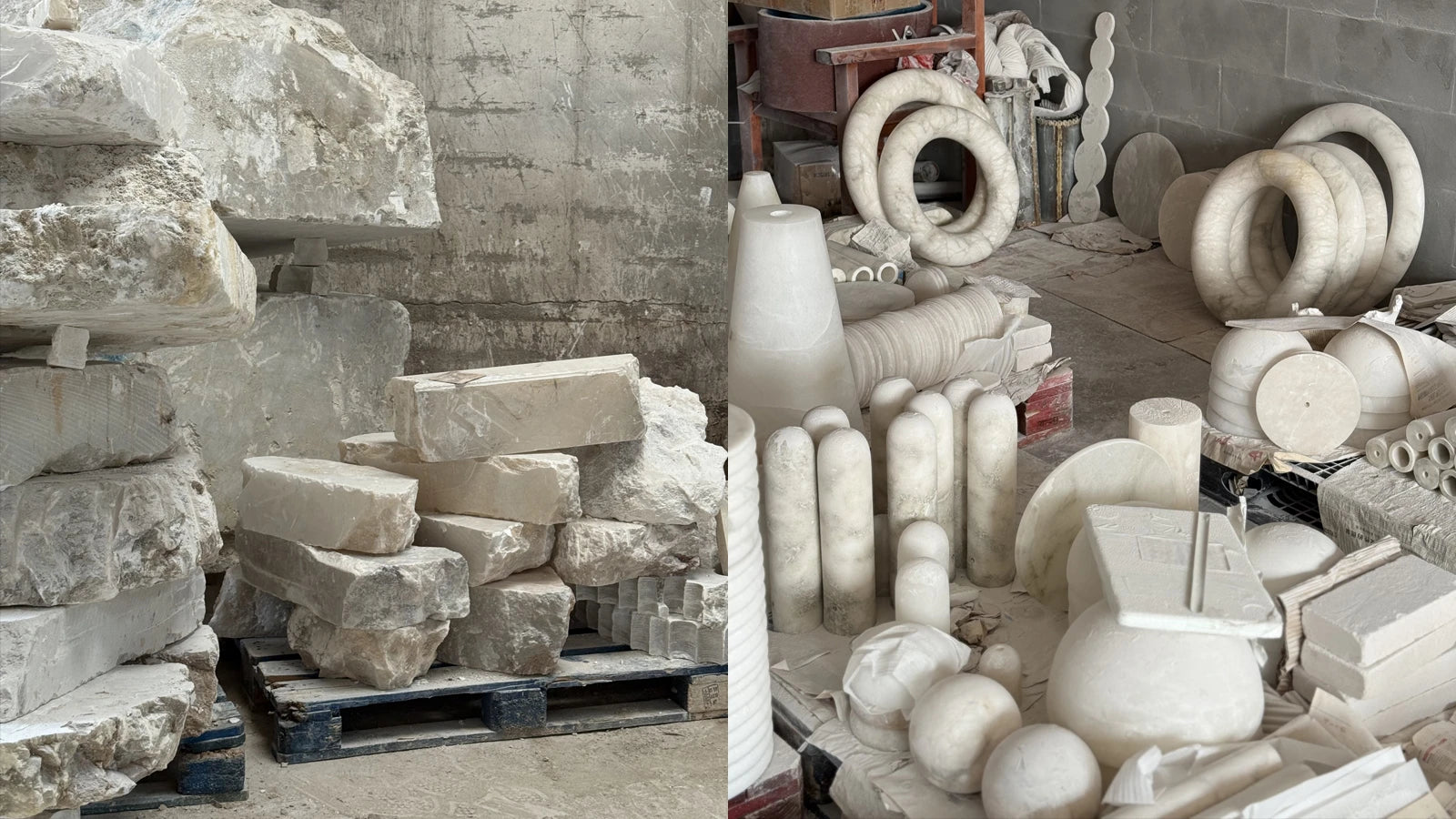
Natural stone lighting

The Vidir lighting edit
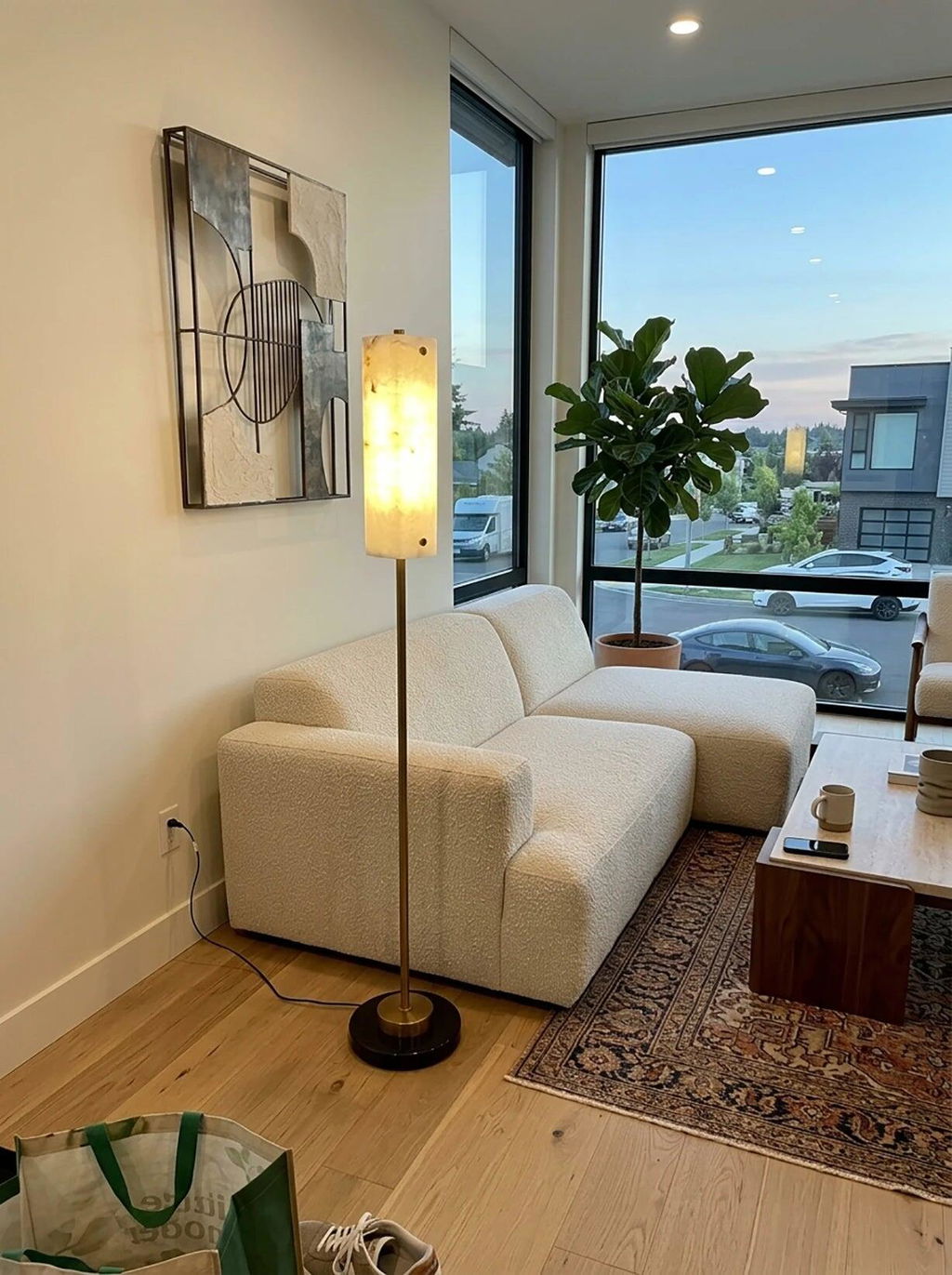
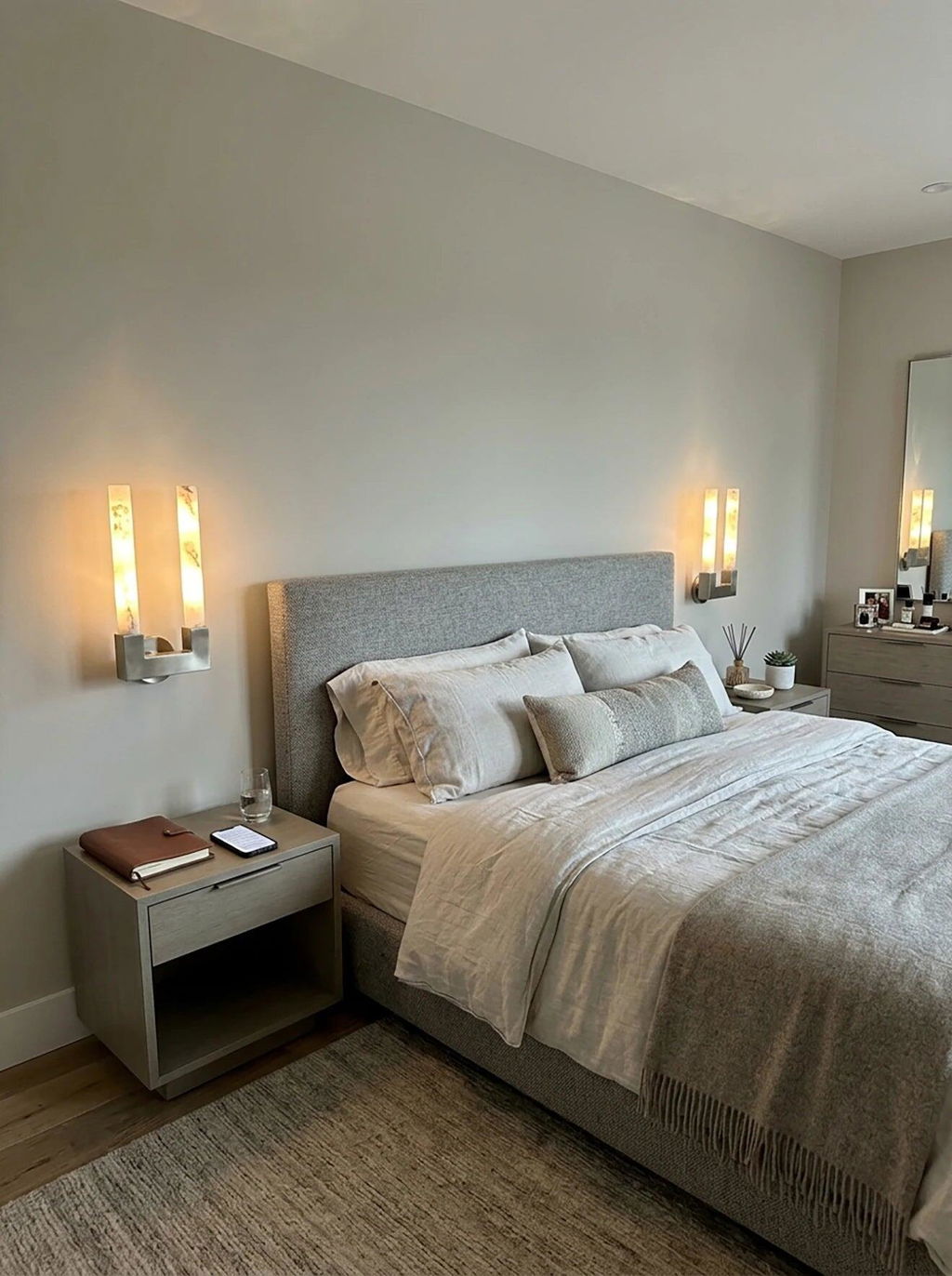
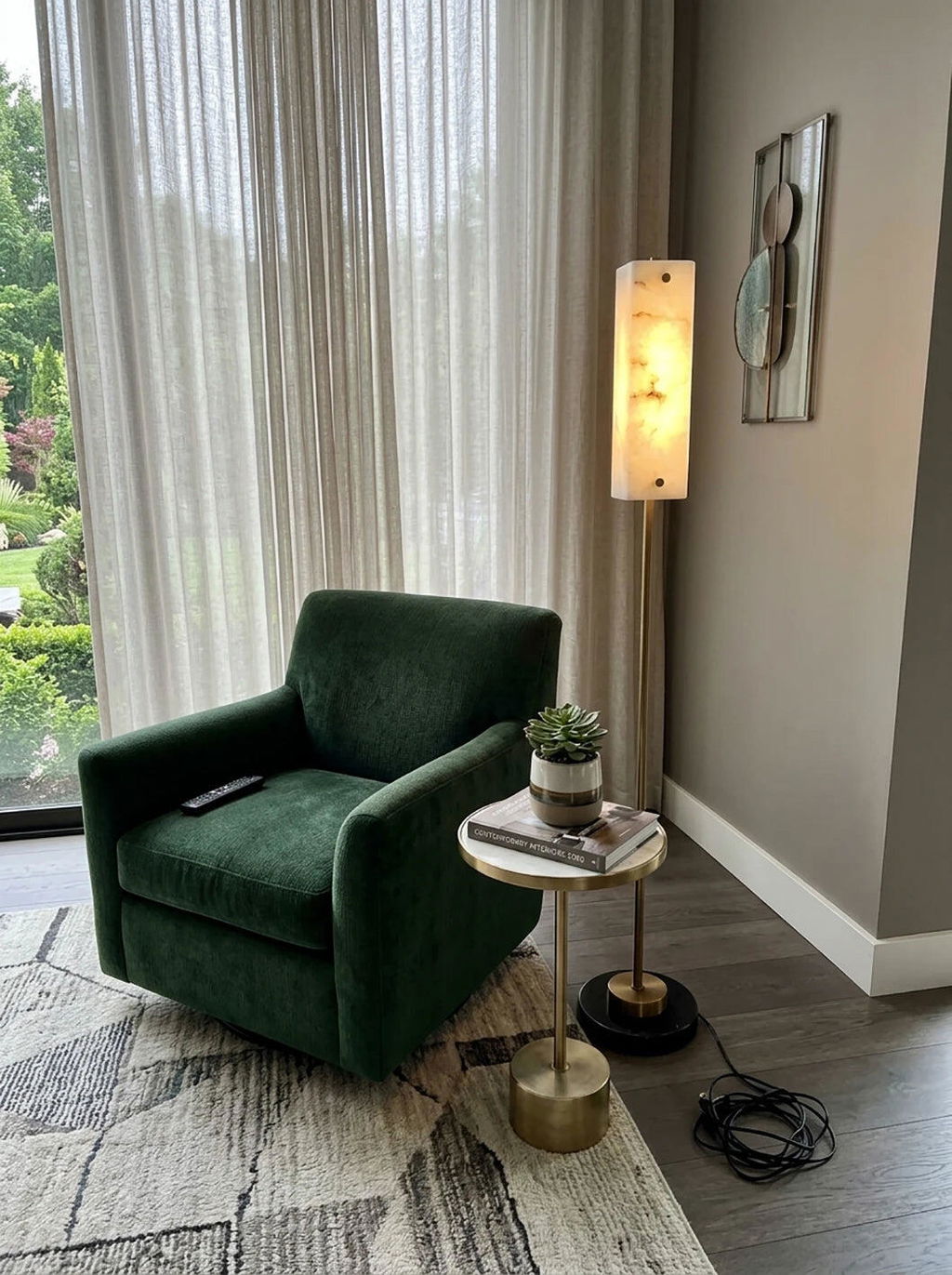
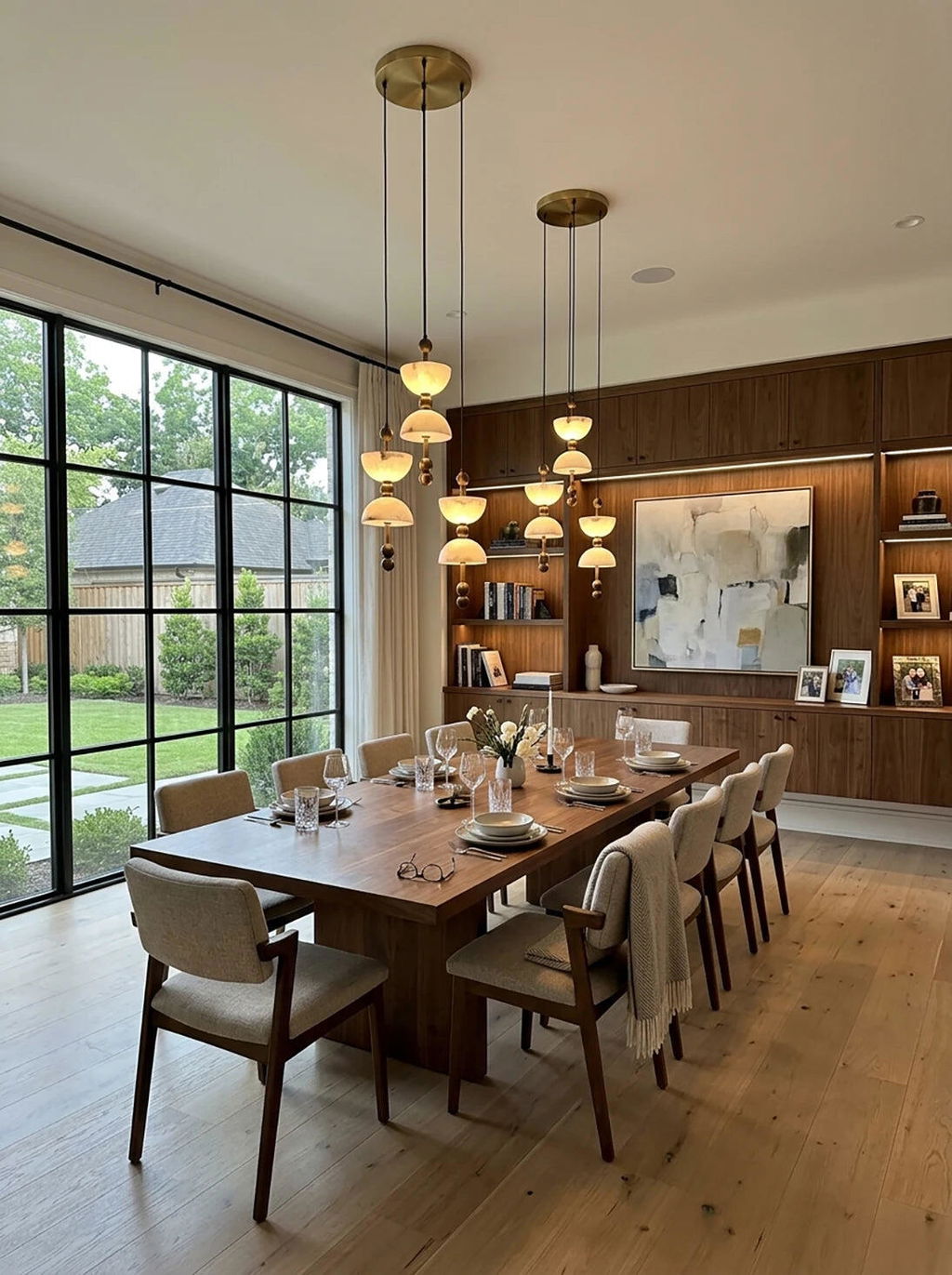
Most shades block light and let it out at the edges. Yet, this stone-textured lampshade manages to achieve exactly that.
Alabaster is translucent. Switch it on and the whole shade lights up from within, veining and all, instead of glowing only where the bulb sits. There is no bright spot to look at, because the light source is the entire surface.
The veining was decided underground, long before anyone cut it. Every shade carries its own pattern and its own faint colour shift — so the piece that arrives is not the piece in the photograph, and that is the point.
Resin and acrylic imitations go amber and brittle within a few years of sitting next to a warm bulb. Stone does not age that way. The shade you unpack is the shade you will have in twenty years.
Designed for better living
Use warm white (2700K). The stone itself has an off-white, creamy tone; cool light passing through it makes it look grayish and dingy, whereas warm light brings out that honey-like hue seen in the photos.
Alabaster is a natural stone that absorbs water and cleaning agents, which can leave permanent stains. Disconnect the power, let the bulb cool down, and then wipe the fixture with a soft, dry cloth—do not use water or spray cleaners.
The density of the stone is far greater than that of a glass shade of the same size; ensure the ceiling's load-bearing capacity is sufficient for safety.

A new perspective
Discover sculptural lighting designed to bring warmth, character, and atmosphere to every room.
 Our product
Alabaster Cylindrical Chain Chandelier
Our product
Alabaster Cylindrical Chain Chandelier
Alabaster is translucent, so the light travels through the stone rather than escaping at the edges — the whole shade glows, veining and all. Every piece carries a pattern that was decided underground, which is why no two are alike.
Resin is cast in moulds, so the "veining" repeats from one shade to the next and the light passes through evenly with no depth to it. It also ages differently: sitting close to a warm bulb, resin tends to amber and grow brittle within a few years.
THE ART OF ALABASTER
The natural texture of alabaster brings a warm, mineral quality to the space. (Please contact us if you require a specific texture.)

A pure white texture reminiscent of fresh snow—warm, smooth, and refined.

Deep, inky patterns flow across a white base.

A dynamic pattern resembling a bolt of lightning streaking across the sky.

Fine, intricate cracks evoking the aesthetic beauty of a sheet of ice at the moment it shatters.

A pattern as light and airy as falling snowflakes, with every single flake unique.
Material · Method · Light
Every texture tells a story of natural light and patient craftsmanship.
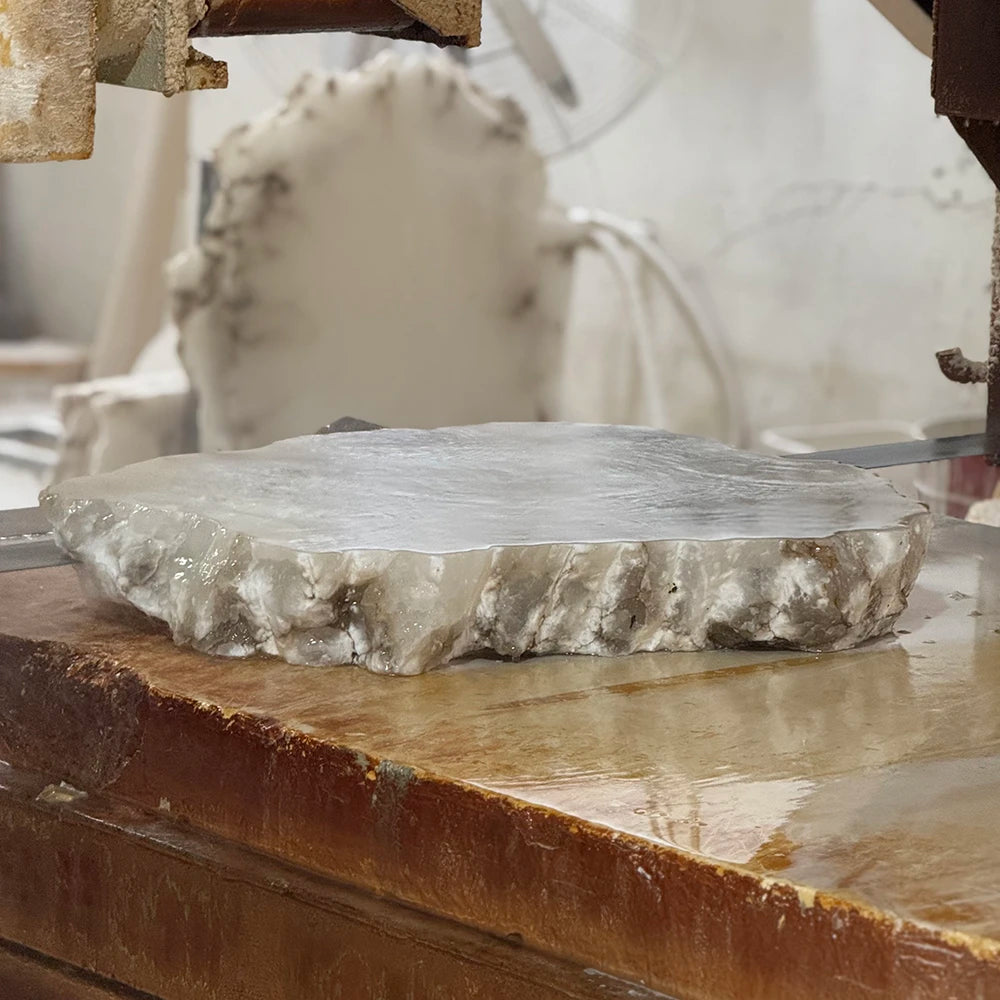
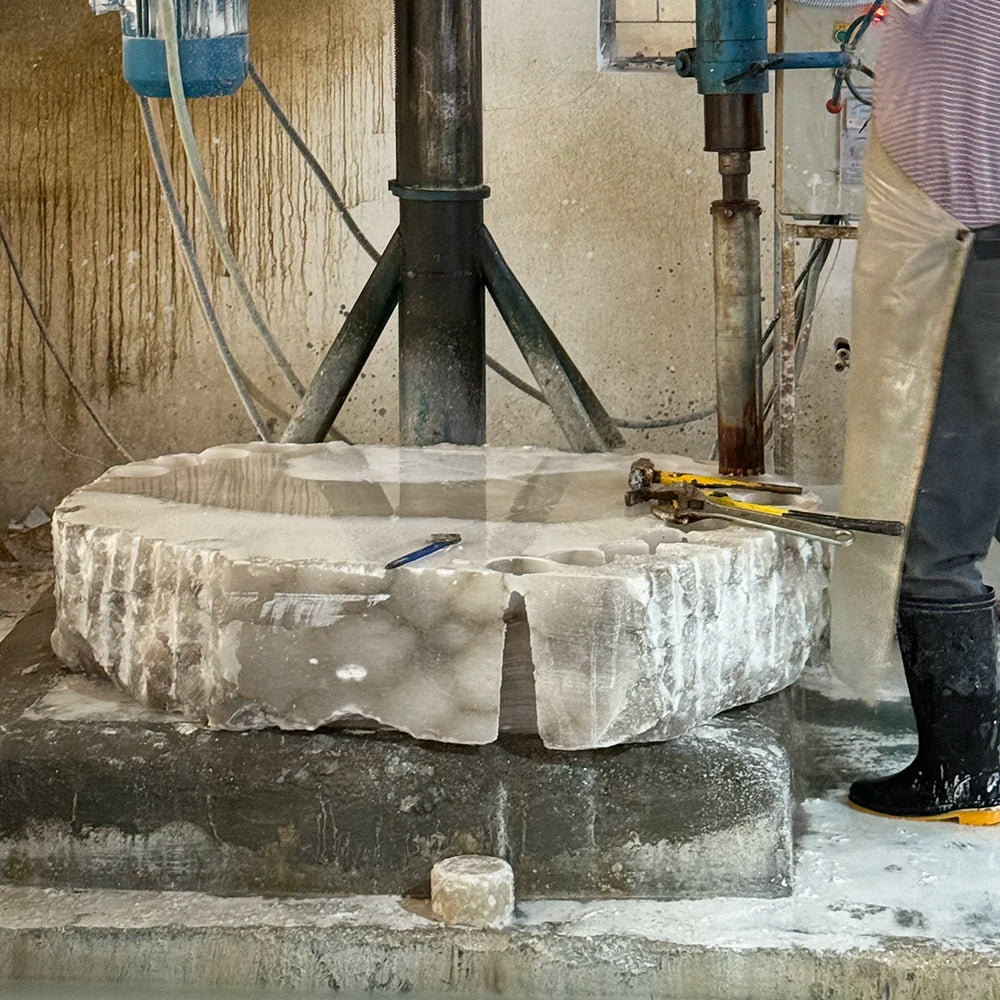
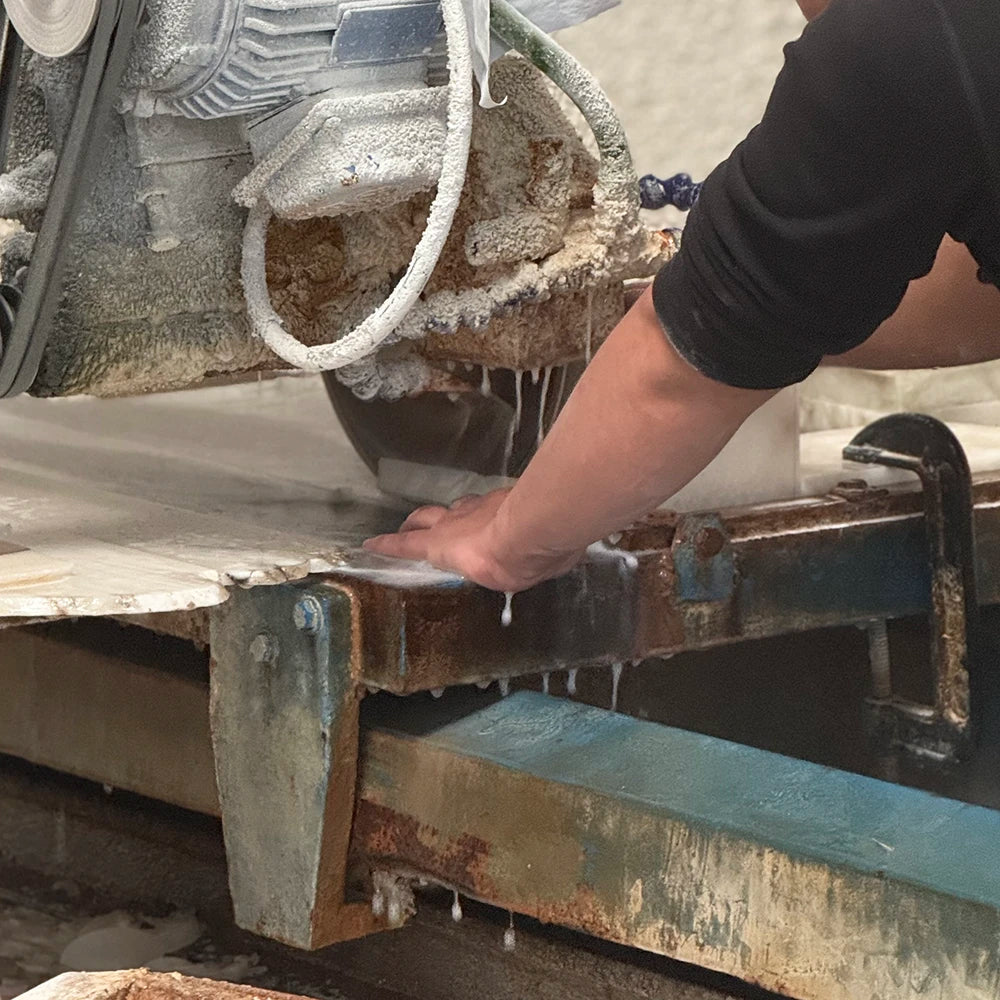
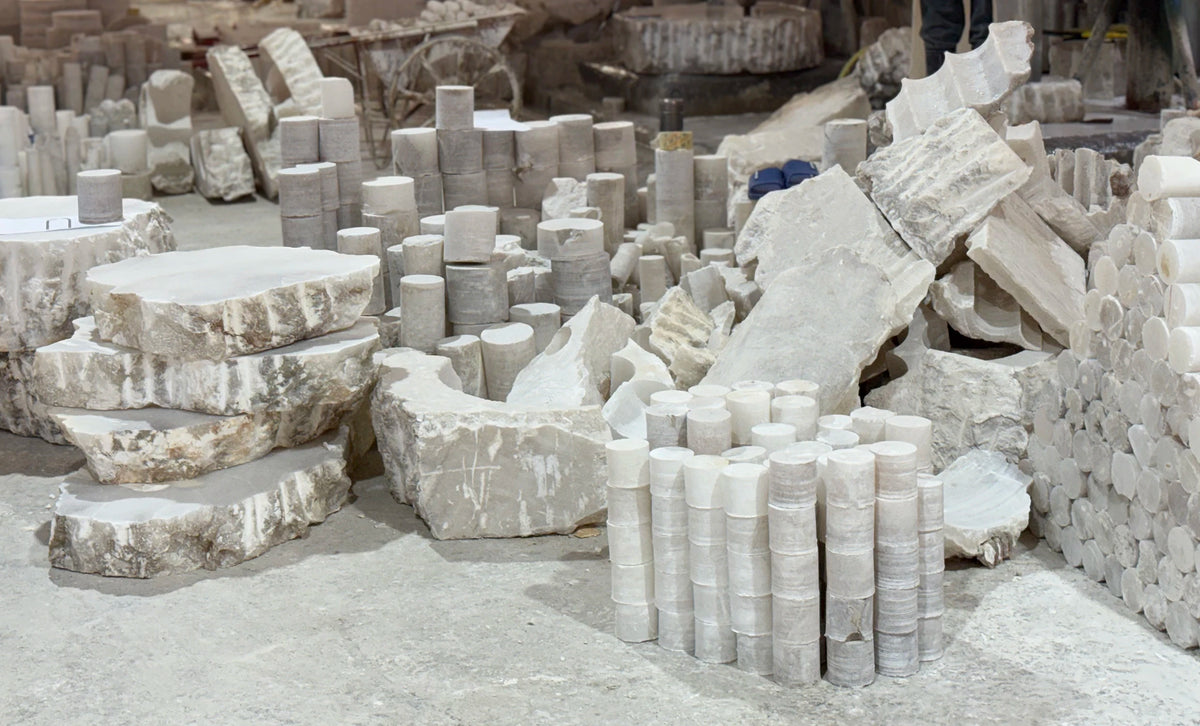
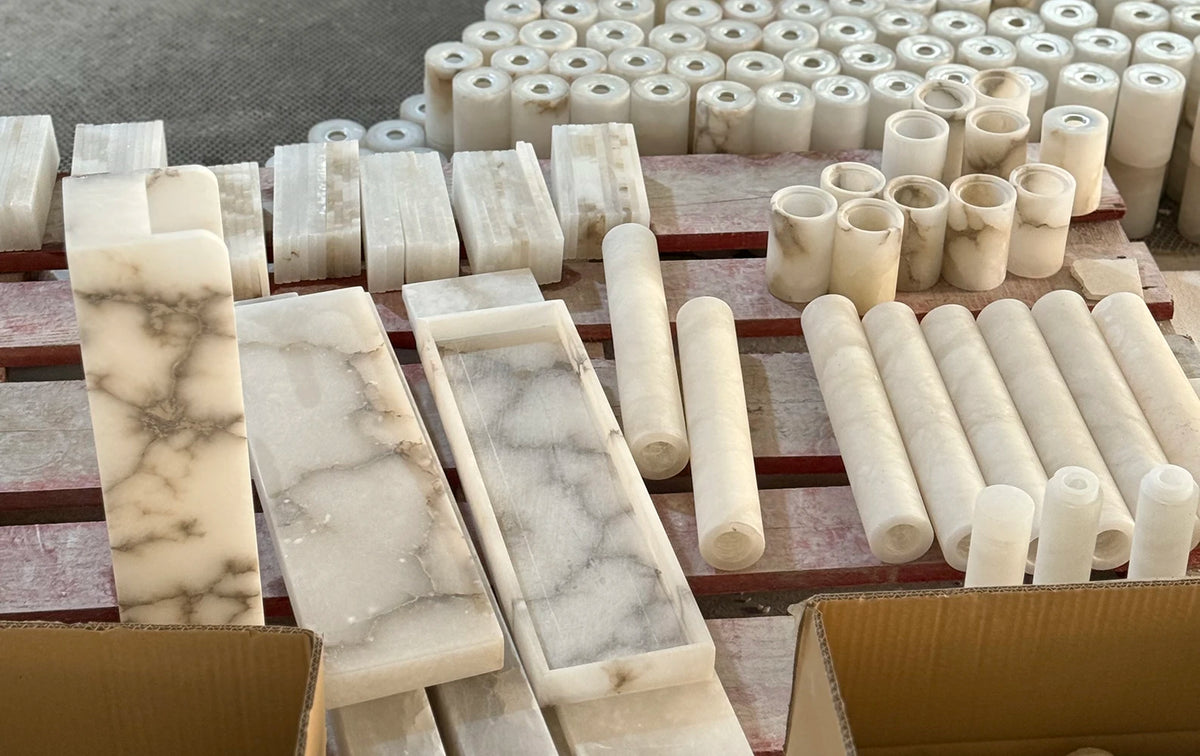
Crafted from select natural alabaster, preserving its unique veining.
Meticulously cut and shaped by artisans.
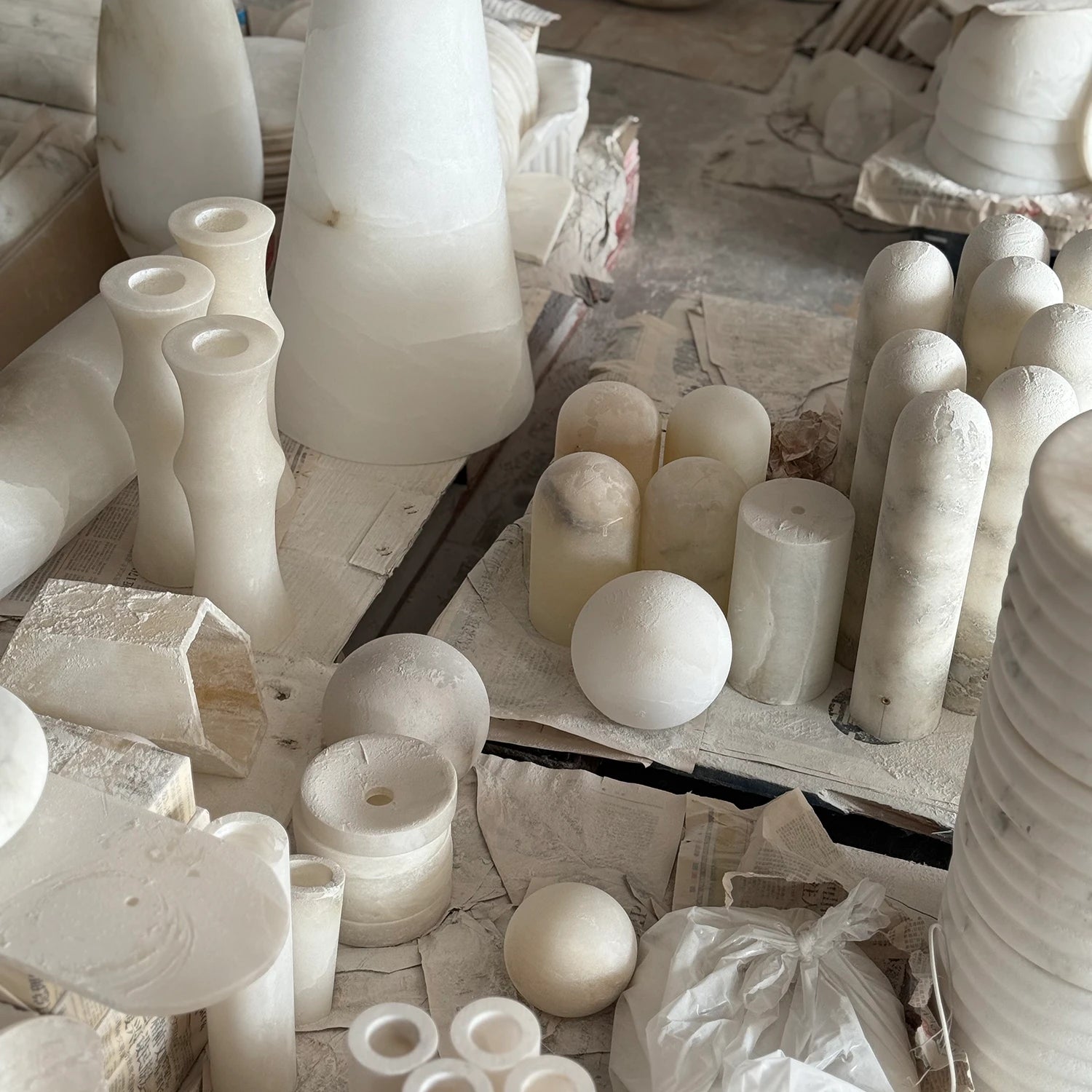
Repeatedly ground and polished for a smooth, refined texture.
Carefully assembled and quality-inspected.
Custom Stone Lighting
SHOP BY CATEGORY
Six major categories, one workshop — find the fixture that fits your room.