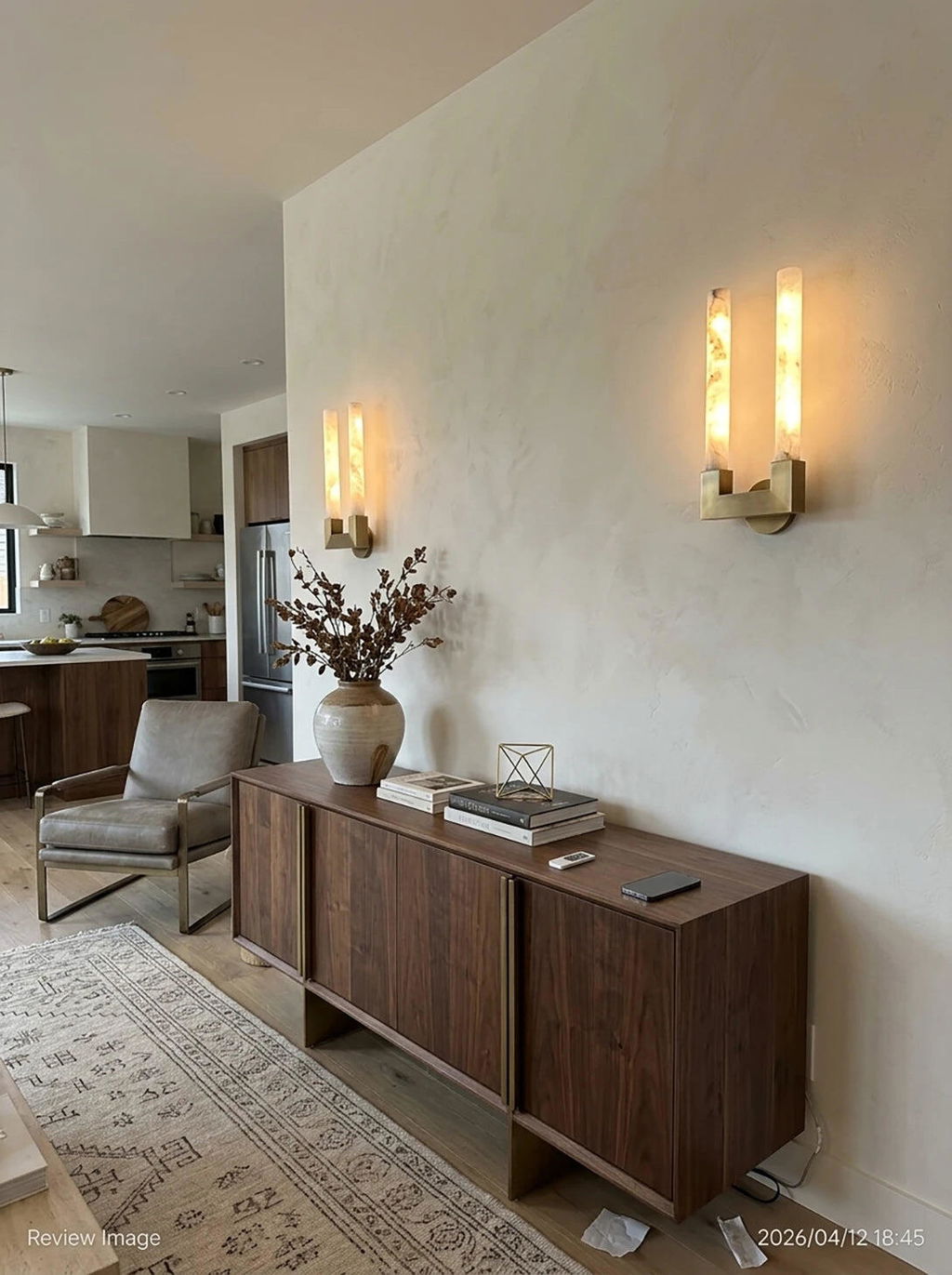
A new perspective
Light changes everything
Discover sculptural lighting designed to bring warmth, character, and atmosphere to every room.


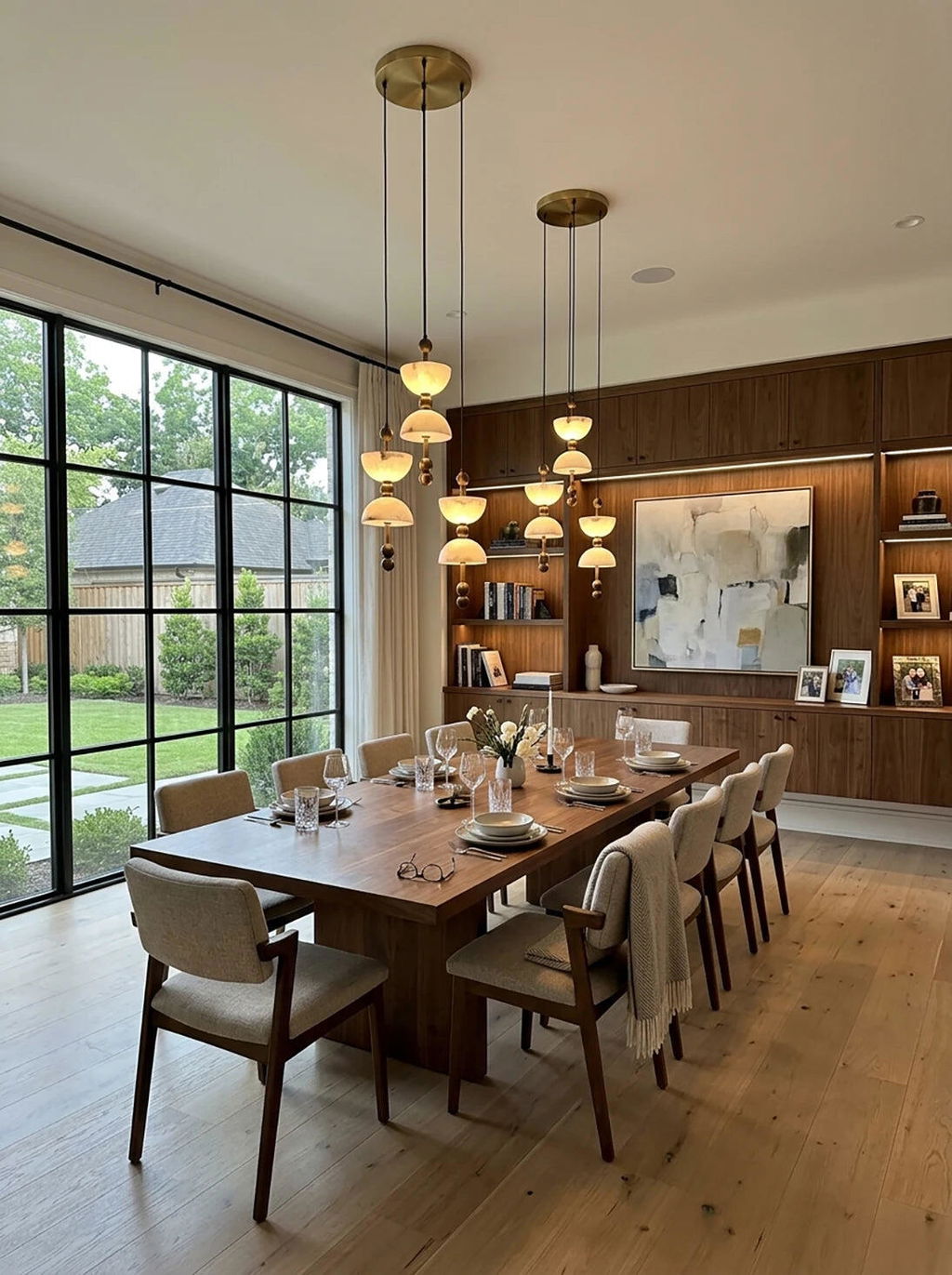
The Anouk Draped Strap Alabaster Chandelier hangs spheres of natural alabaster on long looping straps of PU (faux) leather, each strap running from one ceiling point, down through a sphere, and back up to another. The result is a fixture with no rigid frame at all — what holds it up is the same thing that shapes it. Against the warm tan strap, the pale stone reads as something worn rather than something installed — closer to saddlery than to hardware.
Which means the shape is not decided at our workshop. You decide where each strap is anchored, and the loop finds its own curve between those two points. Anchor them close together and the strap falls in a deep narrow drop; spread them wide and it sweeps in a long shallow swag across the ceiling. The same fixture makes a completely different silhouette depending on where the hooks go — and the curve itself is drawn by gravity, not by a designer.
No two pieces of stone are ever the same
Alabaster is a natural stone, so every piece carries its own veining and subtle variation in color. The fixture you receive may therefore differ slightly from the images shown.

The versions on this page go up to 9 MAX HEADS, which suits most rooms. It is not a limit. A cluster is simply more of the same stone on more of the same strap — so if your span is wider or your stairwell taller, tell us the count you want and we'll make it.
Almost every cluster chandelier is fixed to height by cutting its cords on installation day — one decision, made on a ladder, lived with for twenty years. Two inches too short and there is nothing to be done.
Not here. Every strap carries its own buckle, so each sphere is raised or lowered by hand in seconds, with no tools and no electrician. Hang them all long first, stand where people will actually stand, and adjust one at a time until the arrangement looks right in the room rather than right on paper. Change your mind next year and change it again.
Almost every cluster chandelier is set to height by shortening its cords, which cannot be undone. Here every strap has its own buckle. Each sphere is raised or lowered by hand, in the room, in seconds — and changed again next year if you rearrange the furniture. No electrician, no tools, no regret about a cord cut two inches too short.
The curve of each loop is not fixed at our workshop — it is drawn by the distance between its two anchors. Set them close together and the strap falls in a deep narrow drop; spread them wide and it sweeps in a long shallow swag across the ceiling. The same fixture makes a different silhouette in every room, so it is worth planning the anchor positions before anyone drills.
On this fixture the number of spheres tells you almost nothing about how big it is. The two-head is the largest piece in the range — more than twice the reach of the nine.
The only configuration that suits a standard room. Start here if your ceiling is normal height.

Enough spheres to read as a group, still short enough for a tall room rather than a void.

Six and a half feet deep. More spheres, but still narrower than the two-head.

Nine feet two inches of fixture. Not a small option — the smallest count, the largest piece.

Same size as the two-head — not a slightly bigger Model A. Check which one you are ordering.

Hang a strap between two points and the shape makes itself.
There is a curve that appears whenever something flexible hangs between two fixed points. A washing line. A power cable between two poles. The chain across the front of a shop. Nobody designs that shape — it is simply what a length of material does when it is held at both ends and left alone. It cannot be drawn freehand and it cannot be got wrong, because it is not a decision. It is a consequence.
Each strap runs from one anchor on the ceiling, down through a sphere of alabaster, and back up to another — and the line it takes between those two points is not ours. Move the anchors closer and the loop falls deep and narrow. Spread them apart and it stretches into a long shallow sweep. The fixture has no fixed shape at all; it has a rule, and the room supplies the rest.
Which is why there is no frame. On almost every chandelier the structure and the shade are separate things — a metal armature that does the holding, and something prettier hung off it. Here the strap is the structure, so there is nothing to conceal and nothing left over. What holds the stone up is the same thing that decides how the whole piece looks.
The stone is deliberately the simplest shape we cut. A sphere has no top, no bottom and no front, so it looks the same however the strap happens to turn it — and alabaster passes light evenly all the way around, with no hotspot and nothing to look into. Each one is quarried rather than moulded, so the veining is its own; hung together, the difference between them is the first thing you notice.
How it fixes to the ceiling, why two spheres is the big one, and what you can change later.
Not directly — and this is the most important thing to know before ordering.
Each strap runs from one point on your ceiling, down through a sphere, and back up to another. So a fixture with several spheres needs several fixing points, with wiring run between them.
The two-sphere version — and it catches almost everyone out.
The 2-head spans 79.9″ and drops 110″. The 9-head spans 47.2″ and drops 78.7″. So two spheres is two and a half times wider and more than twice as long as nine.
The reason: the measurement is the distance between the ceiling anchors, not the width of a fixture. Two spheres on straps anchored nearly seven feet apart stretch right across a ceiling; nine gathered close together do not. Choose by the span you want to fill, not by how many stones you want.
Only one version really does. The 3-head Model A — 31.5″ span, 47.2″ drop — suits a room with a 9–11 ft ceiling, over a round table or in an entry.
Everything else needs height. The 5-head wants 10–12 ft, the 9-head 13 ft or more, and the 2-head and 3-head Model B drop 110″ — nine feet two inches. On a standard eight-foot ceiling those would reach the floor. They are stairwell and double-height pieces only.
You choose between leather and woven canvas — and they are not a cheap version and an expensive one. They are two characters at the same quality.
Leather hangs with more weight, holds a crisper edge, and softens and darkens over the years the way a bag or a saddle does. Canvas is lighter, matte, and stays much closer to how it arrived — the quieter of the two in a room that is already busy.
Ask us for a sample if you're undecided. It is a material you'll be looking at every day, and a photograph doesn't settle it.
Yes — and that's unusual. Every strap has its own buckle, so each sphere is raised or lowered by hand, in seconds, with no tools and no electrician.
Almost every other cluster chandelier is set to height by cutting its cords, which cannot be undone. Here nothing is cut. Move the furniture next year, change the arrangement then. The only thing decided permanently is where the anchors go in the ceiling.
Yes, and it is decided by where you place the two anchors for each strap, not by us.
Anchors close together give a deep, narrow drop. Anchors spread wide give a long, shallow sweep across the ceiling. The line between them is drawn by gravity — the same curve a washing line makes — so it cannot be got wrong, but it does mean the anchor positions are worth planning before anyone drills.
Because they're cut from real quarried stone, not moulded. Every sphere carries its own veining, and one or two will glow a little warmer than the rest.
Hung together, that's the first thing you notice — and it's what tells you the stone is real. A set that matched perfectly would have to be resin.
A soft dry cloth on the spheres. Keep water off the stone — alabaster is porous, absorbs it, and leaves a mark that won't buff out.
Wipe the straps dry as well, never damp, and never with any cleaning product. Switch off and let the bulbs cool first. Once or twice a year is plenty.
A strap chandelier asks for several anchor points and an electrician. These two ask for neither — same alabaster, no holes in your ceiling.


Floor standing · Plug in
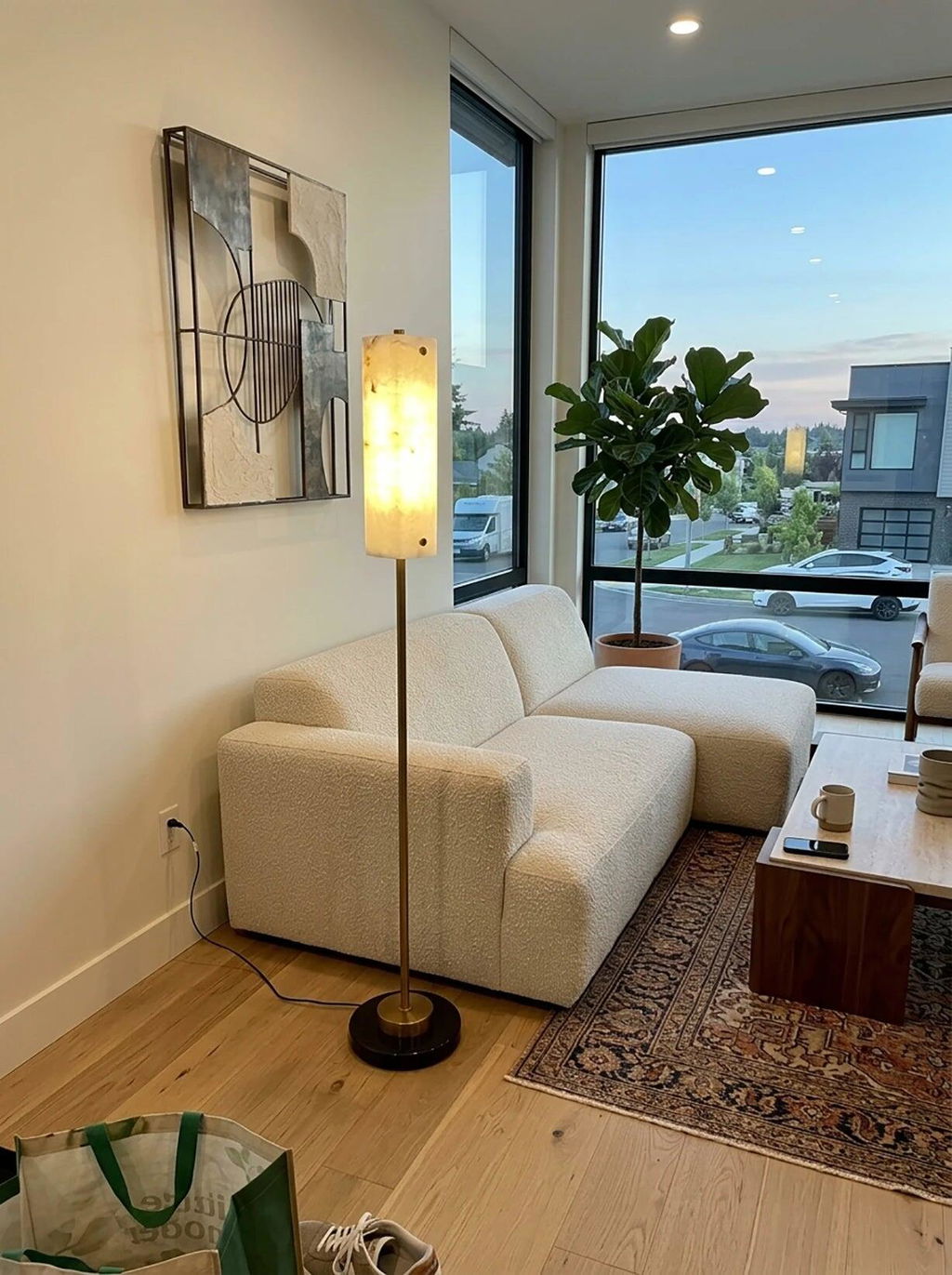
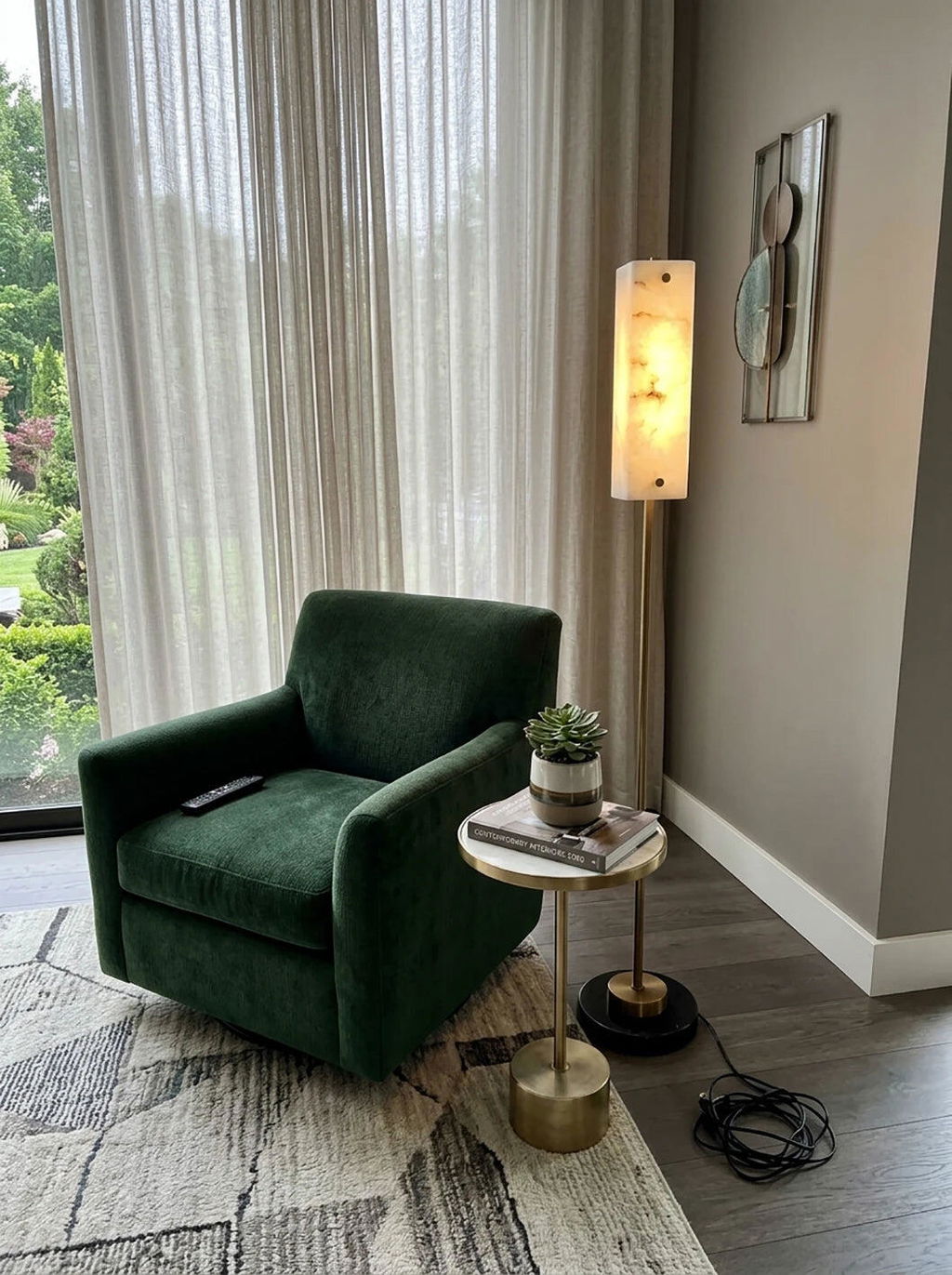
Stone stacked upward rather than hung downward — the same glow, standing in the corner a chandelier will never reach. It plugs in, so there is nothing to wire and nothing to drill.

Wall mounted · Indoor dry rooms
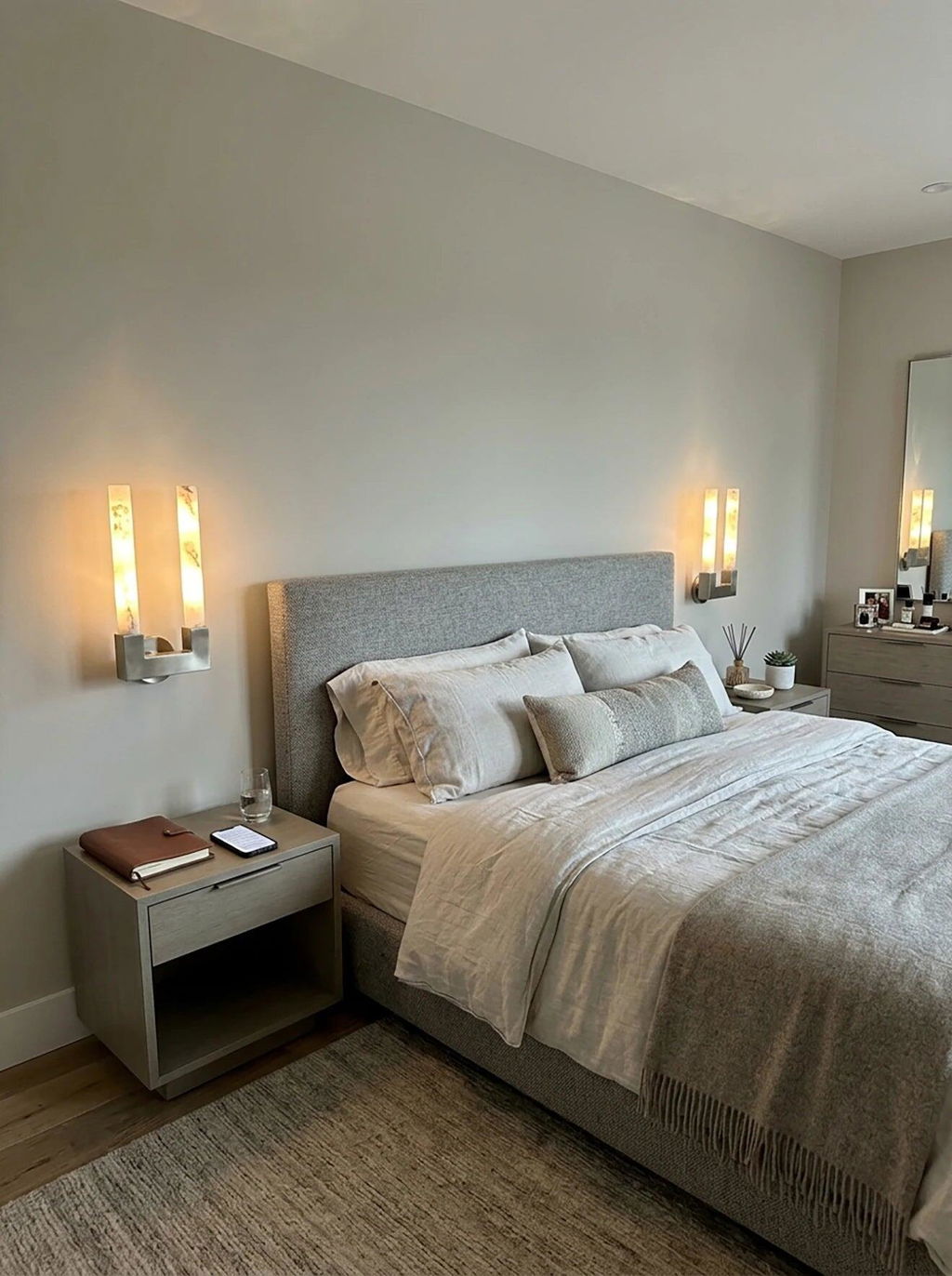
A single point on a wall instead of several across a ceiling. The twist echoes the drape — both are a straight material persuaded into a curve — and in pairs it frames a bed or a doorway.
The price includes tax, and free standard shipping within the U.S. is provided.

Free Shipping on all orders
Hassle-free return within 30 days
Payment Security
The Anouk Draped Strap Alabaster Chandelier hangs spheres of natural alabaster on long looping straps of PU (faux) leather, each strap running from one ceiling point, down through a sphere, and back up to another. The result is a fixture with no rigid frame at all — what holds it up is the same thing that shapes it. Against the warm tan strap, the pale stone reads as something worn rather than something installed — closer to saddlery than to hardware.
Which means the shape is not decided at our workshop. You decide where each strap is anchored, and the loop finds its own curve between those two points. Anchor them close together and the strap falls in a deep narrow drop; spread them wide and it sweeps in a long shallow swag across the ceiling. The same fixture makes a completely different silhouette depending on where the hooks go — and the curve itself is drawn by gravity, not by a designer.
No two pieces of stone are ever the same
Alabaster is a natural stone, so every piece carries its own veining and subtle variation in color. The fixture you receive may therefore differ slightly from the images shown.
The versions on this page go up to 9 MAX HEADS, which suits most rooms. It is not a limit. A cluster is simply more of the same stone on more of the same strap — so if your span is wider or your stairwell taller, tell us the count you want and we'll make it.
Almost every cluster chandelier is fixed to height by cutting its cords on installation day — one decision, made on a ladder, lived with for twenty years. Two inches too short and there is nothing to be done.
Not here. Every strap carries its own buckle, so each sphere is raised or lowered by hand in seconds, with no tools and no electrician. Hang them all long first, stand where people will actually stand, and adjust one at a time until the arrangement looks right in the room rather than right on paper. Change your mind next year and change it again.
Almost every cluster chandelier is set to height by shortening its cords, which cannot be undone. Here every strap has its own buckle. Each sphere is raised or lowered by hand, in the room, in seconds — and changed again next year if you rearrange the furniture. No electrician, no tools, no regret about a cord cut two inches too short.
The curve of each loop is not fixed at our workshop — it is drawn by the distance between its two anchors. Set them close together and the strap falls in a deep narrow drop; spread them wide and it sweeps in a long shallow swag across the ceiling. The same fixture makes a different silhouette in every room, so it is worth planning the anchor positions before anyone drills.
On this fixture the number of spheres tells you almost nothing about how big it is. The two-head is the largest piece in the range — more than twice the reach of the nine.
The only configuration that suits a standard room. Start here if your ceiling is normal height.
Enough spheres to read as a group, still short enough for a tall room rather than a void.
Six and a half feet deep. More spheres, but still narrower than the two-head.
Nine feet two inches of fixture. Not a small option — the smallest count, the largest piece.
Same size as the two-head — not a slightly bigger Model A. Check which one you are ordering.
Hang a strap between two points and the shape makes itself.
There is a curve that appears whenever something flexible hangs between two fixed points. A washing line. A power cable between two poles. The chain across the front of a shop. Nobody designs that shape — it is simply what a length of material does when it is held at both ends and left alone. It cannot be drawn freehand and it cannot be got wrong, because it is not a decision. It is a consequence.
Each strap runs from one anchor on the ceiling, down through a sphere of alabaster, and back up to another — and the line it takes between those two points is not ours. Move the anchors closer and the loop falls deep and narrow. Spread them apart and it stretches into a long shallow sweep. The fixture has no fixed shape at all; it has a rule, and the room supplies the rest.
Which is why there is no frame. On almost every chandelier the structure and the shade are separate things — a metal armature that does the holding, and something prettier hung off it. Here the strap is the structure, so there is nothing to conceal and nothing left over. What holds the stone up is the same thing that decides how the whole piece looks.
The stone is deliberately the simplest shape we cut. A sphere has no top, no bottom and no front, so it looks the same however the strap happens to turn it — and alabaster passes light evenly all the way around, with no hotspot and nothing to look into. Each one is quarried rather than moulded, so the veining is its own; hung together, the difference between them is the first thing you notice.
How it fixes to the ceiling, why two spheres is the big one, and what you can change later.
Not directly — and this is the most important thing to know before ordering.
Each strap runs from one point on your ceiling, down through a sphere, and back up to another. So a fixture with several spheres needs several fixing points, with wiring run between them.
The two-sphere version — and it catches almost everyone out.
The 2-head spans 79.9″ and drops 110″. The 9-head spans 47.2″ and drops 78.7″. So two spheres is two and a half times wider and more than twice as long as nine.
The reason: the measurement is the distance between the ceiling anchors, not the width of a fixture. Two spheres on straps anchored nearly seven feet apart stretch right across a ceiling; nine gathered close together do not. Choose by the span you want to fill, not by how many stones you want.
Only one version really does. The 3-head Model A — 31.5″ span, 47.2″ drop — suits a room with a 9–11 ft ceiling, over a round table or in an entry.
Everything else needs height. The 5-head wants 10–12 ft, the 9-head 13 ft or more, and the 2-head and 3-head Model B drop 110″ — nine feet two inches. On a standard eight-foot ceiling those would reach the floor. They are stairwell and double-height pieces only.
You choose between leather and woven canvas — and they are not a cheap version and an expensive one. They are two characters at the same quality.
Leather hangs with more weight, holds a crisper edge, and softens and darkens over the years the way a bag or a saddle does. Canvas is lighter, matte, and stays much closer to how it arrived — the quieter of the two in a room that is already busy.
Ask us for a sample if you're undecided. It is a material you'll be looking at every day, and a photograph doesn't settle it.
Yes — and that's unusual. Every strap has its own buckle, so each sphere is raised or lowered by hand, in seconds, with no tools and no electrician.
Almost every other cluster chandelier is set to height by cutting its cords, which cannot be undone. Here nothing is cut. Move the furniture next year, change the arrangement then. The only thing decided permanently is where the anchors go in the ceiling.
Yes, and it is decided by where you place the two anchors for each strap, not by us.
Anchors close together give a deep, narrow drop. Anchors spread wide give a long, shallow sweep across the ceiling. The line between them is drawn by gravity — the same curve a washing line makes — so it cannot be got wrong, but it does mean the anchor positions are worth planning before anyone drills.
Because they're cut from real quarried stone, not moulded. Every sphere carries its own veining, and one or two will glow a little warmer than the rest.
Hung together, that's the first thing you notice — and it's what tells you the stone is real. A set that matched perfectly would have to be resin.
A soft dry cloth on the spheres. Keep water off the stone — alabaster is porous, absorbs it, and leaves a mark that won't buff out.
Wipe the straps dry as well, never damp, and never with any cleaning product. Switch off and let the bulbs cool first. Once or twice a year is plenty.
A strap chandelier asks for several anchor points and an electrician. These two ask for neither — same alabaster, no holes in your ceiling.
Floor standing · Plug in
Stone stacked upward rather than hung downward — the same glow, standing in the corner a chandelier will never reach. It plugs in, so there is nothing to wire and nothing to drill.
Wall mounted · Indoor dry rooms
A single point on a wall instead of several across a ceiling. The twist echoes the drape — both are a straight material persuaded into a curve — and in pairs it frames a bed or a doorway.
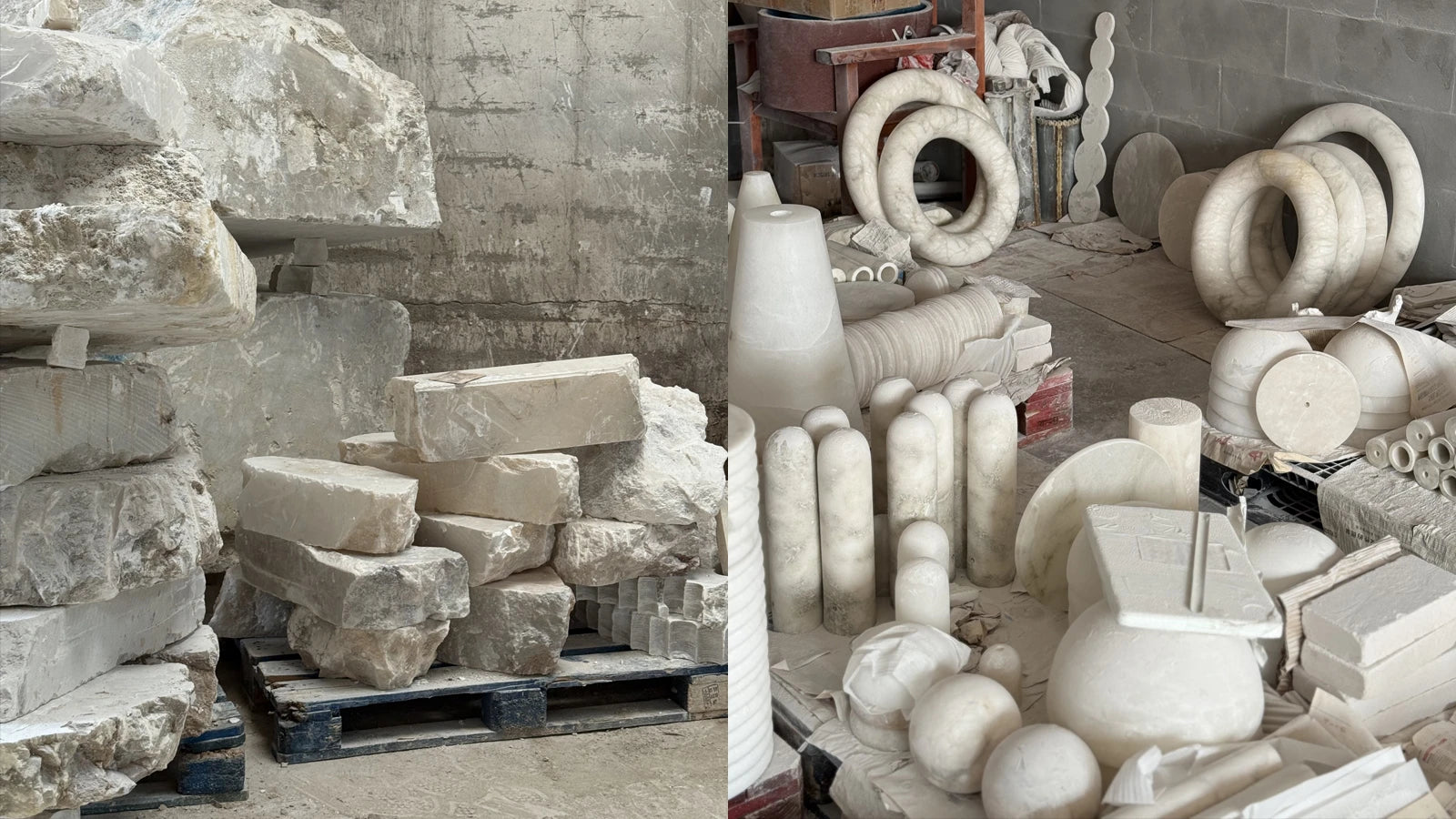
Natural stone lighting

The Vidir lighting edit
Most shades block light and let it out at the edges. Yet, this stone-textured lampshade manages to achieve exactly that.
Alabaster is translucent. Switch it on and the whole shade lights up from within, veining and all, instead of glowing only where the bulb sits. There is no bright spot to look at, because the light source is the entire surface.
The veining was decided underground, long before anyone cut it. Every shade carries its own pattern and its own faint colour shift — so the piece that arrives is not the piece in the photograph, and that is the point.
Resin and acrylic imitations go amber and brittle within a few years of sitting next to a warm bulb. Stone does not age that way. The shade you unpack is the shade you will have in twenty years.
Designed for better living
Use warm white (2700K). The stone itself has an off-white, creamy tone; cool light passing through it makes it look grayish and dingy, whereas warm light brings out that honey-like hue seen in the photos.
Alabaster is a natural stone that absorbs water and cleaning agents, which can leave permanent stains. Disconnect the power, let the bulb cool down, and then wipe the fixture with a soft, dry cloth—do not use water or spray cleaners.
The density of the stone is far greater than that of a glass shade of the same size; ensure the ceiling's load-bearing capacity is sufficient for safety.

A new perspective
Discover sculptural lighting designed to bring warmth, character, and atmosphere to every room.
 Our product
Alabaster Cylindrical Chain Chandelier
Our product
Alabaster Cylindrical Chain Chandelier
Alabaster is translucent, so the light travels through the stone rather than escaping at the edges — the whole shade glows, veining and all. Every piece carries a pattern that was decided underground, which is why no two are alike.
Resin is cast in moulds, so the "veining" repeats from one shade to the next and the light passes through evenly with no depth to it. It also ages differently: sitting close to a warm bulb, resin tends to amber and grow brittle within a few years.
THE ART OF ALABASTER
The natural texture of alabaster brings a warm, mineral quality to the space. (Please contact us if you require a specific texture.)

A pure white texture reminiscent of fresh snow—warm, smooth, and refined.

Deep, inky patterns flow across a white base.

A dynamic pattern resembling a bolt of lightning streaking across the sky.

Fine, intricate cracks evoking the aesthetic beauty of a sheet of ice at the moment it shatters.

A pattern as light and airy as falling snowflakes, with every single flake unique.
Material · Method · Light
Every texture tells a story of natural light and patient craftsmanship.
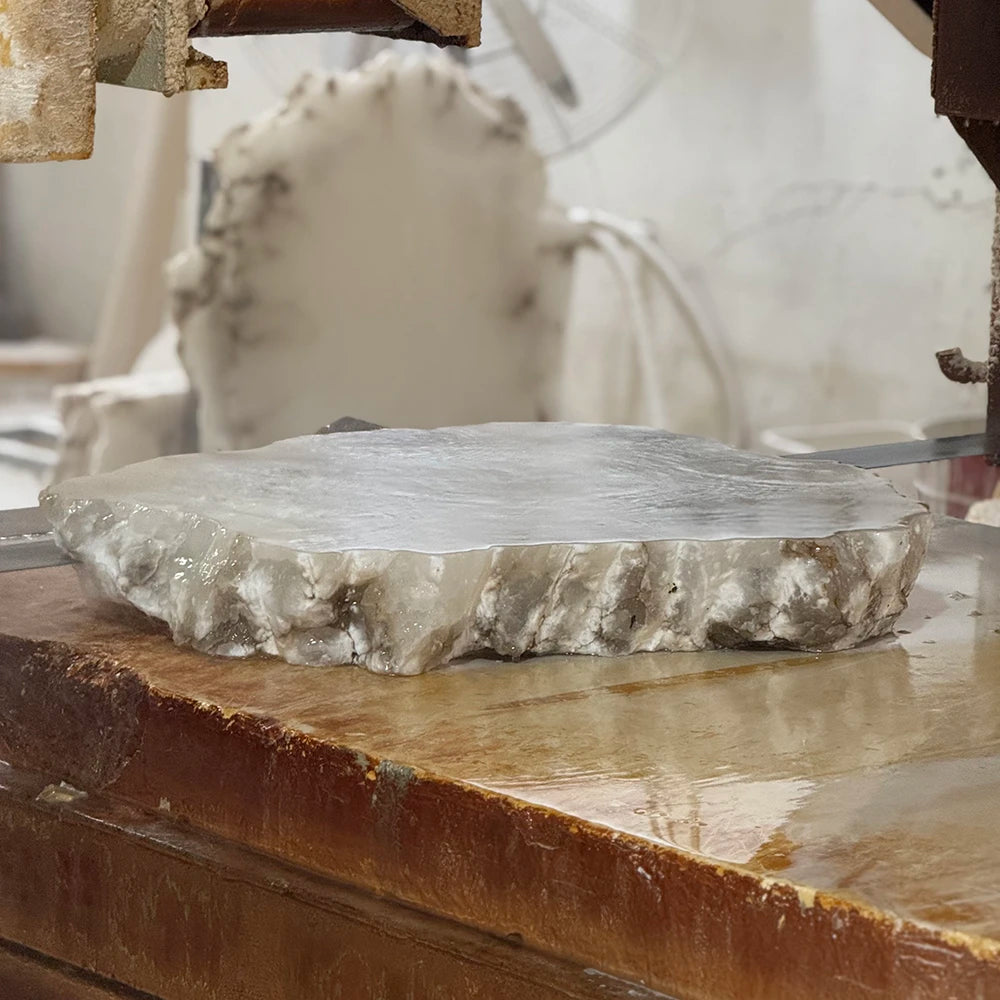
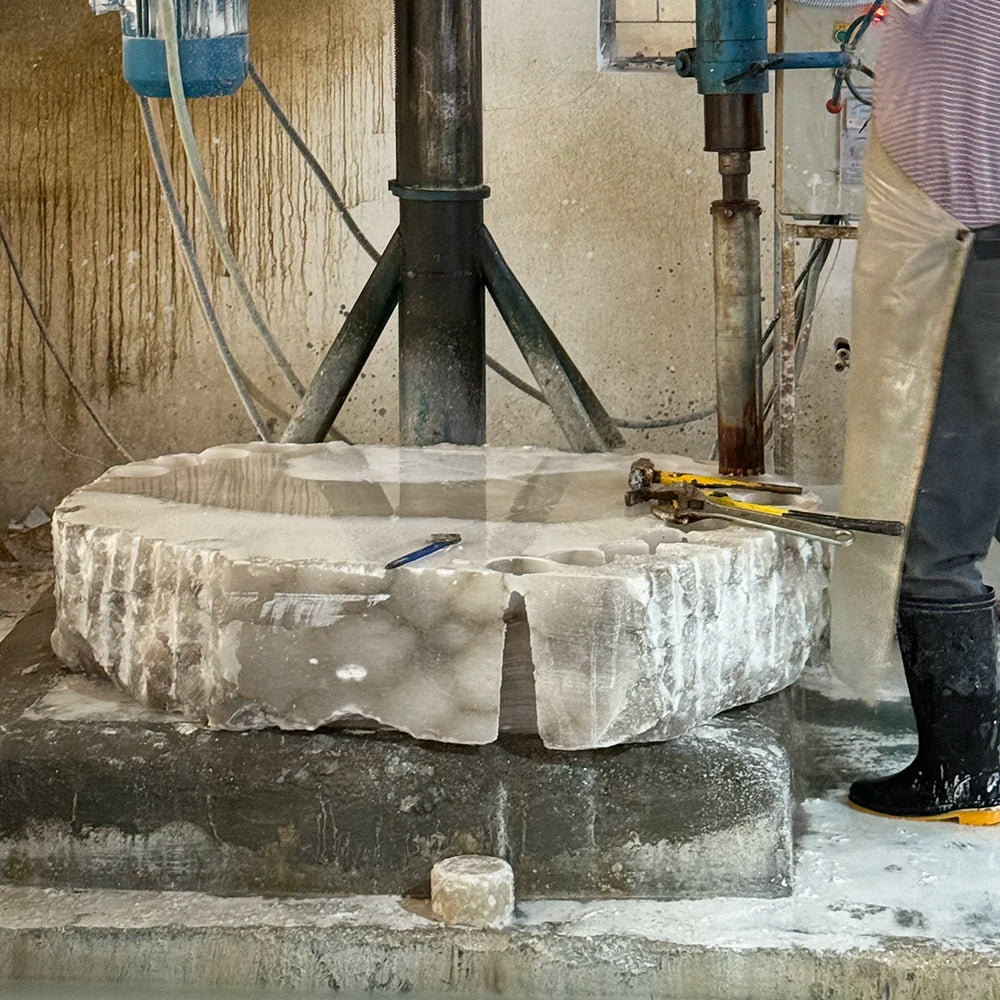
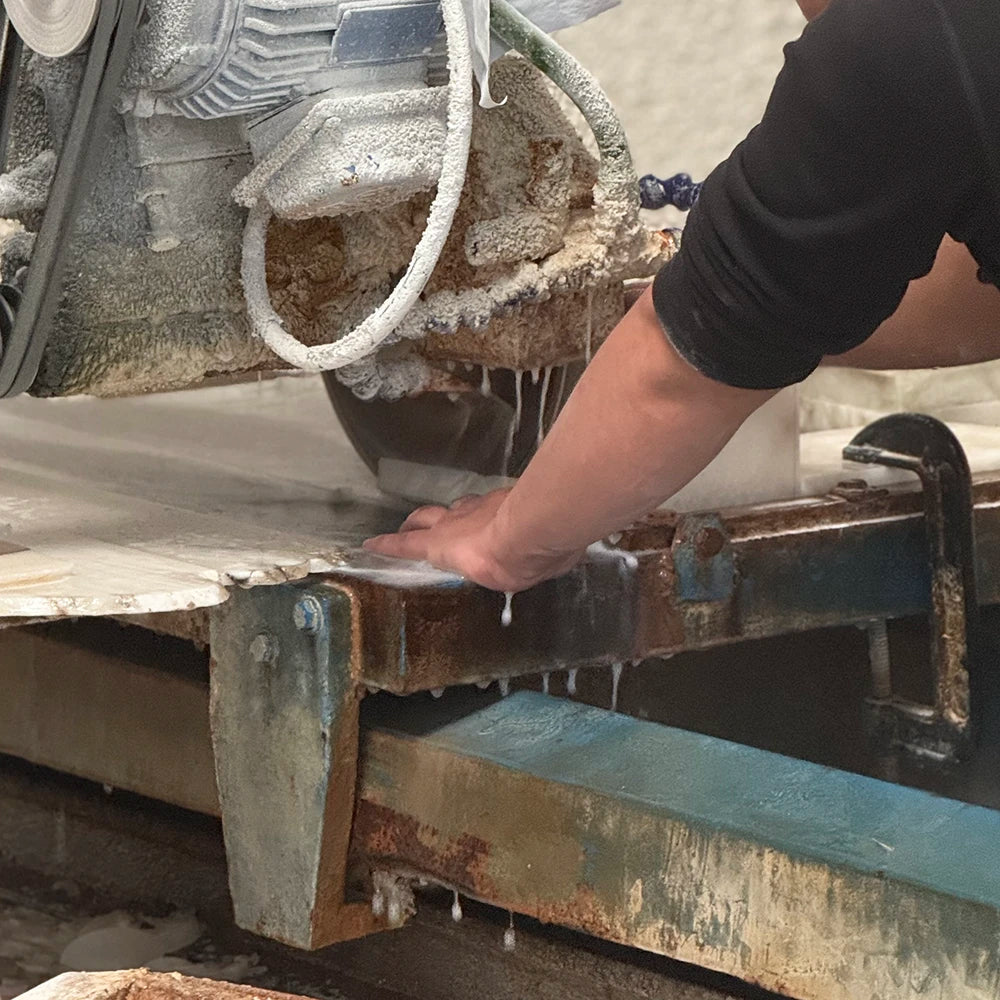
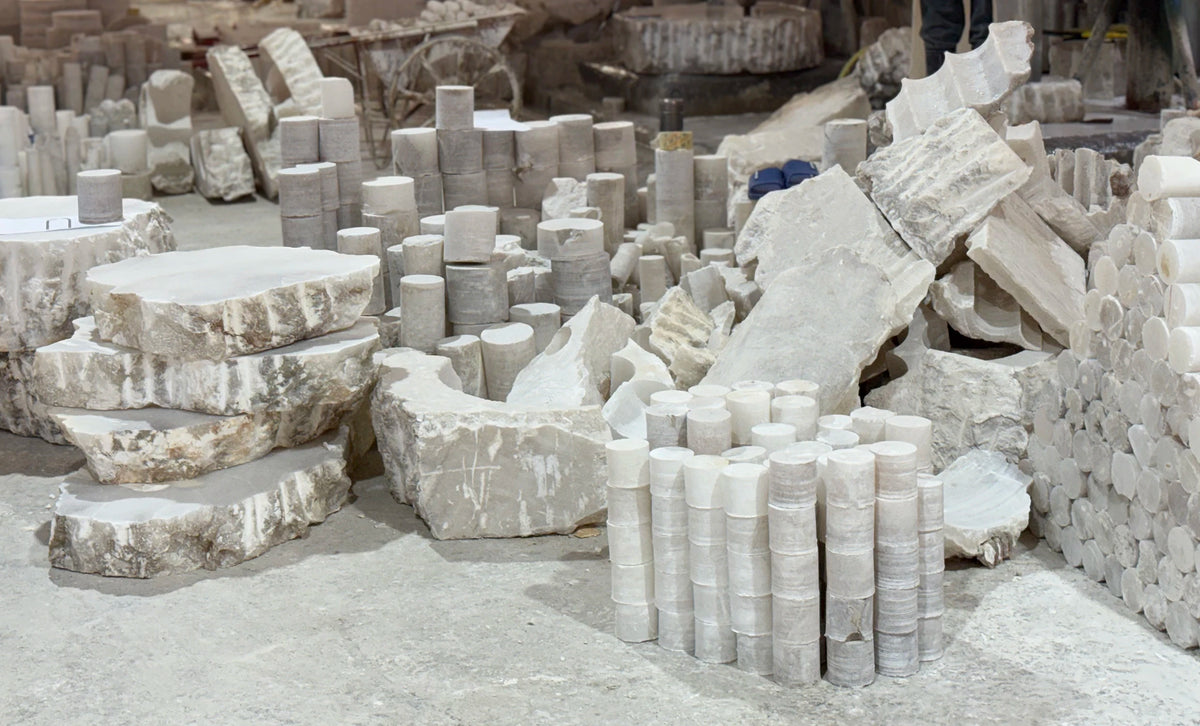
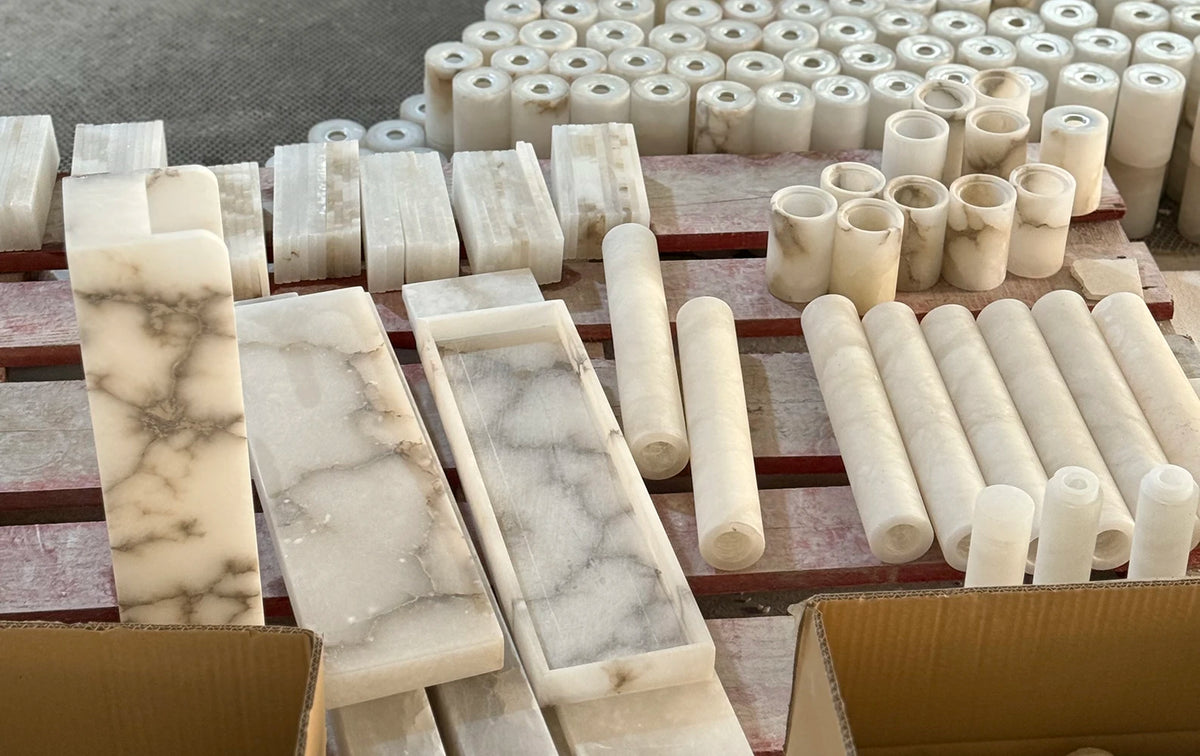
Crafted from select natural alabaster, preserving its unique veining.
Meticulously cut and shaped by artisans.
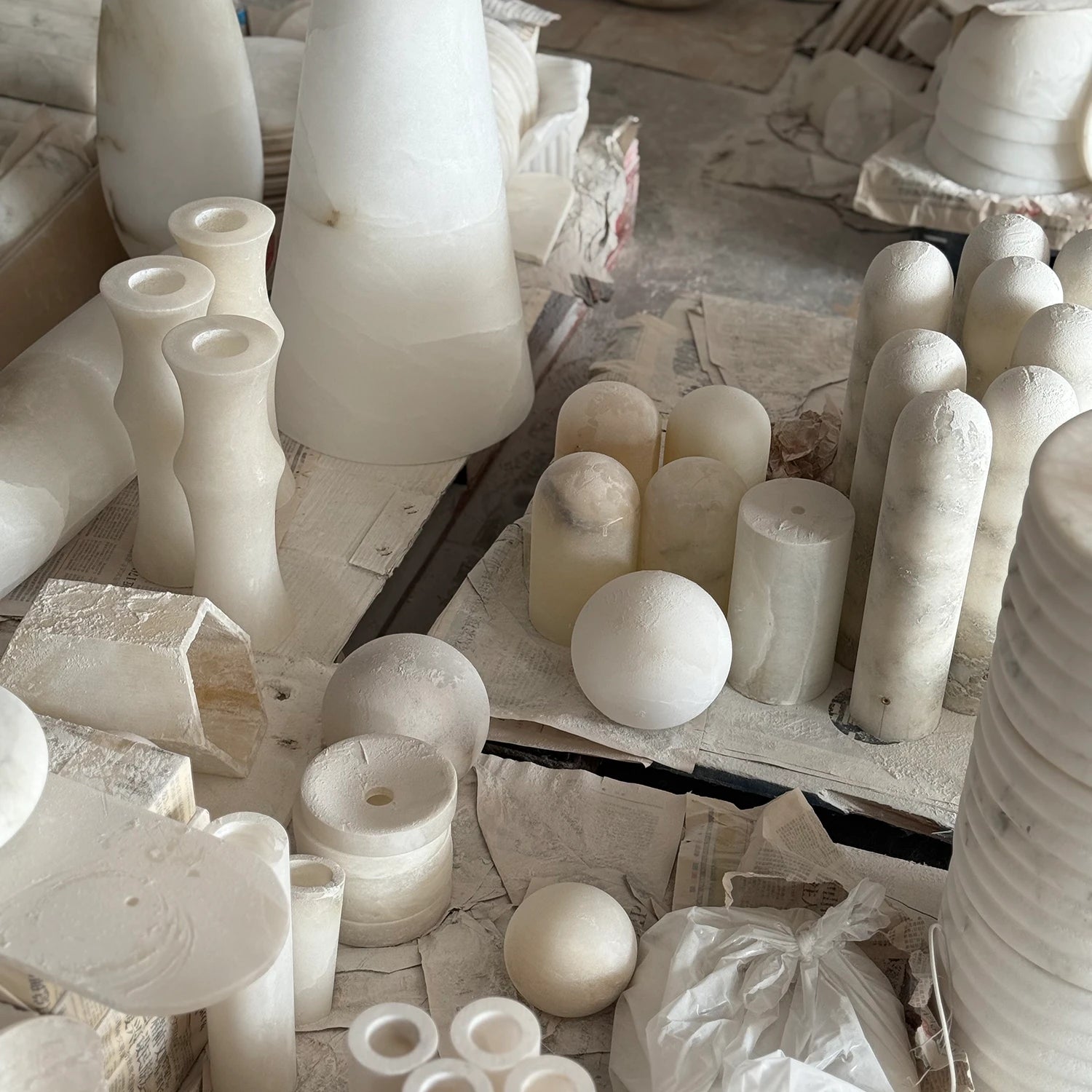
Repeatedly ground and polished for a smooth, refined texture.
Carefully assembled and quality-inspected.
Custom Stone Lighting
SHOP BY CATEGORY
Six major categories, one workshop — find the fixture that fits your room.