Alabaster is a natural mineral formed over thousands of years of geological sedimentation. The veining, hue, and translucency of every panel is unrepeatable. The flowing cloud patterns and delicate mineral fissures are nature's fingerprints—each lamp is not merely a lighting fixture, but an irreplicable work of natural art that belongs to no one else but you.
02
A Light That Breathes
Healing warmth, never harsh
What makes alabaster captivating is its exceptional ability to glow without revealing the source. It filters out the glare of raw light and transforms it into a warm, soft, and atmospheric ambiance. In an instant, the cold edges of a room dissolve—replaced by a quiet, healing presence that turns any space into a sanctuary.
03
The Touch of Craftsmanship
Hand-polished, never machine-made
Each raw stone is studied repeatedly by skilled artisans. From coarse to fine grit, it passes through multiple stages of hand-polishing until the surface reveals a matte, silken sheen. Every imperfection is intentional. Every curve is the trace of a craftsman's hand—evidence that this lamp was made, not manufactured.
04
An Heirloom of Time
Built to age, not to fade
Natural alabaster possesses remarkable durability and physical stability. It will not yellow under light, nor emit chemical odors. Its life force endures the test of time—unfazed by years. As decades pass, a subtle patina forms on the surface, deepening its character and making the stone feel even more grounded and refined.
— Crafted from natural alabaster, illuminated by warm light —
Recommended Choice
Why Natural Alabaster, Not Resin
A side-by-side comparison of materials
Dimension
Natural Alabaster
Resin / Faux Stone Glass
Touch
Warm and smooth like jade, with the substantial weight of natural stone
Cold or plasticky, lightweight and hollow-feeling
Light Transmission
Semi-translucent crystalline interior—light reveals layered depth and dimension
Flat, uniform transparency—light passes through without character or life
Durability
A natural mineral that never yellows or fades, even after decades
Ages quickly, may release odors when heated by the light source
Uniqueness
Each piece has its own veining—genuinely one of a kind
Mass-produced from molds—every unit looks identical
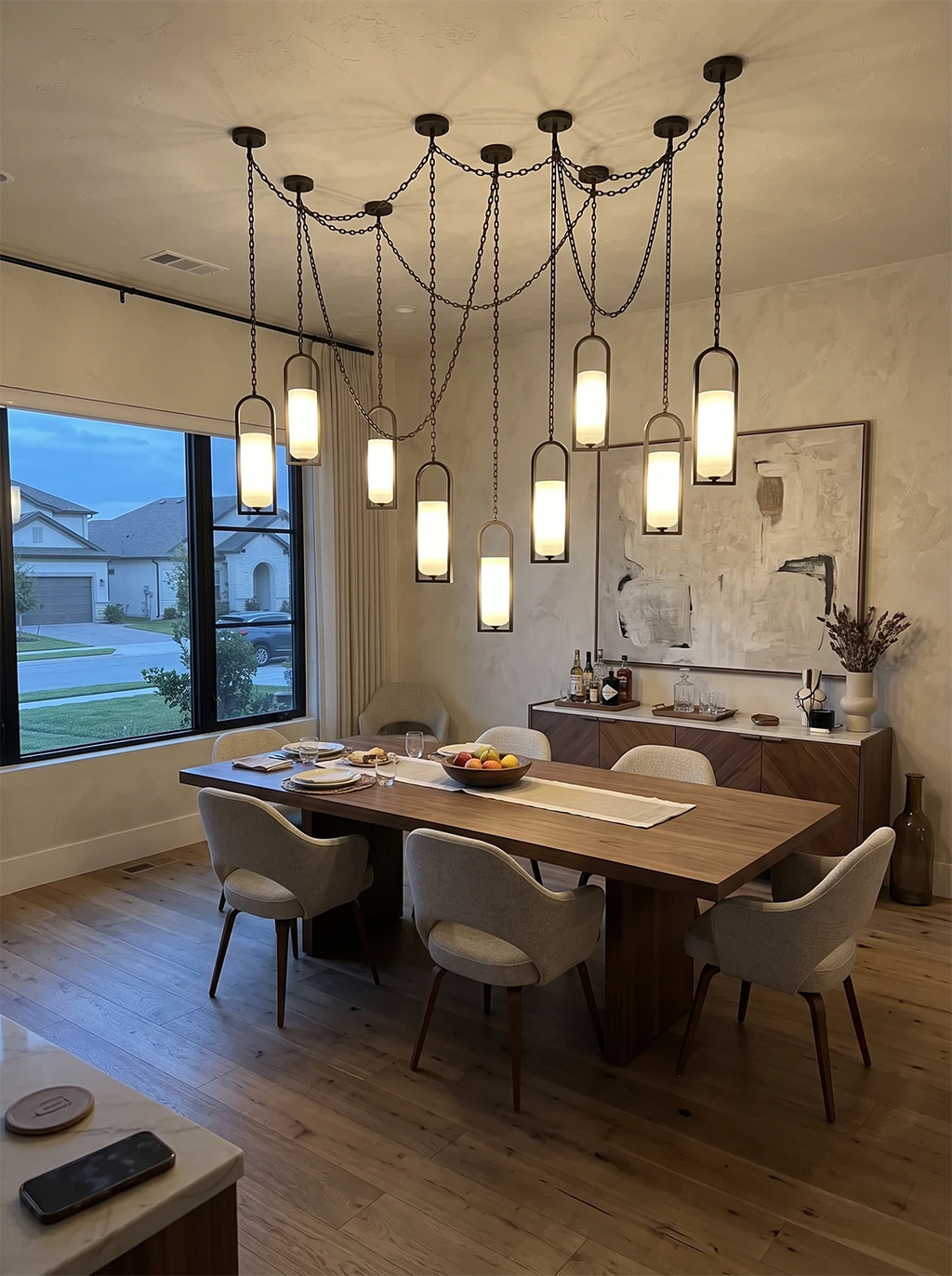
The Romilly Cascading Cone Chain Chandelier features a distinctive design: cone-shaped shades hang from chains that extend outward from a single ceiling canopy, allowing you to position each chain exactly where you choose. Unlike most chandeliers that come in a fixed shape, this fixture is composed of individual components, giving you the freedom to create your own custom arrangement.
Look at the chains themselves and you will notice nobody drew that curve. A chain suspended between two points falls into a catenary — the shape gravity gives it and the only one it will hold. Every swag here is that same curve at a different width, which is why the arrangement looks composed however you route it. The cones drop light downward rather than outward, pooling it on a table or a bedside rather than washing the ceiling.
Part of our chain-hung series, which keeps the same swag system and changes only the shade. The alabaster cylindrical chain chandelier swaps the cone for a straight cylinder — squarer, more architectural, better against a modern kitchen. The alabaster mélange small chain chandelier mixes shade forms within one run, for a corner that wants variation rather than repetition. Same chains, same canopy, same freedom to route them.
Natural Alabaster
Naturally Unique Veining
No two pieces of stone are ever the same
Alabaster is a natural stone, so every piece carries its own veining and subtle variation in color. The fixture you receive may therefore differ slightly from the images shown.
An inherent characteristic of real stone — not a quality defect.
Specifications
The Details
MaterialGenuine Natural Alabaster Shade · Metal Chain & Canopy Hand-cut and hand-polished stone.
Shade finishWhite Natural Alabaster Unique veining on every piece.
Body finishBlack · Gold
Light sourceLED or Edison bulb (E12 or E14)E12 or E14 base · warm white recommended.
VoltageAC 110–240V
ControlWorks with a common wall switch Switch not included — connects to an external wall switch for controlled power supply.
MountingCeiling — hardwired
Chain length100 cm / 39.4″ Adjustable hanging height — can be extended on request.
EnvironmentIndoor only · IP20 Damp-rated; not waterproof — for indoor use only.
Preparation time5–10 days Made and inspected at our own workshop before dispatch.
Good to Know
The chain is part of the design
Each pendant hangs on a 100 cm / 39.4″ chain that adjusts to your ceiling height. In a multi-light cluster the chains can be draped and hooked overhead, so you decide the shape. Need it longer for a stairwell or atrium? Contact us before ordering and we'll extend it.
Bulbs & installation
Takes a standard E12 or E14 bulb — LED or Edison. We recommend warm white for the softest glow through the alabaster. It hardwires to a common wall switch, which supplies and controls the power (switch not included). For dry indoor locations only.
Size Guide
How Many Pendants for Your Space
Eight configurations, from a single drop to a thirteen-pendant sweep. The shade comes in two sizes and the ceiling plate is 5.9″ on every version — what changes is how many pendants you hang and how far you spread them.
Two shade sizes — available on every configuration below
∅ 4.7″ × H 9.7″12 × 24.7 cmThe smaller cone. Better in multiples, over a bedside, or where several pendants need to read as a group rather than as individual lights.
∅ 6.3″ × H 15″16 × 38 cmThe larger cone. More presence per pendant and a wider pool of light — better in low counts, over a table, or where each drop should hold its own.
Ceiling plate 5.9″15 cm · every configurationThe same compact canopy whether you hang one pendant or thirteen. It covers a standard junction box; everything else spreads out from there.
1 Pendant
1 dropOne hook, or none if hung straight down
Best forBedside · reading corner · above a nightstand · or two or three of them in a row over an island
NoteOffered as Model A or Model B — see the variant options
Swag it sideways to reach a bedside the junction box doesn't.
2 Pendants
2 dropsPlan for up to 2 ceiling hooks
Best forEither side of a bed · flanking a mirror · a narrow console or hallway
SpanSet the hooks to match your nightstands — the chains do the rest
The most common bedroom configuration, and it needs no second junction box.
3 Pendants
3 dropsPlan for up to 3 ceiling hooks
Best forRound dining table · breakfast nook · entry hall · small landing
SpanTight cluster, or a short line across a table up to about 4 ft
Hang them level over a table; stagger the heights in a corner.
5 PendantsPopular
5 dropsPlan for up to 5 ceiling hooks
Best forDining table · living room · main bedroom · open-plan seating
SpanComfortable across a table up to about 6 ft, or clustered in a corner
The most forgiving count — enough presence for a table without crowding a normal room.
7 Pendants
7 dropsPlan for up to 7 ceiling hooks
Best forLonger dining table · open-plan seating area · stairwell · double-height corner
SpanAcross a table up to about 8 ft, or falling through a stairwell void
At this count, spread them along an axis rather than around a circle.
9 Pendants
9 dropsPlan for up to 9 ceiling hooks
Best forLong dining table · double-height entry · stairwell void · large open-plan room
SpanAcross a table up to about 10 ft, or a full stairwell drop
Vary the drop lengths so it reads as a cascade rather than a row of identical lamps.
11 Pendants
11 dropsPlan for up to 11 ceiling hooks
Best forStatement over a long table · tall stairwell · gallery wall · hotel or restaurant
SpanWide enough to cross a room rather than sit over one piece of furniture
Mark every hook position on the ceiling before you drill the first hole.
13 Pendants
13 dropsPlan for up to 13 ceiling hooks
Best forGrand entry · full-height stairwell · double-height living room · hospitality
SpanAn installation rather than a fixture — plan the routing on paper first
Two people, and a marked-out plan. Still only one 5.9″ junction box.
Sizing Tip
There is no single diameter to quote here, and that is the point. The shade size is fixed; the size of the fixture is not. You set the footprint by choosing where the ceiling hooks go — the same nine-pendant configuration can be a tight cluster in a corner or a ten-foot sweep down a dining table. So choose by pendant count and span, not by a diameter figure.
Two things do stay constant. The ceiling plate is 5.9″ on every version, even the thirteen-pendant one, so all of them cover a standard junction box and nothing more. And the shade comes in the same two sizes throughout: take the smaller cone in high counts, where the pendants should read as one group, and the larger cone in low counts, where each drop has to hold its own.
Before you order, do one thing: mark the hook positions on the ceiling with tape and live with them for a day. It costs nothing, and it is the only way to know whether five pendants or nine is right for the shape of your room.
The design
A Shape Nobody Drew
Gravity makes the curve. You decide where it falls.
Almost every chandelier arrives with its geometry already settled. The arms are where the arms are, the drop is the drop, and your only real choice is whether it fits. This one arrives as chains, shades and a decision. Hook them close together and it is a tight cluster in a corner; spread them wide and the same fixture becomes a long arc down a dining table. Where you put the hooks is the design.
The curve between them was not styled either. A chain suspended between two points falls into a catenary — the single shape it will hold under its own weight, and the same one architects have used hanging chains to find for centuries. It cannot be drawn wrong because it cannot be drawn at all. Every swag on this fixture is that curve at a different width, which is why an arrangement looks composed however you route it — you are not being asked to have good taste, only to choose a distance.
— Gravity draws it. You place it. —
Why this chandelier
The Shape Is Yours to Set
Chains that hook wherever you place them, a canopy no bigger than a junction box, and a fixture that fits the ceiling you already have.
01
You Route the Chains Yourself
Almost every chandelier arrives with its geometry already decided. This one arrives as chains, shades and a decision. Hook them close together and it is a tight cluster in a corner; spread them wide and the same fixture becomes a long arc down a dining table. The curve between hooks was never styled either — a chain hung between two points falls into the one shape it can hold under its own weight, which is why any routing reads as composed.
02
Eight Counts, Two Cone Sizes
From a single drop to thirteen pendants, with both cone sizes available on every configuration. Take the smaller cone in high counts, where the pendants should read as one group, and the larger cone in low counts, where each drop has to hold its own. A bedside pair and a full stairwell installation end up speaking the same language.
03
Every Cone on Its Own Chain
Each shade hangs independently, so you set the heights one at a time — level over a table, staggered down a stairwell. The tapered form sends light downward rather than outward, so it pools on the table or the bedside instead of washing across the ceiling, and no bulb is in view from a seated height. Nothing is fixed into a housing, so a single damaged shade is replaced on its own.
— Hung on chain, routed by you —
The Format
Why Swag Mounting
A swag fixture hangs from hooks you place, not from the box the electrician left. Here is what that changes — including the one thing it makes harder.
Swag MountingFixed-Canopy Chandelier
Where it hangsWherever you set the hooks — over the table, beside the bed, into a cornerDirectly beneath the junction box, wherever that happens to be
Off-centre boxSolved without touching the ceiling — the chain carries the drop across to where you want itMove the box and patch the ceiling, or live with a light that is not centred on anything
The shapeSet on site by where the hooks go — a tight cluster or a ten-foot sweep from the same boxDecided at the factory; the arms are where the arms are
Over a long tableSpread the drops along the length from one wiring pointOne fixture centred, or a second and third junction box installed
Individual heightsEach pendant set separately — level over a table, staggered down a stairwellHeights fixed by the frame; what you buy is what you hang
Installa tionOne junction box, plus ceiling hooks that each need a joist or a rated anchor. More planning, more holes — this is genuinely the harder installOne box, one bracket, finished. Simpler, and worth saying so
Changing your mindMove a hook and it is a different fixture — one small hole to fillRelocating means new wiring and a repaired ceiling
Rooms it rescuesRenovations where the furniture moved and the wiring did notRooms already built around the light position
Questions, Answered
Common Questions
What is a swag chandelier, and how does it hang?
It wires into one junction box in the usual way, and then the chains run out from that canopy to hooks you fix in the ceiling, each pendant dropping from its own hook. The canopy stays at the box; the lights hang where you decided.
That is the whole idea: the electrical connection and the position of the light are separated. A conventional chandelier ties the two together, which is why it can only hang in one place.
How many ceiling hooks do I need, and where do they go?
Plan for up to one hook per pendant — a five-pendant version needs up to five, a thirteen-pendant version up to thirteen. Chains can share a hook where two drops sit close together, so the real number is often lower.
Position is entirely yours, but do this first: mark the positions on the ceiling with tape and live with them for a day. It costs nothing, it is far easier than moving a hook afterwards, and it is the only reliable way to judge spacing in your own room rather than in a photograph.
How do I fix the hooks safely?
This matters more than anything else on this page. Each hook carries the weight of its pendant plus the sideways pull of the chain, which is a different load from a picture hook.
Fix into a ceiling joist wherever possible. Where a hook has to land between joists, use a properly rated toggle or cavity anchor sized for the load. Never use a plain plastic plug in plasterboard — it will hold for a while and then it will not. If you are unsure what is above your ceiling, have an electrician or a handyman place the hooks.
Can I install it myself?
The wiring should be done by a licensed electrician — it is a hardwired fixture and the power must be off at the breaker. The hook placement and chain routing is the part you can genuinely take on yourself, and arguably should, since you are the one who knows where the light needs to fall. Two people make it much easier: one holding the drop, one marking and fixing.
Can I change the arrangement later?
Yes, and cheaply. Unhook a chain, move it, and fill one small hole — no electrician, no wiring, no ceiling repair. It is worth knowing before you buy: if you rearrange the room in two years, the light rearranges with it. Almost nothing else on a ceiling can say that.
How many pendants should I choose?
Choose by span rather than by room area, because you control the spread. Three suits a round table or a tight cluster; five is the most forgiving over a standard dining table; seven to nine spread along a long table or fall through a stairwell; eleven and thirteen become an installation across a room rather than a fixture over a piece of furniture. Two is the classic bedside pair. And take the smaller cone in high counts, the larger cone in low counts.
What are the shades made of?
The cones are [__], with metal hardware in black or gold tone. [__ — add the two or three sentences that describe how this material behaves with light, and any natural variation the customer should expect. Do not publish this answer until the material is confirmed.]
What bulbs does it take, and can it be dimmed?
Each pendant takes a standard E26 / E27 bulb, LED or Edison style, not included. Dimming depends on the bulb rather than the fixture: fit dimmable bulbs on a compatible dimmer circuit and the whole run dims together. A warm white around 2700K suits the pale cones best. Bear in mind that a high pendant count means a high bulb count — check the total wattage against your dimmer's rating.
How high should each pendant hang?
Over a dining table, hang the bottom of the shade 30–36″ (75–90 cm) above the tabletop and keep the drops level with one another. In any walkway keep 7 ft (2.1 m) of floor clearance. Down a stairwell or in a corner, stagger the heights deliberately — a swag fixture with every pendant at the same height in an open space tends to read as a row of lamps rather than as one piece.
What if something arrives damaged?
Each shade is wrapped individually and the chains, canopy and hardware are packed separately. If something arrives damaged, send photographs within 24 hours of delivery and we will replace the affected part. Because every shade hangs on its own chain, a single damaged cone never means returning the whole fixture.
Romilly Cascading Cone Chain Chandelier
SKU: V-ALCH2607292-1
Regular price
$540.00
Unit price
/per
No reviews
The price includes tax, and free standard shipping within the U.S. is provided.
✦
With a brand-new lighting ambiance, let's usher in a hopeful 202610% Off All Lighting✦
Free Shipping on all orders
Hassle-free return within 30 days
Payment Security
1. How long does shipping take?
Standard delivery orders typically arrive within 25–35 business days.
2. Can I get expedited shipping?
Yes. You can contact our customer service team during checkout to arrange for expedited shipping for an additional fee. This service is not available for oversized items.
3. Can the wire/rod be lengthened or customized?
Yes, we offer custom wire and rod lengths for many of our light fixtures. If you have other specific needs, please contact our customer service team before placing your order and we will assist you with the customization.
4. What materials and light bases are the fixtures made of?
The materials for each light fixture can be found in the product description or specification sheet.
5. What if my item is damaged during shipping?
We take great care with our packaging. In the unlikely event that you receive a damaged product, please contact our customer service team within 24 hours of delivery. Provide photos of the damaged item and its packaging, and we will assist you as soon as possible.
6. Do you ship to countries other than the United States?
Yes, we offer international shipping to select countries.
Alabaster is a natural mineral formed over thousands of years of geological sedimentation. The veining, hue, and translucency of every panel is unrepeatable. The flowing cloud patterns and delicate mineral fissures are nature's fingerprints—each lamp is not merely a lighting fixture, but an irreplicable work of natural art that belongs to no one else but you.
02
A Light That Breathes
Healing warmth, never harsh
What makes alabaster captivating is its exceptional ability to glow without revealing the source. It filters out the glare of raw light and transforms it into a warm, soft, and atmospheric ambiance. In an instant, the cold edges of a room dissolve—replaced by a quiet, healing presence that turns any space into a sanctuary.
03
The Touch of Craftsmanship
Hand-polished, never machine-made
Each raw stone is studied repeatedly by skilled artisans. From coarse to fine grit, it passes through multiple stages of hand-polishing until the surface reveals a matte, silken sheen. Every imperfection is intentional. Every curve is the trace of a craftsman's hand—evidence that this lamp was made, not manufactured.
04
An Heirloom of Time
Built to age, not to fade
Natural alabaster possesses remarkable durability and physical stability. It will not yellow under light, nor emit chemical odors. Its life force endures the test of time—unfazed by years. As decades pass, a subtle patina forms on the surface, deepening its character and making the stone feel even more grounded and refined.
— Crafted from natural alabaster, illuminated by warm light —
Recommended Choice
Why Natural Alabaster, Not Resin
A side-by-side comparison of materials
Dimension
Natural Alabaster
Resin / Faux Stone Glass
Touch
Warm and smooth like jade, with the substantial weight of natural stone
Cold or plasticky, lightweight and hollow-feeling
Light Transmission
Semi-translucent crystalline interior—light reveals layered depth and dimension
Flat, uniform transparency—light passes through without character or life
Durability
A natural mineral that never yellows or fades, even after decades
Ages quickly, may release odors when heated by the light source
Uniqueness
Each piece has its own veining—genuinely one of a kind
Mass-produced from molds—every unit looks identical
The Romilly Cascading Cone Chain Chandelier features a distinctive design: cone-shaped shades hang from chains that extend outward from a single ceiling canopy, allowing you to position each chain exactly where you choose. Unlike most chandeliers that come in a fixed shape, this fixture is composed of individual components, giving you the freedom to create your own custom arrangement.
Look at the chains themselves and you will notice nobody drew that curve. A chain suspended between two points falls into a catenary — the shape gravity gives it and the only one it will hold. Every swag here is that same curve at a different width, which is why the arrangement looks composed however you route it. The cones drop light downward rather than outward, pooling it on a table or a bedside rather than washing the ceiling.
Part of our chain-hung series, which keeps the same swag system and changes only the shade. The alabaster cylindrical chain chandelier swaps the cone for a straight cylinder — squarer, more architectural, better against a modern kitchen. The alabaster mélange small chain chandelier mixes shade forms within one run, for a corner that wants variation rather than repetition. Same chains, same canopy, same freedom to route them.
Natural Alabaster
Naturally Unique Veining
No two pieces of stone are ever the same
Alabaster is a natural stone, so every piece carries its own veining and subtle variation in color. The fixture you receive may therefore differ slightly from the images shown.
An inherent characteristic of real stone — not a quality defect.
Specifications
The Details
MaterialGenuine Natural Alabaster Shade · Metal Chain & Canopy Hand-cut and hand-polished stone.
Shade finishWhite Natural Alabaster Unique veining on every piece.
Body finishBlack · Gold
Light sourceLED or Edison bulb (E12 or E14)E12 or E14 base · warm white recommended.
VoltageAC 110–240V
ControlWorks with a common wall switch Switch not included — connects to an external wall switch for controlled power supply.
MountingCeiling — hardwired
Chain length100 cm / 39.4″ Adjustable hanging height — can be extended on request.
EnvironmentIndoor only · IP20 Damp-rated; not waterproof — for indoor use only.
Preparation time5–10 days Made and inspected at our own workshop before dispatch.
Good to Know
The chain is part of the design
Each pendant hangs on a 100 cm / 39.4″ chain that adjusts to your ceiling height. In a multi-light cluster the chains can be draped and hooked overhead, so you decide the shape. Need it longer for a stairwell or atrium? Contact us before ordering and we'll extend it.
Bulbs & installation
Takes a standard E12 or E14 bulb — LED or Edison. We recommend warm white for the softest glow through the alabaster. It hardwires to a common wall switch, which supplies and controls the power (switch not included). For dry indoor locations only.
Size Guide
How Many Pendants for Your Space
Eight configurations, from a single drop to a thirteen-pendant sweep. The shade comes in two sizes and the ceiling plate is 5.9″ on every version — what changes is how many pendants you hang and how far you spread them.
Two shade sizes — available on every configuration below
∅ 4.7″ × H 9.7″12 × 24.7 cmThe smaller cone. Better in multiples, over a bedside, or where several pendants need to read as a group rather than as individual lights.
∅ 6.3″ × H 15″16 × 38 cmThe larger cone. More presence per pendant and a wider pool of light — better in low counts, over a table, or where each drop should hold its own.
Ceiling plate 5.9″15 cm · every configurationThe same compact canopy whether you hang one pendant or thirteen. It covers a standard junction box; everything else spreads out from there.
1 Pendant
1 dropOne hook, or none if hung straight down
Best forBedside · reading corner · above a nightstand · or two or three of them in a row over an island
NoteOffered as Model A or Model B — see the variant options
Swag it sideways to reach a bedside the junction box doesn't.
2 Pendants
2 dropsPlan for up to 2 ceiling hooks
Best forEither side of a bed · flanking a mirror · a narrow console or hallway
SpanSet the hooks to match your nightstands — the chains do the rest
The most common bedroom configuration, and it needs no second junction box.
3 Pendants
3 dropsPlan for up to 3 ceiling hooks
Best forRound dining table · breakfast nook · entry hall · small landing
SpanTight cluster, or a short line across a table up to about 4 ft
Hang them level over a table; stagger the heights in a corner.
5 PendantsPopular
5 dropsPlan for up to 5 ceiling hooks
Best forDining table · living room · main bedroom · open-plan seating
SpanComfortable across a table up to about 6 ft, or clustered in a corner
The most forgiving count — enough presence for a table without crowding a normal room.
7 Pendants
7 dropsPlan for up to 7 ceiling hooks
Best forLonger dining table · open-plan seating area · stairwell · double-height corner
SpanAcross a table up to about 8 ft, or falling through a stairwell void
At this count, spread them along an axis rather than around a circle.
9 Pendants
9 dropsPlan for up to 9 ceiling hooks
Best forLong dining table · double-height entry · stairwell void · large open-plan room
SpanAcross a table up to about 10 ft, or a full stairwell drop
Vary the drop lengths so it reads as a cascade rather than a row of identical lamps.
11 Pendants
11 dropsPlan for up to 11 ceiling hooks
Best forStatement over a long table · tall stairwell · gallery wall · hotel or restaurant
SpanWide enough to cross a room rather than sit over one piece of furniture
Mark every hook position on the ceiling before you drill the first hole.
13 Pendants
13 dropsPlan for up to 13 ceiling hooks
Best forGrand entry · full-height stairwell · double-height living room · hospitality
SpanAn installation rather than a fixture — plan the routing on paper first
Two people, and a marked-out plan. Still only one 5.9″ junction box.
Sizing Tip
There is no single diameter to quote here, and that is the point. The shade size is fixed; the size of the fixture is not. You set the footprint by choosing where the ceiling hooks go — the same nine-pendant configuration can be a tight cluster in a corner or a ten-foot sweep down a dining table. So choose by pendant count and span, not by a diameter figure.
Two things do stay constant. The ceiling plate is 5.9″ on every version, even the thirteen-pendant one, so all of them cover a standard junction box and nothing more. And the shade comes in the same two sizes throughout: take the smaller cone in high counts, where the pendants should read as one group, and the larger cone in low counts, where each drop has to hold its own.
Before you order, do one thing: mark the hook positions on the ceiling with tape and live with them for a day. It costs nothing, and it is the only way to know whether five pendants or nine is right for the shape of your room.
The design
A Shape Nobody Drew
Gravity makes the curve. You decide where it falls.
Almost every chandelier arrives with its geometry already settled. The arms are where the arms are, the drop is the drop, and your only real choice is whether it fits. This one arrives as chains, shades and a decision. Hook them close together and it is a tight cluster in a corner; spread them wide and the same fixture becomes a long arc down a dining table. Where you put the hooks is the design.
The curve between them was not styled either. A chain suspended between two points falls into a catenary — the single shape it will hold under its own weight, and the same one architects have used hanging chains to find for centuries. It cannot be drawn wrong because it cannot be drawn at all. Every swag on this fixture is that curve at a different width, which is why an arrangement looks composed however you route it — you are not being asked to have good taste, only to choose a distance.
— Gravity draws it. You place it. —
Why this chandelier
The Shape Is Yours to Set
Chains that hook wherever you place them, a canopy no bigger than a junction box, and a fixture that fits the ceiling you already have.
01
You Route the Chains Yourself
Almost every chandelier arrives with its geometry already decided. This one arrives as chains, shades and a decision. Hook them close together and it is a tight cluster in a corner; spread them wide and the same fixture becomes a long arc down a dining table. The curve between hooks was never styled either — a chain hung between two points falls into the one shape it can hold under its own weight, which is why any routing reads as composed.
02
Eight Counts, Two Cone Sizes
From a single drop to thirteen pendants, with both cone sizes available on every configuration. Take the smaller cone in high counts, where the pendants should read as one group, and the larger cone in low counts, where each drop has to hold its own. A bedside pair and a full stairwell installation end up speaking the same language.
03
Every Cone on Its Own Chain
Each shade hangs independently, so you set the heights one at a time — level over a table, staggered down a stairwell. The tapered form sends light downward rather than outward, so it pools on the table or the bedside instead of washing across the ceiling, and no bulb is in view from a seated height. Nothing is fixed into a housing, so a single damaged shade is replaced on its own.
— Hung on chain, routed by you —
The Format
Why Swag Mounting
A swag fixture hangs from hooks you place, not from the box the electrician left. Here is what that changes — including the one thing it makes harder.
Swag MountingFixed-Canopy Chandelier
Where it hangsWherever you set the hooks — over the table, beside the bed, into a cornerDirectly beneath the junction box, wherever that happens to be
Off-centre boxSolved without touching the ceiling — the chain carries the drop across to where you want itMove the box and patch the ceiling, or live with a light that is not centred on anything
The shapeSet on site by where the hooks go — a tight cluster or a ten-foot sweep from the same boxDecided at the factory; the arms are where the arms are
Over a long tableSpread the drops along the length from one wiring pointOne fixture centred, or a second and third junction box installed
Individual heightsEach pendant set separately — level over a table, staggered down a stairwellHeights fixed by the frame; what you buy is what you hang
Installa tionOne junction box, plus ceiling hooks that each need a joist or a rated anchor. More planning, more holes — this is genuinely the harder installOne box, one bracket, finished. Simpler, and worth saying so
Changing your mindMove a hook and it is a different fixture — one small hole to fillRelocating means new wiring and a repaired ceiling
Rooms it rescuesRenovations where the furniture moved and the wiring did notRooms already built around the light position
Questions, Answered
Common Questions
What is a swag chandelier, and how does it hang?
It wires into one junction box in the usual way, and then the chains run out from that canopy to hooks you fix in the ceiling, each pendant dropping from its own hook. The canopy stays at the box; the lights hang where you decided.
That is the whole idea: the electrical connection and the position of the light are separated. A conventional chandelier ties the two together, which is why it can only hang in one place.
How many ceiling hooks do I need, and where do they go?
Plan for up to one hook per pendant — a five-pendant version needs up to five, a thirteen-pendant version up to thirteen. Chains can share a hook where two drops sit close together, so the real number is often lower.
Position is entirely yours, but do this first: mark the positions on the ceiling with tape and live with them for a day. It costs nothing, it is far easier than moving a hook afterwards, and it is the only reliable way to judge spacing in your own room rather than in a photograph.
How do I fix the hooks safely?
This matters more than anything else on this page. Each hook carries the weight of its pendant plus the sideways pull of the chain, which is a different load from a picture hook.
Fix into a ceiling joist wherever possible. Where a hook has to land between joists, use a properly rated toggle or cavity anchor sized for the load. Never use a plain plastic plug in plasterboard — it will hold for a while and then it will not. If you are unsure what is above your ceiling, have an electrician or a handyman place the hooks.
Can I install it myself?
The wiring should be done by a licensed electrician — it is a hardwired fixture and the power must be off at the breaker. The hook placement and chain routing is the part you can genuinely take on yourself, and arguably should, since you are the one who knows where the light needs to fall. Two people make it much easier: one holding the drop, one marking and fixing.
Can I change the arrangement later?
Yes, and cheaply. Unhook a chain, move it, and fill one small hole — no electrician, no wiring, no ceiling repair. It is worth knowing before you buy: if you rearrange the room in two years, the light rearranges with it. Almost nothing else on a ceiling can say that.
How many pendants should I choose?
Choose by span rather than by room area, because you control the spread. Three suits a round table or a tight cluster; five is the most forgiving over a standard dining table; seven to nine spread along a long table or fall through a stairwell; eleven and thirteen become an installation across a room rather than a fixture over a piece of furniture. Two is the classic bedside pair. And take the smaller cone in high counts, the larger cone in low counts.
What are the shades made of?
The cones are [__], with metal hardware in black or gold tone. [__ — add the two or three sentences that describe how this material behaves with light, and any natural variation the customer should expect. Do not publish this answer until the material is confirmed.]
What bulbs does it take, and can it be dimmed?
Each pendant takes a standard E26 / E27 bulb, LED or Edison style, not included. Dimming depends on the bulb rather than the fixture: fit dimmable bulbs on a compatible dimmer circuit and the whole run dims together. A warm white around 2700K suits the pale cones best. Bear in mind that a high pendant count means a high bulb count — check the total wattage against your dimmer's rating.
How high should each pendant hang?
Over a dining table, hang the bottom of the shade 30–36″ (75–90 cm) above the tabletop and keep the drops level with one another. In any walkway keep 7 ft (2.1 m) of floor clearance. Down a stairwell or in a corner, stagger the heights deliberately — a swag fixture with every pendant at the same height in an open space tends to read as a row of lamps rather than as one piece.
What if something arrives damaged?
Each shade is wrapped individually and the chains, canopy and hardware are packed separately. If something arrives damaged, send photographs within 24 hours of delivery and we will replace the affected part. Because every shade hangs on its own chain, a single damaged cone never means returning the whole fixture.
Crafted from carefully selected natural alabaster, this piece preserves the stone’s most primal physical characteristics. As the stone is naturally formed, its internal mineral veining and depth of color vary from one piece to another. This unique “imperfection” is precisely what constitutes the most captivating charm of natural stone.
The Warmth of Artisanal Craftsmanship
Transforming a raw, rugged block into a refined work of art requires the artisan to engage in a slow, meticulous process spanning multiple stages. Following the stone's natural grain, they refine and polish it with painstaking precision.Preserving that texture closest to nature.
Why Choose Our Premium Materials?
Compared to ordinary materials, our products offer significant advantages in terms of quality, durability, and aesthetics.
Recommended Choice
Our Premium Materials
100% Natural Stone
Hand-polished, Smooth Surface
Soft light for comfortable lighting
Each Piece is Unique
💎 Enjoy a discount when you buy now!
ordinary materials
Mass-produced by machine; poor workmanship
Prone to breakage after six months
May contain harmful substances
The Language of Stone
Every texture tells a unique story.
01
Pure
A pure white texture reminiscent of fresh snow—warm, smooth, and refined.
02
Ink-Dyed
Deep, inky patterns flow across a white base.
03
Lightning Pattern
A dynamic pattern resembling a bolt of lightning streaking across the sky.
04
Ice-Crackle Pattern
Fine, intricate cracks evoking the aesthetic beauty of a sheet of ice at the moment it shatters.
05
Snowflake Pattern
A pattern as light and airy as falling snowflakes, with every single flake unique.
The variations in the veining of natural alabaster are what make it so prized; each lighting fixture bears unique natural markings—not flaws, but artistic value bestowed by nature.
Stone Carving — Transforming Stone into Beautiful Lighting Fixtures
Stone Extraction
Extract and select high-quality materials from natural quarries.
Cutting and Carving
Expert craftsmen shape each piece with meticulous attention to detail and design.
Grinding and Polishing
After multiple rounds of polishing, it gradually becomes extremely smooth, with a warm and jade-like feel.
Assembly and Inspection
Each model is meticulously curated, assembled, and tested.
EXPLORE OUR STORY
Discover our brand philosophy and product features through this video. We are dedicated to providing you with the highest quality products and service experience.
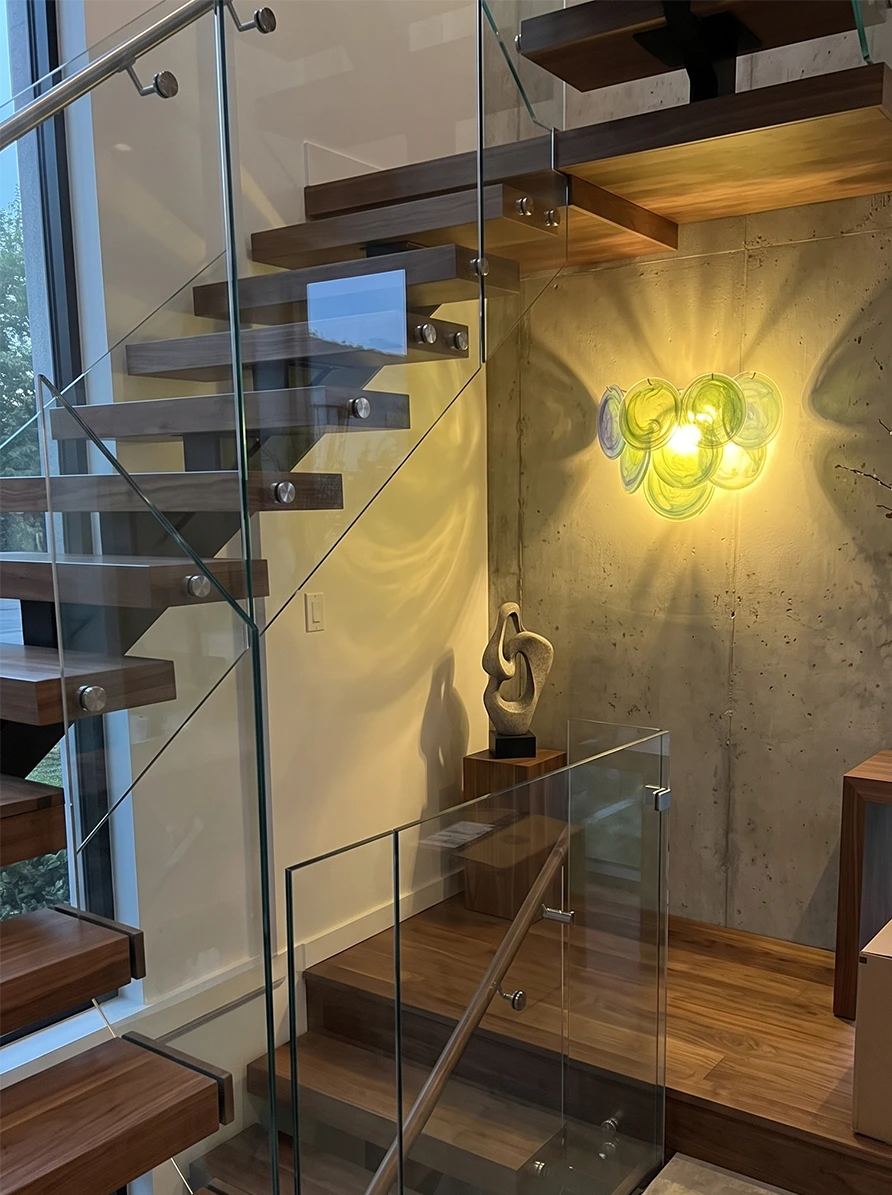
I installed it at the turn of the staircase—a spot that used to be dark and unremarkable. Now, it’s become the most eye-catching little corner of my home.
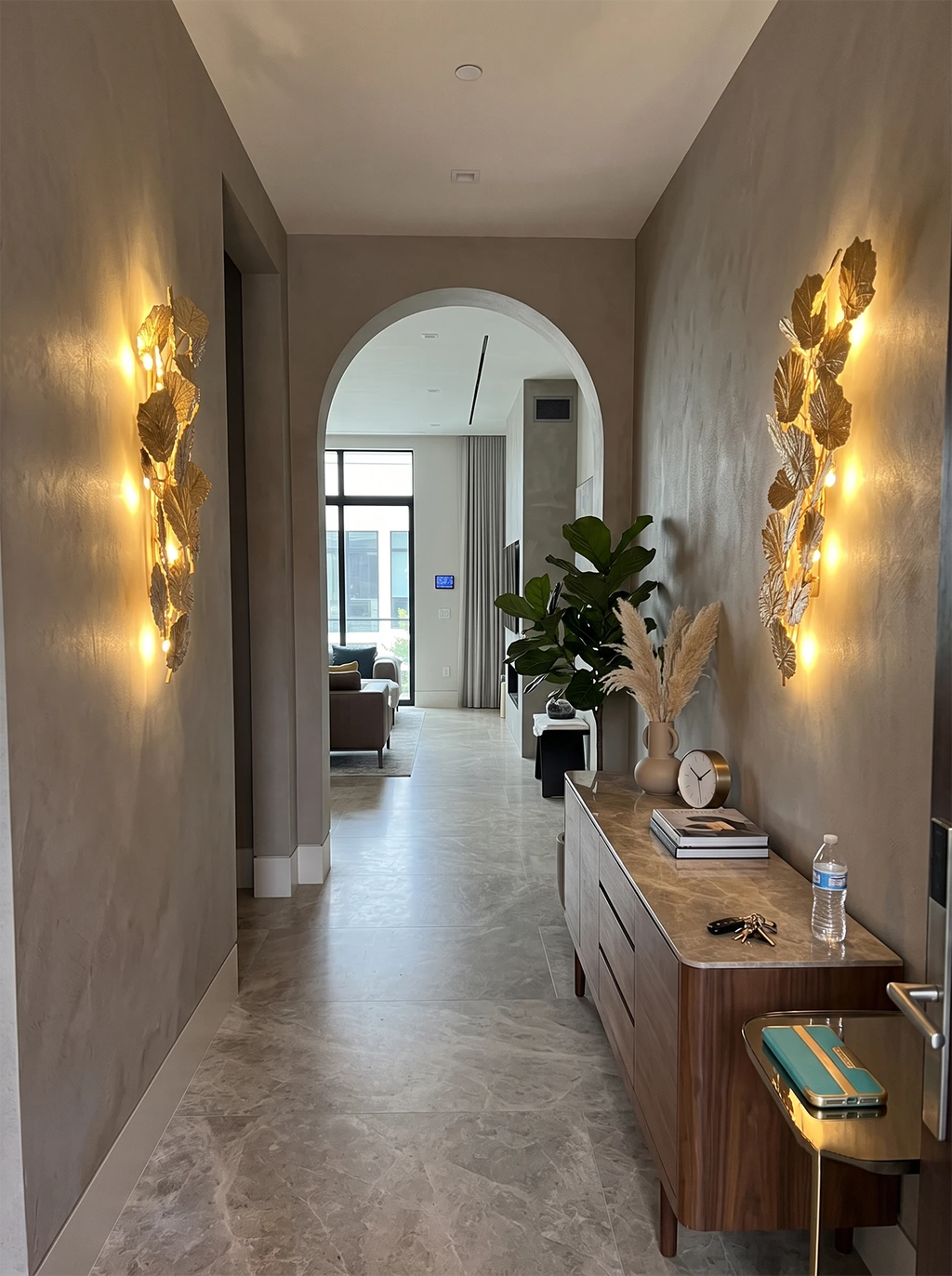
I was initially worried the botanical design might look too fussy, but that’s not the case at all! The brass material lends a modern touch, while the leaf contours soften the room's harder lines. The design strikes the perfect balance.
Extremely secure packaging; arrived in perfect condition.
My biggest worry when buying fragile stone lighting is shipping damage. However, the packaging was incredibly robust, and everything—from the stone components to the chains—arrived in perfect condition. Customer service was also very responsive.