See It In Motion
Watch the Light Come to Life
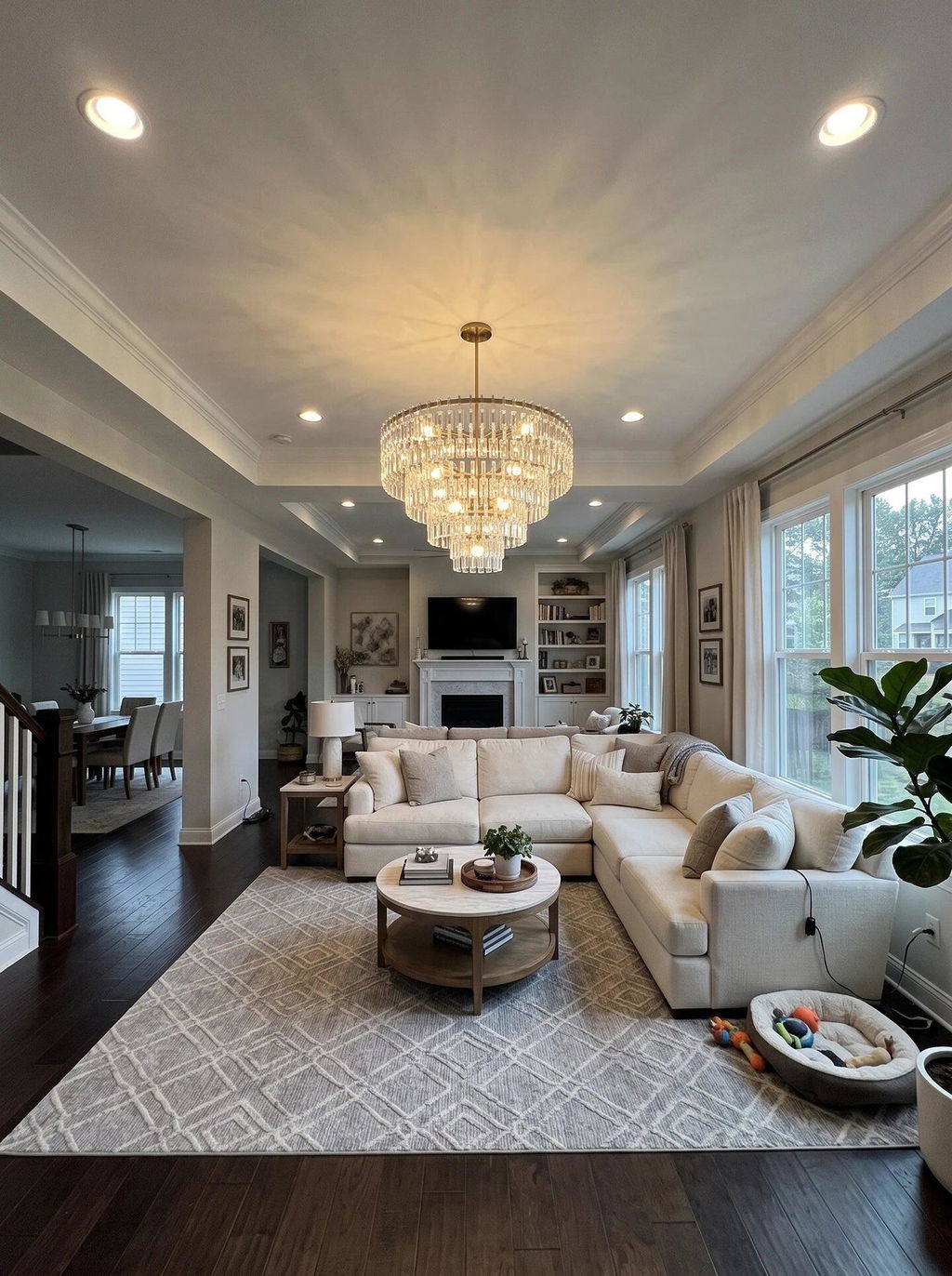
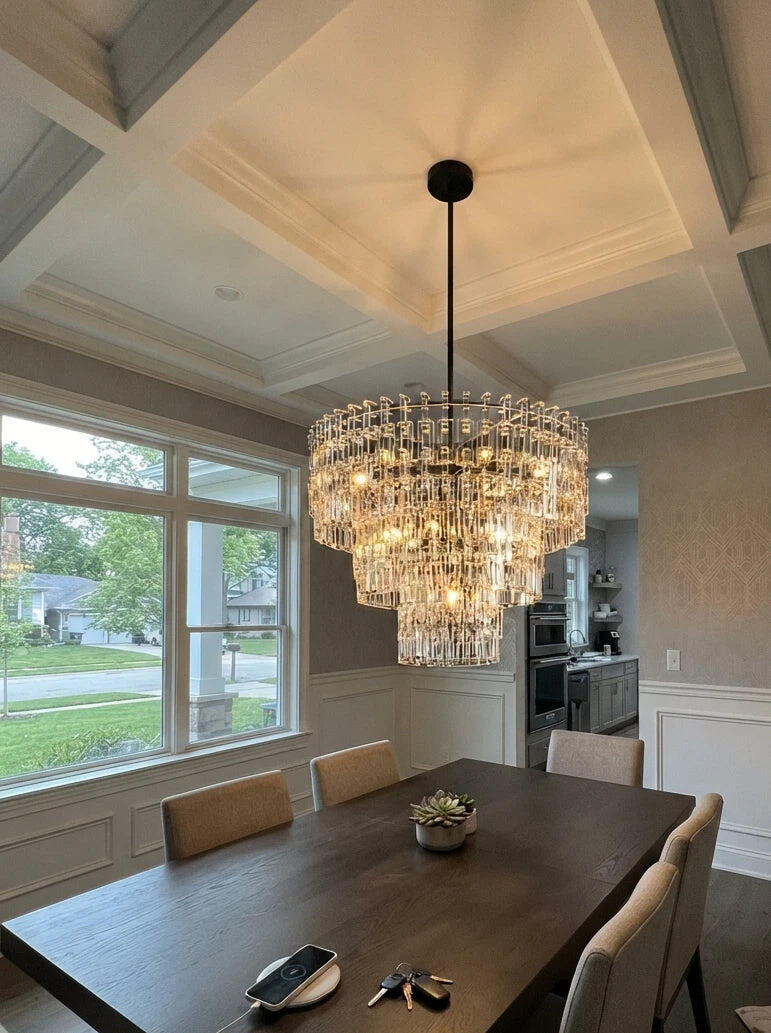
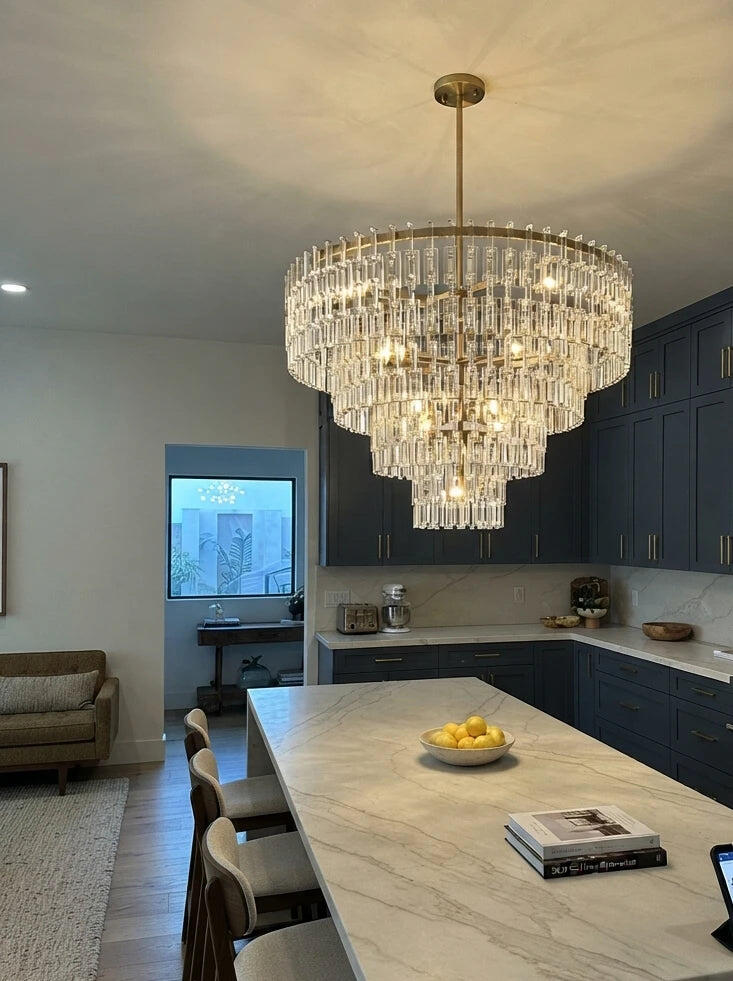
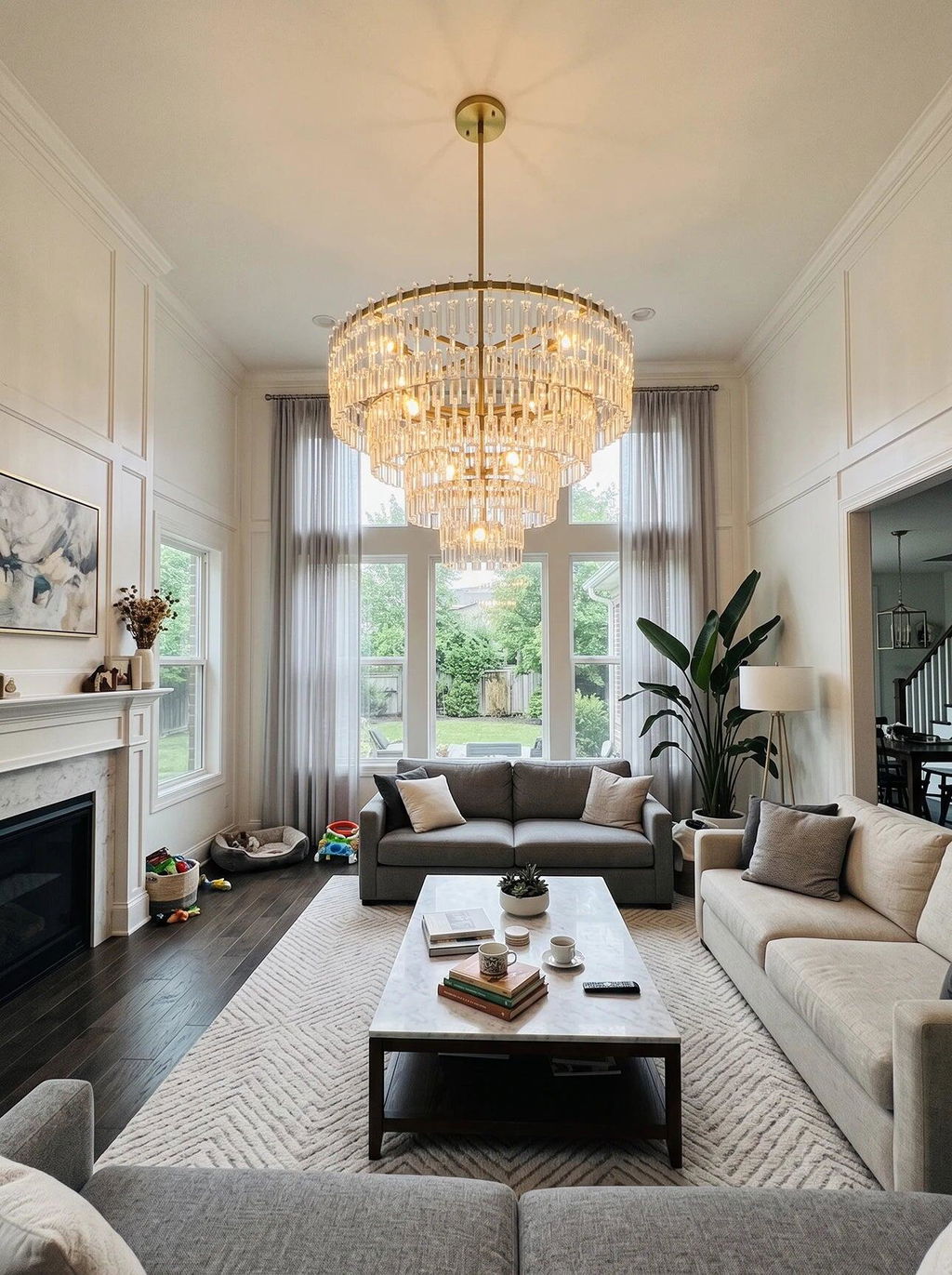
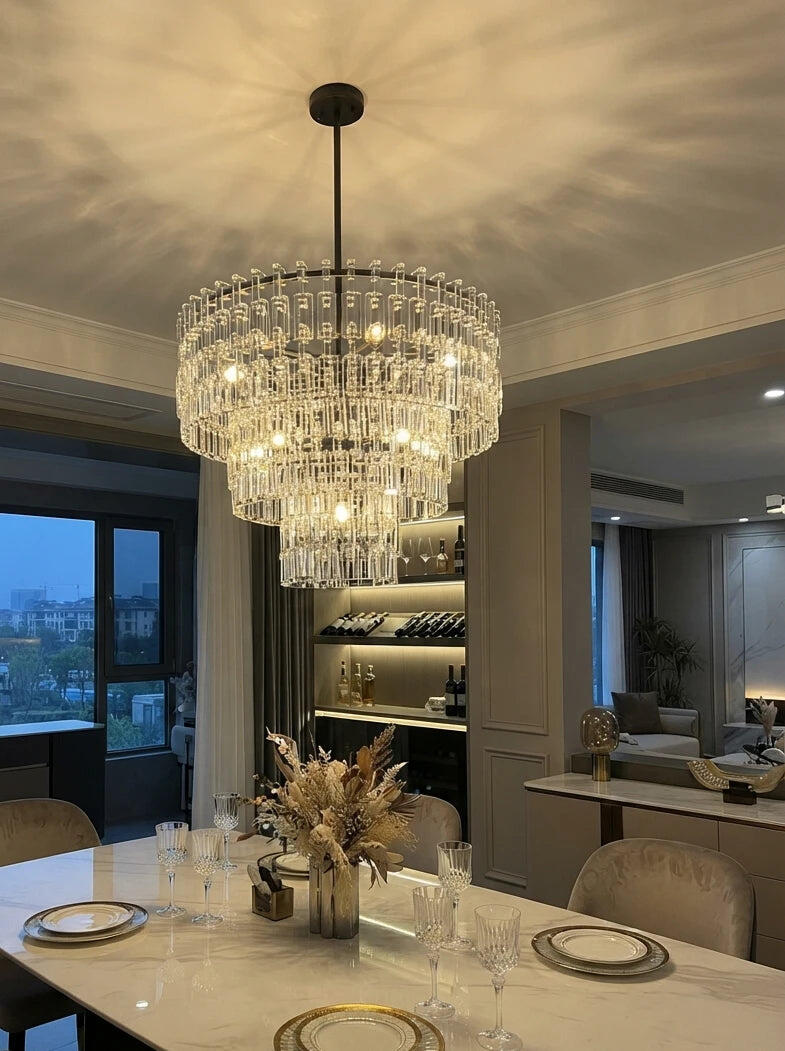
The Corwin Tiered Crystal Bar Chandelier sets upright crystal bars into four descending rings on a metal frame — each ring smaller than the one above it, stepping inward as it falls. The bars stand rather than hang, and that is the first thing that separates it from a conventional crystal chandelier. They are also cut to different lengths, so the top edge of each ring is deliberately uneven — a run of short bars, then a taller one, then two short again. It reads the way a city skyline reads: you register the rhythm before you count anything.
Each bar is a squared prism rather than a rounded drop, so light meets flat cut faces and comes back as defined points rather than a soft shimmer. Set them four rings deep and those points multiply through the layers — which is why the fixture looks dense from across a room and resolves into individual bars when you stand beneath it.
What You See Is What You Get
One bar in the hand, and the frame with nothing on it — the two halves of this fixture, photographed before they were put together.
 One bar, in the hand — squared, not rounded
 The frame with nothing on it — rings, before the crystal
Shown Undressed
Most fixtures are only ever photographed finished. The frame here is shown bare because it holds up to being looked at — four rings, welded and finished, with every bar seated into the metal rather than hung from it.
Squared, Not Rounded
Flat cut faces running the full length of a solid bar — never a moulded tube with a facet pattern pressed on. The faces are what return light as defined points instead of a soft shimmer, and you can feel every edge with a fingertip.
Handled With Gloves
Cut faces take a fingerprint the moment a bare hand touches them, so every bar is fitted wearing gloves — in our workshop and, we would suggest, in your house too when you clean it.
The Details
Good to Know
A rod, not a chain — check your ceiling first
This hangs on a 1 m (39.4″) rigid rod, which is why it sits dead level and never swings when a door opens. It is the right suspension for a fixture this architectural.
But it comes with a condition worth reading twice: a rod cannot be shortened on site the way chain links can. Add the rod to the height of the fixture itself and measure that against your ceiling before ordering. If 39.4″ of drop is too much for your room, tell us your ceiling height and we will supply a shorter rod before it ships — that is far easier than solving it afterwards.
Bulbs and Installation
Compatible with standard E12 or E14 bulbs (LED or Edison bulbs). Warm white bulbs are recommended. If dimming functionality is desired, please purchase dimmable bulbs. Suitable for indoor, dry environments only.
Start With the Drop, Not the Width
The rod is a fixed 1 m and cannot be shortened on site, so what decides whether a size fits is the total distance from ceiling to lowest crystal — not the diameter. Each card leads with that figure.
∅ 91 × H 69 cm
The only one of the three that suits an ordinary dining room ceiling.

∅ 120 × H 86 cm
Nearly four feet across. This wants a long table or a double-height entry.

∅ 150 × H 106 cm
Five feet across and nearly three and a half deep. A hotel lobby, a stairwell void, or a genuinely large hall.

Do the Arithmetic Before You Order
The rod is fixed at 1 m (39.4 in) and cannot be shortened on site the way chain links can. So the number to check is not the diameter — it is the rod plus the height of the fixture itself, which is the total distance from your ceiling to the lowest crystal. That figure heads each card above: 5 ft 7 in, 6 ft 1 in and 6 ft 9 in.
Subtract it from your ceiling and see what is left. On a 9 ft ceiling the smallest leaves 3 ft 5 in of clear air beneath it, the middle size 2 ft 11 in, and the largest 2 ft 3 in. Over a dining table that is fine — nobody walks under one, and you want the lowest crystal roughly 30–36 in above the tabletop anyway. In a hallway or an entry the rule is stricter: keep 7 ft of floor clearance, which is why the walkway figures above are so much higher.
If the drop is too long for your room, tell us your ceiling height when you order and we will fit a shorter rod before it ships. That is a five-minute change in the workshop and a very expensive one afterwards.
On width, take two thirds to three quarters of your table's diameter — and note that these are large fixtures. The smallest is already nearly three feet across; the largest is five. If you are furnishing an ordinary dining room, the smallest is very likely the right answer.
Hooked On, One Bar at a Time
Look at the head of any bar and you can see how it is held: a squared notch cut into the crystal, sitting over the metal rail of the ring.

Every bar is a separate part. The notch in its head sits over the flat rail of the ring and a small clip holds it there — nothing is glued, nothing is threaded on a wire, and nothing is part of a moulded panel. Three things follow from that, and none of them is obvious from a finished photograph.
- One damaged bar is replaced on its own Unclip it, fit the replacement, done. On a fixture built as a sealed unit, the same accident means returning the whole chandelier.
- It travels flat and is built in the room The frame ships in one box and the crystal in another, seated in foam. That is how a fixture at this scale arrives intact — a chandelier shipped assembled would not.
- The uneven top edge is only possible this way Because each bar is its own part, each can be cut to its own length. A moulded panel would have to repeat, and the skyline effect would be gone.
Lit or unlit, the joint is the same — and it is the reason nothing here had to be identical.
The Crystal Stands
Hang it and gravity decides. Stand it and you do.
Every crystal chandelier you have seen hangs its crystal on wire, and that single decision settles everything that follows. A hung drop can only point one way. It swings when a door opens. And because each one is suspended from the same rail, the top edge of the fixture is always a level line — not a choice, just what gravity leaves you.
Here the crystal is set upright into the ring itself, standing rather than dangling. Nothing hangs, nothing swings, and the silhouette stays crisp instead of soft. But the real gain is the one that is easy to miss: once a bar stands, its length is free.
So they are cut to different heights on purpose. Short, short, tall, short — the top edge of every ring is deliberately uneven, and you read it the way you read a skyline: the eye takes in the rhythm long before it counts anything. It is the difference between a fixture that looks set by a machine and one that looks decided by a person.
The rest follows from the same logic. Each bar is a squared prism rather than a rounded drop, so light meets flat cut faces and comes back as defined points instead of a soft shimmer. Four rings step inward as they fall, and the points multiply through the layers. And because the lamps sit inside the rings above the crystal, the light is broken by bar after bar before it ever reaches you — full sparkle, and nothing to look into from below.
Before You Order
Will the bulbs glare at me?
No, and this is the strongest practical thing about the fixture. The lamps sit inside the rings, above the crystal, so light is broken by bar after bar on its way out.
Most crystal chandeliers cannot say that — their bulbs sit in plain view among the drops, which is why they sparkle beautifully in photographs and are uncomfortable to sit beneath. Here you get the full sparkle and nothing to look into from underneath.
Which size do I need?
Over a round table, take two thirds to three quarters of the table width: ∅ 35.8″ suits a table of 48–53″, ∅ 47.2″ suits 63–70″, and ∅ 59.1″ suits 79–88″.
Check the drop as well as the width. The rod is a fixed 1 m, so total drop from ceiling to lowest crystal is 5 ft 7 in, 6 ft 1 in and 6 ft 9 in respectively. These are large fixtures — if you are furnishing an ordinary dining room, the smallest is very likely the right answer.
Black or gold?
What bulbs does it take?
Can it be dimmed?
Will my ceiling take the weight?
Check before ordering. Several hundred solid crystal bars on a metal frame is considerably heavier than it looks — and a rigid rod concentrates all of that at one point rather than spreading it the way a chain and canopy do.
Confirm your junction box is rated for the fixture's weight and properly supported above the ceiling. A standard box carries far less than most people assume, and the larger two sizes may need a brace fitted first. We can send exact net and shipping weights on request — ask before you book an electrician, not after.
Is it difficult to install?
How do I clean it?
A soft dry cloth, or a soft dry brush to reach between the bars — barely damp for marks, one bar at a time. Work from the top ring down so dust falls away from what you have already done.
Cut faces show dust and fingerprints sooner than smooth glass does. That is the price of the sparkle, and a pass every few months keeps it right. Avoid abrasive pads and ammonia-based sprays, and switch off and let the bulbs cool completely first.
What if a crystal bar gets damaged?
It is replaced on its own. Every bar is an individual part — a squared notch in its head sits over the metal rail of the ring and a small clip holds it there. Nothing is glued, nothing is threaded on a wire, and nothing is part of a moulded panel. Unclip the damaged bar, fit the replacement, done.
That matters more than it sounds. On a chandelier built as a sealed unit, one broken piece means returning the whole fixture — freight, weeks of waiting, and a bare ceiling in the meantime.
If something arrives damaged, send photographs within 24 hours of delivery and the affected bars are replaced. Beyond that, we hold spare bars for this fixture and will supply them at any time — tell us the size and finish you own.
The Complete Installation Guide
Not sure how to wire it, how high to hang it, or whether you need an electrician? Our full guide walks through every step for US homes.
Power Off First
Switch off at the breaker and confirm before you touch any wiring.
Check the Box
Make sure your junction box is standard, secure, and rated for the weight.
Match the Wires
Black to black, white to white, ground to ground — the US standard explained.
Set the Height
Mounting heights and clearances for sconces, pendants, and chandeliers.
Corwin Tiered Crystal Bar Chandelier
The price includes tax, and free standard shipping within the U.S. is provided.

Free Shipping on all orders
Hassle-free return within 30 days
Payment Security
Pairs Well With
See It In Motion
Watch the Light Come to Life
The Corwin Tiered Crystal Bar Chandelier sets upright crystal bars into four descending rings on a metal frame — each ring smaller than the one above it, stepping inward as it falls. The bars stand rather than hang, and that is the first thing that separates it from a conventional crystal chandelier. They are also cut to different lengths, so the top edge of each ring is deliberately uneven — a run of short bars, then a taller one, then two short again. It reads the way a city skyline reads: you register the rhythm before you count anything.
Each bar is a squared prism rather than a rounded drop, so light meets flat cut faces and comes back as defined points rather than a soft shimmer. Set them four rings deep and those points multiply through the layers — which is why the fixture looks dense from across a room and resolves into individual bars when you stand beneath it.
What You See Is What You Get
One bar in the hand, and the frame with nothing on it — the two halves of this fixture, photographed before they were put together.
One bar, in the hand — squared, not rounded
The frame with nothing on it — rings, before the crystal
Shown Undressed
Most fixtures are only ever photographed finished. The frame here is shown bare because it holds up to being looked at — four rings, welded and finished, with every bar seated into the metal rather than hung from it.
Squared, Not Rounded
Flat cut faces running the full length of a solid bar — never a moulded tube with a facet pattern pressed on. The faces are what return light as defined points instead of a soft shimmer, and you can feel every edge with a fingertip.
Handled With Gloves
Cut faces take a fingerprint the moment a bare hand touches them, so every bar is fitted wearing gloves — in our workshop and, we would suggest, in your house too when you clean it.
The Details
Good to Know
A rod, not a chain — check your ceiling first
This hangs on a 1 m (39.4″) rigid rod, which is why it sits dead level and never swings when a door opens. It is the right suspension for a fixture this architectural.
But it comes with a condition worth reading twice: a rod cannot be shortened on site the way chain links can. Add the rod to the height of the fixture itself and measure that against your ceiling before ordering. If 39.4″ of drop is too much for your room, tell us your ceiling height and we will supply a shorter rod before it ships — that is far easier than solving it afterwards.
Bulbs and Installation
Compatible with standard E12 or E14 bulbs (LED or Edison bulbs). Warm white bulbs are recommended. If dimming functionality is desired, please purchase dimmable bulbs. Suitable for indoor, dry environments only.
Start With the Drop, Not the Width
The rod is a fixed 1 m and cannot be shortened on site, so what decides whether a size fits is the total distance from ceiling to lowest crystal — not the diameter. Each card leads with that figure.
∅ 91 × H 69 cm
The only one of the three that suits an ordinary dining room ceiling.
∅ 120 × H 86 cm
Nearly four feet across. This wants a long table or a double-height entry.
∅ 150 × H 106 cm
Five feet across and nearly three and a half deep. A hotel lobby, a stairwell void, or a genuinely large hall.
Do the Arithmetic Before You Order
The rod is fixed at 1 m (39.4 in) and cannot be shortened on site the way chain links can. So the number to check is not the diameter — it is the rod plus the height of the fixture itself, which is the total distance from your ceiling to the lowest crystal. That figure heads each card above: 5 ft 7 in, 6 ft 1 in and 6 ft 9 in.
Subtract it from your ceiling and see what is left. On a 9 ft ceiling the smallest leaves 3 ft 5 in of clear air beneath it, the middle size 2 ft 11 in, and the largest 2 ft 3 in. Over a dining table that is fine — nobody walks under one, and you want the lowest crystal roughly 30–36 in above the tabletop anyway. In a hallway or an entry the rule is stricter: keep 7 ft of floor clearance, which is why the walkway figures above are so much higher.
If the drop is too long for your room, tell us your ceiling height when you order and we will fit a shorter rod before it ships. That is a five-minute change in the workshop and a very expensive one afterwards.
On width, take two thirds to three quarters of your table's diameter — and note that these are large fixtures. The smallest is already nearly three feet across; the largest is five. If you are furnishing an ordinary dining room, the smallest is very likely the right answer.
Hooked On, One Bar at a Time
Look at the head of any bar and you can see how it is held: a squared notch cut into the crystal, sitting over the metal rail of the ring.
Every bar is a separate part. The notch in its head sits over the flat rail of the ring and a small clip holds it there — nothing is glued, nothing is threaded on a wire, and nothing is part of a moulded panel. Three things follow from that, and none of them is obvious from a finished photograph.
- One damaged bar is replaced on its own Unclip it, fit the replacement, done. On a fixture built as a sealed unit, the same accident means returning the whole chandelier.
- It travels flat and is built in the room The frame ships in one box and the crystal in another, seated in foam. That is how a fixture at this scale arrives intact — a chandelier shipped assembled would not.
- The uneven top edge is only possible this way Because each bar is its own part, each can be cut to its own length. A moulded panel would have to repeat, and the skyline effect would be gone.
Lit or unlit, the joint is the same — and it is the reason nothing here had to be identical.
The Crystal Stands
Hang it and gravity decides. Stand it and you do.
Every crystal chandelier you have seen hangs its crystal on wire, and that single decision settles everything that follows. A hung drop can only point one way. It swings when a door opens. And because each one is suspended from the same rail, the top edge of the fixture is always a level line — not a choice, just what gravity leaves you.
Here the crystal is set upright into the ring itself, standing rather than dangling. Nothing hangs, nothing swings, and the silhouette stays crisp instead of soft. But the real gain is the one that is easy to miss: once a bar stands, its length is free.
So they are cut to different heights on purpose. Short, short, tall, short — the top edge of every ring is deliberately uneven, and you read it the way you read a skyline: the eye takes in the rhythm long before it counts anything. It is the difference between a fixture that looks set by a machine and one that looks decided by a person.
The rest follows from the same logic. Each bar is a squared prism rather than a rounded drop, so light meets flat cut faces and comes back as defined points instead of a soft shimmer. Four rings step inward as they fall, and the points multiply through the layers. And because the lamps sit inside the rings above the crystal, the light is broken by bar after bar before it ever reaches you — full sparkle, and nothing to look into from below.
Before You Order
Will the bulbs glare at me?
No, and this is the strongest practical thing about the fixture. The lamps sit inside the rings, above the crystal, so light is broken by bar after bar on its way out.
Most crystal chandeliers cannot say that — their bulbs sit in plain view among the drops, which is why they sparkle beautifully in photographs and are uncomfortable to sit beneath. Here you get the full sparkle and nothing to look into from underneath.
Which size do I need?
Over a round table, take two thirds to three quarters of the table width: ∅ 35.8″ suits a table of 48–53″, ∅ 47.2″ suits 63–70″, and ∅ 59.1″ suits 79–88″.
Check the drop as well as the width. The rod is a fixed 1 m, so total drop from ceiling to lowest crystal is 5 ft 7 in, 6 ft 1 in and 6 ft 9 in respectively. These are large fixtures — if you are furnishing an ordinary dining room, the smallest is very likely the right answer.
Black or gold?
What bulbs does it take?
Can it be dimmed?
Will my ceiling take the weight?
Check before ordering. Several hundred solid crystal bars on a metal frame is considerably heavier than it looks — and a rigid rod concentrates all of that at one point rather than spreading it the way a chain and canopy do.
Confirm your junction box is rated for the fixture's weight and properly supported above the ceiling. A standard box carries far less than most people assume, and the larger two sizes may need a brace fitted first. We can send exact net and shipping weights on request — ask before you book an electrician, not after.
Is it difficult to install?
How do I clean it?
A soft dry cloth, or a soft dry brush to reach between the bars — barely damp for marks, one bar at a time. Work from the top ring down so dust falls away from what you have already done.
Cut faces show dust and fingerprints sooner than smooth glass does. That is the price of the sparkle, and a pass every few months keeps it right. Avoid abrasive pads and ammonia-based sprays, and switch off and let the bulbs cool completely first.
What if a crystal bar gets damaged?
It is replaced on its own. Every bar is an individual part — a squared notch in its head sits over the metal rail of the ring and a small clip holds it there. Nothing is glued, nothing is threaded on a wire, and nothing is part of a moulded panel. Unclip the damaged bar, fit the replacement, done.
That matters more than it sounds. On a chandelier built as a sealed unit, one broken piece means returning the whole fixture — freight, weeks of waiting, and a bare ceiling in the meantime.
If something arrives damaged, send photographs within 24 hours of delivery and the affected bars are replaced. Beyond that, we hold spare bars for this fixture and will supply them at any time — tell us the size and finish you own.
The Complete Installation Guide
Not sure how to wire it, how high to hang it, or whether you need an electrician? Our full guide walks through every step for US homes.
Power Off First
Switch off at the breaker and confirm before you touch any wiring.
Check the Box
Make sure your junction box is standard, secure, and rated for the weight.
Match the Wires
Black to black, white to white, ground to ground — the US standard explained.
Set the Height
Mounting heights and clearances for sconces, pendants, and chandeliers.